- Part 1. What is a bloated or swollen LiPo battery?
- Part 2. Explosion mechanisms: understanding thermal runaway
- Part 3. Why do LiPo batteries swell?
- Part 4. Will a bloated LiPo battery explode?
- Part 5. Professional handling protocols for bloated batteries
- Part 6. Warning signs that your LiPo battery is dangerous
- Part 7. What to do with a swollen LiPo battery
- Part 8. How to prevent LiPo battery swelling
- Part 9. Can you still use a swollen LiPo battery?
- Part 10. Can a swollen LiPo be fixed?
- Part 11. FAQs
Key takeaways
- A swollen LiPo battery can explode, but swelling itself does not mean it will fail immediately.
- LiPo battery swelling is usually caused by internal gas generation from chemical degradation.
- A puffy LiPo battery should not be charged, discharged, punctured, or physically compressed.
- Overcharging, overheating, deep discharge, and poor storage conditions are common causes of lithium polymer battery swelling.
- Reliable battery manufacturing processes, including material control, sealing, and aging tests, help reduce swelling risks.
Part 1. What is a bloated or swollen LiPo battery?
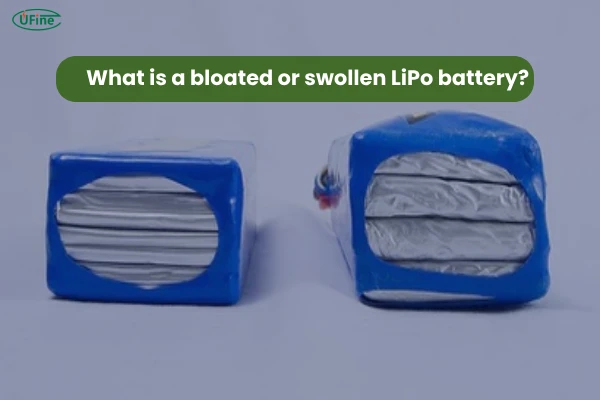
A swollen LiPo battery means the battery has physically expanded due to internal gas buildup. It’s a clear sign that something has gone wrong inside the battery.
This bloating happens when the internal chemical reactions inside the lithium polymer cells go unstable. Gases like carbon dioxide or hydrogen build up inside, making the soft pouch expand.
1.1 Electrochemical Processes Leading to Gas Formation
LiPo batteries swell due to gas evolution inside their sealed pouches. This occurs through several mechanisms:
A. Electrolyte Decomposition:
- At voltages above 4.2V/cell, the electrolyte (typically LiPF₆ in organic solvents) breaks down
- This produces CO₂, CO, and various hydrocarbons
- The reaction follows: LiPF₆ → LiF + PF₅ (then PF₅ + solvent → CO₂ + HF + …)
B. Lithium Plating:
- Occurs during overcharging or fast charging at low temperatures
- Metallic lithium deposits form on the anode
- Reacts with electrolyte to form Li₂CO₃ and H₂ gas
C. Moisture Contamination:
- Just 50ppm of water can trigger: H₂O + LiPF₆ → HF + POF₃ + …
- These acidic byproducts further degrade cell components
1.2 Mechanical Stress Factors
The pouch cell design makes LiPos particularly susceptible to:
- Delamination of electrode layers
- Separator shrinkage at elevated temperatures
- Current collector corrosion
These physical changes create internal voids where gas accumulates.
Part 2. Explosion mechanisms: understanding thermal runaway
2.1 The Chain Reaction Process
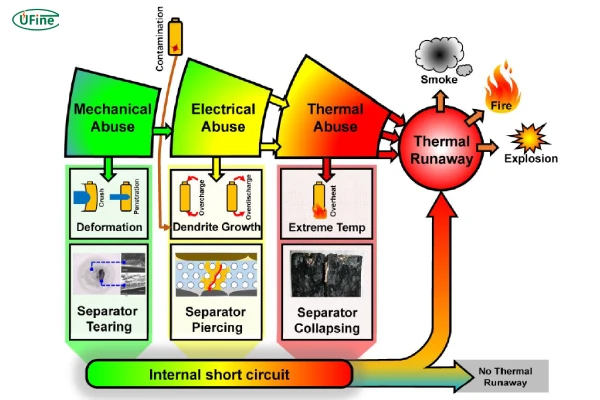
Thermal runaway occurs through this sequence:
- Localized heating (>80°C) melts the polyethylene separator
- Internal short circuits generate more heat
- Electrolyte vaporizes, increasing pouch pressure
- Cathode material decomposes, releasing oxygen
- Exothermic reactions accelerate uncontrollably
2.2 Energy Release Calculations
A standard 2200mAh 3S LiPo contains enough energy to:
- Heat 1 liter of water from 20°C to 80°C
- Produce over 5 liters of flammable gas
- Generate peak temperatures exceeding 800°C
Reasons and Solutions for Lithium Batteries Getting Hot When Charging
Part 3. Why do LiPo batteries swell?
What happens inside a swollen LiPo battery?
To understand why a LiPo battery swells, it helps to look at what happens inside the cell.
A typical lithium polymer battery contains:
- Positive electrode (cathode)
- Negative electrode (anode)
- Separator
- Electrolyte
- Aluminum pouch packaging
During normal operation, lithium ions move between the electrodes during charging and discharging. However, when the battery experiences stress or degradation, unwanted chemical reactions may occur.
These reactions can cause electrolyte decomposition and generate gases inside the battery.
The process usually follows:
Internal chemical degradation
↓
Electrolyte breakdown
↓
Gas generation
↓
Internal pressure increase
↓
Pouch deformation and battery swelling
Because LiPo batteries use a flexible pouch design instead of a rigid metal casing, the gas expansion becomes visible as a battery bulge or puffy LiPo battery appearance.
This flexible structure is one reason LiPo batteries are popular. Manufacturers can create thinner and lighter battery designs for compact devices. However, it also means swelling is easier to observe when internal problems occur.
LiPo batteries are sensitive. A few key things can cause swelling:
- Overcharging – Charging beyond 4.2V per cell stresses the battery and generates gas.
- Over-discharging – Running the battery below 3.0V per cell damages the internal chemistry.
- Overheating – Charging or using a LiPo in hot conditions can lead to chemical breakdown.
- Poor quality or old batteries – Cheaper LiPos with poor chemistry degrade faster.
- Puncture or damage – Even a small tear in the cell pouch can cause gas leakage and swelling.
So if your battery swells up, think back—did you overcharge it? Did you use it right after flying your drone hard in the sun?
Part 4. Will a bloated LiPo battery explode?
Here’s the big question: Will it explode?
Well… it can, but it doesn’t always.
If you keep using a swollen LiPo, or worse, charge it again, you increase the risk. The gas buildup makes the battery unstable. A spark, heat, or over-voltage can trigger thermal runaway—a chemical reaction that causes fire or explosion.
So no, not every swollen battery explodes. But it’s like keeping a balloon over a fire—it might pop, or it might burst into flames.
That’s a risk you just don’t want to take.
We’ve developed a 5-level classification system for swelling severity:
| Level | Puffiness | Internal Pressure | Recommended Action |
|---|---|---|---|
| 1 | <5% thickness increase | <5 psi | Monitor closely |
| 2 | 5-15% increase | 5-15 psi | Remove from service |
| 3 | 15-30% increase | 15-30 psi | Immediate discharge |
| 4 | 30-50% increase | 30-50 psi | Fire containment |
| 5 | >50% increase | >50 psi | Emergency protocols |
Part 5. Professional handling protocols for bloated batteries
5.1 Immediate Response Checklist
For Level 1-3 Swelling:
- Disconnect from all devices
- Place in fireproof container (LiPo bag or metal box)
- Discharge to 0V using a controlled discharger
- Prepare for proper disposal
For Level 4-5 Swelling:
- Evacuate non-essential personnel
- Don fire-resistant gloves and face shield
- Move to outdoor concrete area
- Have Class D fire extinguisher ready
- Contact hazardous materials team if available
5.2 Specialized Discharge Methods
A. Resistive Discharge:
- Use a high-wattage power resistor (10Ω, 50W for 3S)
- Monitor temperature continuously
- Discharge to <1V per cell
B. Saltwater Method:
- Prepare 5% NaCl solution
- Submerge battery for 72+ hours
- Verify 0V before disposal
Part 6. Warning signs that your LiPo battery is dangerous
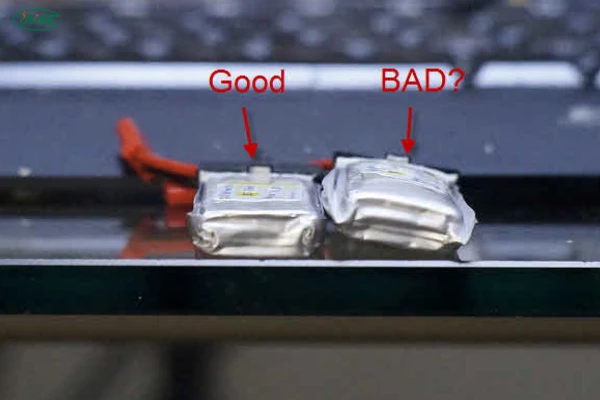
If your battery shows any of these signs, stop using it immediately:
- Visible swelling or puffiness
- Heat while charging or discharging
- Strange smell (sweet or metallic)
- Leaking fluid
- Cracks or punctures in the case
- Reduced runtime or poor performance
Listen to your gut. If your battery “feels” off, it probably is.
Part 7. What to do with a swollen LiPo battery
So, what should you do with a bloated LiPo?
- Stop using it immediately.
- Do not charge it again.
- Place it in a fireproof container, like a LiPo-safe bag or metal box.
- Take it to a battery recycling center or hazardous waste facility. Never toss it in the trash.
If you’re unsure, contact the battery manufacturer for disposal instructions.
And please—don’t puncture it. That’s a recipe for fire.
Part 8. How to prevent LiPo battery swelling
Good news—you can avoid swelling with proper care.
- Always use a LiPo balance charger.
- Never charge above 4.2V per cell.
- Don’t discharge below 3.2V per cell.
- Avoid full charges for storage—store at around 3.7V–3.85V.
- Let the battery cool before charging after use.
- Store batteries in cool, dry places, ideally in LiPo-safe containers.
Part 9. Can you still use a swollen LiPo battery?
No. A swollen LiPo battery should not continue to be used, even if:
- it still powers your device,
- the swelling appears small,
- the battery capacity seems normal.
A common misconception is that a slightly swollen battery is still acceptable. However, swelling indicates that irreversible chemical changes have already occurred inside the cell.
The battery may continue working temporarily, but its:
- internal resistance,
- stability,
- charging behavior,
- safety margin,
may already be compromised.
There is no reliable way to determine how long a swollen battery will remain stable. Some may operate for days, while others may fail unexpectedly.
Part 10. Can a swollen LiPo be fixed?
Sadly, no. Once a battery has bloated, it’s permanently damaged.
You might see online “tricks” to shrink the pouch or vent the gas—but these are dangerous and not recommended. The internal damage has already occurred. Using it again is just asking for trouble.
Your safest bet? Retire it.
Part 11. FAQs
Can I still use a slightly swollen LiPo?
No. Any swelling is a sign of failure. Stop using it immediately.
What happens if I puncture a bloated battery?
It can catch fire or explode. Never puncture a LiPo.
Can I store a swollen LiPo safely?
Yes, in a fireproof container until it can be properly disposed of.
Why do some LiPos bloat faster than others?
Quality, charging habits, and storage conditions all play a role.
Can cold temperatures cause swelling?
Not directly, but extreme temperatures stress the chemistry and may cause damage over time.
Related Tags:

More Articles
Buck vs. Boost vs. Buck-Boost Converter: Which Is Best for Battery?
Not sure which converter your battery-powered device needs? Compare Buck, Boost, and Buck-Boost designs and discover what affects voltage stability and runtime.
How to Match 18650 Cells for a Reliable Battery Pack?
Building an 18650 battery pack? Learn how to compare cell capacity, voltage, and internal resistance to avoid mismatches and improve reliability.
Why Do 18650 Battery Packs Get Hot During Discharge?
Is your 18650 battery pack overheating under load? Learn what causes excess heat, how to spot dangerous symptoms, and what to do next.
18650 Battery BMS: How to Get the Specs Right
Learn how to choose a BMS for an 18650 battery pack. Compare voltage, current ratings, protection features, and balancing before you buy.
Why Does My Ring Camera Battery Drain So Fast or Stop Charging?
Is your Ring camera battery draining fast or not charging? Discover common causes, practical fixes, and when to replace the battery.