
- Key Takeaways
- Part 1. What does a 2000mah battery mean?
- Part 2. How to calculate 2000mah battery runtime
- Part 3. Why voltage changes 2000mah battery backup time
- Part 4. Real-world 2000mah battery runtime examples
- Part 5. Factors that reduce 2000mah battery backup time
- Part 6. How to choose a 2000mah battery for your device
- Part 7. 2000mah battery vs other battery capacities
- Part 8. Can a higher-capacity battery replace a 2000mah battery?
- Part 9. How to extend 2000mah battery runtime and service life
- Part 10. FAQs about 2000mah battery runtime
A 2000mAh battery can theoretically power a 500mA device for four hours. Actual runtime is usually shorter because of voltage conversion, battery age, temperature, internal resistance, and changing device loads.
To estimate 2000mAh battery backup time, you need the device’s average current or power consumption. You should also check the battery voltage, discharge capability, and cutoff conditions.
Key Takeaways
- A 2000mAh battery has a rated capacity of 2Ah.
- At a constant 500mA load, the theoretical runtime is four hours.
- For early design estimates, use about 80% to 90% of the theoretical runtime.
- A 3.7V 2000mAh battery stores about 7.4Wh of nominal energy.
- Compare mAh only when battery voltage is the same.
- Capacity does not define maximum current. High-power devices also need a suitable discharge rate.
- A higher-capacity replacement must match the voltage, chemistry, size, connector, polarity, and protection requirements.
Part 1. What does a 2000mah battery mean?
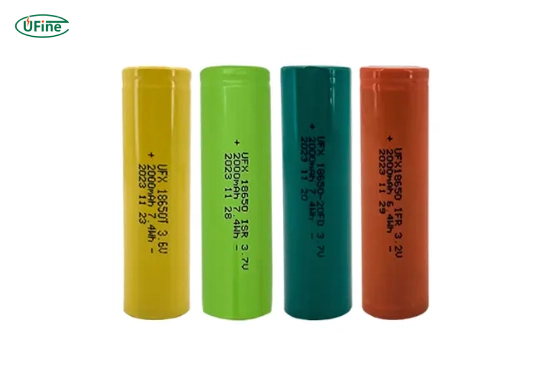
A 2000mAh lithium battery has a rated capacity of 2000 milliampere-hours, which is equal to 2 ampere-hours.
In theory, a 2000mAh battery can provide:
- 2000mA for 1 hour
- 1000mA for 2 hours
- 500mA for 4 hours
- 200mA for 10 hours
- 100mA for 20 hours
These values assume a constant load and full use of the rated capacity. Real devices may stop working before the battery delivers all 2000mAh because the voltage reaches the device’s cutoff point.
Battery capacity also does not show maximum output current. A 2000mAh battery designed for a sensor may not safely power a motor that draws several amps.
For a detailed explanation of battery capacity units, read our guide to amp-hours and lithium battery capacity.
Part 2. How to calculate 2000mah battery runtime
The correct formula depends on whether you know the device’s current draw or power consumption.
Calculate 2000mAh battery runtime from current draw
Use this formula when the battery directly powers a device with a compatible voltage:
Runtime (hours) = Battery capacity (mAh) ÷ Average device current (mA)
For example, if a device draws an average of 400mA:
2000mAh ÷ 400mA = 5 hours
This is the theoretical runtime. Using an 85% planning factor:
5 hours × 0.85 = 4.25 hours
Use the average current over a complete operating cycle. Do not use only standby current or peak current.
| Average Device Current | Theoretical Runtime | Estimated Runtime at 85% |
|---|---|---|
| 100mA | 20 hours | About 17 hours |
| 200mA | 10 hours | About 8.5 hours |
| 400mA | 5 hours | About 4.25 hours |
| 500mA | 4 hours | About 3.4 hours |
| 1000mA | 2 hours | About 1.7 hours |
| 2000mA | 1 hour | About 51 minutes |
The 85% factor is an estimate, not a fixed battery specification. Actual usable capacity depends on the load, battery condition, temperature, voltage cutoff, and system design.
Calculate 2000mAh battery runtime from watts
Use watt-hours when the device voltage differs from the battery voltage or when a voltage converter is used.
First calculate the battery energy:
Battery energy (Wh) = Capacity (Ah) × Nominal voltage (V)
For a 3.7V 2000mAh battery:
2Ah × 3.7V = 7.4Wh
Then calculate runtime:
Runtime (hours) = Battery energy (Wh) × System efficiency ÷ Device power (W)
For example, a 1W device powered through an 85% efficient circuit would run for approximately:
7.4Wh × 0.85 ÷ 1W = 6.29 hours
Our Ah-to-Wh battery conversion guide explains when to use capacity and energy ratings. The U.S. Department of Energy also explains battery energy calculations in its battery energy storage guidance.
Part 3. Why voltage changes 2000mah battery backup time
Two batteries can both be rated at 2000mAh but store different amounts of energy. This is because total energy depends on both capacity and voltage.
| Battery Rating | Nominal Energy |
|---|---|
| 3.2V 2000mAh | 6.4Wh |
| 3.7V 2000mAh | 7.4Wh |
| 3.85V 2000mAh | 7.7Wh |
| 7.4V 2000mAh | 14.8Wh |
| 11.1V 2000mAh | 22.2Wh |
A 7.4V 2000mAh battery stores twice the nominal energy of a 3.7V 2000mAh battery. However, the two batteries are not interchangeable because their voltages are different.
Use mAh to compare batteries with the same voltage. Use Wh to compare total energy across different battery voltages.
Part 4. Real-world 2000mah battery runtime examples
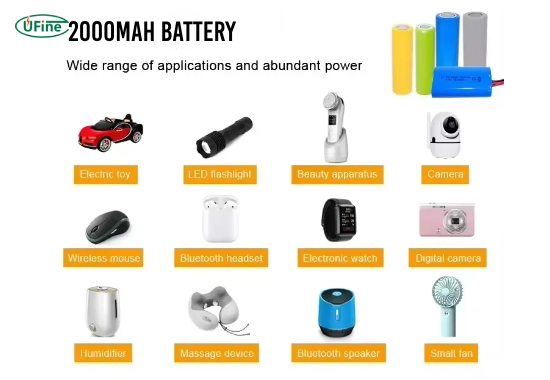
The following values are planning examples. Actual runtime depends on product design, operating mode, signal strength, motor load, brightness, and other conditions.
| Device or Application | Example Average Current | Estimated 2000mAh Runtime | Main Runtime Factor |
|---|---|---|---|
| Low-power tracker or sensor | 20–80mA | About 21–85 hours | Sleep time and data transmission frequency |
| Bluetooth speaker or headset | 200–500mA | About 3.4–8.5 hours | Volume and amplifier efficiency |
| Portable fan | 400–1000mA | About 1.7–4.25 hours | Motor speed and startup current |
| Rechargeable LED light | 300–700mA | About 2.4–5.7 hours | Brightness and driver efficiency |
| Camera or portable display | 500–1000mA | About 1.7–3.4 hours | Screen brightness and video processing |
| Small drone or RC product | 5–10A | About 10–20 minutes | Motor load, weight, voltage, and discharge rate |
High-drain products need more than enough capacity. The battery must also support the required continuous and pulse current.
For example, a 2000mAh battery rated at 1C has a nominal discharge current of 2A. A 5C battery has a nominal discharge current of 10A. Always check the battery datasheet before using it in a motor, drone, or other high-power product.
Part 5. Factors that reduce 2000mah battery backup time
A 2000mAh battery rarely delivers the exact runtime shown by the basic capacity formula. Several electrical and environmental factors reduce usable backup time.
Changing device current
Many products do not draw a constant current. Motors use more current during startup. Wireless devices use short transmission pulses. Displays and processors consume more power during active operation.
Voltage conversion loss
DC-DC converters and voltage regulators lose part of the battery energy as heat. This is common in USB devices, power banks, motor controllers, and products with several voltage rails.
Device cutoff voltage
The device or protection circuit disconnects the battery at a set voltage. A high cutoff voltage can leave part of the rated capacity unused.
Battery age and cycle history
Usable capacity decreases as a lithium battery ages. High temperature, repeated cycling, long storage periods, and unsuitable charging conditions can speed up capacity loss.
Battery operating temperature
Cold temperatures increase internal resistance and reduce available power. High temperatures can speed up battery aging and create safety risks.
Our lithium battery temperature range guide explains common charging, discharging, and storage limits.
High discharge current
High current causes more internal voltage drop and heat. The device may reach its cutoff voltage early, even when some energy remains in the battery.
Part 6. How to choose a 2000mah battery for your device
A 2000mAh battery is often suitable for compact products with low or medium average power consumption. It can provide a practical balance between size, weight, cost, and runtime.
Before selecting the battery, confirm:
- Required operating time
- Average and peak current
- Battery voltage and charging voltage
- Available battery compartment size
- Required continuous discharge rate
- Charging current and target charging time
- Operating and storage temperature
- Connector, wire, polarity, PCM, and NTC requirements
Calculate the required battery capacity
When the required runtime is known, estimate the minimum capacity with this formula:
Required capacity (mAh) = Average current (mA) × Required runtime (hours) ÷ Usable-capacity factor
For example, a device draws an average of 350mA and must operate for five hours:
350mA × 5 hours ÷ 0.85 = 2059mAh
A 2000mAh battery would be slightly below the calculated requirement. The designer should reduce device power consumption or select a higher-capacity battery.
A 2000mAh battery may also be too small for products that need continuous all-day operation, long motor runtime, a large display, or frequent wireless communication.
Part 7. 2000mah battery vs other battery capacities
At the same voltage and under the same test conditions, runtime normally increases in proportion to capacity.
| Battery Capacity | Theoretical Runtime at 500mA | Estimated Runtime at 85% |
|---|---|---|
| 1000mAh | 2 hours | About 1.7 hours |
| 2000mAh | 4 hours | About 3.4 hours |
| 3000mAh | 6 hours | About 5.1 hours |
| 5000mAh | 10 hours | About 8.5 hours |
A higher-capacity battery usually needs more space and adds more weight. The best capacity is not always the largest one. It should meet the required runtime without exceeding the product’s size, weight, charging, and cost limits.
Part 8. Can a higher-capacity battery replace a 2000mah battery?
A 3000mAh or 4000mAh battery can sometimes replace a 2000mAh battery, but matching capacity alone is not enough.
Check the following before replacement:
- Chemistry: Do not mix standard Li-ion, high-voltage Li-ion, and LiFePO4 batteries.
- Voltage: The nominal voltage and charging voltage must match the device.
- Dimensions: Include the cell, PCM, wires, tape, and connector.
- Connector and polarity: The connector model may match while the wire order is different.
- Discharge current: The replacement must support the continuous and peak load.
- Protection circuit: Confirm overcharge, over-discharge, overcurrent, and short-circuit protection.
- Temperature sensing: Some devices require an NTC thermistor.
- Charging current: The new battery must safely accept the device’s charging current.
A larger battery normally takes longer to charge when the charging current remains unchanged. It should not be fast-charged unless both the battery datasheet and charging circuit allow it.
For user-replaceable products, select a battery approved for the device. The U.S. Consumer Product Safety Commission recommends using compatible batteries and chargers in its lithium-ion battery charging safety guidance.
Part 9. How to extend 2000mah battery runtime and service life
Runtime per charge depends mainly on device power consumption. Long-term service life depends on charging, temperature, storage, and operating conditions.
Improve 2000mAh battery runtime per charge
- Reduce standby and leakage current.
- Use sleep mode between operating cycles.
- Lower screen, LED, fan, or motor power when possible.
- Reduce unnecessary wireless communication.
- Use efficient voltage regulators and motor drivers.
- Optimize firmware and background processes.
Protect 2000mAh battery service life
- Keep the battery within its specified temperature range.
- Use the correct charging voltage and current.
- Do not charge a lithium battery below its permitted temperature.
- Avoid prolonged storage at high temperatures.
- Do not use swollen, leaking, damaged, or overheated batteries.
- Follow the manufacturer’s storage state-of-charge instructions.
For more charging details, read our lithium battery charging voltage and current guide.
Part 10. FAQs about 2000mah battery runtime
How many hours does a 2000mAh battery last?
A 2000mAh battery lasts about four hours at 500mA or two hours at 1000mA in theory. Actual runtime is usually lower.
What is the 2000mAh battery backup time at 500mA?
The theoretical backup time is four hours. A practical estimate is about 3.2 to 3.6 hours.
How many watt-hours are in a 2000mAh battery?
A 3.7V 2000mAh battery stores 7.4Wh. Multiply 2Ah by the battery’s nominal voltage.
Can a 3000mAh battery replace a 2000mAh battery?
Yes, but only when the voltage, chemistry, dimensions, connector, polarity, discharge current, and charging requirements match.
Can a 2000mAh battery support fast charging?
Only when the battery datasheet and charging circuit support the selected charging current.
Related Tags:

More Articles

JST vs Molex: The Right Battery Connector Choice
JST or Molex for your battery? Learn how connector selection affects current, voltage drop, reliability, and device performance.
Custom Battery Pricing: Costs Manufacturers Don’t Mention
A low battery quote may not be the final cost. Discover common hidden expenses that affect custom lithium battery projects.
Battery Wire Length: Hidden Cause of Power Loss
A longer battery wire can cause voltage drop, power loss, and unstable operation. Learn how wire length affects battery performance.
How Device Sleep Modes Affect Battery Life
Think sleep mode extends battery life? Learn why devices still drain power and how firmware, hardware, and batteries affect runtime.
LiPo Battery and PCB Design: Clearance, Insulation, and Placement
Learn how to optimize LiPo battery PCB clearance, insulation, placement, wiring, and thermal design—and avoid common integration mistakes.


