
- Part 1. Industry power challenges in rechargeable makeup mirrors
- Part 2. Makeup mirror battery requirements at a glance
- Part 3. Our makeup mirror battery solution overview
- Part 4. Key battery technologies designed for makeup mirrors
- Part 5. Certifications & compliance support
- Part 6. Recommended battery types for makeup mirror applications
- Part 7. Typical makeup mirror applications we support
- Part 8. From concept to mass production
Rechargeable makeup mirrors have become a standard feature in modern beauty and personal care products. From compact travel mirrors to premium LED vanity mirrors, battery performance directly impacts runtime stability, user safety, and product lifecycle reliability.
Makeup Mirror Battery Solution: Ufine Battery provides application-specific lithium battery solutions for makeup mirrors, helping brands and manufacturers optimize slim form factors, LED performance, and global compliance — from concept development to mass production.
Part 1. Industry power challenges in rechargeable makeup mirrors
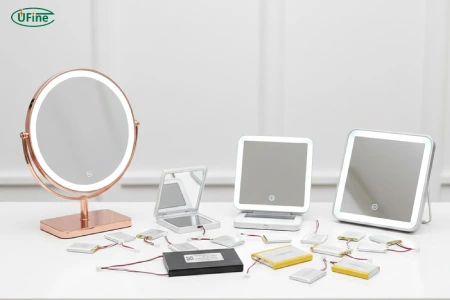
Although makeup mirrors are consumer products, their power requirements are often underestimated. In real-world applications, cosmetic mirrors face several industry-specific battery challenges.
1 High-Frequency Charging & Daily Usage
Most rechargeable makeup mirrors are used daily, often multiple short sessions per day. This leads to:
- Frequent shallow charge/discharge cycles
- Accelerated degradation in poorly optimized small-capacity cells
Without proper chemistry and structure design, battery capacity can drop significantly within the first year of use.
2 Ultra-Thin Industrial Design Constraints
Modern mirrors emphasize:
- Slim thickness
- Compact or foldable structures
- Circular or irregular internal cavities
Standard cylindrical cells rarely fit these designs, making custom lithium polymer batteries essential.
3 LED Stability & User Perception
LED lighting quality is a core selling point. Battery voltage instability may cause:
- Noticeable brightness drop
- Flickering at low battery levels
- Inconsistent touch or dimming control
Even small electrical inconsistencies can directly affect perceived product quality and online reviews.
4 Consumer Safety & Regulatory Pressure
As household devices used close to the face, makeup mirrors require:
- Excellent thermal stability
- Robust protection circuitry
- Compliance with multiple international safety and transport standards
Part 2. Makeup mirror battery requirements at a glance
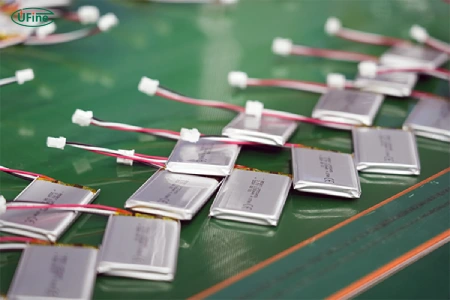
The table below summarizes typical battery requirements for rechargeable makeup mirror applications:
| Requirement Category | Typical Industry Expectation |
|---|---|
| Nominal Voltage | 3.7V / 3.8V lithium systems |
| Capacity Range | 400 mAh – 2000 mAh |
| Battery Type | Ultra-thin Li-polymer pouch |
| Thickness | 3.0 – 6.0 mm (customizable) |
| Cycle Life | ≥500 cycles @ ≥80% capacity |
| Discharge Stability | Flat voltage curve for LED |
| Charging Interface | USB / Micro-USB / USB-C |
| Protection | PCM + NTC (optional) |
| Certifications | UN38.3, IEC62133, UL, CE, etc. |
This structured requirement profile helps ensure stable LED output, safe daily use, and long-term reliability.
Part 3. Our makeup mirror battery solution overview
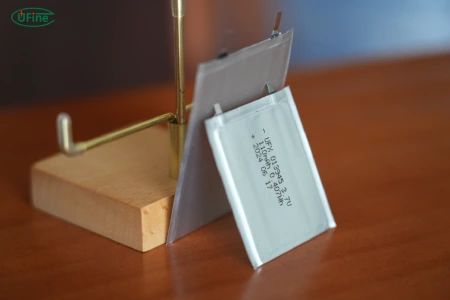
Ufine Battery delivers makeup mirror power solutions from a system-level engineering perspective, not as off-the-shelf battery components.
Our solution framework includes:
- Optimized lithium chemistry selection for compact consumer devices
- Capacity matching based on real usage patterns, not theoretical runtime
- Mechanical customization for slim and irregular housings
- Integrated protection design to meet consumer safety expectations
- Flexible certification planning for different target markets
This approach ensures your mirror design remains competitive in both performance and compliance.
See how we turn your makeup mirror battery ideas into reality — watch our ‘From Concept to Creation’ video showcasing Ufine Battery’s custom sample development process.
Part 4. Key battery technologies designed for makeup mirrors
1 Ultra-Thin Lithium Polymer Pouch Cells
We design thin-profile lithium polymer batteries that support:
- Extremely slim structures (down to a few millimeters)
- Custom length, width, and shape
- Easy integration into circular or folding mirror designs
2 Stable Discharge for LED Lighting Systems
Our cells are engineered with:
- Low internal resistance
- Optimized electrode formulation
- Stable discharge platforms
This minimizes voltage sag and maintains consistent LED brightness throughout the discharge cycle.
3 Long Cycle Life for Frequent Charging
Based on internal testing and industry benchmarks:
- Properly designed Li-polymer cells can achieve ≥500 full cycles with ≥80% capacity retention
- Shallow daily charging patterns common in makeup mirrors are fully supported
This significantly reduces early battery aging and after-sales issues.
4 Integrated Safety & Protection Architecture
Each makeup mirror battery solution can be configured with:
- PCM (Protection Circuit Module)
- NTC temperature sensing
- Overcharge, over-discharge, overcurrent, and short-circuit protection
Safety design is aligned with consumer electronics best practices.
Use Case: See how Ufine Battery helped clients overcome battery inflation and power outage challenges — Boosted Sales by 30%: Ufine’s Solution for Battery Inflation & Power Outage in Beauty Devices
Part 5. Certifications & compliance support
We support a wide range of international safety, transport, and environmental certifications, which can be customized based on your target market requirements:
- UN38.3 – Lithium battery transport certification
- MSDS – Material Safety Data Sheet
- IEC 62133 – International lithium battery safety standard
- UL – North American market access
- KC – Korea Certification
- PSE – Japan market compliance
- CE – European conformity
- CB Scheme – Global certification recognition
- RoHS – Environmental compliance
Certification combinations can be custom-tailored based on your sales regions and regulatory strategy.
Learn more about our global certifications and safety compliance to ensure your makeup mirror batteries meet international standards — Boosted Sales by 30%: Ufine’s Solution for Battery Inflation & Power Outage in Beauty Devices
Part 6. Recommended battery types for makeup mirror applications
For most cosmetic mirror designs, we recommend:
- Ultra-thin lithium polymer batteries for compact and portable mirrors
- Custom-shaped pouch cells for round or folding mirrors
- Small rechargeable battery packs with integrated protection for LED mirrors
Part 7. Typical makeup mirror applications we support
Our battery solutions are widely used in:
- Portable LED makeup mirrors
- Folding cosmetic mirrors
- Travel beauty mirrors
- Desktop vanity mirrors
- Rechargeable magnifying mirrors
Each solution is optimized for form factor, lighting power, and daily usage frequency.
Part 8. From concept to mass production
We support makeup mirror manufacturers at every stage:
- Battery design evaluation
- Mechanical and electrical customization
- Prototype sampling and validation
- Certification and compliance assistance
- Stable mass production supply
Our goal is to reduce development risk while accelerating time to market.
Ufine Battery customizes capacity, voltage, thickness, shape, protection circuits, and certifications to meet your makeup mirror requirements — from early prototypes to high-volume production.
Find a Mirror Battery Solution NowExplore More Personal Care Battery Solutions
If your product line includes other personal care or bathroom devices, you may also be interested in our battery solutions for electric toothbrushes, optimized for safety, durability, and everyday use.
High Energy Density
It stores large amounts of energy in a smaller and lighter package
Longer Cycle Life
Withstands extensive charge and discharge cycles
Low Self-Discharge
Maintains power longer when not in use
Safety
Minimizes the risk of accidents and ensures safe operation
More Information About Makeup Mirror Battery
-
What type of battery is best for a rechargeable makeup mirror?
-
How long should a makeup mirror battery last on a single charge?
-
Why do some makeup mirrors lose brightness after a few months?
-
Can battery size and shape be customized for round or folding makeup mirrors?
-
Do makeup mirror batteries require special certifications for shipping and sales?
-
What charging method is recommended for rechargeable makeup mirrors?
Latest Blogs
About Lithium Battery Industry News

JST vs Molex: The Right Battery Connector Choice
JST or Molex for your battery? Learn how connector selection affects current, voltage drop, reliability, and device performance.
2026/09/15 Ufine
Custom Battery Pricing: Costs Manufacturers Don’t Mention
A low battery quote may not be the final cost. Discover common hidden expenses that affect custom lithium battery projects.
2026/09/15 Ufine

Battery Wire Length: Hidden Cause of Power Loss
A longer battery wire can cause voltage drop, power loss, and unstable operation. Learn how wire length affects battery performance.
2026/09/14 Ufine

How Device Sleep Modes Affect Battery Life
Think sleep mode extends battery life? Learn why devices still drain power and how firmware, hardware, and batteries affect runtime.
2026/09/14 Ufine

LiPo Battery and PCB Design: Clearance, Insulation, and Placement
Learn how to optimize LiPo battery PCB clearance, insulation, placement, wiring, and thermal design—and avoid common integration mistakes.
2026/09/14 Ufine

Battery Calibration: Why Is Your Battery % Wrong?
Is your battery percentage inaccurate? Learn how battery calibration works, when you need it, and how to fix unexpected battery drops.
2026/09/09 Ufine