Popular Choice
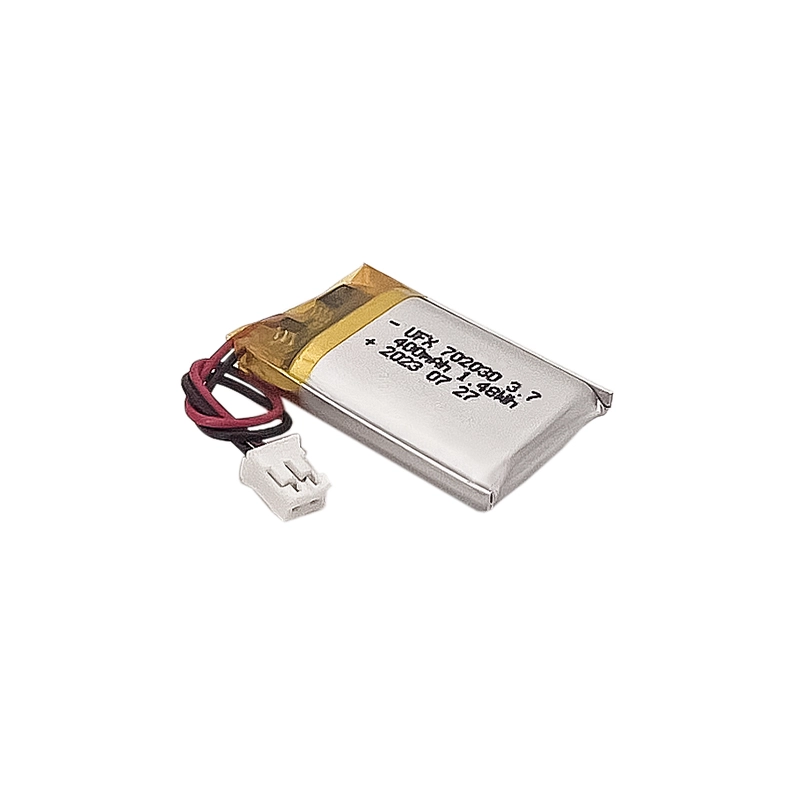
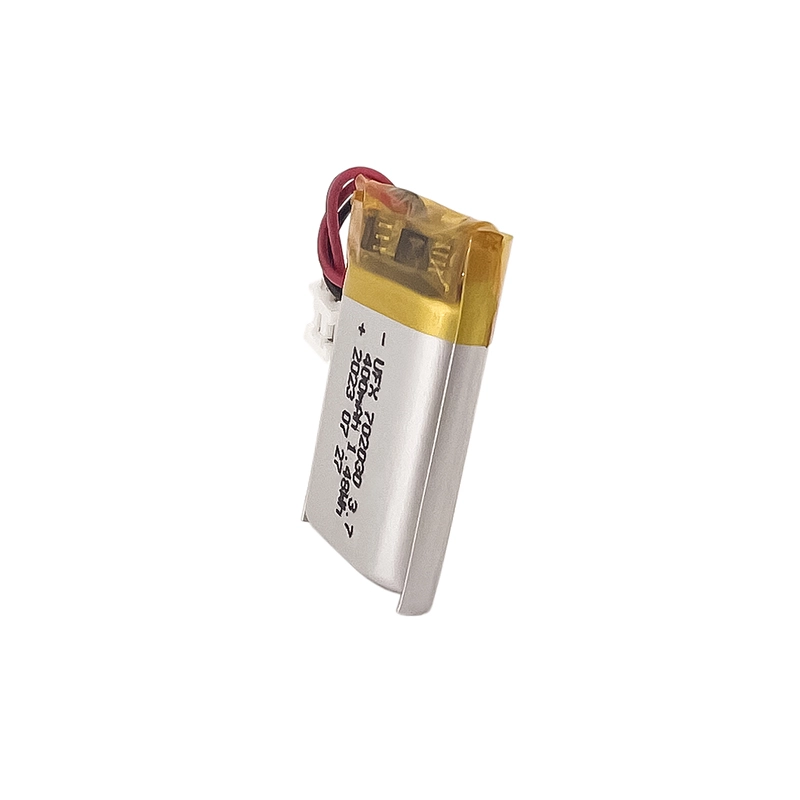
702030 3.7V 400mAh LiPo Battery for Compact Devices

- 16 Years Experience
- 200+ Certifications
- 1000+ Customers
- 7X24 Customer Support
-
Product Details
-
Specs
-
Content
-
FAQs

3.7V 400mAh 702030 LiPo Battery for Compact Electronics
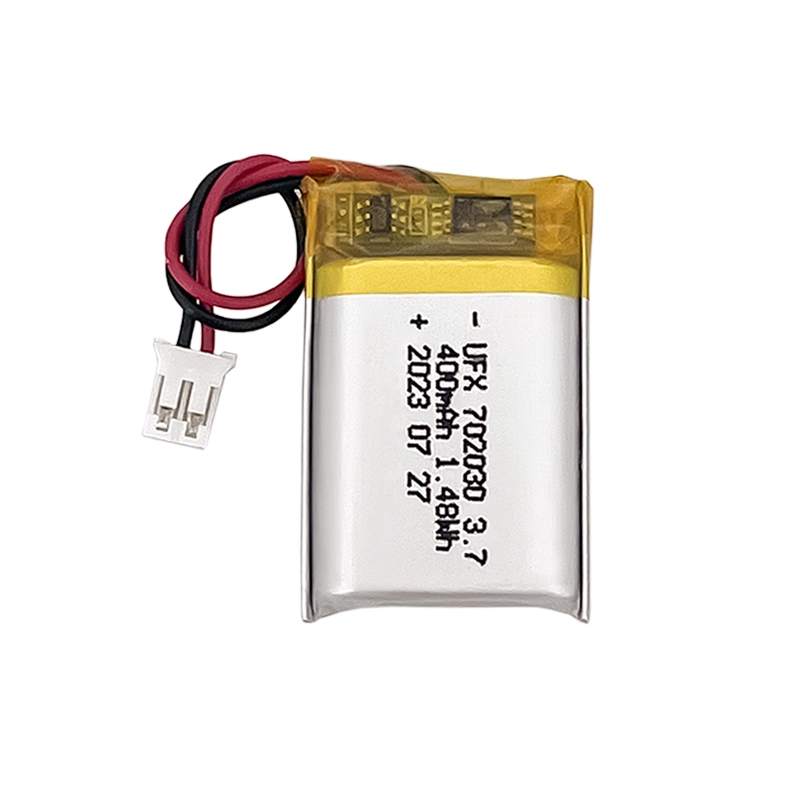
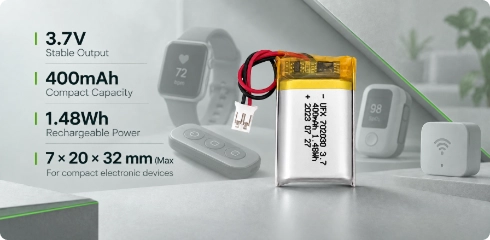
The Ufine 702030 LiPo battery provides 3.7V nominal voltage, 400mAh capacity, and 1.48Wh nominal energy. Its compact pouch format is designed for small rechargeable electronics where battery space is limited. Typical uses include remote controls, compact medical devices, beauty electronics, sensors, and other portable products.
How the 702030 Performs in Daily Use
The 702030 is designed for compact 3.7V systems. Its cycle life and operating temperature range support repeated use in portable electronics.
- Battery Output
- Cycle Life
- Storage
- Temperature
3.7V 400mAh Output
The 702030 provides 3.7V nominal voltage and 400mAh rated capacity. This equals 1.48Wh of nominal energy.
- Nominal voltage: 3.7V
- Rated capacity: 400mAh
- Nominal energy: 1.48Wh
- Rechargeable single-cell pouch format
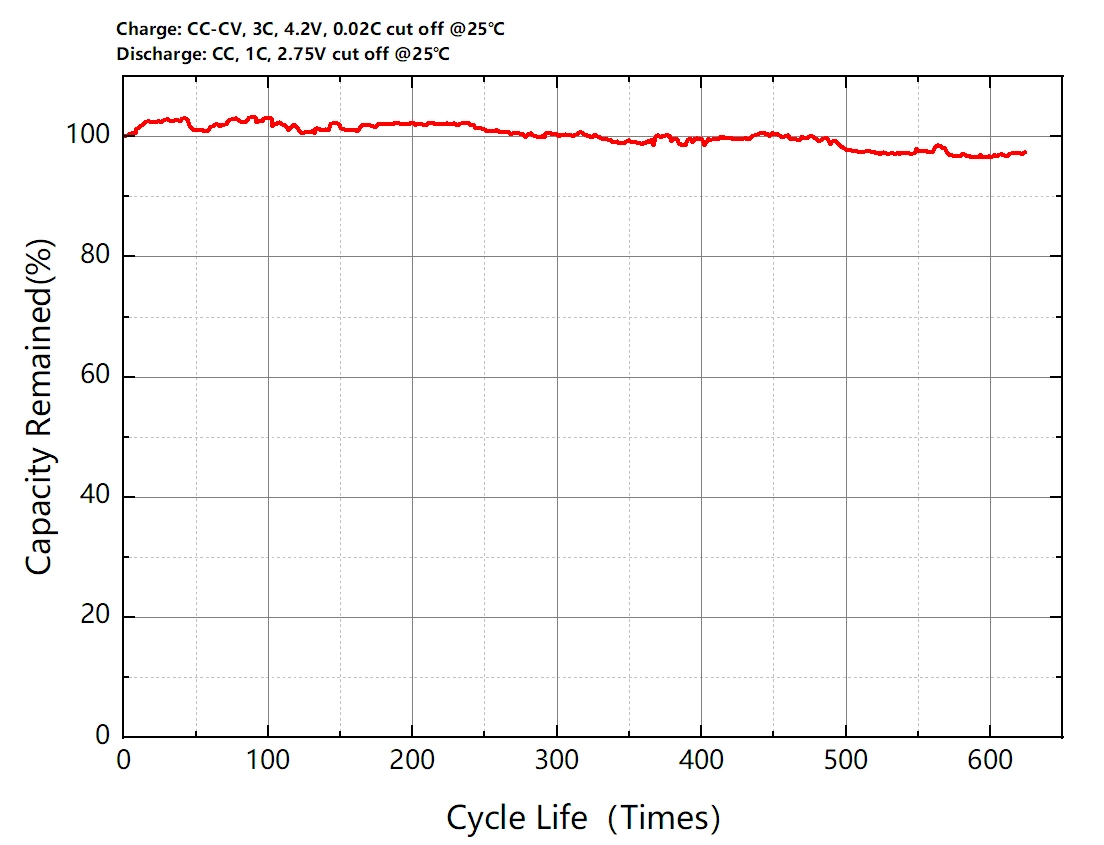
Capacity After 500 Cycles
Under the stated cycle-test conditions, the battery retains more than 80% capacity after 500 cycles.
- Cycle test: up to 500 cycles
- Capacity retention: >80%
- Test condition: 0.5C charge and discharge at room temperature
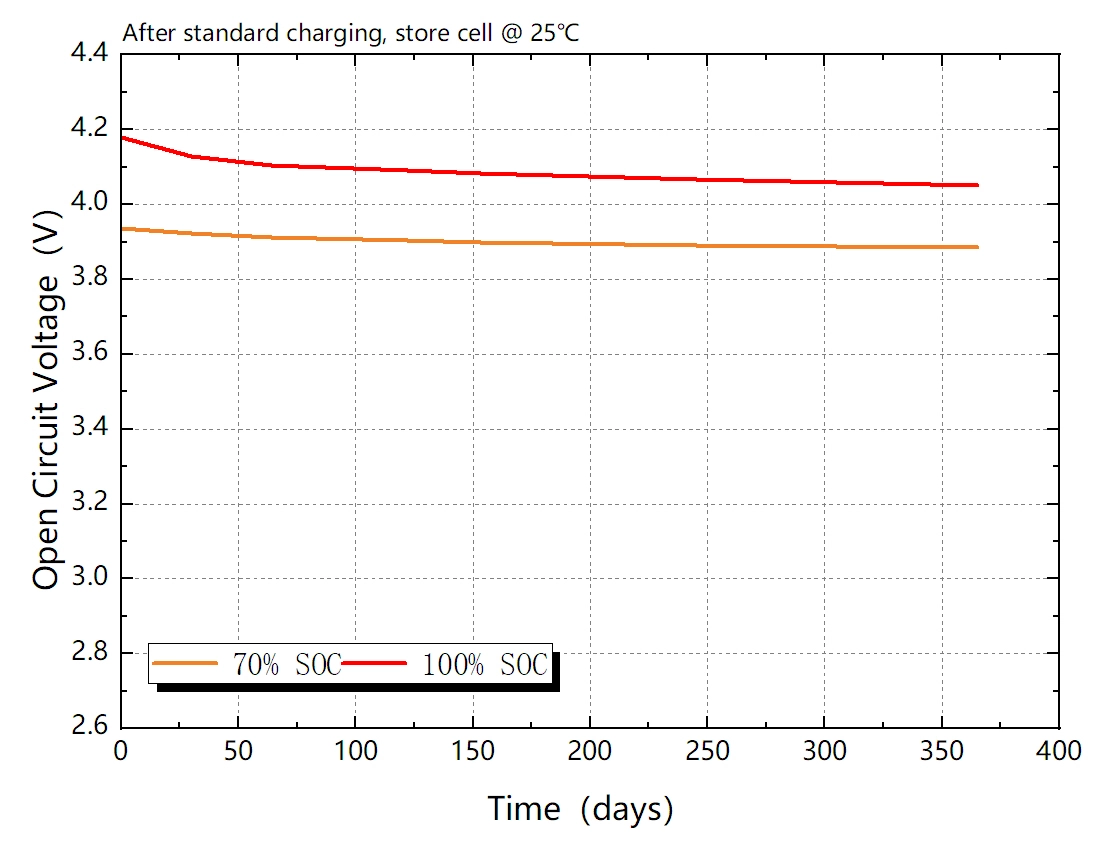
Better Conditions for Storage
Lithium batteries age faster when stored at high temperature or kept fully charged for long periods. For longer storage, use a cool and dry environment.
- Avoid long-term storage at high temperature
- Keep the battery away from moisture and direct heat
- Check battery condition before returning it to service
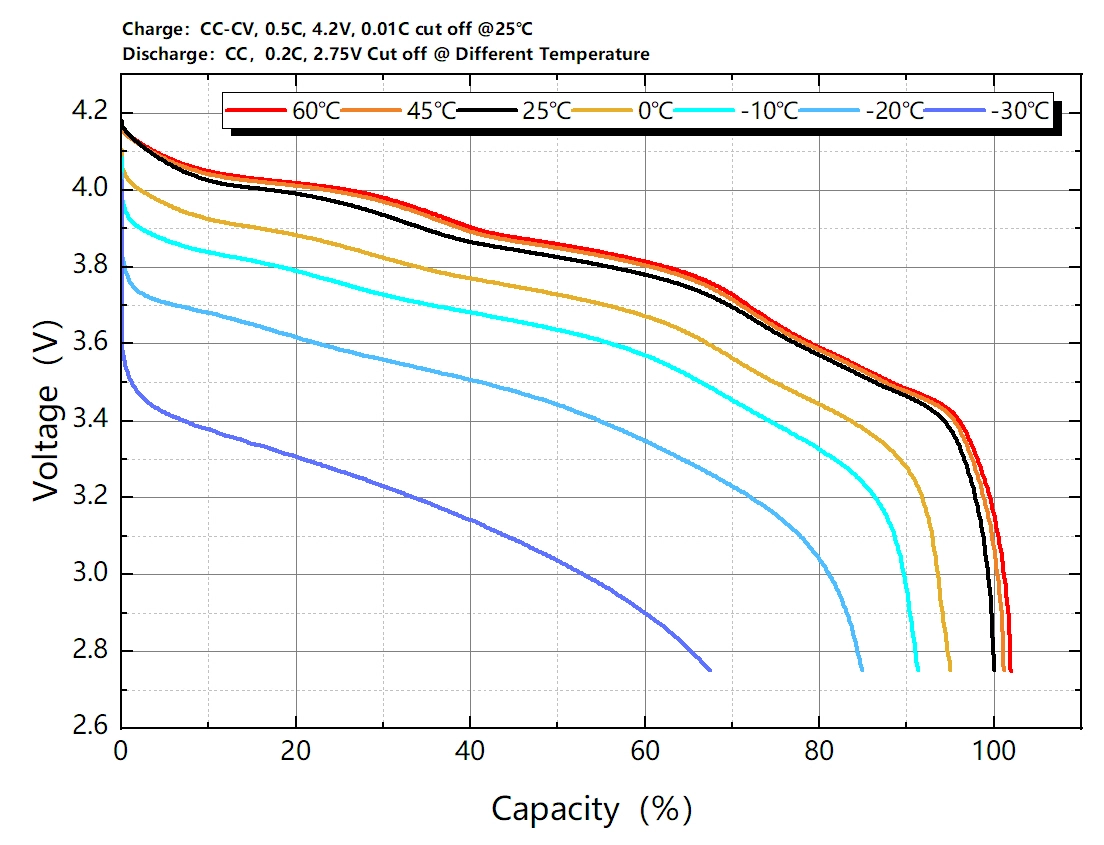
-20°C to 60°C Discharge Range
The battery supports discharge operation from -20°C to 60°C. Temperature should be considered when the battery is integrated into the device.
- Discharge temperature: -20°C to 60°C
- Avoid charging outside the specified battery limits
- Special temperature requirements should be evaluated separately
Why the 702030 Fits Small Devices
The 400mAh capacity and compact pouch format make the 702030 suitable for electronics that need a small rechargeable 3.7V power source.
Compact Power for Portable Designs
The 702030 combines 400mAh capacity with a small single-cell format. It can be integrated into portable products where available battery space is limited.
- Nominal voltage: 3.7V
- Rated capacity: 400mAh
- Nominal energy: 1.48Wh
- Battery type: Rechargeable LiPo pouch cell
- Typical use: Compact and low-power electronics
- Suitable device categories: Remote controls, sensors, medical, beauty, and portable electronics
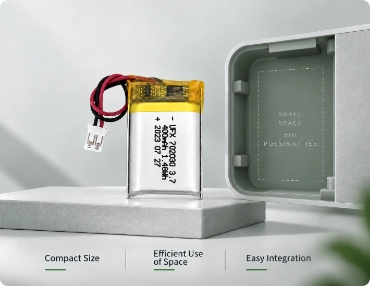
How 702030 Battery Quality Is Checked
Production and inspection controls focus on battery structure, capacity, assembly consistency, and final electrical performance.
View Production Details 


Use the 702030 or Customize the Integration?
The standard 702030 provides a 3.7V 400mAh power source. Device-side connection and integration requirements can also be evaluated for OEM projects.
702030 Battery
- 3.7V nominal voltage
- 400mAh rated capacity
- 1.48Wh nominal energy
- Rechargeable pouch-cell format
- 500-cycle performance under stated test conditions
- -20°C to 60°C discharge temperature range
- Suitable for compact electronic products
Custom Integration
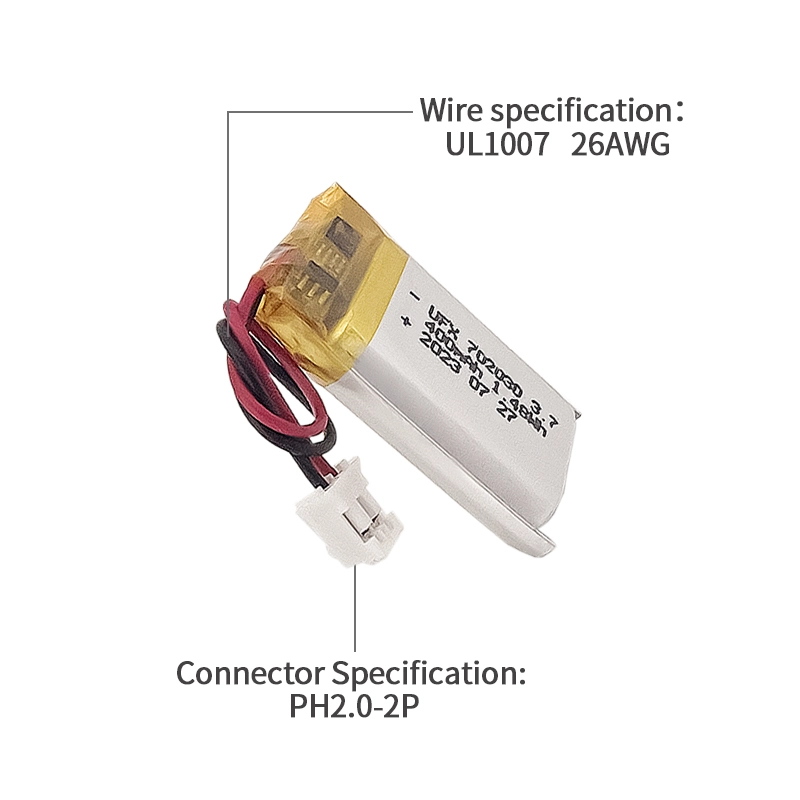
- Connector type and mating interface
- Wire length and polarity
- Protection circuit requirements
- Optional temperature sensing
- Device installation requirements
- Other options subject to engineering evaluation
Compare Similar 3.7V LiPo Batteries
Compare nearby 3.7V battery options by capacity and physical format. The best choice depends on the available device space and required runtime.
| Voltage | Model | Capacity | Size (mm) | Product Highlights |
|---|---|---|---|---|
| 3.7V | 552826 | 450mAh | 5.5 × 28 × 28 | Compact Design, Space Saving |
| 3.7V | 672330 | 450mAh | 6.7 × 23 × 32 | Compact Design, Balanced Performance |
| 3.7V | 702527 | 380mAh | 7 × 25 × 29 | Small Form Factor, Lightweight Solution |
| 3.7V | 402248 | 400mAh | 4 × 22 × 48 | Slim Design, Space Efficient |
Battery Specification
-
1. Mechanical Characteristics
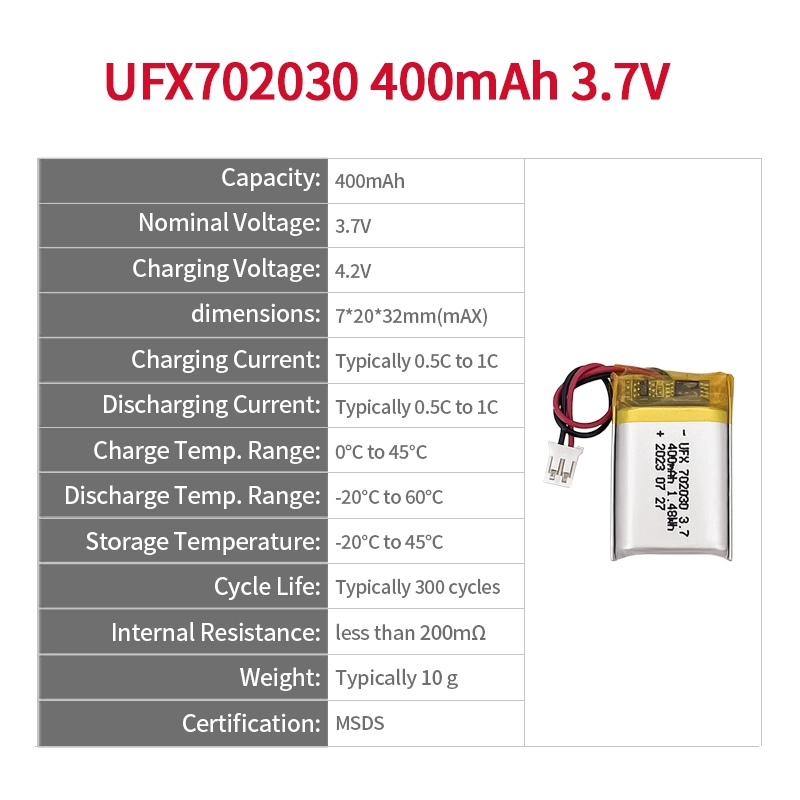
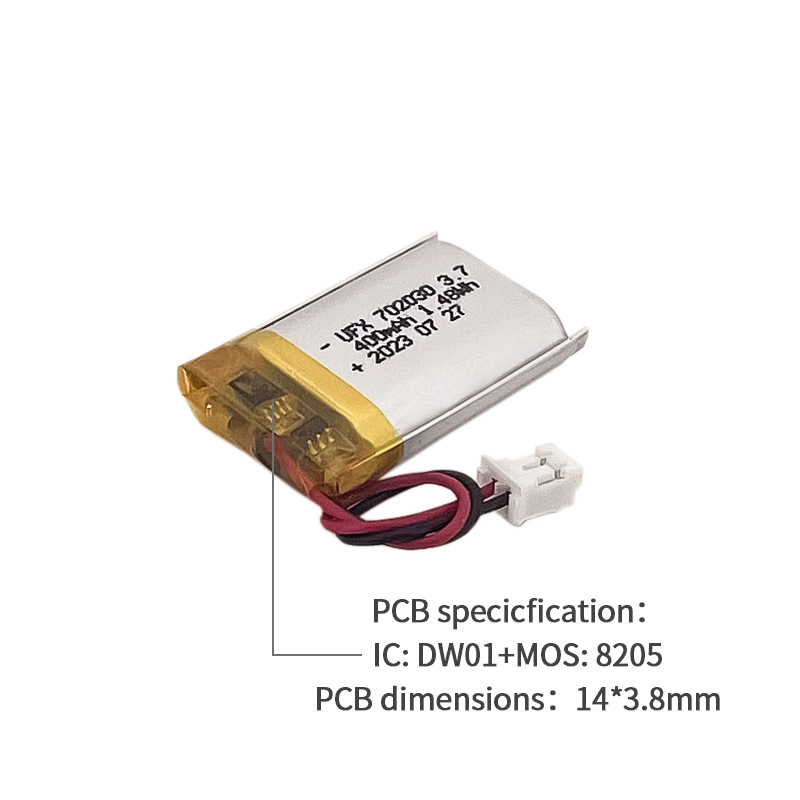
Cell 702030 PCM Yes NTC No Weight appr. 10g Configuration 1S1P -
2. Electrical Specification
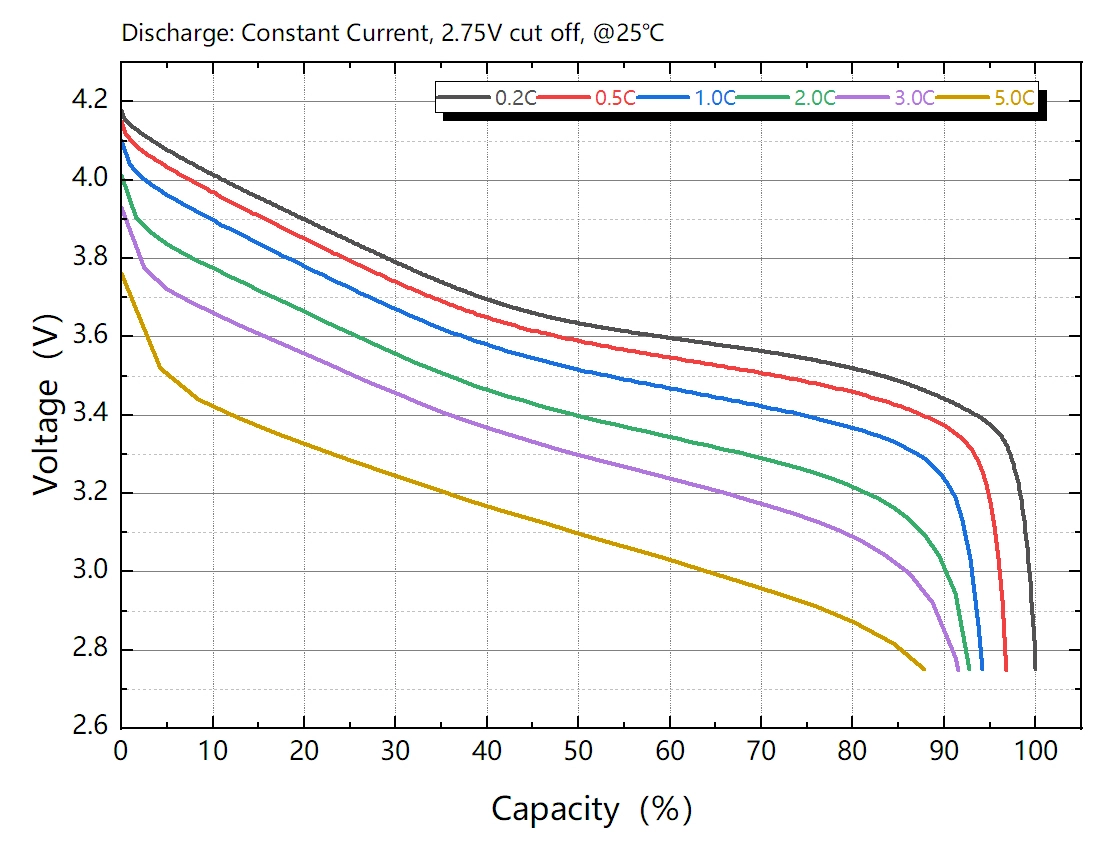
Capacity 400mAh Nominal Voltage 3.7V Energy 1.48Wh Internal Resistance less than 200mΩ Max. Charge Voltage 4.2V Discharge Cut Off 2.75V Max. Charge Current 400mA Max. Discharge Current 400mA Standard Charge Current 200mA Standard Discharge Current 200mA Charging Temperature 0℃ to 45℃ Discharging Temperature -20℃ to 60℃ Storage Temp.Range 1 year at -20℃ to +30℃ 3 mos. at -20℃ to +45℃ 1 mo. at -20℃ to +60℃ Cycle life 100 cycles ≥92% 300 cycles ≥88% 500 cycles ≥80% -
3. Cell protection
Overcharge Detection 4.28V ±50mV (80 to 200msec delay, release 4.08V ±50mV) Overdischarge Detection 2.4V ±100mV (40 to 120msec. delay, release 3.0V ±100mV) Overcurrent Detection 2.5A to 4.5A (5 to 10msec. delay) Short protection Yes
The 702030 3.7V 400mAh LiPo battery is designed for compact rechargeable electronics that need a small single-cell power source. Its 400mAh capacity provides a practical balance between runtime and installation space for low-power portable devices.
When selecting this battery, engineers should look beyond capacity alone. Device current, available battery space, connector layout, protection requirements, temperature, and charging design all affect whether the 702030 is the right choice.
Part 1. When is the 702030 battery a good fit?
The 702030 is best suited to compact electronics that use a single 3.7V rechargeable lithium battery. It can be considered when the device has limited internal space and does not require a large battery capacity.
-
Remote controls and handheld controllers
-
Compact sensors and IoT devices
-
Small medical and monitoring electronics
-
Beauty and personal-care devices
-
Small portable consumer electronics
Before final selection, compare the battery envelope with the actual battery compartment. Also leave enough space for the pouch, wires, connector, and protection circuit if required.
Part 2. How long can a 400mAh battery run?
Runtime mainly depends on the average current used by the device. A simple first estimate is:
Runtime (hours) ≈ Battery capacity (mAh) ÷ Average device current (mA)
For a 400mAh battery, theoretical examples are:
-
20mA average load: about 20 hours
-
50mA average load: about 8 hours
-
100mA average load: about 4 hours
-
200mA average load: about 2 hours
These are theoretical values. Actual runtime is usually lower because device efficiency, standby current, discharge conditions, temperature, and cut-off voltage also affect usable capacity.
Part 3. Check the device load before selection
A battery should be selected according to both average current and peak current. Capacity alone does not show whether the battery can support the device load.
-
Average current: affects expected runtime.
-
Peak current: affects voltage drop during startup, wireless transmission, motors, or other short load changes.
-
Cut-off voltage: determines when the device stops using the battery.
-
Standby current: can be important for products that spend most of their time in sleep mode.
If the device has high pulse current or motor loads, the current profile should be checked before choosing the 702030. A higher-capacity or different battery format may be more suitable.
Part 4. Confirm the connector, wire, and protection design
The battery connection should match the device PCB and available installation space. For OEM projects, several integration details should be confirmed before production.
-
Connector: confirm the connector series, mating housing, and pin arrangement.
-
Wire length: keep the wire long enough for assembly without creating unnecessary internal clutter.
-
Polarity: confirm positive and negative pin positions before production.
-
Protection: confirm whether the device requires a battery with PCM or uses protection on the main PCB.
-
Temperature sensing: confirm whether an NTC is required by the charging system.
Part 5. Consider temperature and storage conditions
The 702030 supports discharge operation from -20°C to 60°C. However, battery performance can change with temperature, so the actual device environment should be reviewed during design.
-
Avoid charging or using the battery outside its specified limits.
-
Keep the battery away from direct heat during storage.
-
Store the battery in a cool and dry environment.
-
Do not crush, puncture, bend, or short-circuit the pouch cell.
For products used in very cold or very hot environments, a standard 702030 may not be the best option. Special-temperature battery designs should be evaluated separately.
Part 6. When should you choose another LiPo size?
The 702030 is not automatically the best choice just because the device uses a 3.7V battery. Another LiPo size may be better when the product has different space or runtime requirements.
-
Choose a higher-capacity cell when longer runtime is more important than battery size.
-
Choose a thinner cell when product thickness is the main mechanical limit.
-
Choose a narrower or shorter cell when the PCB, speaker, motor, or enclosure limits battery placement.
-
Choose a different battery design when the device needs higher current, special temperature performance, or a different connector layout.
For battery selection, compare voltage, capacity, available space, load current, connector position, and protection requirements together. This reduces the risk of changing the battery design later in product development.
FAQs
-
What are the main specifications of the 702030 battery?
The 702030 is a 3.7V 400mAh rechargeable lithium polymer battery with 1.48Wh nominal energy. It is designed for compact electronics that need a small single-cell power source. -
How long can a 400mAh 702030 battery run a device?
Runtime depends on the device’s average current. Theoretically, a 400mAh battery provides about 8 hours at 50mA, 4 hours at 100mA, or 2 hours at 200mA. Actual runtime is usually lower because of system losses, temperature, and cut-off conditions. -
What types of devices are suitable for a 702030 400mAh battery?
The 702030 is suitable for compact low-power electronics such as remote controls, sensors, IoT devices, small medical electronics, beauty devices, and other portable products, provided the battery size and current requirements match the device. -
Can the 702030 replace another 3.7V 400mAh LiPo battery?
It may be suitable if the battery dimensions, charging system, load current, connector, polarity, protection design, and available installation space are compatible with the device. -
What is the discharge temperature range of the 702030 battery?
The specified discharge temperature range is -20°C to 60°C. For products used outside this range, a special-temperature battery design should be evaluated separately. -
How many cycles can the 702030 LiPo battery provide?
Under the stated test condition of 0.5C charge and discharge at room temperature, the battery retains more than 80% of its capacity after 500 cycles. -
Can the connector, wire, protection circuit, or NTC be customized?
Yes. Connector type, wire length, polarity, protection-circuit configuration, and optional NTC sensing can be evaluated according to the device and OEM integration requirements.
Ready to Power Your Project?
We’ll help you design the perfect power source — tailored to your voltage, capacity, size, C-rate, and performance needs.
Contact Us NowWhat Our Customers Are Saying
We love hearing from you! Your experiences help us improve and inspire others. Check out what our happy customers have to say about our lithium batteries—share your thoughts with us too!









Latest Articles
About Lithium Battery Industry News

Why iPhone Duo Uses Two Batteries: The Engineering Behind Foldable Phone Power
Why do foldable phones need two batteries? Explore the engineering challenges behind iPhone Duo’s dual-battery architecture and future battery trends.
2026-9-21 Ufine
Solid-State Batteries: 3 Myths You Need to Know
Solid-state batteries promise safer EVs and longer range, but the reality is more complex. Discover the challenges behind this next-gen technology.
2026-9-21 Ufine

Battery Capacity vs Discharge Rate: The Choice Engineers Face
Higher capacity or higher discharge rate? Learn how to choose the right LiPo battery for longer runtime, stable power output, and better device performance.
2026-9-21 Ufine