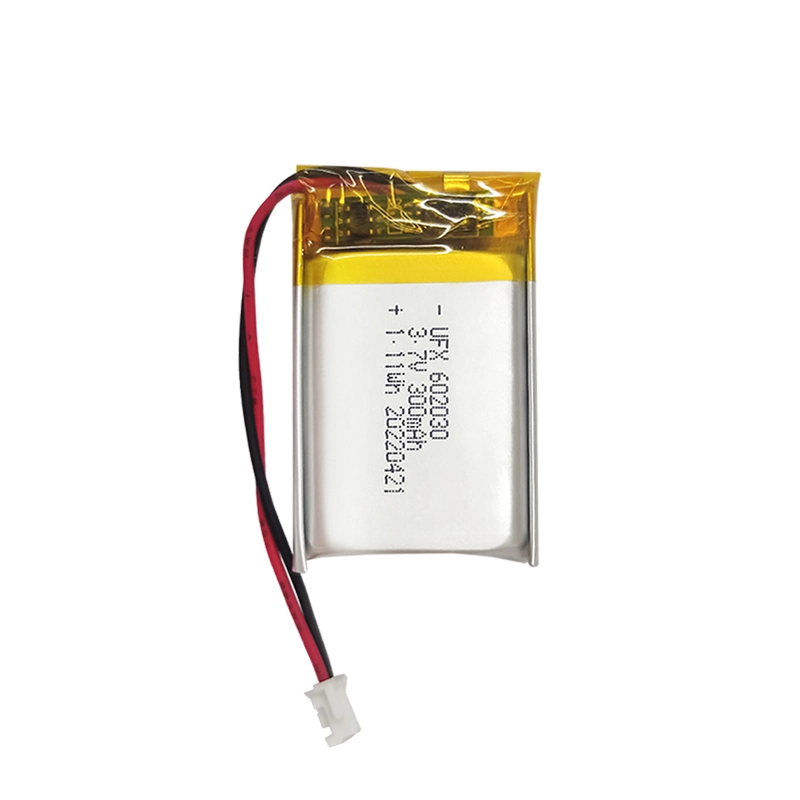
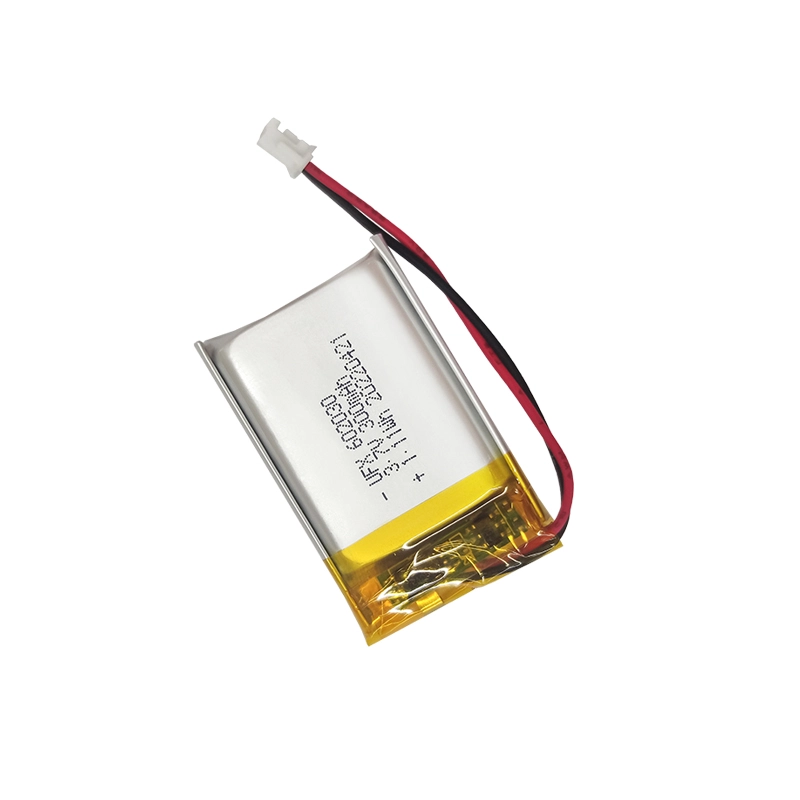
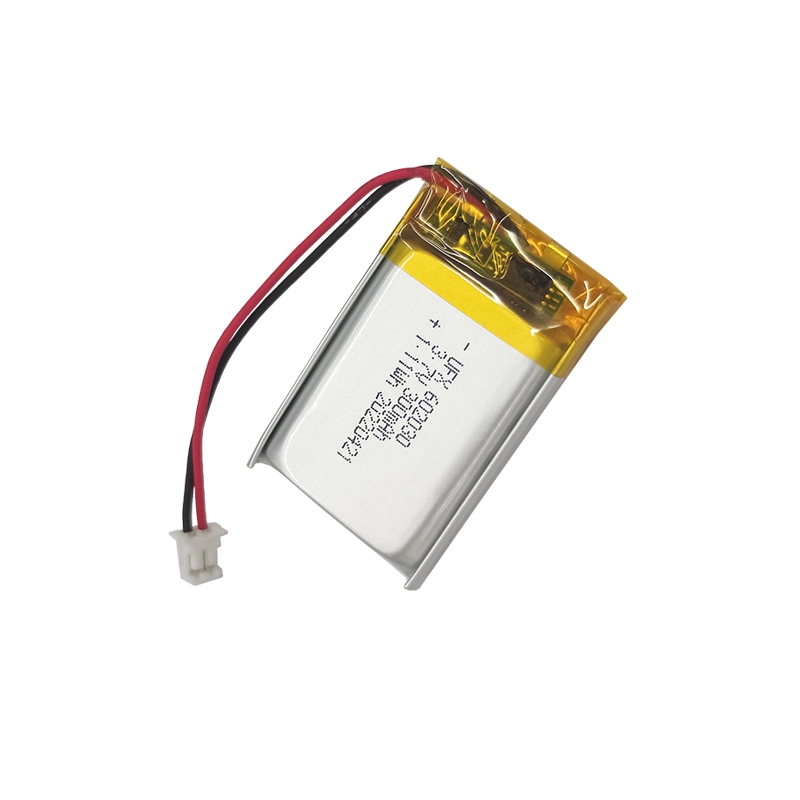
3.7 V 300mAh Lithium Ion Battery 602030 - Fully Certified


- 16 Years Experience
- 200+ Certifications
- 1000+ Customers
- 7X24 Customer Support
-
Product Details
-
Specs
-
Content
-
FAQs

Compact Power in a Tiny 602030 LiPo Battery
If your project demands lightweight, compact, and high-performance energy, the 602030 LiPo battery is an ideal solution for wearables, IoT devices, smart sensors, and other miniature electronics.
Test Curves of 3.7v Battery
Take a closer look at the battery test curves—see the stability and performance you can trust for all your power needs!
- Cycle Life
- Self-Discharge
- Discharge Rate
- Temp Performance
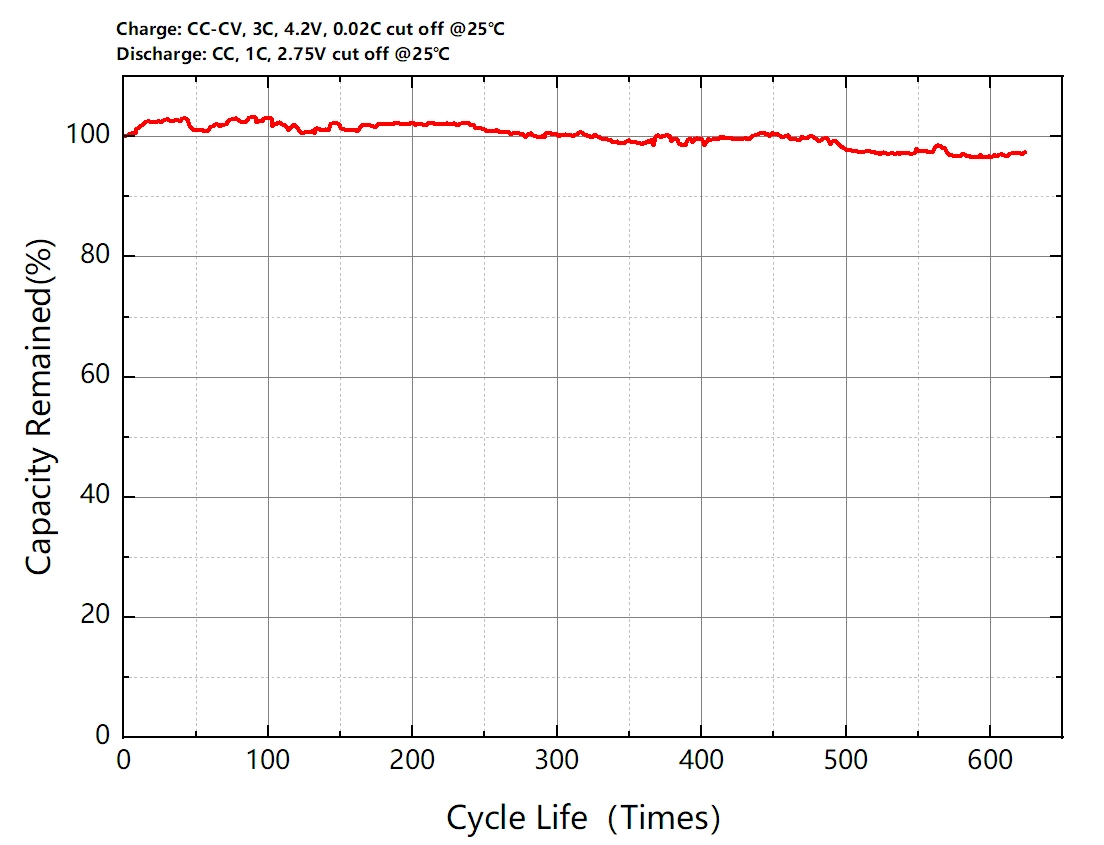
Long-Lasting Power
This battery is a long-lasting powerhouse, retaining over 95% of its initial capacity even after 600 charge-discharge cycles. This outstanding longevity ensures a reliable and consistent performance, making it the perfect choice for devices that require extended use and durability.
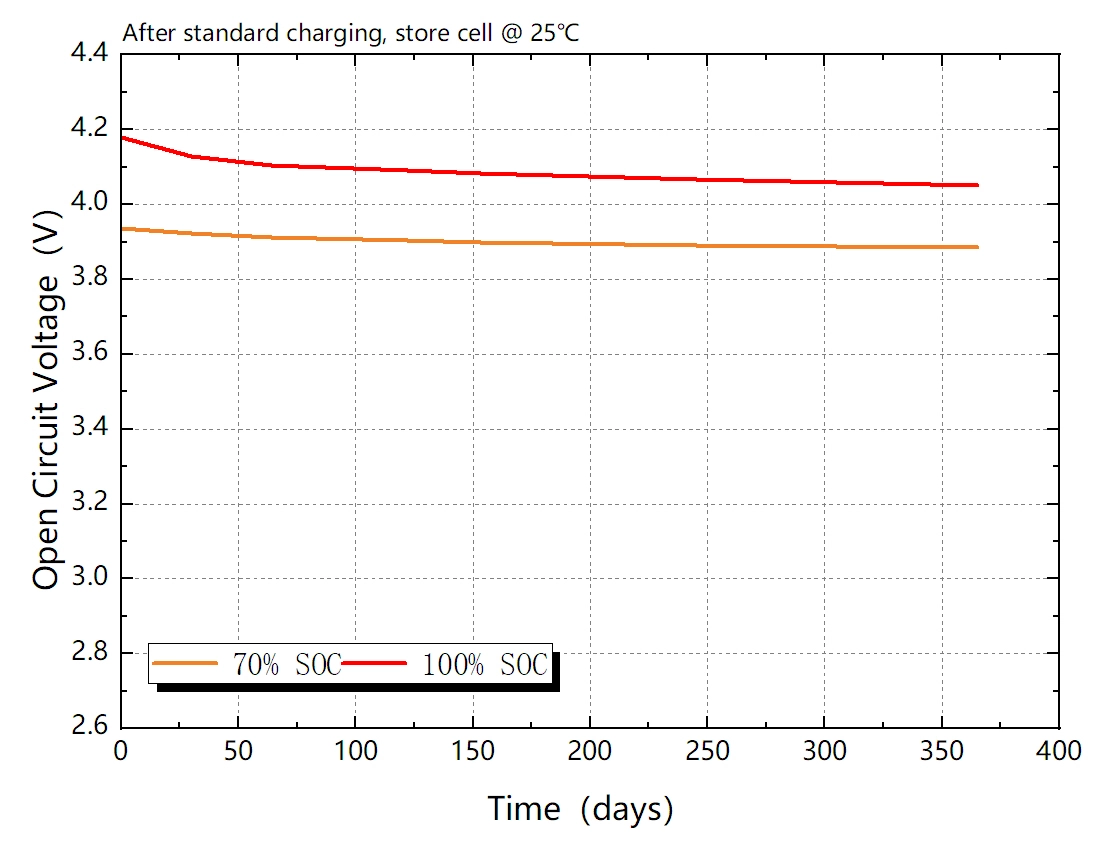
Incredible Charge Retention
With an incredibly low self-discharge rate, this battery holds its charge exceptionally well. After a full year of storage, its voltage only shows a minimal drop from 4.15V to 4.05V, keeping your device ready to go even after long periods of inactivity.
Learn More About Discharge Rate 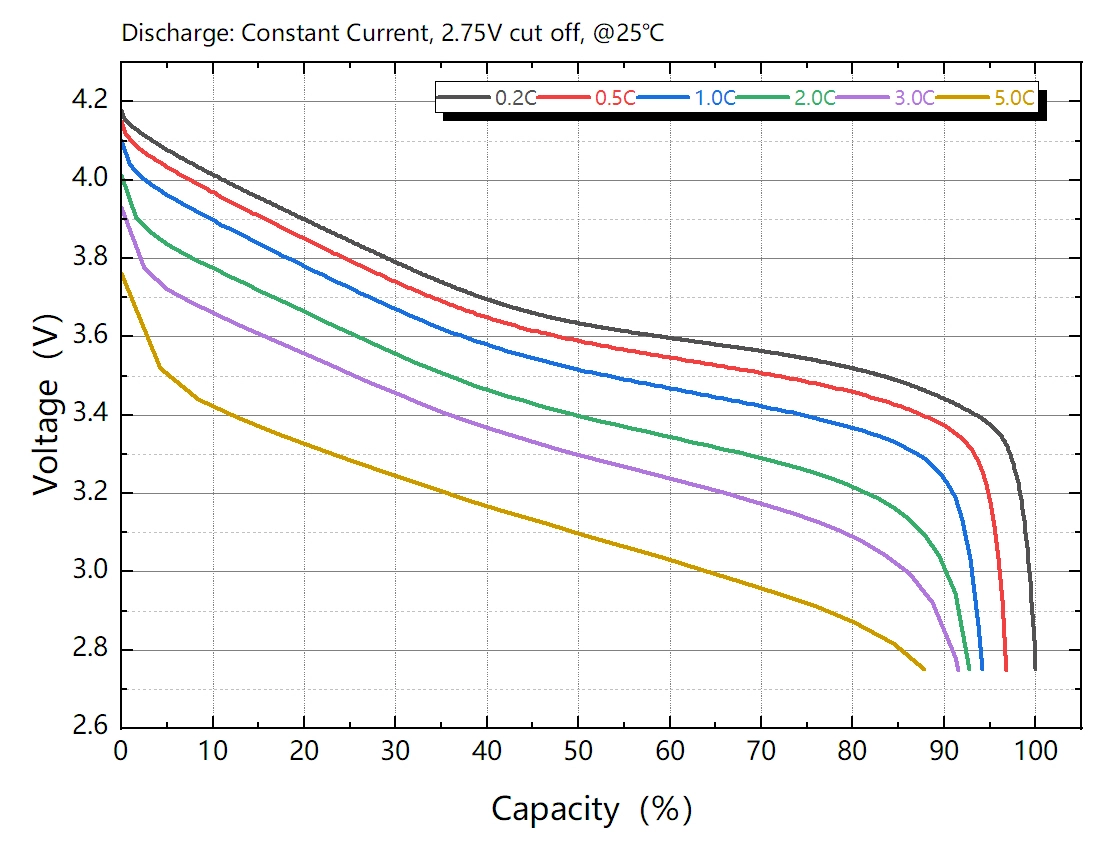
Discharge Characteristics
Experience stable and reliable power delivery. The battery maintains an operating voltage above 3.4V for over 80% of its discharge cycle, ensuring consistent performance. It also delivers high capacity, retaining over 90% even at a high 5.0C discharge rate.
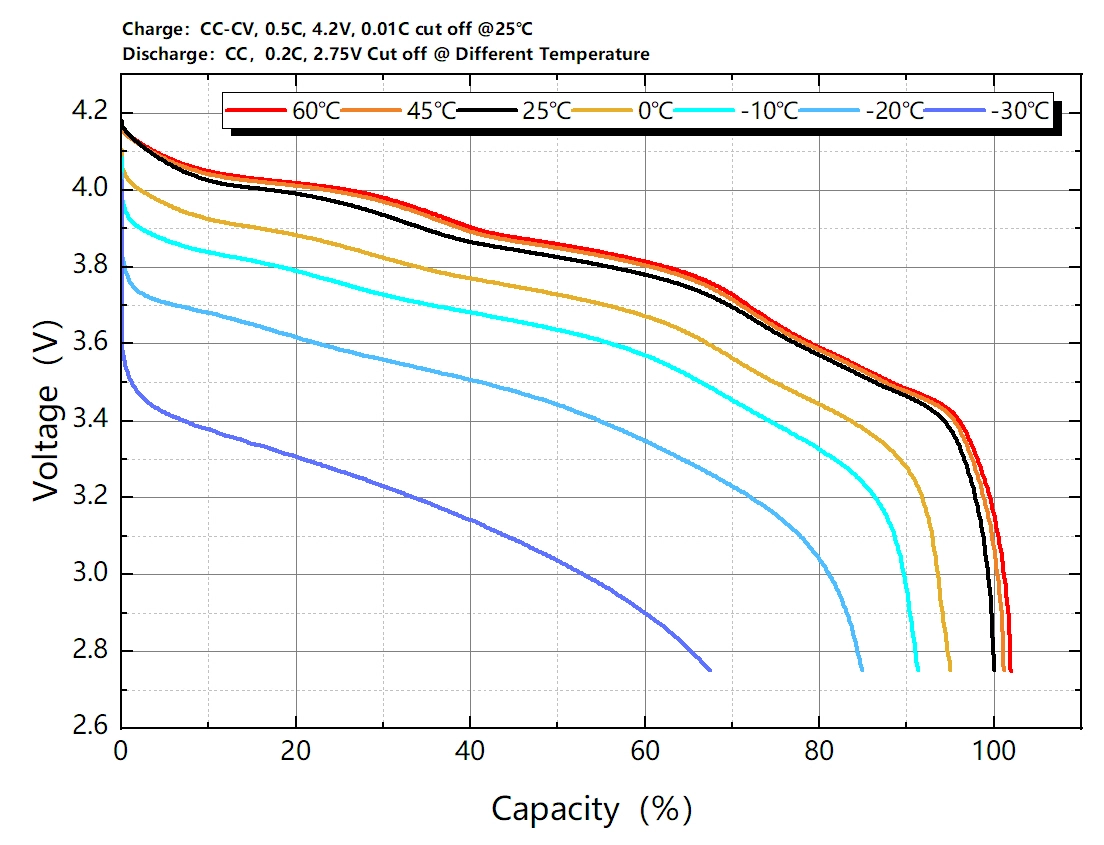
Extreme Temperature Performance
This battery is built for a wide range of climates. It offers consistent, high-capacity performance from 25°C to 60°C. Even in freezing conditions, it remains reliable, providing approximately 65% of its capacity at a frigid -30°C.
7 Major Certifications
Certified Safe and Reliable
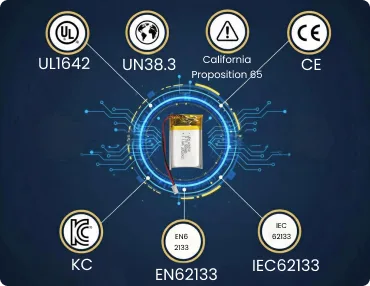
Our products have passed 7 authoritative certifications to guarantee safety, compliance, and global shipping eligibility.
- KC Certification – Compliance with Korean electrical safety standards
- UL1642 – U.S. safety standard for lithium cells
- UN38.3 – Required for international air transport safety
- California Proposition 65 – Environmentally compliant, non-toxic materials
- CE – European conformity and safety mark
- EN62133 – International standard for rechargeable batteries
- IEC62133 – Ensures reliability and safe battery performance
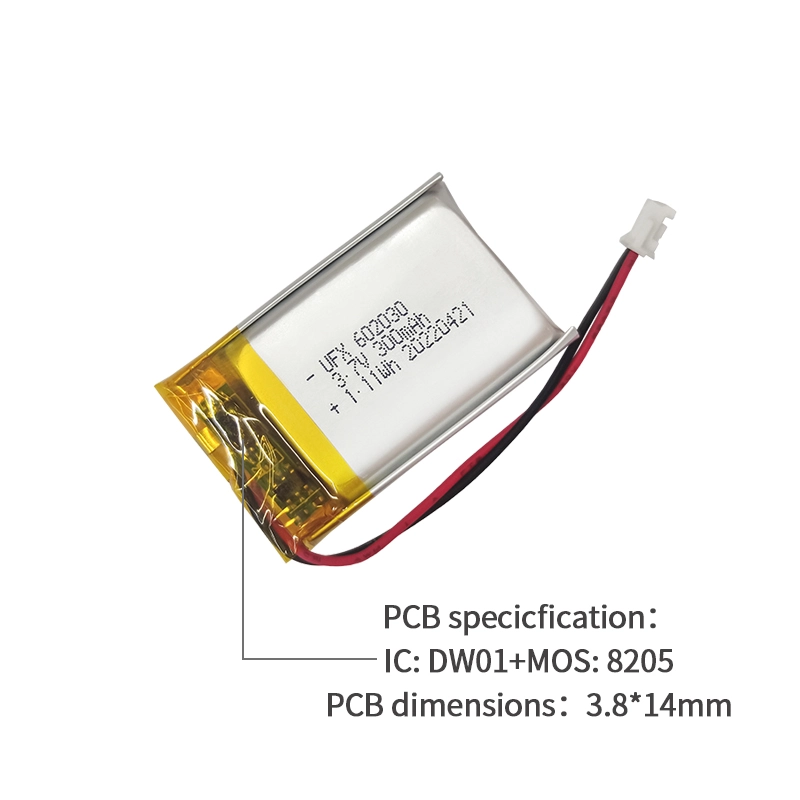
Built-in Protection Circuit
Safer Than Ordinary LiPo Batteries
With Built-in Protection
- Overcharge Detection – prevents voltage from exceeding safe limits
- Overdischarge Detection – stops deep discharge that shortens battery life
- Overcurrent Detection – controls current to protect internal components
- Short Circuit Protection – instantly cuts off output during short events
Without Protection
- May overcharge or overdischarge, leading to capacity loss or swelling
- Risk of short circuit or overcurrent during operation
- Shorter lifespan and unstable performance
- Requires careful voltage monitoring during use
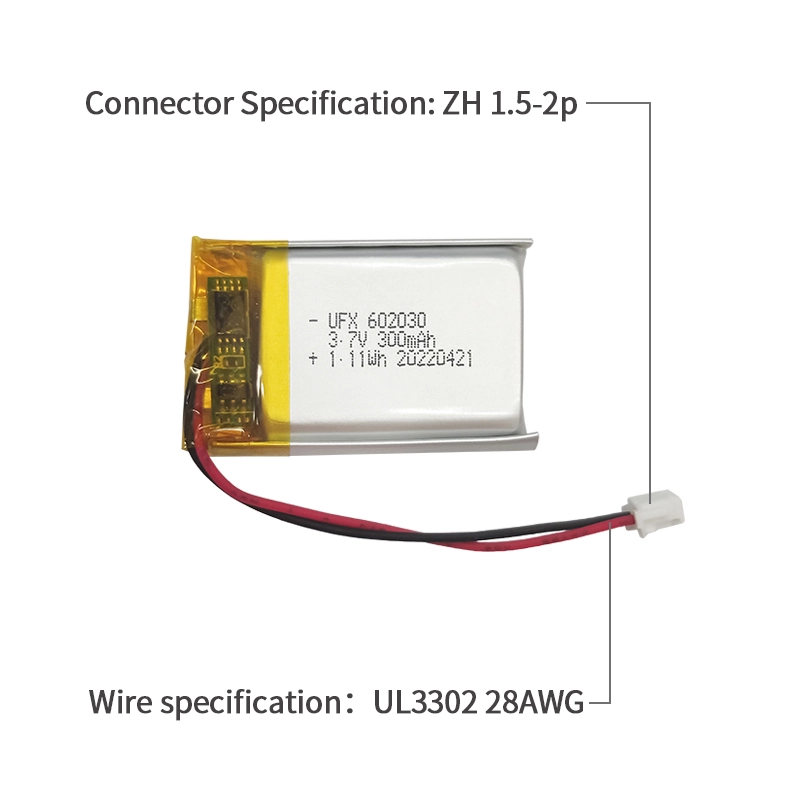
Connector & Wiring Specifications
To ensure smooth integration into your design, the 602030 3.7V 300mAh battery comes with customizable connector and wire options.
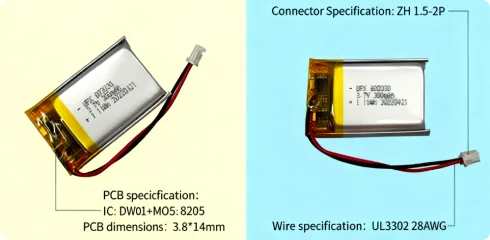
Battery Specification
-
1. Mechanical Characteristics
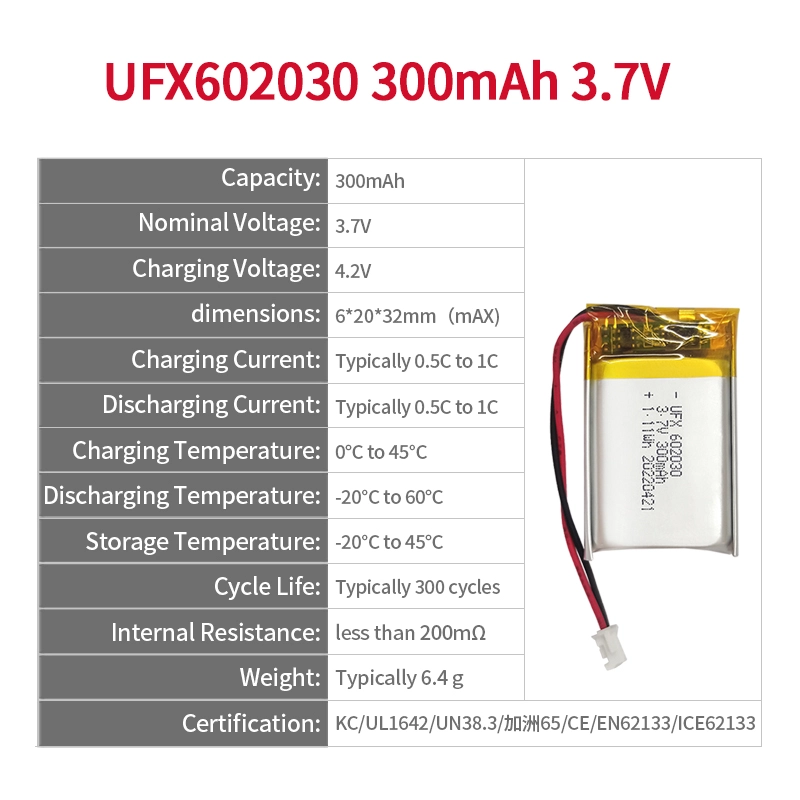
Cell 602030 PCM Yes NTC No Weight appr. 6.4g Configuration 1S1P -
2. Electrical Specification
Capacity 300mAh Nominal Voltage 3.7V Energy 1.11Wh Internal Resistance less than 200mΩ Max. Charge Voltage 4.2V Discharge Cut Off 2.75V Max. Charge Current 300mA Max. Discharge Current 300mA Standard Charge Current 150mA Standard Discharge Current 150mA Charging Temperature 0℃ to 45℃ Discharging Temperature -20℃ to 60℃ Storage Temp.Range 1 year at -20℃ to +30℃ 3 mos. at -20℃ to +45℃ 1 mo. at -20℃ to +60℃ Cycle life 100 cycles ≥92% 300 cycles ≥88% 500 cycles ≥80% -
3. Cell protection
Overcharge Detection 4.28V ±50mV (80 to 200msec delay, release 4.08V ±50mV) Overdischarge Detection 2.4V ±100mV (40 to 120msec. delay, release 3.0V ±100mV) Overcurrent Detection 2.5A to 4.5A (5 to 10msec. delay) Short protection Yes
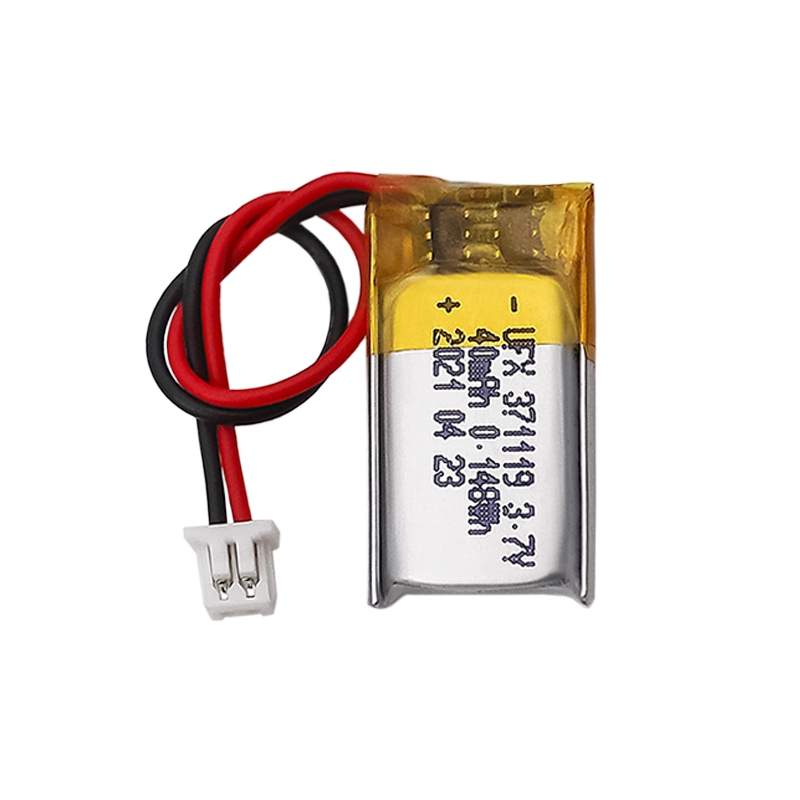
If you’re designing compact electronics that demand stable power in a small form factor, the UFX602030 3.7V 300mAh lithium polymer battery is a reliable solution. Combining lightweight design, high energy density, and full safety certifications, it’s ideal for wearables, IoT devices, medical sensors, and wireless transmitters.
Part 1. Why choose a LiPo battery?
LiPo (Lithium Polymer) batteries are the preferred power source for modern electronics due to their superior performance and flexibility. Here’s why the UFX602030 LiPo battery stands out:
-
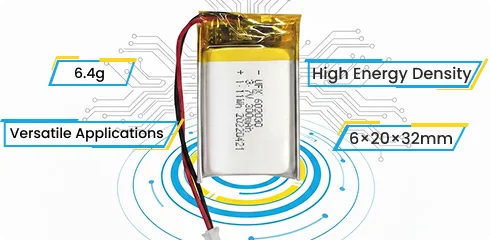
Compact and Lightweight: Only 6.4 g, with dimensions of 6×20×32 mm, perfect for slim and portable designs.
-
High Energy Density: 3.7V nominal voltage and 300mAh capacity in a small footprint.
-
Low Internal Resistance: Less than 200mΩ for efficient power delivery.
-
Certified Safety: Fully compliant with KC, UL1642, UN38.3, California 65, CE, and IEC62133 standards.
Its stable chemistry and verified safety performance make it suitable even for demanding industrial and consumer applications.
What is the IEC62133 Certification?
Part 2. What is LiPo battery cycle life?
Cycle life indicates how many times a battery can be charged and discharged before its capacity drops below 80% of its initial level. The UFX602030 lithium polymer battery typically achieves around 300 cycles, depending on usage conditions.
-
Avoid full discharges; recharge around 20–30% remaining capacity.
-
Use a regulated charger with proper cutoff voltage (4.2V).
-
Keep the battery within the recommended temperature range.
Part 3. How long can a 300mAh battery last?
Runtime depends on your device’s current draw. For a 300mAh 3.7V LiPo battery, here are some general estimates:
-
20mA load → ~15 hours
-
50mA load → ~6 hours
-
100mA load → ~3 hours
Since the UFX602030 battery supports a 0.5C–1C discharge rate, it can safely handle loads from 150mA to 300mA continuous current without overheating or voltage sag.
Part 4. Does temperature affect the 602030 battery?
Yes — temperature directly influences both performance and lifespan. The UFX602030 is designed to perform reliably under the following conditions:
-
Charging Temperature: 0°C to 45°C
-
Discharging Temperature: -20°C to 60°C
-
Storage Temperature: -20°C to 45°C
At extremely low temperatures, capacity decreases temporarily; at high temperatures, chemical aging accelerates. Keep the battery away from heat sources for long-term stability.
Part 5. Can you connect 602030 batteries in series or parallel?
Yes, you can — but it requires careful configuration:
-
Series Connection (Higher Voltage): Two cells = 7.4V total.
-
Parallel Connection (Higher Capacity): Two cells = 600mAh capacity.
Note: ⚠️ Use cells of the same model, age, and voltage level, and always include a protection circuit (PCM) and balancing board (BMS) to prevent overcharging or imbalance.
Part 6. Is the 602030 Battery compatible with your device?
The UFX602030 3.7V 300mAh battery is widely used in compact and portable devices such as:
-
GPS trackers and positioning modules
-
Bluetooth headsets and transmitters
-
Smart pens, fitness bands, and handheld sensors
-
Wireless microphones and IoT sensors
-
Small-scale robotics and wearable electronics
Its 6×20×32 mm form factor and customizable connector options make it easy to integrate into different circuit designs.
Part 7. What is the 80% rule for LiPo batteries?
The “80% rule” means using only up to 80% of the total capacity before recharging — this helps extend cycle life and prevent deep discharge damage.
For the UFX602030 (300mAh) battery, this means using around 240mAh before recharging. Staying within this limit ensures optimal performance across hundreds of cycles.
Part 8. Buyer’s checklist
Before purchasing a UFX602030 lithium polymer battery, make sure to confirm:
-
Dimensions Fit Your Device – Ensure the battery’s size (6×20×32mm MAX) fits your device enclosure.
-
Rated Voltage & Capacity – Confirm your device requires 3.7V and that 300mAh meets your runtime needs.
-
Charging & Discharging Current – Make sure your charger and device can safely handle 0.5C–1C current.
-
Protection Circuit (PCB/PCM) – Verify whether the battery includes a protection board for overcharge, over-discharge, and short-circuit safety.
-
Certifications & Compliance – Check for relevant safety certifications such as UL1642, UN38.3, CE, and IEC62133 for safe and reliable usage.
Buying from a reliable manufacturer ensures consistent quality and performance.
Part 9. Common mistakes to avoid
🚫 Charging above 4.2V per cell
🚫 Using the battery without a PCM or protection circuit
🚫 Leaving the battery in hot environments
🚫 Mixing different capacities or brands in one pack
🚫 Long-term storage when fully charged or fully discharged
Always charge with a dedicated LiPo charger, and store at about 50% charge for best results.
Part 10. Conclusion
The UFX602030 3.7V 300mAh LiPo battery offers compact size, stable voltage, and certified safety. With customization options and reliable performance, it’s an excellent choice for small IoT devices, wearable tech, and portable smart electronics.
FAQs
-
Can I charge the UFX602030 battery with a USB charger?
Not directly. Use a LiPo charger with constant current/constant voltage (CC/CV) mode and a cutoff at 4.2V. -
What’s the difference between LiPo and Li-ion batteries?
LiPo uses a polymer electrolyte, allowing flexible shapes and lower profile designs. Li-ion typically uses a cylindrical metal case. -
Can I customize the wire length or connector type?
Yes, Ufine Battery provides OEM customization, including JST/Molex connectors and protection PCBs. -
How should I store spare batteries?
Keep them at 40–60% charge in a dry, cool place between -20°C and 45°C. -
What if my battery’s internal resistance increases?
A gradual rise over time is normal. A significant increase (>200mΩ) indicates cell aging and may require replacement.
Ready to Power Your Project?
We’ll help you design the perfect power source — tailored to your voltage, capacity, size, C-rate, and performance needs.
Contact Us NowWhat Our Customers Are Saying
We love hearing from you! Your experiences help us improve and inspire others. Check out what our happy customers have to say about our lithium batteries—share your thoughts with us too!









Latest Articles
About Lithium Battery Industry News
Best 24V Lithium Battery: Top 10 Compared
Discover the top 24V lithium batteries. We compare capacity, price, cycle life, safety features, and the best options for different applications.
2026-8-24 Ufine
Top LFP Cell Manufacturers in China You Should Know
Looking for reliable LiFePO4 cells? Explore China's top LFP battery manufacturers, key technologies, production capabilities, and supplier selection tips.
2026-8-24 Ufine
Check If Your Charger Works: Simple Test Guide
Think your battery charger's broken? Quick tests can show you for sure. See if it’s the charger or the battery that's causing issues. Read more.
2026-8-24 Ufine