- Key Takeaways
- Part 1. What is the lithium-ion battery temperature range?
- Part 2. What affects li-ion battery temperature?
- Part 3. How temperature affects battery performance
- Part 4. Lithium-ion battery storage temperature guidelines
- Part 5. Practical tips to manage battery temperature
- Part 6. Application-based lithium ion battery temperature guide
- Part 7. FAQs: Lithium ion battery temperature range
Li-ion batteries power smartphones, EVs, and industrial equipment. But temperature directly affects their performance, safety, and lifespan. If you are selecting, designing, or using batteries, understanding the lithium ion battery temperature range is essential.
Key Takeaways
- The optimal battery temperature for Li-ion cells is typically 15°C to 25°C (59°F–77°F) for best performance and lifespan.
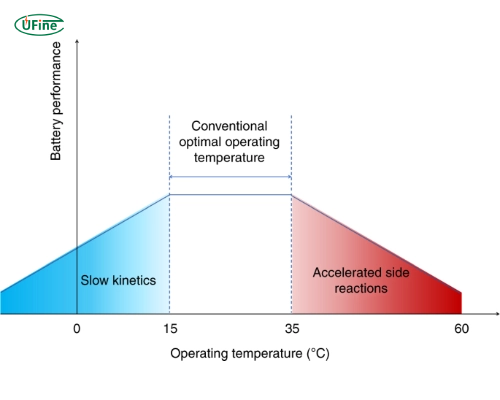
- The common li ion battery operating temperature range is about -20°C to 60°C, but performance drops outside 0°C–45°C.
- High temperature accelerates aging and increases safety risk, including thermal runaway.
- Low temperature reduces capacity, power output, and charging efficiency.
- Proper thermal design, BMS control, and moderate charging rates are critical in real applications.
Part 1. What is the lithium-ion battery temperature range?
Optimal battery temperature (best performance zone)
Most Li-ion batteries perform best between:
15°C to 25°C (59°F to 77°F)
This is the optimal battery temperature range, where you get:
- Maximum capacity
- Stable voltage output
- Lowest internal resistance
- Longest cycle life
Typical operating temperature range
In real-world use, the li ion battery operating temperature range is broader:
| Condition | Temperature Range |
|---|---|
| Discharge | -20°C to 60°C (-4°F to 140°F) |
| Charging | 0°C to 45°C (32°F to 113°F) |
| Storage (recommended) | 15°C to 25°C (59°F to 77°F) |
⚠️ Charging below 0°C can cause lithium plating, which permanently damages the battery.
For detailed lithium battery specifications and custom solutions, see our 3.7V lithium-ion battery example.
Part 2. What affects li-ion battery temperature?
Ambient environment
External temperature is the biggest factor.
- High ambient temperature → overheating risk
- Low ambient temperature → reduced power output
For industrial or outdoor systems, thermal design must consider worst-case environments.
Charge and discharge rate (C-rate)
Higher current = more heat.
- Fast charging → rapid temperature rise
- High discharge (e.g., EV, drones) → internal heat buildup
This is why high-rate applications require thermal management systems.
Battery chemistry and structure
Different chemistries behave differently:
- LiFePO4 → better thermal stability
- NMC / NCA → higher energy density but more sensitive to heat
Cell format (18650, pouch, prismatic) also impacts heat dissipation. Explore more options in our 18650 lithium-ion battery range.
Thermal design and cooling
Heat must be removed efficiently.
Common solutions:
- Passive cooling (airflow, spacing)
- Active cooling (fans, liquid cooling)
- Heat sinks and thermal interface materials
For EVs and energy storage systems, this is a core engineering challenge.
Part 3. How temperature affects battery performance
Capacity and efficiency
- High temperature: increases side reactions → capacity loss
- Low temperature: slows electrochemical reactions → lower usable capacity
At -10°C, capacity can drop by 20–40% depending on chemistry.
Lifespan and degradation
Temperature is one of the biggest aging factors.
- Every 10°C increase roughly doubles degradation rate (Arrhenius behavior)
- Long-term exposure above 40°C significantly reduces cycle life
Authoritative testing standards like UL and IEC define thermal test conditions for safety and durability.
Safety risks (thermal runaway)
High temperature increases the risk of:
- Internal short circuits
- Gas generation and swelling
- Thermal runaway (>80°C critical zone)
This is why modern systems rely on Battery Management Systems (BMS).
Learn more about manufacturing and safety control in our battery production process.
Part 4. Lithium-ion battery storage temperature guidelines
Proper storage is often overlooked but critical.
| Storage Condition | Recommended Range |
|---|---|
| Short-term | 0°C to 35°C |
| Long-term | 15°C to 25°C |
| Extreme limit | -20°C to 60°C (avoid if possible) |
Best practices:
- Store at 40–60% charge (SOC)
- Avoid high humidity
- Keep away from direct sunlight
Part 5. Practical tips to manage battery temperature
Avoid extreme conditions
Do not expose batteries to:
- Direct sunlight in cars
- Freezing outdoor conditions without insulation
Control charging behavior
- Avoid frequent fast charging
- Do not charge below 0°C
- Keep SOC between 20%–80% when possible
Improve thermal design
- Ensure airflow around battery packs
- Use thermal pads or heat sinks
- Consider active cooling for high-power systems
Use a reliable BMS
A Battery Management System can:
- Monitor temperature in real time
- Cut off unsafe charging/discharging
- Balance cells to reduce heat buildup
Inspect and maintain regularly
Watch for:
- Swelling
- Overheating
- Voltage imbalance
Replace damaged batteries immediately.
Part 6. Application-based lithium ion battery temperature guide
| Application | Key Temperature Concern | Design Focus |
|---|---|---|
| EV batteries | High load heat | Liquid cooling + BMS |
| Solar storage | Outdoor temperature swings | Insulated enclosure |
| Consumer electronics | Compact heat buildup | Passive cooling |
| Industrial equipment | Continuous operation | Thermal monitoring |
Part 7. FAQs: Lithium ion battery temperature range
What is the ideal lithium ion battery temperature range?
The optimal range is 15°C to 25°C (59°F–77°F) for best performance and lifespan.
What is the safe li ion battery operating temperature range?
Typical safe operation:
- Discharge: -20°C to 60°C
- Charging: 0°C to 45°C
What is the maximum temperature for lithium batteries?
Temperatures above 60°C (140°F) can damage the battery. Above 80°C, there is a risk of thermal runaway.
Can lithium-ion batteries work in cold temperatures?
Yes, but performance drops significantly below 0°C. Charging in freezing conditions can cause permanent damage.
What is the best storage temperature for lithium-ion batteries?
Store at 15°C to 25°C, with 40–60% charge, in a dry environment.
Related Tags:

More Articles

Dead Battery or Device Failure? How to Find the Cause
Think your device is broken? Learn how to tell if the problem comes from battery aging or hardware failure before replacing your electronics.
Why iPhone Duo Uses Two Batteries: The Engineering Behind Foldable Phone Power
Why do foldable phones need two batteries? Explore the engineering challenges behind iPhone Duo’s dual-battery architecture and future battery trends.
Solid-State Batteries: 3 Myths You Need to Know
Solid-state batteries promise safer EVs and longer range, but the reality is more complex. Discover the challenges behind this next-gen technology.
Battery Capacity vs Discharge Rate: The Choice Engineers Face
Higher capacity or higher discharge rate? Learn how to choose the right LiPo battery for longer runtime, stable power output, and better device performance.
Battery Cable Size Guide: Choose the Right Wire Fast
Not sure what battery cable size you need? Learn how to select the right wire gauge, terminal size, and cable for safer, more efficient battery systems.