
- Key takeaways
- Part 1. What is a battery electrolyte?
- Part 2. What is an electrolyte made of?
- Part 3. Common battery electrolyte types by battery chemistry
- Part 4. What is the electrolyte in a lithium-ion battery?
- Part 5. Why is electrolyte important in a battery?
- Part 6. How electrolytes affect battery performance
- Part 7. Liquid, gel, and solid electrolytes: what is the difference?
- Part 8. Main challenges of battery electrolytes
- Part 9. Battery electrolyte selection: what engineers should consider
- Part 10. Future trends in battery electrolytes
- Part 11. Battery electrolyte FAQs
Batteries power many devices, but their operation depends on one key component: the electrolyte.
A battery electrolyte is the medium that allows ions to move between the positive and negative electrodes, enabling charging and discharging.
This article explains electrolyte composition, common materials, and how electrolytes affect battery performance.
Key takeaways
- A battery electrolyte allows ions to move between electrodes during charging and discharging.
- Most liquid battery electrolytes are made of solvents, salts, and additives.
- Lithium ion battery electrolyte usually contains organic carbonate solvents and lithium salts such as LiPF6.
- Different batteries use different electrolytes, such as sulfuric acid, potassium hydroxide, gel electrolyte, or solid electrolyte.
- The electrolyte affects battery capacity, cycle life, charging speed, low-temperature performance, leakage risk, and safety.
Part 1. What is a battery electrolyte?
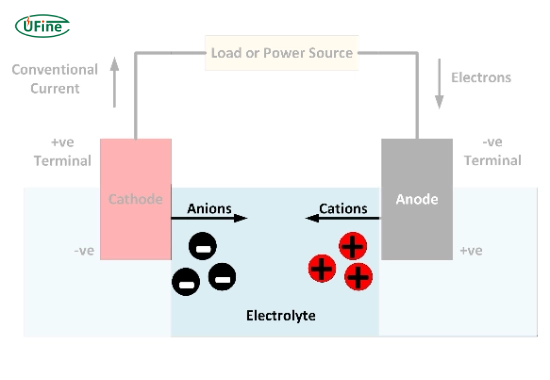
A battery electrolyte is a material that lets ions move inside a battery. It carries ions between the anode and cathode. At the same time, it blocks electrons inside the cell. Electrons must flow through the outer circuit, not through the electrolyte.
Electrolytes can be liquid, gel, or solid. The choice depends on battery type, voltage, temperature, safety needs, and use case.
In lithium batteries, lithium ions move between two electrodes. They move one way during discharge and back during charging. This movement allows the battery to recharge.
If you want to learn more about how lithium batteries are made, you can read where lithium batteries come from.
Part 2. What is an electrolyte made of?
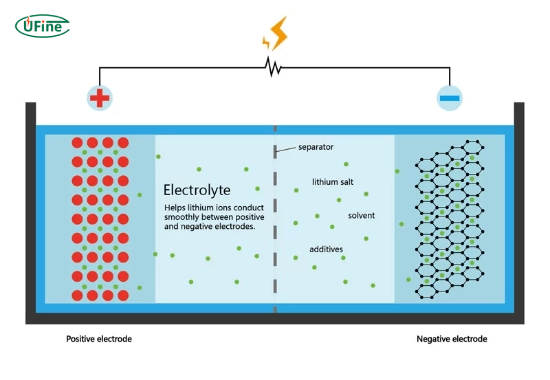
The composition depends on the battery type. Most liquid electrolytes have three parts: solvents, salts, and additives.
1. Solvents
Solvents are the liquid base. They dissolve the salt and help ions move.
In lithium-ion batteries, common solvents are organic carbonates. Examples include ethylene carbonate, dimethyl carbonate, diethyl carbonate, and ethyl methyl carbonate. These support ion flow and stable voltage.
Solvent choice affects:
- Ionic conductivity
- Low-temperature performance
- Viscosity
- Voltage stability
- Safety and flammability
2. Salts
Salts provide the ions. In lithium-ion batteries, the most common salt is LiPF6.
When dissolved, it splits into lithium ions and anions. Lithium ions move during charge and discharge.
Other batteries use different salts. Sodium-ion batteries use sodium salts. Alkaline batteries use potassium hydroxide.
3. Additives
Additives are used in small amounts. They improve performance and safety.
They can:
- Form a stable SEI layer
- Reduce gas
- Improve high-temperature storage
- Improve overcharge safety
- Reduce breakdown
- Improve low-temperature use
For custom lithium polymer batteries, the electrolyte must match the cell design and use. Learn more in our guide to lithium battery electrolyte.
Part 3. Common battery electrolyte types by battery chemistry
| Battery Type | Common Electrolyte | Main Role | Typical Applications |
|---|---|---|---|
| Lead-acid battery | Diluted sulfuric acid | Moves ions between lead plates | Car batteries, UPS, backup power |
| Lithium-ion battery | Organic solvents + lithium salt | Moves lithium ions | Phones, laptops, EVs, tools, medical devices |
| Lithium polymer battery | Liquid or gel electrolyte in pouch cells | Supports thin and flexible design | Wearables, trackers, smart locks |
| Alkaline battery | Potassium hydroxide | Moves ions in primary cells | Remotes, toys, flashlights |
| Gel battery | Gelled acid | Reduces leakage | Solar, mobility, backup |
| Solid-state battery | Solid electrolyte materials | Improves safety | Future EVs and electronics |
Part 4. What is the electrolyte in a lithium-ion battery?
A lithium-ion electrolyte uses lithium salt in organic solvents. The most common salt is LiPF6.
It must conduct ions well and stay stable at working voltage. It must also work across the needed temperature range.
It must match other parts of the battery, including:
- Cathode material
- Anode material
- Separator
- Cell shape
- Charging conditions
- Temperature range
- Safety design
So, two batteries with the same specs may still perform differently.
Part 5. Why is electrolyte important in a battery?
The electrolyte directly affects battery performance.
1. It enables ion transfer
It allows ions to move. Poor movement increases resistance and heat.
2. It affects energy output
Good conductivity helps deliver more usable energy.
3. It affects cycle life
Stable electrolyte reduces aging and keeps capacity longer.
4. It affects battery safety
Some electrolytes are flammable. Proper design and protection are needed.
5. It affects temperature performance
Cold temperatures slow ion movement. This reduces performance.
Part 6. How electrolytes affect battery performance
Electrolyte design affects key performance areas.
| Performance Factor | How Electrolyte Affects It | Engineering Impact |
|---|---|---|
| Capacity | Better ion flow improves use of materials | More usable energy |
| Internal resistance | Poor conductivity raises resistance | More heat, less power |
| Fast charging | Needs fast ion movement | Lower plating risk |
| Cycle life | Stable electrolyte reduces side reactions | Longer life |
| Low-temperature use | Low viscosity helps cold use | Better outdoor performance |
| Safety | Stability affects risk | Safer operation |
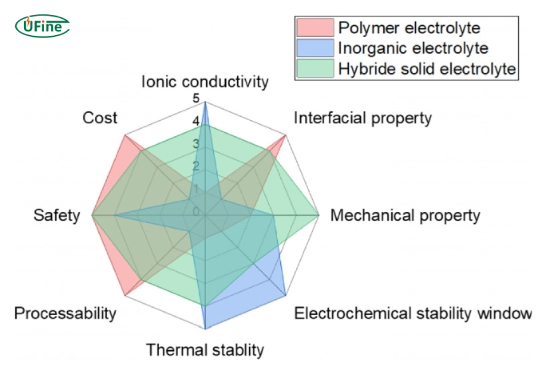
Part 7. Liquid, gel, and solid electrolytes: what is the difference?
Liquid electrolyte
Common and widely used. Good conductivity. May leak or burn if damaged.
Gel electrolyte
Liquid held in gel form. Lower leakage risk.
Solid electrolyte
Uses solid materials. Better safety. Still under development.
For more basics, see the battery science guide.
Part 8. Main challenges of battery electrolytes
1. Flammability
Organic solvents can burn. Good design reduces risk.
2. Degradation over time
Electrolytes break down with heat and stress.
3. Gas generation
Side reactions can create gas and swelling.
4. Low-temperature limitation
Cold slows ion movement and charging.
5. Recycling difficulty
Lithium batteries are harder to recycle. See EPA guidance.
Part 9. Battery electrolyte selection: what engineers should consider
Buyers usually choose battery type, not electrolyte. But understanding helps better decisions.
| Selection Question | Why It Matters |
|---|---|
| Operating temperature? | Affects performance |
| Need fast charging? | Requires proper design |
| Indoor or outdoor use? | Outdoor needs better tolerance |
| Worn on body? | Needs higher safety |
| Need long life? | Depends on stability |
| High current use? | Needs low resistance |
Part 10. Future trends in battery electrolytes
Research focuses on safety and longer life.
- Solid-state: safer design
- Flame-retardant: better safety
- High-voltage: supports new materials
- Low-temperature: better cold use
- Water-based: safer and greener
- Recycling-friendly: easier recovery
These trends will improve battery safety and performance.
Part 11. Battery electrolyte FAQs
Why does electrolyte affect battery lifespan?
Electrolyte stability determines how well it resists decomposition during cycling. A stable electrolyte reduces side reactions, helping the battery maintain capacity over time.
Can electrolyte influence charging speed?
Yes, electrolytes with higher ionic conductivity allow faster ion movement, which supports quicker charging without excessive heat or performance loss.
What happens if electrolyte degrades?
Degradation can increase internal resistance, reduce capacity, and generate gas, which may lead to swelling or reduced battery efficiency.
Do all batteries use the same type of electrolyte?
No, different battery chemistries require specific electrolytes tailored to their voltage range, materials, and operating conditions.
How does temperature impact electrolyte performance?
Low temperatures slow ion movement, reducing performance, while high temperatures can accelerate chemical breakdown and shorten battery life.
Related Tags:

More Articles
LiFePO4 Voltage Chart Guide: Everything You Need to Know
Check the LiFePO4 voltage chart for 3.2V, 12V, 24V and 51.2V batteries. Compare SOC, charging voltage, cutoff limits and internal resistance.
Lithium Ion Cell Sizes: A Comprehensive Guide
Compare lithium ion cell sizes with a chart of dimensions, capacity ranges, cell types, applications, and key factors for selecting the right battery.
6 Volt Tractor Battery vs 12 Volt: Which One Fits Your Farm Equipment Best?
Compare 6V and 12V tractor batteries. Learn which voltage fits vintage or modern tractors, which specifications matter, and how to convert safely.
The Ultimate Guide to a Molten Salt Battery
Learn how a molten salt battery works, its main types, advantages, disadvantages, operating temperature, safety, and grid energy storage uses.
2000mAh Battery Runtime: How Long Will It Last in Real Devices?
Learn how to calculate 2000mAh battery runtime and backup time. See real device examples, power-loss factors, and battery replacement checks.


