
- Key Takeaways
- Part 1. What is a lithium pouch cell?
- Part 2. How does a lithium pouch cell work?
- Part 3. Lithium pouch cell chemistries explained
- Part 4. Lithium pouch cell voltage and capacity
- Part 5. Key parameters when choosing a lithium pouch cell
- Part 6. Advantages and disadvantages of lithium pouch cells
- Part 7. Pouch cell vs cylindrical vs prismatic battery
- Part 8. Common applications of lithium pouch cells
- Part 9. How to prevent lithium pouch cell swelling?
- Part 10. Choosing a reliable lithium pouch cell supplier
- Part 11. FAQs about lithium pouch cells
Lithium pouch cells are lithium-ion batteries that use a flexible aluminum pouch instead of a metal case. They offer high energy density, low weight, and compact designs, making them widely used in smartphones, drones, EVs, medical devices, and energy storage systems.
Common types include LFP pouch cells and NMC pouch cells, each designed for different safety, cycle life, and performance needs.
Key Takeaways
- A lithium pouch cell uses a soft foil pouch instead of a metal case.
- Pouch battery designs offer high energy density and flexible dimensions.
- Common chemistries include NMC, LFP pouch cell, and NCA.
- LFP pouch cells provide better thermal stability and longer cycle life.
- Lithium pouch cells are widely used in EVs, drones, medical devices, and portable electronics.
- Pouch cells require proper BMS protection to prevent swelling and overcharging.
- Compared with cylindrical cells, pouch cells save space and reduce battery weight.
- Choosing the right lithium pouch cell supplier is critical for safety, consistency, and custom battery design.
Part 1. What is a lithium pouch cell?
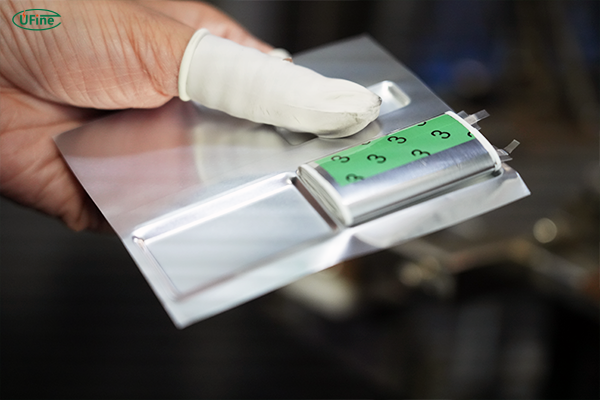
A lithium pouch cell is a type of lithium-ion battery packaged inside a flexible laminated aluminum pouch instead of a rigid metal casing.
Inside the pouch battery are several electrochemical layers:
- Anode (usually graphite or silicon-based graphite)
- Cathode (LFP, NMC, or NCA chemistry)
- Separator
- Electrolyte
- Current collectors
These layers are stacked or wound together and then vacuum-sealed inside the aluminum polymer film.
Compared with cylindrical batteries, lithium pouch cells use less inactive material. This improves gravimetric and volumetric energy density.
The soft package also allows manufacturers to create custom shapes and ultra-thin battery designs for compact electronic products.
For a deeper understanding of battery materials, read: Cathode and Anode of Lithium Batteries
Part 2. How does a lithium pouch cell work?
A lithium pouch cell works using the same electrochemical principle as other lithium-ion batteries.
During charging:
- Lithium ions move from the cathode to the anode.
- Electrons flow through the external circuit.
During discharge:
- Lithium ions move back to the cathode.
- Stored energy powers the device.
The difference is mainly in the packaging structure.
Because pouch cells do not use heavy steel cans, they achieve:
- Higher energy density
- Better space utilization
- Lower overall battery weight
This makes lithium pouch cells especially attractive for:
- Smartphones
- Drones
- Robotics
- Electric vehicles
- Portable medical devices
According to the U.S. Department of Energy, lightweight battery architecture plays an important role in improving EV efficiency and portable electronics performance.
Part 3. Lithium pouch cell chemistries explained
Different lithium pouch cell chemistries offer different performance advantages.
NMC Lithium Pouch Cell
NMC (Nickel Manganese Cobalt Oxide) balances:
- High energy density
- Good cycle life
- Moderate thermal stability
NMC pouch cells are commonly used in:
- Electric vehicles
- Consumer electronics
- Power tools
- E-bikes
They are ideal when compact size and long runtime are priorities.
LFP Pouch Cell
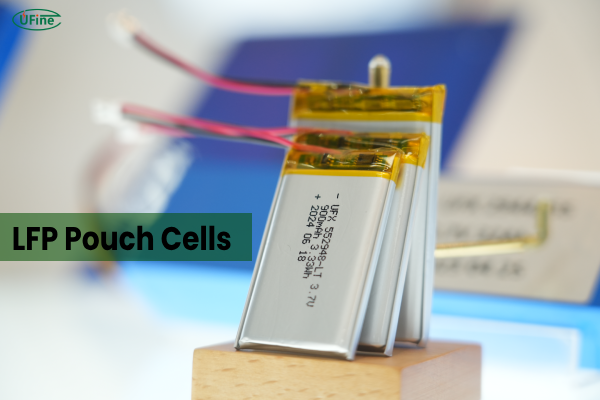
An LFP pouch cell uses Lithium Iron Phosphate chemistry.
Compared with NMC:
- Energy density is lower
- Thermal stability is much higher
- Cycle life is significantly longer
LFP pouch cells are widely used in:
- Solar energy storage
- Industrial equipment
- Electric buses
- Backup power systems
- Marine batteries
Advantages of LFP pouch cells:
- Excellent safety
- Low thermal runaway risk
- Long service life
- Better high-temperature tolerance
Explore related products: LFP Pouch Cell Solutions
NCA Lithium Pouch Cell
NCA (Nickel Cobalt Aluminum Oxide) focuses on:
- Very high energy density
- High output performance
This chemistry is used in:
- High-performance EVs
- Aerospace systems
- Premium energy applications
However, NCA batteries require stricter thermal management systems.
Part 4. Lithium pouch cell voltage and capacity
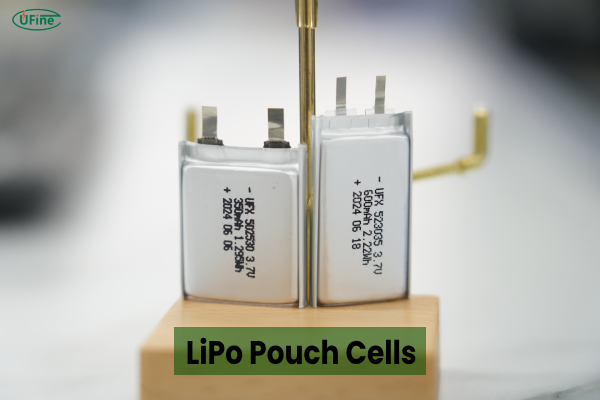
The nominal voltage of a lithium pouch cell usually depends on chemistry.
| Chemistry | Nominal Voltage | Fully Charged Voltage |
|---|---|---|
| NMC | 3.6V–3.7V | 4.2V |
| NCA | 3.6V–3.7V | 4.2V |
| LFP | 3.2V | 3.65V |
Capacity is measured in:
- mAh (milliamp-hours)
- Ah (amp-hours)
A higher-capacity pouch battery can power a device longer before recharging.
For example:
- 500mAh → wearable electronics
- 5000mAh → smartphones/tablets
- 50Ah+ → EV modules and ESS systems
When designing a battery pack, engineers must balance:
- Capacity
- Weight
- Size
- Thermal performance
- Discharge rate
Part 5. Key parameters when choosing a lithium pouch cell
Selecting the right lithium pouch cell requires more than checking voltage and capacity.
1. Energy Density
Measured in Wh/kg or Wh/L. Higher energy density means longer runtime, smaller battery pack, and lower product weight. This is critical for drones, medical devices, and portable electronics.
2. Cycle Life
Cycle life measures how many charge/discharge cycles the battery can complete before capacity significantly decreases.
Typical values:
- NMC pouch cell: 500–1200 cycles
- LFP pouch cell: 2000–6000 cycles
Applications requiring long-term reliability often prefer LFP chemistry.
3. C-Rate
C-rate defines charging and discharge speed.
Examples:
- 1C = full discharge in 1 hour
- 5C = full discharge in 12 minutes
High-rate lithium pouch cells are used in FPV drones, RC vehicles, robotics, and industrial tools.
4. Operating Temperature
Temperature directly affects safety, capacity, and cycle life.
Some industrial lithium pouch cells support:
- Low-temperature discharge below -20°C
- High-temperature operation above 60°C
Custom temperature solutions are common in military and outdoor equipment.
5. Internal Resistance
Lower internal resistance provides better efficiency, lower heat generation, and higher output stability. This is especially important in high-current applications.
Part 6. Advantages and disadvantages of lithium pouch cells
Advantages
| Advantage | Benefit |
|---|---|
| Lightweight structure | Improves portability |
| Flexible dimensions | Easier product integration |
| High energy density | More energy in less space |
| Better space utilization | Efficient battery pack design |
| Thin profile | Ideal for slim electronics |
Disadvantages
| Limitation | Description |
|---|---|
| Swelling risk | Gas generation can expand the pouch |
| Lower mechanical strength | Requires external support |
| Sensitive to puncture | Needs protective enclosure |
| Higher BMS requirements | Charging protection is critical |
Proper battery design and quality control greatly reduce these risks.
The International Electrotechnical Commission (IEC) and UL Solutions provide battery safety standards widely used in lithium battery manufacturing.
Part 7. Pouch cell vs cylindrical vs prismatic battery
Choosing the correct lithium-ion cell format depends on the application.
| Feature | Pouch Cell | Prismatic Cell | Cylindrical Cell |
|---|---|---|---|
| Structure | Flexible pouch | Rigid rectangular shell | Metal cylinder |
| Weight | Lightest | Medium | Heaviest |
| Energy Density | High | Medium | Lower |
| Mechanical Strength | Lower | High | Very high |
| Space Efficiency | Excellent | Good | Moderate |
| Custom Shapes | Excellent | Limited | Poor |
| Cost | Moderate | Higher | Lowest |
When to Choose a Pouch Battery
Pouch batteries are ideal for:
- Smartphones
- Tablets
- Wearables
- Drones
- Compact EV modules
- Portable medical devices
When Cylindrical Cells Are Better
Cylindrical cells are preferred for:
- Power tools
- E-bikes
- Industrial packs
- Applications requiring strong mechanical durability
Learn more about cylindrical battery types here: 18650 vs 21700 Battery Comparison
Part 8. Common applications of lithium pouch cells
Lithium pouch cells are used across many industries because of their flexible structure and high energy density.
| Industry | Typical Use |
|---|---|
| Consumer electronics | Smartphones, tablets, laptops |
| Electric mobility | EVs, scooters, e-bikes |
| Drones | UAVs, FPV racing drones |
| Medical devices | Portable monitors, pumps |
| Wearables | Smartwatches, smart glasses |
| Robotics | AGV robots, industrial automation |
| Energy storage | Solar ESS and backup systems |
As device miniaturization continues, lithium pouch cells will become even more important in next-generation electronics.
Part 9. How to prevent lithium pouch cell swelling?
Battery swelling is one of the most discussed pouch battery issues.
Common causes include:
- Overcharging
- High temperature
- Deep discharge
- Internal gas generation
- Poor-quality electrolyte
- Weak battery management systems
Best practices to reduce swelling risk:
- Use certified chargers
- Implement a reliable BMS
- Avoid high-temperature storage
- Prevent over-discharge
- Purchase from reputable lithium pouch cell suppliers
Battery pack mechanical support also plays a major role in long-term stability.
Part 10. Choosing a reliable lithium pouch cell supplier
A reliable lithium pouch cell supplier should provide more than just battery cells.
Key factors include:
- Stable cell consistency
- Safety certifications
- Custom battery design capability
- Engineering support
- Low MOQ flexibility
- Fast prototyping
- Temperature customization
- Long-term supply reliability
Ufine Battery specializes in:
- Lithium pouch cells
- LFP pouch cells
- High-rate LiPo pouch batteries
- Ultra-thin batteries
- High-temperature and low-temperature batteries
- Custom battery packs
Ufine supports OEM and ODM battery projects for robotics, medical equipment, consumer electronics, solar storage systems, and industrial devices.
Contact the engineering team here: Custom Lithium Battery Inquiry
Part 11. FAQs about lithium pouch cells
What is a lithium pouch cell?
A lithium pouch cell is a lithium-ion battery packaged in a flexible aluminum laminated pouch instead of a rigid metal case.
Are LFP pouch cells safer than NMC pouch cells?
Yes. LFP pouch cells generally offer better thermal stability and lower thermal runaway risk than NMC batteries.
Why do lithium pouch cells swell?
Swelling usually happens because of gas buildup caused by overcharging, overheating, aging, or internal chemical reactions.
What are lithium pouch cells used for?
Lithium pouch cells are used in smartphones, drones, EVs, robotics, medical devices, wearables, and energy storage systems.
How do I choose a lithium pouch cell supplier?
Choose a supplier with:
- Strong quality control
- Engineering support
- Custom battery capability
- Safety certifications
- Stable long-term production experience
Related Tags:

More Articles

JST vs Molex: The Right Battery Connector Choice
JST or Molex for your battery? Learn how connector selection affects current, voltage drop, reliability, and device performance.
Custom Battery Pricing: Costs Manufacturers Don’t Mention
A low battery quote may not be the final cost. Discover common hidden expenses that affect custom lithium battery projects.
Battery Wire Length: Hidden Cause of Power Loss
A longer battery wire can cause voltage drop, power loss, and unstable operation. Learn how wire length affects battery performance.
How Device Sleep Modes Affect Battery Life
Think sleep mode extends battery life? Learn why devices still drain power and how firmware, hardware, and batteries affect runtime.
LiPo Battery and PCB Design: Clearance, Insulation, and Placement
Learn how to optimize LiPo battery PCB clearance, insulation, placement, wiring, and thermal design—and avoid common integration mistakes.


