- Part 1. What is a 4.8V battery?
- Part 2. Types of 4.8V batteries
- Part 3. How is a 4.8V battery pack constructed?
- Part 4. Common uses of 4.8V batteries
- Part 5. 4.8V battery vs. similar voltages
- Part 6. Advantages and disadvantages of 4.8V batteries
- Part 7. Key features to look for in a good 4.8V battery
- Part 8. How to calculate the runtime of a 4.8V battery pack
- Part 9. How to charge a 4.8V battery safely
- Part 10. 4.8V battery charger selection
- Part 11. FAQs
The world of batteries can be surprisingly complex. But understanding the specifics—like what a 4.8V battery is, how it works, and how it fits into your application—is key to better product performance, safety, and innovation. If you’re an engineer developing compact electronics, a hobbyist upgrading your RC models, or a business sourcing reliable energy solutions, this guide offers a comprehensive deep dive into 4.8V battery technology.
Key Takeaways
- A 4.8V battery is typically a rechargeable battery pack made from four 1.2V cells connected in series, commonly using NiMH or NiCd chemistry.
- 4.8V battery packs are widely used in RC models, portable electronics, medical devices, IoT products, and industrial equipment due to their stable voltage and compact size.
- Different battery chemistries have different advantages: NiMH offers reliability and safety, while lithium battery packs provide higher energy density and design flexibility.
- Choosing the right 4.8V rechargeable battery requires considering capacity (mAh), discharge rate, cycle life, size, connector type, and operating conditions.
- A suitable 4.8V battery charger must match the battery chemistry and charging requirements to ensure safety and extend battery life.
- Custom 4.8V battery solutions can be designed with flexible voltage, capacity, dimensions, connectors, and protection circuits for specific product requirements.
Part 1. What is a 4.8V battery?
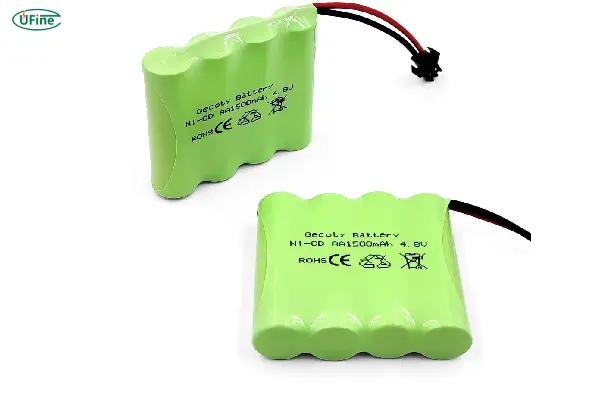
A 4.8V battery is typically a battery pack consisting of four individual 1.2V cells connected in series. This gives a total nominal voltage of 4.8 volts. These cells can be based on various chemistries, including:
- Nickel-Metal Hydride (NiMH)
- Nickel-Cadmium (NiCd)
- Custom lithium-ion packs (though less common due to standard lithium cell voltages)
The 4.8V voltage is considered ideal for a broad range of medium-power electronics. It strikes a balance between safety, efficiency, and portability.
It’s not just the voltage that defines a battery, but the chemistry, capacity, discharge rate, internal resistance, and application that matter just as much.
Part 2. Types of 4.8V batteries
A. NiMH (Nickel-Metal Hydride)
NiMH is the most common choice for modern 4.8V battery packs. Why?
- Higher energy density than NiCd
- Environmentally safer (no cadmium)
- No memory effect under normal usage
- Supports 300–500 full charge-discharge cycles
B. NiCd (Nickel-Cadmium)
Though older, NiCd still holds a place in specific use cases:
- Tolerates extreme temperatures well
- Offers a higher discharge rate, suitable for motors
- But comes with a memory effect and toxic waste concerns
C. Custom Lithium-Ion 4.8V Packs
Most lithium-ion batteries have nominal voltages of 3.7V per cell, so a 4.8V lithium pack is often custom-made using regulated BMS and parallel/series configurations. These are:
- Lightweight
- Space-saving
- Great for advanced electronics or wearable devices
NiMH Battery vs Li-Ion Battery vs NiCad Battery: How are they different?
D. Physical Formats
- Flat Pack: Ideal for thin devices
- Stick Pack: Used in RC toys and hand tools
- Cylindrical Pack: Preferred in retrofitting and DIY applications
When off-the-shelf options don’t fit, manufacturers like Ufine Battery can custom-engineer 4.8V batteries in varied shapes, sizes, and specifications, including high-rate, ultra-thin, or high-temperature models.
Looking for tailored solutions? Contact Ufine Battery for custom 4.8V lithium battery design.
Part 3. How is a 4.8V battery pack constructed?
A rechargeable 4.8V battery pack is more than just individual cells connected together. A complete battery pack usually includes several important components:
1 Battery Cells
The cells determine the battery’s:
- Voltage output
- Capacity (mAh)
- Energy density
- Cycle life
- Discharge performance
2 Protection Circuit Module (PCM) or Battery Management System (BMS)
For lithium-based battery packs, protection circuits are essential for safety.
They help prevent:
- Overcharging
- Over-discharging
- Short circuits
- Excessive current
- Abnormal temperatures
3 Connector and Wiring
The connector design affects compatibility with the final device.
Common options include:
- JST connectors
- Molex connectors
- Custom wiring solutions
4 Outer Packaging
Battery packs can be customized with:
- PVC wrapping
- Heat shrink film
- Protective housings
- Custom mechanical structures
For OEM projects, manufacturers can adjust battery dimensions, connectors, and internal structures to fit specific product requirements.
Part 4. Common uses of 4.8V batteries
You’ll find 4.8V batteries powering a wide range of devices, including:
- RC cars, helicopters, boats (thanks to high discharge needs)
- Cordless phones and walkie-talkies
- Electric toothbrushes and shavers
- Medical devices (low-power diagnostic or monitoring equipment)
- Solar-powered lighting systems
- Robotic kits and Arduino projects
The key to its popularity is the voltage—it’s just high enough to power motors and low enough to keep designs compact and safe.
Part 5. 4.8V battery vs. similar voltages
4.8V vs. 3.7V
- 3.7V is standard for single-cell Li-ion or LiPo
- 4.8V allows for more power output—useful when driving motors or LEDs
4.8V vs. 6V
- 6V systems are stronger but may damage circuits designed for 4.8V
- More battery cells = larger physical size
- 4.8V is more compact, safer for precision electronics
When choosing between voltages, always match device voltage requirements to avoid underperformance or permanent damage.
Part 6. Advantages and disadvantages of 4.8V batteries
Advantages:
- Balanced voltage ideal for moderate-power applications
- Available in rechargeable and disposable formats
- Wide compatibility with consumer electronics
- Customizable packs available
- Long cycle life for NiMH types
Disadvantages:
- NiCd packs are toxic and outdated
- Voltage drop under heavy load if capacity is too low
- Not ideal for high-voltage applications
- Charger compatibility must be ensured
Part 7. Key features to look for in a good 4.8V battery
When selecting a 4.8V battery, consider these critical specifications:
- Battery Chemistry: NiMH is preferred for reliability and safety. Lithium-based if weight and compactness are critical.
- Capacity (mAh): Choose based on application. High-drain devices need 1500mAh+, while sensors or lights may use 600–1000mAh.
- Discharge Rate (C-rating): Defines how quickly the battery can deliver current. For RC devices, a high C-rate (10C or more) is vital.
- Operating Temperature Range: Some applications (outdoors, industrial) demand resistance to temperature extremes.
- Cycle Life: A battery should support at least 300 cycles. Ufine Battery offers options with 500+ cycles for commercial use.
- Physical Size: The pack must fit your device. Check LxWxH and shape.
- Connector Compatibility: Ensure the connector matches your product (e.g., JST, Molex, Tamiya).
Part 8. How to calculate the runtime of a 4.8V battery pack
Battery capacity directly affects how long a device can operate before recharging.
A simple calculation method is:
Runtime (hours) = Battery Capacity (mAh) ÷ Device Current Consumption (mA)
For example:
A 4.8V 2000mAh battery powering a device that consumes 200mA:
2000mAh ÷ 200mA ≈ 10 hours
However, real-world performance may vary depending on:
- Discharge rate
- Battery age
- Operating temperature
- Device efficiency
Engineers should always leave a safety margin when selecting battery capacity to ensure reliable operation.
Part 9. How to charge a 4.8V battery safely
Charging a 4.8V battery safely protects both the battery and the user. Here’s how:
Use the Correct Charger
- NiMH chargers for NiMH batteries only
- NiCd chargers for NiCd only
- Never use a lithium charger on NiMH/NiCd
Observe Charging Voltage
- Standard charge voltage for 4.8V is 5.6V–6.0V
- Avoid overvoltage to prevent swelling or leakage
Monitor Charging Time
- Smart chargers stop automatically. Manual ones must be timed.
- Charging typically takes 2–6 hours depending on capacity
Prevent Overheating
- Don’t charge in enclosed or hot environments
- Always allow batteries to cool after use before charging
Storage After Charging
- Store in cool, dry places
- Partial charge (50%) is best for long-term storage
Ufine Battery also provides matching charging solutions with overcharge and thermal protection circuits.
Part 10. 4.8V battery charger selection
Choosing the correct charger is just as important as selecting the battery itself.
A charger must match:
- Battery chemistry
- Voltage requirements
- Charging current
- Protection requirements
For NiMH 4.8V Batteries
NiMH chargers typically use:
- Constant current charging
- Temperature monitoring
- Automatic charge termination
For Lithium-Based Battery Packs
Lithium batteries require:
- CC/CV charging method
- Dedicated protection circuit
- Correct charging voltage
Using an incorrect charger can reduce battery lifespan or create safety risks.
Always confirm the battery chemistry before selecting a charger.
Part 11. FAQs
Can I use a 5V battery instead of 4.8V?
No. Even a 0.2V difference can cause damage or overheating if the device isn’t rated for it.
How many times can I recharge a 4.8V battery?
NiMH typically lasts 300–500 cycles. Quality varies by brand.
Are 4.8V batteries safe for kids’ toys?
Yes, especially NiMH versions. Just make sure the casing is sealed and durable.
Why does my 4.8V battery lose charge quickly?
It could be aging, overheating during charge, or a poor-quality pack. Time to replace.
Can Ufine Battery customize 4.8V packs for my project?
Yes. Ufine offers full custom services including shape, voltage, connectors, and BMS.
Related Tags:

More Articles

Comparative Analysis: 14500 Battery Vs. 18650 Battery
Compare 14500 vs 18650 batteries by size, voltage, capacity, runtime, discharge current, charging, safety, and applications to choose the right cell.
12V Lithium-Ion What Voltage at Fully Charged and Why Your Battery Might Not Reach It
Check the 12V lithium battery voltage chart for 3S Li-ion and 4S LiFePO4. Learn full charge, resting voltage, charger limits, and fault checks.
LiFePO4 Voltage Chart Guide: Everything You Need to Know
Check the LiFePO4 voltage chart for 3.2V, 12V, 24V and 51.2V batteries. Compare SOC, charging voltage, cutoff limits and internal resistance.
Lithium Ion Cell Sizes: A Comprehensive Guide
Compare lithium ion cell sizes with a chart of dimensions, capacity ranges, cell types, applications, and key factors for selecting the right battery.
6 Volt Tractor Battery vs 12 Volt: Which One Fits Your Farm Equipment Best?
Compare 6V and 12V tractor batteries. Learn which voltage fits vintage or modern tractors, which specifications matter, and how to convert safely.