- Key Takeaways
- Part 1. What is a 12V 100Ah lithium battery?
- Part 2. How does a 100 amp hour lithium battery work?
- Part 3. Key advantages of a 12V 100Ah lithium battery
- Part 4. 100 amp hour lithium battery vs lead-acid
- Part 5. Typical applications of 12V 100Ah lithium batteries
- Part 6. Series and parallel connections: engineering guidelines
- Part 7. Performance in extreme temperature conditions
- Part 8. Safety and reliability of 100 amp hour lithium batteries
- Part 9. Cost efficiency and total cost of ownership (TCO)
- Part 10. How to choose the right 12V 100Ah lithium battery
- Part 11. Common misconceptions about 100 amp hour lithium batteries
- Part 12. FAQs about 12V 100Ah lithium batteries
12V 100Ah lithium batteries have become one of the most widely adopted energy storage solutions for RVs, marine systems, solar installations, and off-grid power setups. Compared with traditional lead-acid batteries, a 100 amp hour lithium battery delivers higher usable capacity, longer service life, and significantly better efficiency—making it the preferred choice for both engineers and system integrators.
Key Takeaways
- A 12V 100Ah lithium battery provides ~1.28 kWh of usable energy with up to 90% depth of discharge.
- Compared to lead-acid, lithium batteries offer 3–5× longer cycle life and 40–60% weight reduction.
- Integrated BMS improves safety by protecting against overcharge, over-discharge, short circuit, and overheating.
- 100 amp hour lithium batteries are ideal for RV, marine, solar storage, and backup power applications.
- Although upfront cost is higher, total cost of ownership is significantly lower over 8–10 years.
Part 1. What is a 12V 100Ah lithium battery?
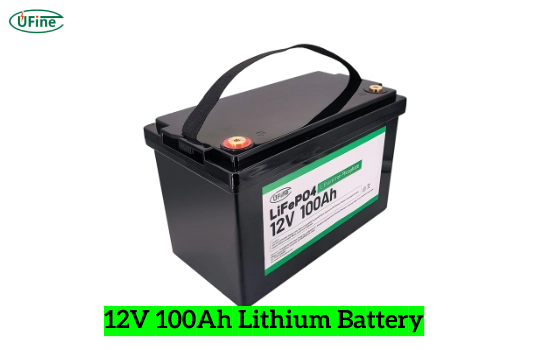
A 12V 100Ah lithium battery is a rechargeable battery system with a nominal voltage of 12.8V (LiFePO₄ chemistry) and a rated capacity of 100 amp hours. In practical terms, it can deliver:
- 100A for 1 hour
- 50A for 2 hours
- 10A for 10 hours
Most modern 12V 100Ah lithium batteries use lithium iron phosphate (LiFePO₄), which offers improved thermal stability, longer cycle life, and enhanced safety compared to older lithium-ion chemistries.
Core specifications (typical)
- Nominal Voltage: 12.8V
- Capacity: 100Ah
- Energy: ~1280Wh
- Cycle Life: 3,000–5,000 cycles @ 80% DoD
- Weight: 11–14 kg (vs. 25–30 kg lead-acid)
Part 2. How does a 100 amp hour lithium battery work?
A 100 amp hour lithium battery stores and releases energy through the controlled movement of lithium ions between the anode and cathode.
- Charging: Lithium ions move from the cathode to the graphite anode through the electrolyte.
- Discharging: Ions return to the cathode, generating a stable electrical current.
This electrochemical process is highly efficient, typically achieving 95–98% charge/discharge efficiency, which is significantly higher than lead-acid batteries (70–85%).
The role of the battery management system (BMS)
Every high-quality 12V 100Ah lithium battery includes a built-in BMS that:
- Monitors cell voltage and temperature
- Prevents overcharge and over-discharge
- Protects against short circuits and excessive current
- Balances cells to extend service life
For technical safety references, see IEC 62619 and UL 1973 battery safety standards.
IEC Lithium Battery Safety Standards
Part 3. Key advantages of a 12V 100Ah lithium battery
Higher usable capacity
Unlike lead-acid batteries limited to ~50% depth of discharge, a lithium battery can safely deliver up to 90% of its rated capacity. This means more usable energy without oversizing the system.
Long service life
A quality 100 amp hour lithium battery typically lasts 8–10 years or more, with 3,000–5,000 cycles, compared to 300–500 cycles for lead-acid alternatives.
Lightweight & compact design
Lithium batteries weigh up to 60% less, reducing installation complexity and improving overall system efficiency—especially critical for RVs and marine vessels.
Fast charging
Lithium batteries accept higher charge currents and can reach full capacity in 2–4 hours, making them ideal for solar and generator-supported systems.
Minimal maintenance
No watering, no equalization, and no sulfation issues—lithium batteries are effectively maintenance-free.
Part 4. 100 amp hour lithium battery vs lead-acid
| Feature | 100Ah Lithium Battery | Lead-Acid Battery |
|---|---|---|
| Usable Capacity | 90% | 50% |
| Cycle Life | 3,000–5,000 | 300–500 |
| Weight | ~12 kg | ~28 kg |
| Maintenance | None | Regular |
Part 5. Typical applications of 12V 100Ah lithium batteries
The balanced voltage, capacity, and form factor of a 12V 100Ah lithium battery make it suitable for a wide range of mobile and stationary power systems.
RV and camper power systems
In RV applications, a 100 amp hour lithium battery is commonly used to power:
- Lighting systems
- Refrigerators and water pumps
- Inverters (500W–2000W)
- Charging ports and control electronics
Compared with AGM or flooded batteries, lithium reduces weight while delivering longer off-grid runtime.
Marine and boat electrical systems
Marine environments benefit significantly from lithium batteries due to their vibration resistance and stable voltage output. Typical use cases include:
- Navigation and communication equipment
- Fish finders and onboard electronics
- House battery banks (non-engine starting)
Solar energy storage systems
In off-grid or hybrid solar systems, 12V 100Ah lithium batteries are widely used as modular energy storage units. They offer:
- High charge acceptance from MPPT controllers
- Excellent partial state-of-charge performance
- High round-trip efficiency
Backup power and UPS applications
For backup power systems, lithium batteries provide reliable energy during outages without the maintenance and degradation issues associated with lead-acid batteries.
Part 6. Series and parallel connections: engineering guidelines
12V 100Ah lithium batteries can be configured in series or parallel to meet specific system voltage and capacity requirements.
Series connection (increase voltage)
Connecting batteries in series increases system voltage while keeping capacity constant.
- 2 × 12V 100Ah in series → 24V 100Ah
- 4 × 12V 100Ah in series → 48V 100Ah
Engineering Notes:
- Use identical battery models and production batches
- Ensure BMS supports series configuration
- Verify inverter and charge controller voltage limits
Parallel connection (increase capacity)
Parallel connections increase total capacity while maintaining voltage.
- 2 × 12V 100Ah in parallel → 12V 200Ah
Engineering Notes:
- Use equal-length cables to balance current
- Install proper fusing for each battery string
- Avoid mixing batteries with different aging levels
Part 7. Performance in extreme temperature conditions
A major advantage of lithium batteries is their ability to operate across a wide temperature range.
- Discharge Temperature: -20°C to 60°C
- Charge Temperature: 0°C to 45°C (without heating)
In cold climates, lithium batteries maintain usable capacity better than lead-acid batteries, which can lose up to 40% capacity at freezing temperatures.
Important: Charging below 0°C should be avoided unless the battery includes low-temperature protection or self-heating functionality.
Battery University – Lithium Battery Temperature Guidelines
Part 8. Safety and reliability of 100 amp hour lithium batteries
Modern lithium batteries are designed with multiple layers of safety:
- Integrated BMS for real-time monitoring
- Over-current and short-circuit protection
- Thermal cutoff and cell balancing
LiFePO₄ chemistry further improves safety by offering higher thermal stability compared to traditional lithium-ion cells.
Part 9. Cost efficiency and total cost of ownership (TCO)
Although a 100 amp hour lithium battery typically costs more upfront than lead-acid alternatives, its long-term cost is significantly lower.
- 3–5× longer service life
- No maintenance or replacement fluids
- Lower energy losses during charge/discharge
Over an 8–10 year operating period, lithium batteries often reduce total ownership costs by 30–50%.
Part 10. How to choose the right 12V 100Ah lithium battery
Selecting the right 12V 100Ah lithium battery is not just about capacity—it requires evaluating system compatibility, operating conditions, and long-term reliability.
Key selection criteria
- Chemistry: Prefer LiFePO₄ for stationary, RV, and marine applications due to superior safety and lifespan.
- BMS Rating: Ensure the BMS continuous discharge current matches your inverter or load demand.
- Cycle Life: Look for ≥3,000 cycles at 80% DoD for long-term value.
- Operating Temperature: Verify low-temperature protection or self-heating if used in cold climates.
- Certifications: UL, IEC, UN38.3, and CE improve compliance and deployment safety.
For custom voltage, size, or high-rate requirements, consider custom lithium battery solutions tailored to your application.
Part 11. Common misconceptions about 100 amp hour lithium batteries
Myth 1: Lithium batteries are unsafe
Modern LiFePO₄ batteries with integrated BMS are among the safest rechargeable batteries available today.
Myth 2: A 100Ah lithium battery equals a 100Ah lead-acid battery
Due to deeper discharge capability, a 100 amp hour lithium battery delivers nearly double the usable energy of a 100Ah lead-acid battery.
Myth 3: Lithium batteries require special maintenance
Lithium batteries are maintenance-free under normal operating conditions.
Part 12. FAQs about 12V 100Ah lithium batteries
What is the typical lifespan of a 12V 100Ah lithium battery?
Most quality lithium batteries last 8–10 years or 3,000–5,000 cycles depending on depth of discharge and operating conditions.
Can I replace a lead-acid battery directly with lithium?
In most cases yes, but the charging profile, inverter compatibility, and system voltage limits should be verified before replacement.
Can I charge a 100 amp hour lithium battery with solar panels?
Yes. Lithium batteries are highly compatible with MPPT solar charge controllers and support high charge acceptance.
Is a 12V 100Ah lithium battery suitable for engine starting?
Most are designed for deep-cycle use. Engine starting requires batteries specifically rated for high cold cranking current.
How many batteries do I need for my system?
This depends on system voltage, daily energy consumption, and desired autonomy. A typical RV system uses 1–4 units.
Related Battery Guides
Related Tags:

More Articles

Best 24V Lithium Battery: Top 10 Compared
Discover the top 24V lithium batteries. We compare capacity, price, cycle life, safety features, and the best options for different applications.
Top LFP Cell Manufacturers in China You Should Know
Looking for reliable LiFePO4 cells? Explore China's top LFP battery manufacturers, key technologies, production capabilities, and supplier selection tips.
Check If Your Charger Works: Simple Test Guide
Think your battery charger's broken? Quick tests can show you for sure. See if it’s the charger or the battery that's causing issues. Read more.
Best Camera Batteries: 7 Brands Compared & Tested
Looking for the best camera battery? Compare 7 top brands, including OEM and third-party options, to find the right battery for your camera.
What You Need to Know About Portable Fan Batteries
Discover the best portable electric fan battery, its types, lifespan, and maintenance tips. Learn how to choose the right one and keep it running longer.