- Part 1. AI devices are changing how electronics consume power
- Part 2. Real products reveal the battery challenges of AI hardware
- Part 3. Why AI hardware requires new battery approaches
- Part 4. The growing battery demands of AI smartphones and AI PCs
- Part 5. Why lithium polymer batteries are important for future AI devices
- Part 6. The future of AI hardware depends on power innovation
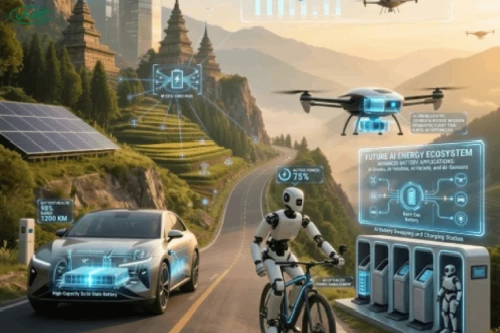
Artificial intelligence is no longer limited to cloud servers and data centers. In 2026, AI is moving into everyday hardware — from smart glasses and AI PCs to smartphones and intelligent robots.
Gartner forecasts that AI PCs will reach approximately 143 million units in 2026, representing more than half of global PC shipments. Meanwhile, AI glasses are entering a new growth phase, with global shipments reaching 4.2 million units in the first half of 2026, driven largely by products such as Meta’s AI-powered Ray-Ban glasses.
But this rapid adoption creates a fundamental hardware challenge: AI devices require more processing power, more sensors, and more continuous connectivity — while consumers still expect smaller, lighter, and longer-lasting products.
The next challenge for AI hardware may not only be building smarter algorithms. It may be creating batteries capable of powering them.
Part 1. AI devices are changing how electronics consume power
From Passive Electronics to Always-Aware Devices
Traditional consumer electronics were designed around predictable usage patterns.
A conventional smartwatch, for example, mainly tracks time, notifications, and basic health data. A pair of wireless earbuds primarily processes audio playback.
AI devices work differently.
They are designed to understand users and their surroundings continuously.
An AI wearable may need to:
- recognize objects through cameras
- respond to voice commands
- analyze environmental information
- provide real-time recommendations
Each function requires additional hardware components, including:
- cameras
- microphones
- AI processors
- wireless communication modules
- advanced sensors
The result is a significant increase in power consumption.
A device that previously spent most of its time in standby mode may now need to remain active throughout the day.
This creates a difficult engineering balance:
More intelligence requires more computing power, but consumers still expect smaller and lighter devices.
Part 2. Real products reveal the battery challenges of AI hardware
Ray-Ban Meta Shows the Challenge of Combining AI and Wearable Design
One of the clearest examples of this challenge is the rise of AI glasses.
The Ray-Ban Meta smart glasses demonstrate how traditional products are evolving into intelligent devices.
Unlike ordinary glasses, these AI-powered glasses combine:
- cameras for capturing images and videos
- microphones for voice interaction
- speakers for audio responses
- wireless connectivity
- AI assistant functions
Users can ask questions, receive information, translate languages, capture moments, and interact with digital services through voice and vision features.
The challenge is that consumers still expect these glasses to look and feel like normal eyewear.
Manufacturers cannot simply install a much larger battery because:
- the frame would become heavier
- wearing comfort would decrease
- the product design would change
This creates a fundamental limitation:
AI glasses require smartphone-level intelligence but must maintain the size and weight of ordinary glasses.
Battery design therefore becomes a critical part of product development.
Apple Vision Pro Demonstrates the Trade-Off Between Computing Power and Portability
The launch of Apple Vision Pro also highlights the difficulty of powering advanced wearable computing.
The device combines:
- high-resolution displays
- multiple cameras
- spatial sensors
- Apple silicon processing
- real-time environmental tracking
These features enable advanced mixed-reality experiences, but they also require substantial energy.
Instead of placing a large battery inside the headset, Apple uses an external battery pack connected through a cable.
This design choice helps reduce weight on the user’s head, but it also reveals a broader industry challenge:
High-performance wearable devices still struggle to combine:
- powerful computing
- long operating time
- compact physical design
As AI capabilities become more advanced, this balance will become even more difficult.
Part 3. Why AI hardware requires new battery approaches
Energy Density Is Becoming the Core Limitation
Battery performance is often measured by capacity, but capacity alone does not solve the problem.
The basic relationship is:
Operating Time = Battery Energy ÷ Device Power Consumption
AI hardware creates pressure on both sides of this equation.
On one side:
Device power consumption increases because of:
- AI processors
- sensors
- cameras
- connectivity features
On the other side:
Physical space for batteries remains limited because consumers demand:
- thinner designs
- lighter products
- smaller form factors
Simply adding a larger battery is often impossible.
The solution requires improvements in energy density — storing more energy within the same physical space.
For AI hardware manufacturers, the goal is not just a bigger battery.
It is a battery that provides more power without increasing:
- weight
- thickness
- device size
Weight Has Become a Critical Design Constraint
For many AI devices, battery weight is no longer only a technical specification. It directly affects the user experience.
This is especially important for wearable products.
Consumers expect AI glasses, smart rings, and health devices to be:
- comfortable for long periods
- lightweight enough for daily use
- visually similar to traditional products
However, AI functions require more internal components.
A modern AI wearable may need:
- processors for AI inference
- cameras for visual recognition
- sensors for environmental awareness
- wireless modules for communication
Each additional component increases power demand, but the physical size of the product cannot grow indefinitely.
This creates a difficult engineering trade-off:
More features require more energy, but better user experiences require less weight.
Battery technology has therefore become closely connected with industrial design.
In the future, successful AI hardware companies will not only compete on software capabilities. They will also compete on how efficiently they can integrate power solutions into compact devices.
Addressing these challenges requires collaboration between device developers and battery specialists. A reliable lithium battery manufacturer can support AI hardware companies by developing customized battery solutions that balance energy density, size constraints, safety requirements, and long-term performance.
Battery Shape Is Becoming as Important as Battery Capacity
For decades, battery selection was often one of the final steps in consumer electronics development.
Manufacturers designed the product first and then selected a battery that could fit inside.
AI hardware is changing this approach.
Because many AI devices have unique designs, battery shape and size are becoming part of the original product strategy.
Examples include:
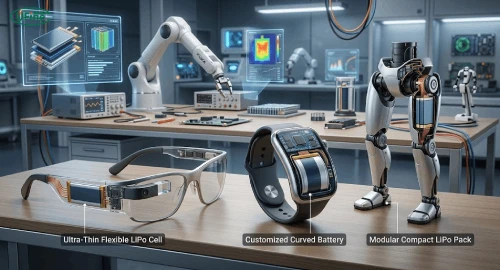
- curved batteries for smart glasses
- ultra-thin batteries for wearable devices
- customized batteries for compact robotics
- flexible battery solutions for next-generation electronics
This is especially important because AI devices are expanding into categories where traditional battery formats are difficult to apply.
A smart ring, for example, has extremely limited internal space but still needs to support:
- health monitoring sensors
- wireless communication
- continuous data processing
Similarly, AI glasses require batteries that can fit into small frames while maintaining enough runtime for everyday use.
As AI hardware becomes more specialized, customized battery designs may become increasingly common.
Part 4. The growing battery demands of AI smartphones and AI PCs
AI Smartphones Are Creating New Power Challenges
Smartphones are one of the largest platforms where AI features are becoming mainstream.
Companies including Samsung Electronics, Google, and Apple are integrating AI features into mobile devices.
Modern AI smartphones can perform functions such as:
- real-time language translation
- AI-powered photo editing
- voice assistance
- image generation
- intelligent search features
Many of these functions rely on on-device AI processing, which improves response speed and privacy but also increases energy consumption.
Unlike laptops, smartphones have very limited space for additional cooling systems or larger batteries.
Manufacturers must balance:
- AI performance
- battery life
- device thickness
- charging speed
A smartphone with powerful AI features but poor battery endurance would create a frustrating user experience.
This means battery efficiency will become an important competitive factor in the AI smartphone market.
AI PCs Face Similar Power Management Challenges
The AI PC market is another example of how artificial intelligence is changing hardware requirements.
Unlike traditional computers, AI PCs include dedicated AI processing units, such as neural processing units (NPUs), designed to handle AI workloads more efficiently.
These processors support features including:
- AI-assisted productivity tools
- real-time communication enhancement
- content creation applications
- intelligent system management
However, AI workloads introduce new power management challenges.
Laptop manufacturers must ensure that AI capabilities do not significantly reduce battery endurance.
The future of AI PCs depends not only on faster processors but also on more efficient energy management across the entire system.
Part 5. Why lithium polymer batteries are important for future AI devices
Flexible Designs for Compact AI Hardware
As AI devices become smaller and more specialized, battery flexibility becomes increasingly valuable.
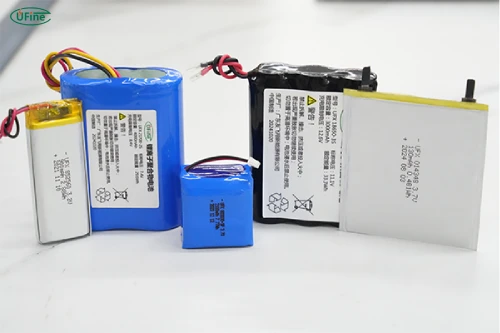
Lithium polymer (LiPo) batteries are widely used in applications where manufacturers need customized shapes and lightweight designs.
Compared with traditional rigid battery formats, LiPo batteries can provide advantages such as:
- customizable dimensions
- thinner profiles
- lightweight construction
- flexible product integration
These characteristics make them suitable for products including:
- wearable electronics
- smart devices
- portable medical equipment
- intelligent hardware systems
For AI device developers, the ability to customize battery dimensions can help overcome space limitations during product design.
High-Rate Performance for Intelligent Machines and Robotics
AI is not limited to consumer electronics.
The technology is also expanding into robotics, drones, and intelligent machines.
These applications create additional battery requirements.
Robotic systems may require batteries that can support:
- motors
- cameras
- sensors
- communication systems
- real-time processing
Unlike simple electronic devices, robots often experience sudden increases in power demand during movement or operation.
Therefore, battery characteristics such as:
- discharge capability
- voltage stability
- internal resistance
- thermal performance
become essential.
For intelligent machines, the battery is not just an energy source. It is a performance component that directly affects operation reliability.
Part 6. The future of AI hardware depends on power innovation
The AI revolution is often discussed as a competition between software companies, chip manufacturers, and cloud providers.
However, the future of AI hardware will also depend on another critical factor: energy.
The next generation of AI devices must solve a difficult challenge:
How can manufacturers create products that are:
- smarter
- smaller
- lighter
- more powerful
- longer-lasting
The answer will require improvements across multiple areas, including:
- processor efficiency
- software optimization
- thermal management
- battery technology
Battery innovation will become especially important as AI moves closer to everyday life.
A powerful AI device that requires frequent charging or compromises user comfort may struggle to achieve mass adoption.
The winners of the AI hardware era will not only be companies that develop smarter algorithms. They will also be companies that successfully solve the power challenges behind those algorithms.
As AI continues moving from the cloud into personal devices, battery technology will become one of the foundations supporting the next generation of intelligent electronics.
Smarter devices will ultimately require smarter energy solutions.
Related Tags:

More Articles

How to Test Battery Overcurrent Protection in an Electronic Device
Want to verify battery safety? Learn how engineers test overcurrent protection, measure response time, and optimize LiPo battery performance.
How to Measure Standby Power Consumption in Battery-Powered Devices
Learn how to measure standby power, detect hidden current drain, and calculate battery life with practical testing methods for battery-powered devices.
How to Audit a Battery Manufacturer Before You Buy
Not sure if a battery supplier is reliable? Learn what to inspect, which records to request, and how to spot risks before placing an order.
How to Route Battery Wires in a Compact Electronic Enclosure
Routing battery wires in tight spaces? Learn how to prevent pinched cables, voltage drop, insulation damage, and costly electronic failures.
How to Match Battery Discharge Current to Motor Startup Demand
Does your motor struggle to start? Learn how to calculate startup current, prevent voltage drop, and choose a battery that delivers reliable power.