
- Part 1. Understanding charging li-ion cells
- Part 2. Why lithium-ion batteries don’t discharge evenly
- Part 3. Problems during charging and discharging
- Part 4. Depth of discharge and why it controls your battery lifespan
- Part 5. Temperature: the hidden factor behind battery performance
- Part 6. Internal resistance: why old batteries feel weaker
- Part 7. How BMS controls your entire charging experience
- Part 8. How long does it take to charge li-ion cells?
- Part 9. Is it best to charge li-ion cells to 100%?
- Part 10. How to charge new li-ion cells?
- Part 11. Charging and discharging best practices you should actually follow
- Part 12. FAQs
Key takeaways
- Lithium-ion battery charging and discharging is not linear — voltage, current, and capacity behave in very different ways in real use.
- Most battery issues (fast drain, incomplete charging, overheating) come from misunderstanding the CC/CV charging behavior and discharge curve, not battery failure.
- Temperature, depth of discharge (DoD), and internal resistance are the real factors that determine battery lifespan.
- The Battery Management System (BMS) quietly controls almost everything you experience as a user — from charging cutoff to safety protection.
- If you understand how lithium-ion batteries actually behave under load, you can significantly extend cycle life and improve performance.
Part 1. Understanding charging li-ion cells
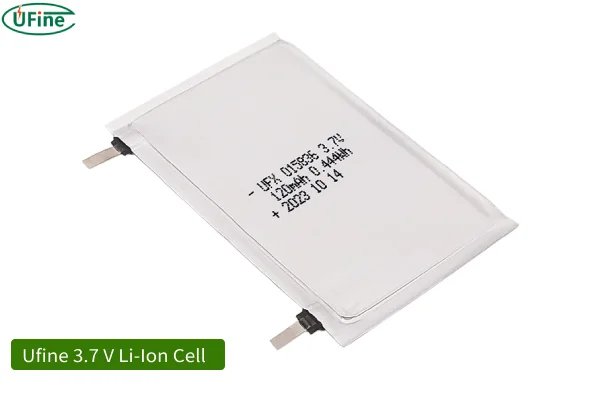
1 Li-Ion Cell Charging Principle
Charging a li-ion cell involves a delicate electrochemical process. When you connect a charger to a li-ion cell, it initiates a flow of electric current. This current drives lithium ions to migrate from the cathode (the positive electrode) to the anode (the negative electrode). As the ions move, they store energy within the cell. This process must be carefully controlled to avoid overcharging, which can lead to overheating, reduced battery life, or even dangerous situations like fires.
2 Li-Ion Cell Charging Current
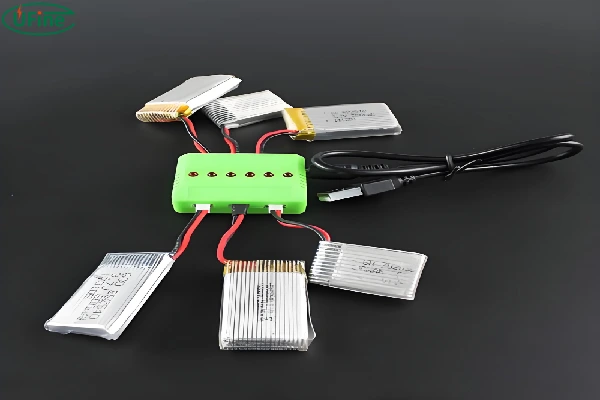
The charging current refers to the amount of electrical current supplied to the li-ion cell during charging. It’s measured in amperes (A). Typically, li-ion cells are charged at a rate between 0.5C and 1C, where “C” represents the battery’s capacity in ampere-hours (Ah). For example, a 2000mAh battery charged at 1C would use a 2A current. Charging li-ion cells at too high a current can cause the battery to overheat, while charging at a current that is too low can result in inefficient charging.
3 Li-Ion Cell Charging Voltage
Charging voltage is the electrical potential difference applied to the cell during charging li-ion cell. For most li-ion cells, the standard maximum charging voltage is 4.2 volts per cell. As charging progresses, the voltage gradually increases until it reaches this maximum limit. At this point, charging should stop to prevent overcharging, which can severely damage the battery and pose safety risks.
Lithium-ion battery charging usually follows a CC/CV process (Constant Current / Constant Voltage).
Lithium-ion charging = CC stage + CV stageLithium-ion charging = CC stage + CV stage
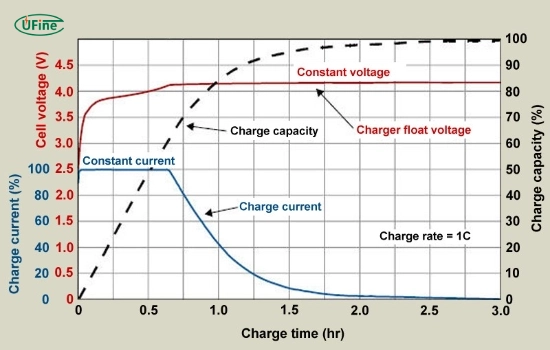
But instead of thinking of it as a formula, it helps to see it as a two-phase real-world experience:
1 Fast charging phase (CC stage)
At the beginning, the charger pushes a constant current into the battery.
This is why your phone or device charges quickly from 0% to around 70–80%.
However, during this stage:
- Voltage gradually increases
- Heat may start to build up
- Battery accepts energy efficiently
2 Tapering phase (CV stage)
Once the battery reaches its upper voltage limit (usually ~4.2V per cell), things slow down.
Now the charger holds voltage steady, while current slowly decreases.
This is why:
- The last 20% takes much longer
- Charging feels “slow” near full capacity
This is not inefficiency — it’s protection. Without this stage, lithium plating could damage the cell.
Part 2. Why lithium-ion batteries don’t discharge evenly
If charging is controlled, discharging feels more “chaotic” to users.
A lithium-ion battery does not discharge in a straight line. Instead, it follows a curve with three behavior zones:
Voltage drop is nonlinear during dischargeVoltage drop is nonlinear during discharge
Typical discharge behavior:
| Stage | Battery behavior | What you experience |
|---|---|---|
| 100% → 80% | Slow voltage drop | Feels stable |
| 80% → 30% | Plateau region | Normal usage |
| 30% → 0% | Rapid drop | Sudden shutdown risk |
That sudden drop at the end is one of the most misunderstood behaviors in lithium-ion batteries.
It’s not that the battery is “bad” — it’s because voltage under load falls below the cutoff threshold faster than expected.
Part 3. Problems during charging and discharging
In practice, most users don’t think about electrochemistry — they just notice problems like:
Common issues you might see:
- Battery stops charging at 4.1V instead of 4.2V
- Device shuts down at 20% battery
- Battery gets warm during fast charging
- Charging stops before reaching 100%
So what’s actually happening?
Most of the time, it’s one of these:
- BMS protection limits preventing overcharge
- Internal resistance increase in aging cells
- Temperature protection triggering early cutoff
- Voltage sag under load during discharge
👉 In other words, the battery is not “broken” — it is protecting itself.
Part 4. Depth of discharge and why it controls your battery lifespan
One of the most important but ignored factors is Depth of Discharge (DoD).
For a more detailed breakdown, this guide on battery DoD shows how discharge depth directly impacts cycle life.
Simply put:
The more deeply you discharge your battery every cycle, the shorter its lifespan becomes.
Here’s a simplified comparison:
| Usage pattern | Typical DoD | Cycle life impact |
|---|---|---|
| Light use | 30–50% | Very long lifespan |
| Medium use | 50–80% | Balanced performance |
| Full discharge | 100% | Faster degradation |
So if you constantly drain your battery to 0%, you are effectively shortening its lifespan significantly.
That’s why many EVs and high-end systems never use 100% of total capacity.
Part 5. Temperature: the hidden factor behind battery performance
Temperature is one of the most critical — and most ignored — aspects of lithium-ion battery behavior.
At different temperatures, the battery behaves completely differently:
| Condition | Charging behavior | Risk level |
|---|---|---|
| Cold (<0°C) | Slow / blocked charging | Lithium plating risk |
| Normal (20–35°C) | Stable performance | Safe |
| High (>45°C) | Fast degradation | Thermal stress |
This is why advanced systems will refuse to charge in extreme cold or will reduce charging speed when the battery gets too hot.
If you want to go deeper, this article on extreme temperature charging explains what really happens to lithium batteries in hot and cold conditions.
Part 6. Internal resistance: why old batteries feel weaker
Even if a battery still shows “100% charge,” it may not perform like a new one.
That’s because internal resistance increases over time.
As resistance grows:
- Voltage drops faster under load
- Heat generation increases
- Effective capacity decreases
This is why an old battery can feel “weak” even when fully charged — it’s not the capacity meter that lies, it’s the voltage behavior under load.
Part 7. How BMS controls your entire charging experience
Most users never see it, but the Battery Management System (BMS) is constantly working in the background.
It controls:
- Maximum charging voltage
- Discharge cut-off voltage
- Cell balancing in multi-cell packs
- Temperature safety limits
Without BMS, lithium-ion batteries would be unsafe in real-world applications. To better understand how protection systems work, you can check this guide on battery management system, which explains how it monitors voltage, temperature, and safety.
Part 8. How long does it take to charge li-ion cells?
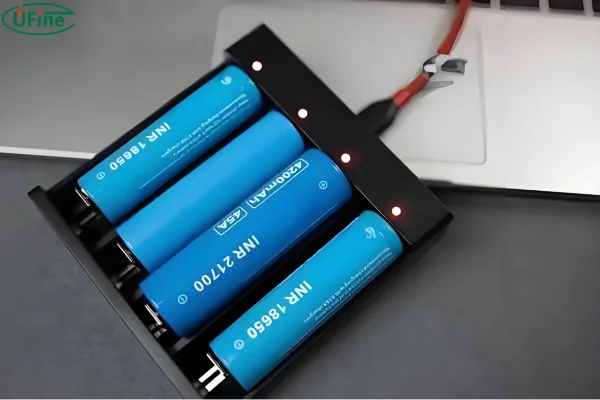
Charging times for Li-ion cells can vary based on several factors, including the battery’s capacity, the charger’s output, and the specific chemistry of the Li-ion cells. Generally, it takes between 1 to 4 hours to fully charge a Li-ion battery.
- Standard Charging: Using a standard charger that supplies a typical current (usually around 0.5C to 1C, where C is the battery’s capacity), it takes approximately 2 to 3 hours to charge a Li-ion cell from 0% to 100%.
- Fast Charging: Some modern chargers can supply higher currents (above 1C), reducing charging time to as little as 1 hour. However, this may lead to increased heat and potential wear on the battery over time.
- Slow Charging: Charging at a lower current (below 0.5C) can extend the time to 4 hours or more but is gentler on the battery and may prolong its lifespan.
Part 9. Is it best to charge li-ion cells to 100%?
Charging Li-ion cells to 100% is generally fine for most users, but it’s not always necessary and can impact the battery’s long-term health. Here are some considerations:
- Battery Lifespan: Charging to 100% and then discharging to 0% (full cycle) can reduce the battery’s lifespan. Keeping the charge between 20% and 80% can prolong the battery’s life by reducing stress on the cells.
- Usage Requirements: If you need maximum battery life for a specific task or day, charging to 100% is practical. However, for daily use where top-end capacity is less critical, partial charging cycles can be beneficial.
- Heat Management: Charging to 100% generates more heat, which can degrade the battery over time. Using a charger that slows down the charging rate as it approaches full capacity helps manage this.
Part 10. How to charge new li-ion cells?
Charging new Li-ion cells properly is crucial for optimizing their performance and longevity. Here are some steps to follow:
- Initial Charge: New Li-ion batteries typically come partially charged (around 40-60%). It’s recommended to fully charge them to 100% before the first use to ensure cell balancing and full capacity utilization.
- Use a Quality Charger: Always use the charger provided by the manufacturer or a reputable third-party charger designed for your specific Li-ion battery type. Avoid cheap, generic chargers as they may not have the proper safety features.
- Slow and Steady: For the initial charge, it’s often best to use a slower charging rate (0.5C or less). This gentle charge helps to balance the cells and reduce initial stress.
- Avoid Overcharging: Modern Li-ion chargers are equipped with overcharge protection. However, it’s still good practice to remove the battery from the charger once it’s fully charged to prevent unnecessary stress and heat buildup.
- Monitor Temperature: Ensure that the charging environment is not too hot or cold. The ideal temperature range for charging Li-ion batteries is between 10°C and 30°C (50°F and 86°F).
- Partial Charging Cycles: For regular use, adopting a partial charging cycle (e.g., charging to 80% and discharging to 20%) can help extend the battery’s lifespan.
Understanding the principles and best practices for charging and discharging li-ion cells is essential for maximizing their lifespan and ensuring safety. By following the guidelines and tips provided in this article; you can effectively manage your li-ion batteries and keep your devices running smoothly.
Part 11. Charging and discharging best practices you should actually follow
If you want to extend battery life in real use, you don’t need complex engineering knowledge. You just need to follow a few practical rules:
- Avoid full 0% discharge whenever possible
- Don’t keep the battery at 100% for long periods
- Use moderate charging speed instead of always fast charging
- Avoid charging in extreme temperature conditions
These small habits can significantly improve cycle life and stability over time.
Part 12. FAQs
1. Can I leave a lithium-ion battery charging overnight?
Yes, in most cases you can. Modern batteries have a built-in BMS that stops charging when full. However, keeping a battery at 100% for long periods can slightly accelerate aging over time.
2. Why does my battery percentage jump or drop suddenly?
This usually happens due to voltage fluctuation under load or inaccurate calibration. As batteries age, internal resistance increases, making percentage estimation less stable.
3. Do lithium-ion batteries need to be fully discharged before charging?
No. Unlike older battery types, lithium-ion batteries do not require full discharge. In fact, frequent deep discharge can shorten their lifespan.
4. Why does my battery charge faster when it’s low?
At lower charge levels, the battery can accept higher current (CC stage). As it fills up, charging slows down intentionally to prevent damage (CV stage).
5. Does fast charging always damage lithium batteries?
Not always, but frequent high-speed charging can increase heat and stress on the battery. Occasional fast charging is fine, but constant use may reduce long-term cycle life.
6. Why won’t my lithium battery charge in cold weather?
At low temperatures, chemical reactions slow down, and charging can become unsafe due to lithium plating. Many systems block charging automatically to prevent damage.
Related Tags:

More Articles

The Ultimate Guide to Battery Terminal Adapters
Compare battery terminal adapters for top post, side post, stud, marine, and U1 batteries. Learn how to choose, install, and maintain them safely.
What Can a 12V 50Ah Lithium Battery Power? Real-World Applications Explained
Learn what a 12V 50Ah lithium battery can power, realistic runtimes, inverter limits, charging methods, and uses for RVs, camping, solar, and backup.
18500 Battery Fundamentals: Specifications, Performance, and Applications
Learn 18500 battery size, voltage, capacity, charging, runtime, applications, safety, and differences from 18650, 18350, AA, and LiPo cells.
Smart Watch Battery: Everything You Need to Know
Learn how smart watch batteries work, how long they last, what battery types are used, and how to choose the right battery for longer performance.
Is a 3000 mAh Lithium Battery Enough for Your Device?
Wondering what a 3000mAh battery means? Learn about its power, lifespan, types, and how to choose the best one for your device!


