- Key takeaways
- Part 1. What is a lithium manganese oxide battery?
- Part 2. How does a lithium manganese battery work?
- Part 3. Advantages of lithium manganese batteries
- Part 4. Disadvantages of lithium manganese batteries
- Part 5. Common applications of lithium manganese oxide batteries
- Part 6. Lithium manganese battery vs other battery chemistries
- Part 7. How to choose the right lithium manganese battery?
- Part 8. Future of lithium manganese oxide battery technology
- Part 9. FAQs about lithium manganese batteries
A lithium manganese oxide battery (LMO battery) is a lithium-ion battery that uses manganese oxide as its cathode material. It is valued for high safety, strong power output, and good thermal stability. LMO batteries are commonly used in electric vehicles, power tools, medical equipment, and industrial systems. This guide covers how lithium manganese batteries work, their advantages, limitations, applications, and comparisons with other lithium-ion battery chemistries.
Key takeaways
- Lithium manganese oxide battery (LMO battery) uses lithium manganese oxide as the cathode material.
- LMO batteries provide high power output and strong thermal stability.
- They are safer than many traditional lithium-ion chemistries.
- Lithium manganese batteries are commonly used in EVs, medical devices, power tools, and industrial equipment.
- Their main limitation is lower energy density compared with NMC and NCA batteries.
- Manganese is abundant and less expensive than cobalt, improving sustainability and cost efficiency.
- Many modern EV battery packs combine LMO with NMC chemistry to balance energy density, safety, and lifespan.
Part 1. What is a lithium manganese oxide battery?
A lithium manganese oxide battery is a type of lithium-ion battery that uses manganese oxide (LiMn₂O₄) as the cathode material.
Because of its spinel crystal structure, lithium ions can move quickly through the cathode during charging and discharging. This allows LMO batteries to deliver high current and excellent power performance.
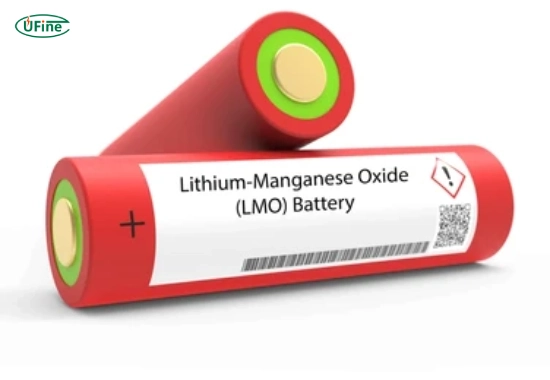
Main characteristics of LMO batteries:
| Parameter | Typical Value |
|---|---|
| Chemistry | Lithium Manganese Oxide (LiMn₂O₄) |
| Nominal Voltage | 3.7V–4.0V |
| Energy Density | 100–150 Wh/kg |
| Cycle Life | 500–2,000 cycles |
| Thermal Stability | High |
| Power Capability | Excellent |
| Safety | High |
Manganese-based cathodes are attractive because manganese is widely available, environmentally friendlier than cobalt, and relatively inexpensive.
Part 2. How does a lithium manganese battery work?
Like all lithium-ion batteries, a lithium ion manganese oxide battery stores and releases energy through the movement of lithium ions between the anode and cathode.
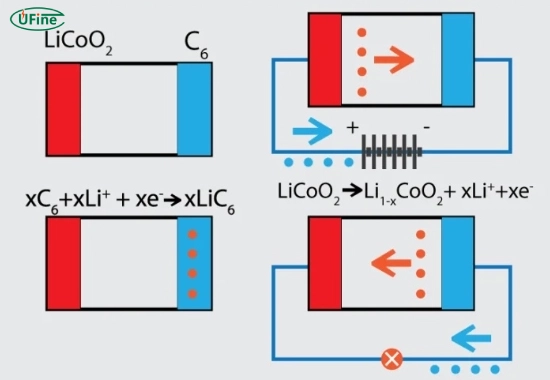
During charging:
- Lithium ions leave the manganese oxide cathode.
- They move through the electrolyte toward the graphite anode.
- Electrons travel through the external charging circuit.
- Energy becomes stored inside the battery.
During discharging:
- Lithium ions move back to the manganese oxide cathode.
- Electrons flow through the external circuit.
- Electrical energy powers the connected device.
The spinel structure of lithium manganese oxide allows rapid ion transport, which explains the battery’s strong power delivery capability.
Part 3. Advantages of lithium manganese batteries
-
High Safety Performance
One of the biggest advantages of lithium manganese oxide batteries is safety.
- Compared with lithium cobalt oxide batteries, LMO chemistry has a much lower risk of thermal runaway.
- This makes it suitable for applications where reliability is critical.
-
Excellent Power Output
LMO batteries can provide high discharge currents, making them ideal for:
- Power tools
- Electric vehicles
- Medical equipment
- Robotics
- Backup power systems
-
Better Thermal Stability
- The manganese oxide cathode remains more stable at elevated temperatures than many other lithium-ion chemistries.
- This reduces overheating risks and improves operational safety.
-
Lower Raw Material Cost
- Manganese is significantly more abundant than cobalt.
- As a result, lithium manganese batteries often offer a more cost-effective solution for high-power applications.
-
Environmentally Friendlier
- Because they require less or no cobalt, lithium manganese batteries generally have a lower environmental and ethical sourcing impact.
Part 4. Disadvantages of lithium manganese batteries
Despite their strengths, LMO batteries are not ideal for every application.
-
Lower Energy Density
- Compared with NMC, NCA, and LCO batteries, LMO batteries store less energy per kilogram.
- This means larger battery packs may be required for the same runtime.
-
Shorter Lifespan Than LFP
- While LMO can achieve respectable cycle life, it generally does not match the longevity of lithium iron phosphate (LFP) batteries.
-
Capacity Fade at High Temperatures
- Prolonged operation at elevated temperatures can accelerate manganese dissolution inside the cell, leading to capacity loss over time.
Part 5. Common applications of lithium manganese oxide batteries
-
Electric Vehicles
LMO batteries became popular in early electric vehicles because of their:
- High power output
- Strong safety profile
- Fast charging capability
Some automakers combine LMO and NMC chemistry to achieve both high energy density and high power.
-
Medical Devices
Portable medical equipment often requires safe and reliable power.
- LMO batteries are commonly used in:
- Infusion pumps
- Portable monitors
- Emergency medical devices
-
Power Tools
The ability to deliver large bursts of current makes lithium manganese batteries suitable for:
- Cordless drills
- Electric saws
- Construction equipment
-
Energy Storage Systems
- LMO batteries can be used in:
- Solar storage systems
- Backup power units
- Industrial energy storage
-
Consumer Electronics
Some laptops, portable electronics, and specialty devices utilize manganese battery technology where safety and power performance are priorities.
Part 6. Lithium manganese battery vs other battery chemistries
When selecting a battery technology, understanding the differences between chemistries is essential.
Comparison table:
| Chemistry | Energy Density | Power Output | Safety | Cycle Life | Cost |
|---|---|---|---|---|---|
| LMO | Medium | High | High | Medium | Medium |
| LFP | Medium | Medium | Very High | High | Low |
| NMC | High | High | Medium | Medium | Medium-High |
| LCO | Very High | Low-Medium | Low | Low | High |
| NCA | High | High | Medium | Medium | High |
When LMO is the best choice:
Choose an LMO battery when high discharge current is required, safety is a priority, fast charging is important, moderate energy density is acceptable, and cost must remain reasonable.
When another chemistry may be better:
- Choose LFP for maximum lifespan and safety.
- Choose NMC for higher energy density.
- Choose LCO when compact size and high energy density are critical.
For further comparison, see our guides on Lithium Iron Phosphate (LiFePO4) Batteries, NMC Battery vs LFP Battery, and Lithium-Ion Battery Types Explained.
Part 7. How to choose the right lithium manganese battery?
-
Define the Application
Start by identifying:
- EV
- Medical device
- Industrial equipment
- Energy storage system
- Portable electronics
Different applications require different discharge rates and capacities.
-
Evaluate Capacity Requirements
- Battery capacity determines runtime.
- Choose an Ah rating that meets operational requirements without oversizing the system.
-
Check Discharge Rate
- Power-hungry devices need batteries capable of delivering high current safely.
- LMO batteries perform particularly well in high-power applications.
-
Review Operating Temperature
Consider:
- Ambient temperature
- Charging temperature
- Storage temperature
Extreme conditions can reduce battery lifespan.
-
Verify Safety Certifications
Look for batteries meeting recognized standards such as:
- UL
- IEC 62133
- UN38.3
- CE
-
Select a Reliable Manufacturer
An experienced battery manufacturer can provide:
- Cell matching
- Battery management systems (BMS)
- Custom battery pack design
- Safety testing
Ufine Battery provides custom lithium battery solutions for industrial, medical, robotics, and energy storage applications.
Part 8. Future of lithium manganese oxide battery technology
Research into lithium manganese oxide batteries continues to improve several performance areas.
Current development focuses include:
- Higher energy density cathode materials
- Improved electrolyte formulations
- Reduced manganese dissolution
- Faster charging capability
- Hybrid LMO-NMC battery systems
- Lower manufacturing costs
As EV adoption and renewable energy deployment continue growing, manganese-based batteries are expected to remain an important part of the lithium-ion battery market.
The abundance of manganese and reduced reliance on cobalt make this chemistry increasingly attractive for sustainable battery production.
Part 9. FAQs about lithium manganese batteries
What is a lithium manganese oxide battery?
A lithium manganese oxide battery (LMO battery) is a lithium-ion battery that uses manganese oxide as the cathode material. It is known for safety, high power output, and thermal stability.
Are LMO batteries safe?
Yes. LMO batteries are considered among the safer lithium-ion chemistries because they have lower thermal runaway risk than many cobalt-based batteries.
What is the lifespan of an LMO battery?
Most lithium manganese batteries provide approximately 500 to 2,000 charge cycles, depending on operating conditions, temperature, and depth of discharge.
What are lithium manganese batteries used for?
They are widely used in electric vehicles, medical devices, power tools, industrial equipment, robotics, and energy storage systems.
Which is better: LMO or LFP battery?
Neither is universally better. LMO batteries offer higher power output and fast charging, while LFP batteries provide longer cycle life and superior long-term durability.
Related Tags:

More Articles

Comparative Analysis: 14500 Battery Vs. 18650 Battery
Compare 14500 vs 18650 batteries by size, voltage, capacity, runtime, discharge current, charging, safety, and applications to choose the right cell.
12V Lithium-Ion What Voltage at Fully Charged and Why Your Battery Might Not Reach It
Check the 12V lithium battery voltage chart for 3S Li-ion and 4S LiFePO4. Learn full charge, resting voltage, charger limits, and fault checks.
LiFePO4 Voltage Chart Guide: Everything You Need to Know
Check the LiFePO4 voltage chart for 3.2V, 12V, 24V and 51.2V batteries. Compare SOC, charging voltage, cutoff limits and internal resistance.
Lithium Ion Cell Sizes: A Comprehensive Guide
Compare lithium ion cell sizes with a chart of dimensions, capacity ranges, cell types, applications, and key factors for selecting the right battery.
6 Volt Tractor Battery vs 12 Volt: Which One Fits Your Farm Equipment Best?
Compare 6V and 12V tractor batteries. Learn which voltage fits vintage or modern tractors, which specifications matter, and how to convert safely.