
- Key Takeaways
- Part 1. What affects lipo battery lifespan?
- Part 2. How to care for lipo batteries (best practices)
- Part 3. Temperature management for lipo batteries
- Part 4. Lipo battery storage and maintenance
- Part 5. Practical application: How to extend lipo battery lifespan
- Part 6. Lipo battery care faqs
Lithium polymer batteries are widely used in drones, medical devices, consumer electronics, and industrial systems due to their high energy density and flexible form factor. Understanding lipo battery care, lipo battery maintenance, and correct usage is essential to extend battery life and ensure safe operation.
If you are sourcing or integrating batteries, proper maintenance directly impacts cycle life, safety, and total cost of ownership.
👉 For battery selection and customization, see lithium polymer battery solutions
Key Takeaways
- Avoid overcharging and deep discharging to maximize LiPo battery lifespan (300–500 cycles typical)
- Keep batteries within 5–45°C charging range and 0–40°C operating range for optimal performance
- Store batteries at 40–60% charge (storage voltage) to reduce chemical degradation
- Use certified chargers with voltage and current control to ensure safe charging
- High temperature is the #1 factor accelerating LiPo degradation and swelling
- Proper storage and handling significantly reduce safety risks and replacement costs
Part 1. What affects lipo battery lifespan?

Understanding these factors is critical for lithium ion battery care and long-term reliability:
- Charge Cycles
Each full charge-discharge cycle causes gradual capacity loss. Most LiPo batteries last:- 300–500 cycles (standard)
- Higher with controlled usage and shallow cycling
- Temperature Exposure
High heat accelerates electrolyte breakdown
Low temperatures increase internal resistance
Thermal stress is a leading cause of capacity fade - Overcharging & Deep Discharging
Overcharge → electrolyte oxidation and gas formation
Deep discharge → copper dissolution and structural damage - Charger Quality
Using incompatible chargers can cause:- Voltage overshoot
- Cell imbalance
- Long-term degradation
- Storage Conditions
High SOC (state of charge) storage → faster aging
Humidity and heat accelerate degradation - Mechanical Damage
Puncture, vibration, or compression may:- Damage internal layers
- Lead to swelling or safety hazards
Part 2. How to care for lipo batteries (best practices)
Effective caring for LiPo batteries focuses on two areas: charging control and storage management.
1 Lipo battery charging best practices
Proper charging is the foundation of lipo battery maintenance:
- Use the correct charger
Match voltage (e.g., 3.7V per cell)
Use balance chargers for multi-cell packs - Avoid overcharging
Standard cutoff: 4.2V per cell
Do not leave batteries connected after full charge - Use moderate charge rates
Recommended: 0.5C–1C
High current charging increases heat and wear - Charge in safe conditions
Use fire-resistant containers (LiPo safe bags)
Avoid charging unattended
👉 For safety standards, refer to UL battery safety guidelines
2 Lipo battery discharging guidelines
Discharging control is equally important for how to maintain LiPo batteries:
- Avoid deep discharge
Minimum safe voltage: ~3.0V per cell
Recommended cutoff: 3.3–3.5V per cell - Use Battery Management Systems (BMS)
Prevents over-discharge
Ensures balanced cells - Avoid high discharge spikes
Excessive current increases internal stress
Leads to faster aging
Deep discharge causes irreversible structural damage, reducing capacity and safety.
Part 3. Temperature management for lipo batteries
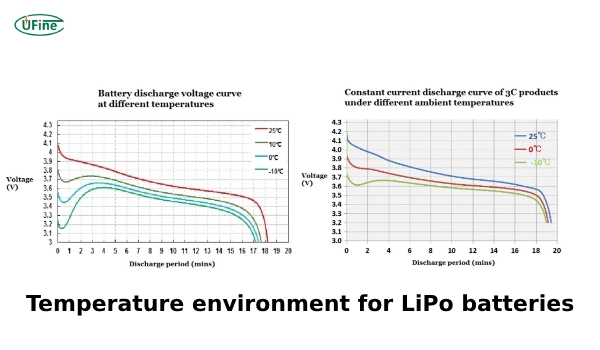
Temperature control is one of the most critical aspects of lithium ion battery care.
Charging Temperature
- Optimal: 5°C to 45°C
- 0–5°C: Reduce charging current
- <0°C: Risk of lithium plating (permanent damage)
- >45°C: Electrolyte degradation and gas formation
Discharging Temperature
- Typical range: -20°C to 60°C
- Best performance: 0°C to 40°C
👉 Industry reference: IEC battery standards
Part 4. Lipo battery storage and maintenance
Proper storage is essential for long-term lipo battery lifespan.
Storage Best Practices
- Store at 40–60% charge (storage voltage ~3.7–3.85V/cell)
- Temperature: -5°C to 35°C
- Humidity: <75% RH
- Keep in dry, ventilated areas
Long-Term Storage Maintenance
- Recharge every 3–6 months
- Avoid full discharge during storage
- Use protective cases to prevent short circuits
Safety Precautions
- Keep away from metal objects (prevent short circuit)
- Avoid crushing, puncturing, or bending
- Do not expose to direct sunlight or heat sources
- Never disassemble battery packs
Part 5. Practical application: How to extend lipo battery lifespan
| Scenario | Recommended Practice |
|---|---|
| Drone batteries | Stop flight at 20–30% capacity |
| Industrial devices | Use BMS + temperature monitoring |
| Consumer electronics | Avoid overnight charging |
| Long-term storage | Store at ~50% SOC |
Part 6. Lipo battery care faqs
How to take care of LiPo batteries properly?
Use the correct charger, avoid overcharging and deep discharging, keep within safe temperature ranges, and store at 40–60% charge.
What is the typical LiPo battery lifespan?
Most LiPo batteries last 300–500 charge cycles, depending on usage and maintenance conditions.
Is it safe to leave LiPo batteries fully charged?
No. Keeping batteries at 100% charge for long periods accelerates degradation. Store at ~50% instead.
Why do LiPo batteries swell?
Swelling is caused by gas buildup due to overcharging, overheating, deep discharge, or internal damage.
What is the best way to maintain lithium-ion batteries?
Maintain moderate charge levels, avoid extreme temperatures, use certified chargers, and follow proper storage practices.
Related Tags:

More Articles

What is UN38.3? Learn UN38.3 lithium battery transport tests, requirements, certification process, and compliance tips for safe global shipping.
Differences Between a Car Battery and a Truck Battery
Compare truck battery vs car battery differences, including CCA, capacity, size, and applications. Learn how to choose the right battery.
Top 10 Recommended Small Size Battery
Learn about small size batteries, including types, uses, and how to choose the right one. Compare options for different devices and applications.
Voltage vs Current: What is the Difference?
Learn voltage vs current, their differences, relationship, and battery applications. Clear examples explain current vs voltage and power.
Can You Overcharge a Lithium Battery?
Can you overcharge a lithium battery? Learn what happens, key risks, and how to prevent battery overcharging for safer and longer battery life.


