
In modern energy storage, two technologies often appear in the same comparison: flow batteries vs lithium-ion batteries. Each has clear strengths, limits, and ideal use cases.
If you are selecting a battery for grid storage, industrial systems, or commercial projects, understanding this difference is critical.
Key Takeaways
- Flow batteries offer long lifespan (10,000+ cycles) and are ideal for grid-scale storage.
- Lithium-ion batteries provide high energy density, making them best for EVs and portable devices.
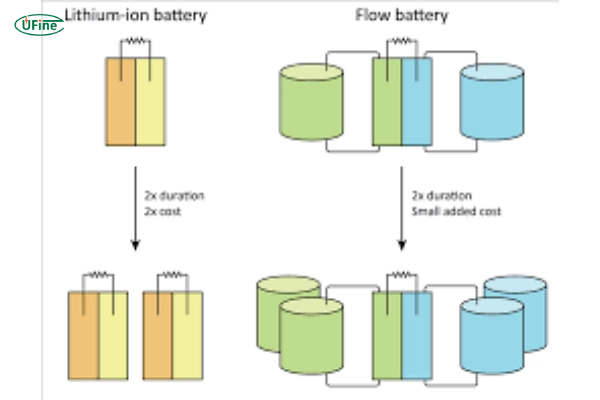
- Flow battery systems scale energy and power independently, unlike lithium-ion.
- Lithium-ion is more cost-effective upfront, while flow batteries can win in long-term TCO.
- Safety risk is lower in flow batteries due to no thermal runaway.
- The choice depends on application: mobility vs stationary energy storage.
Part 1. What is a flow battery?
A flow battery (or redox flow battery) stores energy in liquid electrolytes kept in external tanks.
Common types include:
- Vanadium redox flow batteries (VRFB)
- Zinc-bromine flow batteries
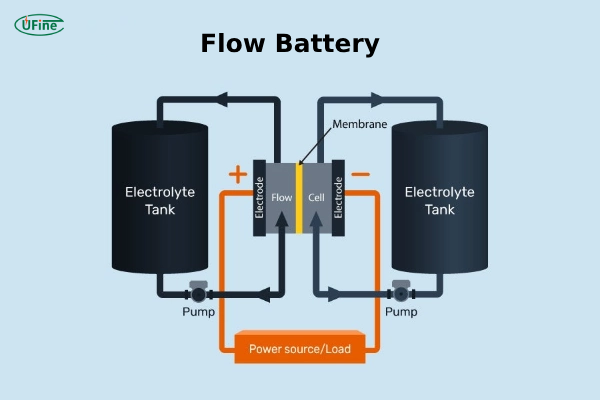
How flow batteries work
Electrolyte liquids circulate through a cell stack. Electrochemical reactions occur inside the stack to charge or discharge energy.
Key feature:
- Energy capacity = tank size
- Power output = stack size
This separation is unique and very important for large-scale systems.
Part 2. What is a lithium-ion battery?
Lithium-ion batteries are the most widely used rechargeable batteries today. They power:
- Electric vehicles (EVs)
- Consumer electronics
- Residential storage systems
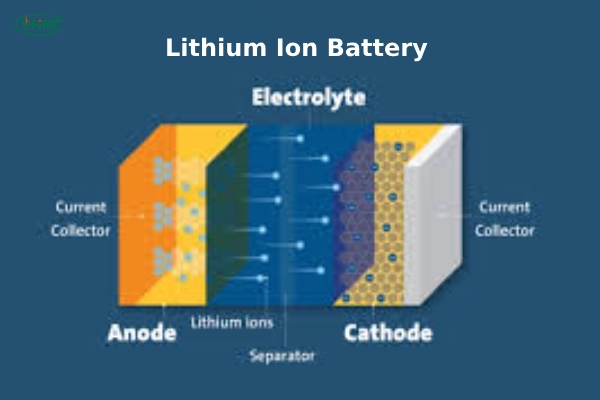
How lithium-ion batteries work
Lithium ions move between:
- Anode
- Cathode
- Electrolyte
during charge and discharge cycles.
If you want a deeper understanding of cell structure, see:
👉 Battery terminology guide
Part 3. Flow battery vs lithium-ion: Core differences
1 Energy density
Flow Battery
- Low energy density
- Large footprint required
- Not suitable for mobile devices
Lithium-Ion Battery
- High energy density (>200 Wh/kg typical)
- Compact and lightweight
- Ideal for EVs and electronics
👉 This is the main reason lithium-ion dominates mobility.
2 Efficiency
- Flow batteries: ~70–85%
- Lithium-ion: ~85–95%
Lithium-ion clearly wins in round-trip efficiency.
3 Lifespan and cycle life
Flow Battery
- 10,000+ cycles
- 15–20+ years
- Minimal degradation
Lithium-Ion Battery
- 500–3,000 cycles (depending on chemistry)
- 5–10 years typical
👉 For long-duration storage, flow batteries are more durable.
4 Safety
Flow Battery
- No thermal runaway
- Non-flammable electrolytes (in many designs)
- Safer for large installations
Lithium-Ion Battery
- Risk of thermal runaway
- Requires BMS and thermal management
5 Cost comparison
| Factor | Flow Battery | Lithium-Ion |
|---|---|---|
| Initial Cost | High | Lower |
| Operating Cost | Low | Medium |
| Lifetime Cost | Competitive | Moderate |
| Scalability Cost | Flexible | Limited |
- Flow batteries have higher CAPEX
- Lithium-ion has better short-term ROI
- For long-duration (>4 hours), flow batteries become more competitive.
6 Environmental impact
Flow Battery
- Electrolytes can be reused
- Longer life → less waste
- Lower fire risk
Lithium-Ion
- Uses lithium, cobalt, nickel
- Mining impact is significant
- Recycling is improving but complex
7 Applications: Where each technology fits
| Application | Best Choice |
|---|---|
| Grid storage | Flow battery |
| Renewable integration | Flow battery |
| Industrial backup | Flow battery |
| Electric vehicles | Lithium-ion |
| Consumer electronics | Lithium-ion |
| Home energy storage | Lithium-ion |
8 Maintenance
Flow Battery
- Requires pumps and fluid management
- Easier component replacement
Lithium-Ion
- Low maintenance
- Requires BMS monitoring
9 Performance in extreme conditions
Flow Battery
- More stable across temperatures
- Suitable for harsh environments
Lithium-Ion
- Sensitive to heat and cold
- Needs thermal control systems
Part 4. Flow batteries vs lithium-ion: Selection guide
Choose flow battery if you need:
- Long-duration storage (>4–6 hours)
- High cycle life
- Grid or industrial applications
- High safety requirement
Choose lithium-ion battery if you need:
- Compact size
- High energy density
- Mobility (EVs, devices)
- Lower upfront cost
Part 5. FAQs: Flow battery vs lithium-ion
What is a flow battery and how is it different from lithium-ion?
A flow battery stores energy in liquid electrolytes outside the cell. Lithium-ion stores energy inside solid electrodes. This makes flow batteries scalable and longer-lasting.
Why do flow batteries have lower energy density?
Because energy is stored in external tanks, not compact solid materials. This increases size but allows flexible scaling.
Which is better: flow battery vs lithium-ion?
It depends on the use case: Flow battery → grid storage. Lithium-ion → EVs and electronics.
What are the main disadvantages of flow batteries?
Large size, higher upfront cost, and lower efficiency than lithium-ion.
Will flow batteries replace lithium-ion?
No. They serve different markets. Flow batteries will grow in stationary storage, while lithium-ion remains dominant in mobile applications.
Related Tags:

More Articles

Dead Battery or Device Failure? How to Find the Cause
Think your device is broken? Learn how to tell if the problem comes from battery aging or hardware failure before replacing your electronics.
Why iPhone Duo Uses Two Batteries: The Engineering Behind Foldable Phone Power
Why do foldable phones need two batteries? Explore the engineering challenges behind iPhone Duo’s dual-battery architecture and future battery trends.
Solid-State Batteries: 3 Myths You Need to Know
Solid-state batteries promise safer EVs and longer range, but the reality is more complex. Discover the challenges behind this next-gen technology.
Battery Capacity vs Discharge Rate: The Choice Engineers Face
Higher capacity or higher discharge rate? Learn how to choose the right LiPo battery for longer runtime, stable power output, and better device performance.
Battery Cable Size Guide: Choose the Right Wire Fast
Not sure what battery cable size you need? Learn how to select the right wire gauge, terminal size, and cable for safer, more efficient battery systems.


