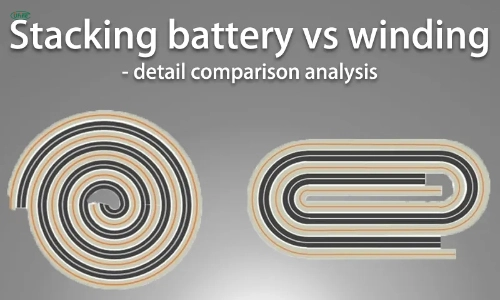
When selecting a lithium battery cell, engineers often compare stack battery (battery stack) and winding battery (spiral-wound battery) structures. Although both are based on similar electrochemical principles, their manufacturing process, internal resistance, thermal behavior, and mechanical stability can significantly affect performance and cost.
This guide provides a technical and application-focused comparison to help procurement managers and battery engineers make informed decisions.
Key Takeaways
Stack batteries (layered electrode design) typically offer higher volumetric energy density and better structural stability in prismatic formats.
Winding batteries (spiral-wound design) enable high-speed automated production and are common in cylindrical cells like 18650 and 21700.
For fast charging and low internal resistance optimization, stacking provides more uniform current distribution.
Winding structures are cost-efficient and mature for large-scale production.
Application requirements (EV, ESS, medical, high-rate discharge) determine whether stack battery or winding battery technology is the better fit.
Part 1. What is a stack battery?
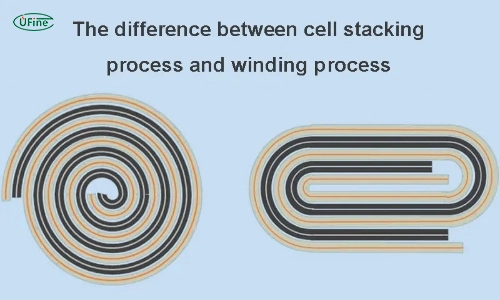
A stack battery, also called a battery stack, uses a layered construction method where cathode, separator, and anode sheets are cut and stacked alternately in a flat configuration.
1 Manufacturing process
- Electrode sheets are coated onto metal foils.
- Precision cutting ensures dimensional consistency.
- Layers are stacked in sequence: cathode → separator → anode.
- The stacked assembly is inserted into a pouch or prismatic housing.
- Electrolyte filling and formation follow.
This structure is widely used in pouch cells and prismatic lithium batteries, especially in EV battery packs.
For more on lithium battery configurations, see our internal guide on 👉 Prismatic vs Pouch vs Cylindrical Battery Comparison
2 Structural characteristics of stack battery
- Flat, rectangular electrode layout
- High space utilization in prismatic form
- Uniform current distribution
- Reduced mechanical stress compared to winding designs
Advanced stacking technologies (Z-fold stacking, laser alignment) improve precision and reduce delamination risks.
3 Advantages of stack battery technology
- Higher Volumetric Energy Density
- Stacked layers maximize internal space utilization, reducing inactive gaps common in spiral-wound cores.
- Improved Structural Stability
- Flat stacking reduces mechanical deformation during cycling, which may contribute to longer cycle life in certain designs.
- Better Fast-Charging Adaptation
- Because current pathways are shorter and more evenly distributed, stack batteries can optimize internal resistance design for fast charging applications.
- Customizable Cell Dimensions
- Stacking allows flexibility in adjusting electrode thickness, layer count, and cell footprint. This is especially useful in custom lithium battery projects. 👉 See: Custom Lithium Battery Solutions
- Disadvantages of Stack Battery
- More complex alignment requirements
- Higher equipment precision cost
- Slower production speed compared to high-speed winding lines
- Risk of misalignment or delamination if process control is weak
Part 2. What is a winding battery?
A winding battery (also known as spiral-wound battery) is manufactured by continuously winding long electrode sheets and separators around a central mandrel into a cylindrical or elliptical shape.
This design dominates cylindrical formats such as:
- 18650 cells
- 21700 cells
- 4680 cells
Learn more about cylindrical cells here: 👉 18650 Lithium Battery Guide
1 Manufacturing process of winding battery
- Continuous electrode coating
- Slitting into long strips
- Automated spiral winding under tension control
- Insertion into cylindrical metal can
- Electrolyte injection and sealing
The process is highly automated and scalable.
2 Advantages of winding battery technology
- Mature Mass Production
- Spiral winding is faster and more automation-friendly, enabling high output and lower per-unit cost.
- Mechanical Integrity in Cylindrical Cells
- The cylindrical shell provides strong external compression support and good resistance to swelling.
- Efficient Thermal Dissipation
- Cylindrical shape enables uniform radial heat distribution.
For thermal safety standards, refer to:
- UL 1642 (Lithium Batteries Safety Standard)
- IEC 62133 (Secondary Cells Safety Standard)
3 Disadvantages of winding battery
- Slightly lower volumetric space utilization
- Potential internal stress due to winding tension
- Current density gradients between inner and outer layers
- Less geometric flexibility for flat devices
Part 3. Stack battery vs winding battery: technical comparison
| Parameter | Stack Battery | Winding Battery |
|---|---|---|
| Structure | Layered electrode sheets | Spiral-wound roll |
| Typical Format | Pouch / Prismatic | Cylindrical / Some prismatic |
| Energy Density | Higher volumetric efficiency | Slightly lower (void space in core) |
| Power Density | Optimizable with design | Strong in cylindrical high-rate cells |
| Manufacturing Speed | Moderate | High-speed automated |
| Structural Stability | High (flat compression) | High (cylindrical shell support) |
| Fast Charging | Better current uniformity | Heat management required |
| Cost | Higher initial precision cost | Lower large-scale cost |
Part 4. Application-based selection guide
1 Electric vehicles (EV)
- Prismatic stack battery commonly used in EV modules
- Cylindrical winding battery used in modular pack systems
2 Energy storage systems (ESS)
Stack batteries provide:
- High packing efficiency
- Better module-level thermal management
3 High-rate power tools
Winding batteries are preferred due to:
- Strong cylindrical casing
- Excellent mechanical durability
4 Medical & portable devices
Stack batteries (especially pouch type) are ideal for:
- Thin form factors
- Flexible size customization
Part 5. Engineering considerations when choosing
- Space constraint: Flat vs cylindrical cavity
- Thermal strategy: Passive vs forced cooling
- Cost target: High-volume vs specialized project
- Discharge rate requirement: Continuous vs pulse
- Cycle life expectations
If unsure, consulting a lithium battery manufacturer with customization capability can significantly reduce development risk.
Part 6. FAQ: stack battery vs winding battery
Is a stack battery better than a winding battery?
Not necessarily. Stack batteries typically offer higher volumetric energy density, while winding batteries are more cost-effective and mature for large-scale cylindrical production.
Which battery type supports faster charging?
Stack batteries often provide more uniform current distribution, which can support optimized fast-charging designs, but final performance depends on chemistry and thermal control.
Are winding batteries safer?
Both designs can meet UL and IEC standards. Safety depends more on BMS design, separator quality, and manufacturing precision than on stacking or winding alone.
Why are cylindrical batteries usually winding type?
The spiral-wound process naturally fits cylindrical metal cans and enables high-speed automation.
What about flex stacked battery technology?
Flex stacked battery designs use thin stacked layers to create ultra-thin or flexible lithium cells, often applied in wearables and compact electronics.
Related Tags:

More Articles

Dead Battery or Device Failure? How to Find the Cause
Think your device is broken? Learn how to tell if the problem comes from battery aging or hardware failure before replacing your electronics.
Why iPhone Duo Uses Two Batteries: The Engineering Behind Foldable Phone Power
Why do foldable phones need two batteries? Explore the engineering challenges behind iPhone Duo’s dual-battery architecture and future battery trends.
Solid-State Batteries: 3 Myths You Need to Know
Solid-state batteries promise safer EVs and longer range, but the reality is more complex. Discover the challenges behind this next-gen technology.
Battery Capacity vs Discharge Rate: The Choice Engineers Face
Higher capacity or higher discharge rate? Learn how to choose the right LiPo battery for longer runtime, stable power output, and better device performance.
Battery Cable Size Guide: Choose the Right Wire Fast
Not sure what battery cable size you need? Learn how to select the right wire gauge, terminal size, and cable for safer, more efficient battery systems.