- Part 1. What is a universal battery strap down?
- Part 2. Are universal battery strap downs safe for LiFePO4 batteries?
- Part 3. Why LiFePO4 batteries require special attention?
- Part 4. Which types of universal strap downs are compatible?
- Part 5. How to check whether a strap is safe for your LiFePO4 battery?
- Part 6. Installation best practices for universal straps on LiFePO4 batteries
- Part 7. When a universal strap is not enough
- Part 8. Universal strap down compatibility by installation type
- Part 9. Recommended universal strap specifications for LiFePO4 batteries
- Part 10. When to choose a custom LiFePO4 strap down instead?
- Part 11. Conclusion
LiFePO4 batteries are engineered to be safer, lighter, and more durable than traditional lead-acid batteries—but they still require proper installation to perform reliably. One of the most common installation questions users ask is whether a universal battery strap down can be safely used with LiFePO4 packs.
With so many “one-size-fits-all” battery straps on the market, it’s easy to assume any universal product will work. In reality, LiFePO4 batteries have different casing structures, vibration behavior, thermal properties, and installation requirements, which means certain universal straps are compatible while others may cause long-term problems such as case deformation, terminal stress, or electrical instability.
This guide breaks down how universal battery strap downs work, what makes LiFePO4 different, and how to choose a strap that protects the battery while meeting installation safety standards.
Part 1. What is a universal battery strap down?
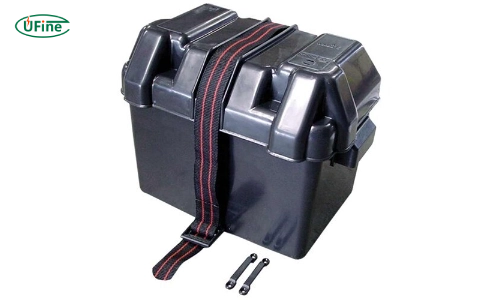
A universal battery strap down is a flexible securing device designed to hold different battery sizes and shapes in place during vibration, movement, and impact. Most universal straps use:
- Nylon or polyester webbing
- Adjustable buckles
- Elastic or semi-elastic material
- Metal or plastic fastening hardware
- Hook-and-loop (Velcro) closure systems
They are commonly used in:
- Small vehicles
- Kayaks and marine equipment
- Backup power systems
- Solar installations
- Portable devices or DIY projects
- RC equipment and hobby applications
The appeal is simple:
One adjustable strap that fits multiple battery dimensions.
However, universal straps were originally designed around the shape and weight of lead-acid batteries, not the lighter and more rigid construction of modern LiFePO4 batteries.
Part 2. Are universal battery strap downs safe for LiFePO4 batteries?
Yes—but only when the strap meets certain requirements.
Many universal straps are compatible, but some can damage LiFePO4 cells if they apply uneven pressure or fail to secure the battery effectively.
1 A strap is considered LiFePO4-safe if:
- It distributes pressure evenly
- It does not deform the battery’s outer casing
- It prevents vibration and battery movement
- It uses non-conductive materials
- It does not rub, scrape, or cut into the battery
- Its tension is adjustable without overtightening
2 A strap is considered unsafe if:
- ❌ It compresses or bends the battery enclosure
- ❌ It uses metal contact points that could scratch the battery
- ❌ It requires excessive tension to keep the battery stable
- ❌ It loosens under vibration
- ❌ It applies pressure only at narrow points
- ❌ It damages insulation or wiring around the battery
Because LiFePO4 cells are built differently, the wrong strap can create installation risks even when the battery operates normally.
Part 3. Why LiFePO4 batteries require special attention?
LiFePO4 batteries differ from lead-acid batteries in several structural and mechanical ways. These differences directly affect how strap-down systems should grip and protect them.
1 Lighter weight = Different vibration behavior
A LiFePO4 battery typically weighs 30–70% less than a lead-acid battery of the same capacity.
This means:
- They bounce more easily if not tightly secured
- They require a strap that minimizes micro-movement
- Excess slack in universal straps becomes more dangerous
A universal strap designed for a heavy battery may not hold a lightweight LiFePO4 pack firmly enough.
2 Rigid case = More sensitive to uneven pressure
LiFePO4 batteries often use:
- ABS plastic casings
- Aluminum housings
- Polymer-wrapped pouch cells
These materials maintain precise tolerances.
Excessive or concentrated strap pressure can lead to:
- Casing deformation
- Internal cell compression
- Seal damage
- Reduced cycle life
Universal straps with narrow pressure zones pose the greatest risk.
3 Sensitive terminals
LiFePO4 terminals differ in:
- Shape
- Height
- Thread style
- Torque requirements
If the battery moves because a universal strap is too loose, terminals may experience:
- Mechanical stress
- Loosening
- Cracked welds
- Poor electrical contacts
Motion around the terminal area is one of the most common causes of LiFePO4 installation failures.
4 BMS wiring must remain protected
A LiFePO4 battery includes a built-in Battery Management System (BMS).
External pressure on:
- Wiring
- Sensors
- BMS enclosure
…can cause long-term issues.
Universal straps that are too wide or positioned incorrectly may press against these components.
Part 4. Which types of universal strap downs are compatible?
Below is a full breakdown of which universal strap types work well with LiFePO4 and which should be avoided.
1 Compatible Types
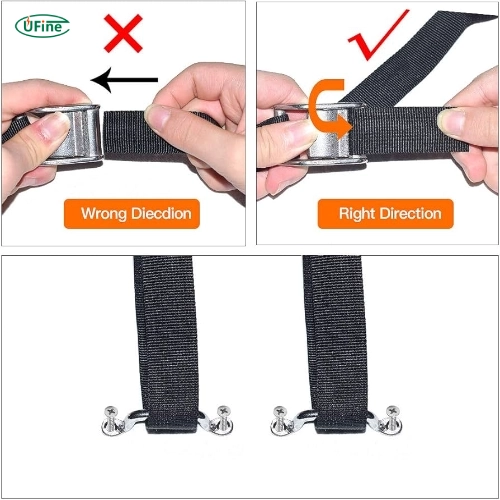
- ✔ Nylon Webbing + Buckle Strap
- Best overall option.
- Strong, flexible, lightweight, and distributes pressure evenly.
- ✔ Hook-and-Loop (Velcro) Strap
- Excellent for small LiFePO4 packs.
- Easy to adjust and protects the battery case.
- ✔ Polyester Reinforced Strap
- Higher tensile strength than nylon.
- Stable under vibration and temperature changes.
- ✔ Elastic Straps with Limiters
- Only safe if the elastic tension is moderate.
- Limiters prevent overstretching.
- ✔ Marine-grade Nylon Strap with Stainless Buckles
- Safe for boat or kayak installations.
- Corrosion-resistant and vibration-stable.
2 Straps to Avoid
- ✘ Ratchet Straps
- Too much tension → may crush or deform LiFePO4 casings.
- ✘ Metal Chain Straps
- Conductive → risk of short-circuit and case damage.
- ✘ Thin Elastic Bungee Cords
- Insufficient stability → battery will move under vibration.
- ✘ Wire-based Tie Downs
- Cut into battery casing → extremely unsafe.
- ✘ Very Narrow Straps (<20mm width)
- Concentrate pressure → risk of indentation or deformation.
Part 5. How to check whether a strap is safe for your LiFePO4 battery?
Use the following compatibility checklist.
Step 1: Check Strap Width
Recommended: 20–30 mm minimum
Wider straps = more stable and safer.
Step 2: Check Battery Movement After Tightening
Test tightening the strap:
- Move the battery by hand
- Try lifting one side
- Simulate vibration
If any motion is detected → strap is not compatible.
Step 3: Check Pressure Points
Ensure the strap pressure is:
- Even
- Flat
- Not bending the case
- Not pressing wiring or the BMS enclosure
Avoid straps that leave marks after removal.
Step 4: Confirm Strap Material Is Non-Conductive
Nylon, polyester, and Velcro are safe.
Bare metal is not.
Step 5: Long-Term Vibration Test
During the first 48 hours of use:
- Re-tighten if needed
- Inspect for rubbing or chafing
- Add padding if the strap touches corners
Part 6. Installation best practices for universal straps on LiFePO4 batteries
To maximize lifespan and minimize risk, follow these installation guidelines.
1 Use two straps instead of one (whenever possible)
Especially for:
- Marine environments
- RVs
- Off-road vehicles
- Solar power banks
Two straps create stable cross-pressure to prevent side-to-side motion.
2 Add a rubber or EVA foam base pad
A soft pad under the battery prevents:
- Sliding
- Vibration resonance
- Bottom-case wear
Many manufacturers, including Ufine Battery, use foam liners in OEM installations.
3 Avoid mounting near the terminal area
Position strap(s):
- At the mid-section
- Or on reinforced areas of the casing
Never strap directly over terminals or BMS wiring.
4 Protect sharp edges
If the mounting tray has metal edges:
- Add rubber padding
- Use heat-shrink sleeves
- Apply edge protectors
This prevents abrasion damage to both the strap and the battery casing.
5 Follow tightening torque limits
LiFePO4 batteries do not require extremely tight straps.
Recommended:
Tighten only until the battery no longer moves under vibration tests.
Over-tightening reduces structural life.
Part 7. When a universal strap is not enough
In certain installations, a universal strap is not recommended.
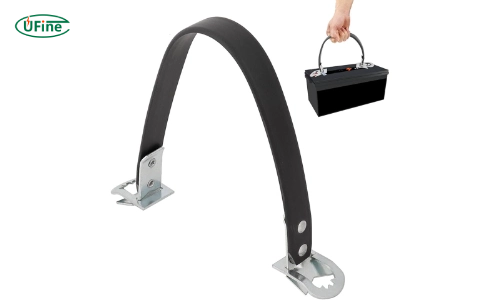
Instead, use a custom LiFePO4 battery hold-down system.
Situations requiring a dedicated hold-down:
- High-vibration environments
- Off-road vehicles
- Power sports
- Marine engines
Universal straps may loosen over time.
- Large-capacity LiFePO4 batteries
- 12V 100Ah
- 24V 200Ah
- 48V 50Ah
Large packs need a more secure mounting frame.
- Vertical installations
- Some LiFePO4 batteries are not designed for vertical mounting.
A loose strap may cause the pack to shift and damage internal cells.
- Outdoor environments with UV exposure
- Low-quality universal straps degrade quickly outdoors.
Part 8. Universal strap down compatibility by installation type
| Installation Type | Universal Strap Safe? | Notes |
|---|---|---|
| Solar battery box | Yes | Use wide nylon strap |
| RV / Caravan | Yes | Use double straps |
| Marine / Kayak | Yes | Use marine-grade strap |
| Off-road vehicle | ⚠ Conditional | Use reinforced tray |
| Motorcycle | ⚠ Conditional | Try a rigid strap + padding |
| Boats with engine vibration | ❌ No | Requires hold-down bracket |
| Heavy industrial equipment | ❌ No | Use steel frame holder |
Part 9. Recommended universal strap specifications for LiFePO4 batteries
For best compatibility, choose a strap with:
- Width: 25–30 mm
- Wide enough to distribute pressure.
- Material: Nylon or polyester
- Strong, flexible, non-conductive.
- Closure: Buckle, hook-and-loop, or dual-lock design
- Avoid ratchet systems.
- Tensile strength: ≥ 300–500 lbs
- Prevents tearing under vibration.
- Padding: EVA/Silicone padding available
- Ideal for marine or vehicle use.
- Temperature resistance: −20°C to 85°C
- Matches LiFePO4 thermal range.
Part 10. When to choose a custom LiFePO4 strap down instead?
For the best protection, choose a dedicated LiFePO4 strap when:
- The battery is expensive (e.g., 12V 200Ah, 24V 50Ah, 48V power packs)
- The application involves constant movement
- The installation environment is harsh
- The battery must comply with safety regulations (marine, RV, utility)
Many manufacturers—including Ufine Battery—offer custom strap-down solutions built around:
- Exact battery dimensions
- Terminal protection
- BMS enclosure position
- Vibration and shock absorption requirements
A custom strap down ensures the installation meets long-term reliability standards.
Part 11. Conclusion
Using a universal battery strap down with a LiFePO4 battery is safe when the strap meets certain material, width, tension, and pressure distribution requirements. However, not all universal straps are compatible—especially those that apply narrow or excessive pressure, use metal components, or fail to stabilize lightweight LiFePO4 packs under vibration.
By choosing the right strap type and following proper installation practices, users can safely secure LiFePO4 batteries in almost any system. For high-vibration or mission-critical environments, a dedicated LiFePO4 strap-down or hold-down bracket remains the safest long-term choice.
If needed, a manufacturer-grade custom strap—designed around the exact battery size, casing material, and mounting environment—provides the highest level of protection and stability.
Related Tags:

More Articles
Buck vs. Boost vs. Buck-Boost Converter: Which Is Best for Battery?
Not sure which converter your battery-powered device needs? Compare Buck, Boost, and Buck-Boost designs and discover what affects voltage stability and runtime.
How to Match 18650 Cells for a Reliable Battery Pack?
Building an 18650 battery pack? Learn how to compare cell capacity, voltage, and internal resistance to avoid mismatches and improve reliability.
Why Do 18650 Battery Packs Get Hot During Discharge?
Is your 18650 battery pack overheating under load? Learn what causes excess heat, how to spot dangerous symptoms, and what to do next.
18650 Battery BMS: How to Get the Specs Right
Learn how to choose a BMS for an 18650 battery pack. Compare voltage, current ratings, protection features, and balancing before you buy.
Why Does My Ring Camera Battery Drain So Fast or Stop Charging?
Is your Ring camera battery draining fast or not charging? Discover common causes, practical fixes, and when to replace the battery.