
Part 1. What is a drill battery?
A drill battery is a rechargeable battery pack specifically designed to power cordless drills and other portable power tools.
Instead of using a direct power cord, cordless drills rely on battery packs to provide mobility and convenience. This makes them ideal for professional contractors, workshops, home maintenance, and outdoor construction work.
The most common drill machine battery types include:
- Lithium-ion (Li-ion)
- Nickel-Cadmium (Ni-Cd)
- Nickel-Metal Hydride (NiMH)
Among these, lithium-ion batteries are now the most popular because they offer:
- Lightweight design
- High energy density
- Fast charging
- Low self-discharge
- No memory effect
- Longer cycle life
This is why most users searching for the best battery for a cordless drill usually end up choosing lithium-ion systems.
Part 2. Which cell is used in drilling machines?
Most modern drill batteries use cylindrical lithium-ion cells such as:
- 18650 cells
- 21700 cells
For users choosing between cylindrical lithium cells for power tools, this breakdown of 18650 vs 21700 vs 26650 helps explain size, capacity, and performance differences clearly.
Some premium battery systems also use:
- Pouch cells
These battery packs usually include a Battery Management System (BMS), which helps improve safety and battery life by managing:
- Overcharge protection
- Over-discharge protection
- Temperature control
- Short-circuit prevention
- Cell balancing
This is one of the major reasons battery quality varies so much between manufacturers.
Part 3. How We Tested
To make this ranking more useful and trustworthy, we focused on real-world buying factors instead of relying only on marketing claims.
Evaluation Criteria
Each manufacturer was evaluated based on:
- Battery chemistry (Li-ion, NiCd, NiMH)
- Voltage range and drill platform compatibility
- Capacity options (Ah / Wh)
- Charging speed
- Cycle life and long-term durability
- Safety protections (overcharge, overheating, short circuit)
- Battery thermal management
- Warranty and after-sales support
- Suitability for DIY users, professionals, and industrial buyers
- Manufacturing consistency and market reputation
Research Process
We reviewed official manufacturer specifications, battery platform compatibility, charging systems, and common drill battery models used in 12V, 18V, and 20V cordless drills.
We also considered practical usage factors such as:
- Runtime stability during heavy use
- Heat management under repeated charging cycles
- Replacement battery availability
- Long-term support and warranty reliability
Rather than ranking brands by popularity alone, we focused on which manufacturers provide the best balance of performance, safety, usability, and long-term value.
Part 4. Quick comparison table
| Product | Best For | Key Features | Price Range | Pros | Cons |
|---|---|---|---|---|---|
| Ufine Battery | OEM customization and special applications | Custom Li-ion packs, BMS protection, flexible specs | $$ | Strong customization, affordable pricing | Less known in retail markets |
| Bosch | Professional contractors | CoolPack thermal tech, fast charging, strong compatibility | $$$ | Excellent cooling system, reliable performance | Higher replacement cost |
| Makita | Fast charging and daily professional use | 18V LXT, XGT platform, strong durability | $$$ | Very fast charging, durable design | Limited cross-platform use |
| Milwaukee | Heavy-duty industrial applications | REDLITHIUM system, M12/M18 ecosystem | $$$$ | Long runtime, strong power output | Premium pricing |
| DeWalt | Jobsite reliability and contractor use | FlexVolt system, pouch cell design | $$$ | Strong durability, wide support network | Some models charge slower |
Part 5. Buying a drill battery: key considerations
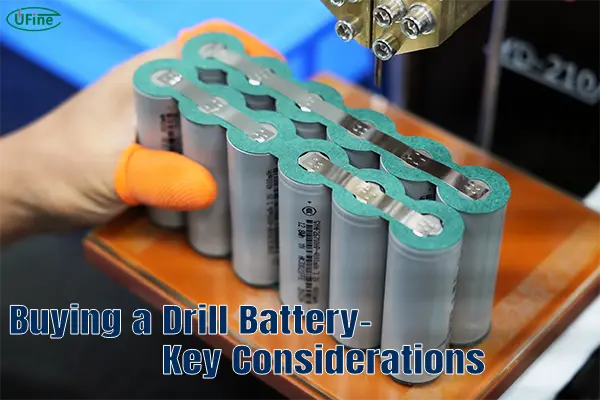
Before choosing a drill battery, there are several important factors to consider.
1. Voltage
Higher voltage generally means more power output.
Common voltage ranges include:
- 12V for light DIY work
- 18V or 20V for general professional use
- 36V+ for heavy-duty industrial drilling
Higher voltage improves torque and drilling speed but may also increase battery weight.
2. Capacity (Ah or Wh)
Battery capacity determines how long the drill can run before recharging.
Examples:
- 2.0Ah → lighter and compact
- 4.0Ah → balanced performance
- 5.0Ah+ → longer runtime for heavy workloads
Higher capacity is better for professionals using drills for extended periods.
3. Battery Chemistry
The three main battery types are:
Lithium-Ion (Li-ion)
Best overall option for most users because it is:
- Lightweight
- Fast charging
- Low maintenance
- Long-lasting
Nickel-Cadmium (NiCd)
Older technology that is:
- Durable
- Heavier
- Affected by memory effect
Nickel-Metal Hydride (NiMH)
Middle-ground option with:
- Moderate performance
- Larger size
- Less common use today
For most users, Li-ion remains the best lithium-ion battery choice for power tools.
If you’re comparing older NiCd or NiMH batteries with modern lithium-ion options, this guide on NiMH vs Li-ion vs NiCd explains which battery type works best for different drill applications.
4. Charging Time
Fast charging reduces downtime significantly.
Many premium batteries now support:
- 30 to 60-minute charging times
This is especially important for contractors and heavy daily users.
5. Weight
A lighter battery improves comfort and reduces fatigue, especially during:
- Overhead drilling
- Long work sessions
- Repetitive tasks
Balance between runtime and weight is important.
6. Cycle Life
Cycle life refers to how many full charge and discharge cycles a battery can complete before noticeable capacity loss occurs.
Higher cycle life means:
- Better long-term value
- Lower replacement costs
- More reliable daily use
7. Manufacturer Quality
The manufacturer directly affects battery quality.
Choosing a trusted battery manufacturer helps ensure:
- A-grade raw material usage
- Better safety standards
- Consistent performance
- Strong warranty support
- Reliable after-sales service
- Better customization options if needed
This is why manufacturer selection is often just as important as battery specifications.
Part 6. The top 5 best drill battery manufacturers
1. Ufine Battery

Founded in 2008 and headquartered in Shenzhen, China, Ufine Battery focuses heavily on lithium battery manufacturing rather than finished power tools. This makes it different from Bosch, Makita, or DeWalt, which mainly serve end users inside closed tool ecosystems.
For buyers looking for custom battery for drill machine applications, Ufine offers more flexibility than traditional branded battery systems. Customers can customize battery voltage, capacity, housing structure, dimensions, discharge performance, and safety protection based on exact project requirements.
Its lithium-ion drill batteries are commonly used not only in power tools, but also in RV systems, UPS, medical equipment, and industrial electronics. This cross-industry manufacturing experience improves battery consistency and engineering quality.
For OEM brands, wholesalers, and industrial users, Ufine is often a stronger solution than standard retail replacement batteries because the focus is on battery engineering itself rather than brand ecosystem lock-in.
Best For: OEM customization, industrial buyers, private-label drill battery projects, and specialized power tool battery solutions
Price: Low to Mid Range (depending on customization requirements)
Key Features:
- Lithium-ion and lithium polymer battery manufacturing
- Full customization for voltage, capacity, dimensions, shape, discharge rate, and protection circuits
- BMS integration for overcharge, over-discharge, overcurrent, and short-circuit protection
- Multiple international certifications available depending on project requirements
- OEM and ODM production support
- Engineering support for custom drill machine battery packs
- Flexible small-batch and bulk production capability
- Global export experience across multiple industries
What We Like:
- Strong flexibility for non-standard drill battery requirements
- Better suited for battery pack customization than many branded retail manufacturers
- Competitive pricing for wholesale and industrial procurement
- In-house engineering team helps optimize battery structure and performance
- Can support special voltage platforms beyond common 12V, 18V, and 20V systems
- Suitable for private-label cordless drill battery projects
What Could Be Better:
- Not as widely recognized by retail consumers as major power tool brands
- Limited direct compatibility with mainstream branded drill platforms like DeWalt or Makita
- Better suited for B2B buyers than individual DIY consumers
2. Bosch

Bosch has been a major engineering company since 1886 and remains one of the most respected names in professional power tools and industrial battery systems. Its drill battery reputation comes largely from strong thermal engineering and battery durability.
The company’s CoolPack technology is one of its most important advantages. Heat is one of the biggest reasons lithium-ion batteries lose capacity over time, and Bosch addresses this by using heat-conductive housing and improved internal thermal design. This helps extend battery lifespan and supports stronger sustained performance.
The ProCORE18V platform has become especially popular among professionals who need high-output performance for heavy drilling, hammer drilling, and impact applications. Compared to standard battery packs, ProCORE batteries offer stronger current delivery and improved runtime.
Bosch is not usually the cheapest option, but for contractors using drills every day, reliability often matters more than initial price. Its batteries are designed for long-term professional use rather than occasional home repairs.
Best For: Professional contractors, construction users, and tradespeople who prioritize reliability, cooling performance, and long-term durability
Price: Mid to High Range
Key Features:
- Professional-grade lithium-ion battery systems
- GBA 12V and GBA 18V battery platforms
- ProCORE18V high-performance battery line
- CoolPack thermal management technology
- Fast charging compatibility
- Low self-discharge and zero memory effect
- Heat-conductive battery housing
- Advanced battery-cell balancing for improved lifespan
What We Like:
- CoolPack technology significantly improves heat management
- Strong consistency during demanding drilling applications
- Excellent performance stability under continuous heavy loads
- Long battery lifespan compared to lower-cost alternatives
- Strong compatibility across Bosch Professional tools
- High-quality internal cell selection and protection systems
What Could Be Better:
- Original replacement batteries can be expensive
- Bosch battery systems work best inside the Bosch ecosystem
- Some high-capacity ProCORE models may be heavier for light-duty users
3. Makita

Makita has been manufacturing professional tools since 1915 and introduced one of the earliest rechargeable cordless drills decades before lithium-ion became standard. Today, its battery platforms are among the most trusted in construction and industrial work.
Its 18V LXT system remains one of the most widely used professional cordless drill platforms worldwide. For users needing even more output, the newer XGT 40V max platform supports heavier-duty drilling and demanding industrial applications.
One of Makita’s strongest advantages is charging speed. Rapid Optimum Chargers significantly reduce downtime, which is a major benefit for contractors working multiple jobs per day. Instead of needing several backup batteries, users can rotate fewer packs more efficiently.
Makita also uses Star Protection technology to monitor battery temperature, overload, and discharge conditions in real time. This improves both user safety and battery longevity.
For users who value productivity and reduced downtime, Makita consistently ranks among the best battery drill systems available.
Best For: Professionals who want fast charging, strong runtime, and dependable all-day job site performance
Price: Mid to High Range
Key Features:
- 18V LXT lithium-ion battery platform
- 40V max XGT high-output battery system
- Rapid Optimum Charger technology
- Full charge in as little as 25–45 minutes depending on model
- Battery charge level indicator
- Star Protection Computer Controls
- Impact-resistant outer case
- Shock-absorbing inner liner
- Strong high-temperature and low-temperature operating stability
What We Like:
- One of the fastest charging systems in the professional tool market
- Excellent runtime-to-weight balance
- Strong cycle life with 500+ charge cycles common
- Durable battery construction for rough job site environments
- Reliable performance under temperature extremes
- Wide compatibility across the Makita cordless platform
What Could Be Better:
- Premium batteries can be expensive for first-time buyers
- Full value is best realized only inside the Makita ecosystem
- XGT platform investment can be costly for smaller users
4. Milwaukee

Milwaukee Electric Tool Corporation, founded in 1924 and now part of Techtronic Industries, has built a reputation around professional-grade durability and job site performance. Its batteries are designed for users who cannot afford downtime.
The company’s REDLITHIUM system focuses on delivering stable power output rather than short bursts of performance. This matters in heavy drilling, concrete anchoring, mechanical fastening, and industrial repair work where voltage drop can reduce productivity.
Its M12 platform is ideal for compact drills and tight-space work, while M18 supports larger drills and higher-demand applications. The newer High Output battery line pushes performance even further for professional users requiring stronger continuous discharge.
Milwaukee batteries also feature strong environmental resistance against grease, solvents, vibration, and job site abuse. This makes them especially popular in automotive, HVAC, electrical, and industrial maintenance work.
For serious professionals, Milwaukee is often viewed as a productivity investment rather than simply a battery purchase.
Best For: Heavy-duty professional work, industrial applications, mechanical trades, and users demanding maximum output and durability
Price: High Range
Key Features:
- REDLITHIUM lithium-ion battery technology
- M12 compact battery platform
- M18 heavy-duty battery platform
- High Output battery series for extreme performance
- Fade-free power delivery
- Intelligent communication between battery, charger, and tool
- Protection against oil, grease, and chemical exposure
- Strong vibration and impact resistance
- Extended runtime with high current output
What We Like:
- Excellent sustained power under heavy drilling loads
- Very strong durability in harsh environments
- High-output models support industrial-grade applications
- Strong reputation among electricians, mechanics, and contractors
- Battery platform supports a huge range of professional tools
- Very reliable performance for continuous daily use
What Could Be Better:
- Higher upfront battery cost than many competitors
- Larger battery packs can become heavy for overhead or precision work
- Premium ecosystem may be excessive for casual DIY users
5. DeWalt

DeWalt, founded in 1924 and now part of Stanley Black & Decker, remains one of the most recognized names in power tools across both professional construction and advanced DIY markets.
Its 20V MAX platform is widely used for standard cordless drills, while the FLEXVOLT system provides a more advanced dual-voltage solution for users needing both portability and high-output performance. This makes DeWalt especially attractive for users operating across multiple tool categories.
The company’s pouch cell battery technology helps improve battery lifespan and cooling performance compared to older cylindrical pack structures. Combined with Tool Connect smart battery management, DeWalt offers strong modern battery management features.
Another major strength is ecosystem accessibility. Replacement batteries, chargers, and compatible tools are easy to find globally, which reduces long-term ownership risk.
For buyers who want a reliable, future-proof drill battery platform without overly specialized industrial complexity, DeWalt remains one of the safest and strongest choices.
Best For: Professional users, serious DIY owners, and buyers who want broad tool compatibility with strong long-term value
Price: Mid to High Range
Key Features:
- 20V MAX lithium-ion battery platform
- FLEXVOLT dual-voltage battery technology
- Pouch cell battery design
- Charge level indicator
- Tool Connect smart battery management compatibility
- Strong wear and impact resistance
- 90-minute full charge depending on model
- 3-year limited warranty
- Strong dealer and replacement battery availability
What We Like:
- Excellent compatibility across a large cordless tool ecosystem
- FLEXVOLT system offers strong flexibility for different power demands
- Strong durability for both professional and home workshop use
- Pouch cell design improves thermal efficiency and service life
- Reliable warranty and strong aftermarket support
- Easy availability of genuine replacement batteries
What Could Be Better:
- FLEXVOLT premium batteries can be expensive
- Full performance benefits are strongest inside the DeWalt ecosystem
- Some heavy-duty packs add noticeable weight
Part 7. FAQs
1. Can I replace a Ni-Cd drill battery with a lithium-ion battery?
Not directly in most cases. Lithium-ion and Ni-Cd batteries use different charging systems, voltage behavior, and battery management requirements. Unless the drill and charger are specifically designed for both types, replacing a Ni-Cd battery with a lithium-ion battery may cause compatibility and safety issues.
2. Why does my cordless drill battery lose power so quickly?
Common reasons include battery aging, improper charging habits, overheating, long-term storage without use, or using non-original replacement batteries. Lithium-ion batteries naturally lose capacity over time, especially after hundreds of charge cycles.
3. Should I leave my drill battery on the charger overnight?
Modern lithium-ion batteries usually have overcharge protection, but leaving them on the charger continuously is still not ideal for long-term battery health. It is better to remove the battery once fully charged whenever possible.
4. Does cold weather affect drill battery performance?
Yes. Low temperatures can temporarily reduce lithium-ion battery efficiency and runtime. In very cold environments, the battery may deliver less power until it returns to normal operating temperature.
5. Can one battery work across different tool brands?
Usually no. Most major brands like Bosch, Makita, Milwaukee, and DeWalt use proprietary battery platforms with unique connectors and electronic communication systems, so cross-brand compatibility is very limited.
Related Tags:

More Articles
Best 24V Lithium Battery: Top 10 Compared
Discover the top 24V lithium batteries. We compare capacity, price, cycle life, safety features, and the best options for different applications.
Top LFP Cell Manufacturers in China You Should Know
Looking for reliable LiFePO4 cells? Explore China's top LFP battery manufacturers, key technologies, production capabilities, and supplier selection tips.
Check If Your Charger Works: Simple Test Guide
Think your battery charger's broken? Quick tests can show you for sure. See if it’s the charger or the battery that's causing issues. Read more.
Best Camera Batteries: 7 Brands Compared & Tested
Looking for the best camera battery? Compare 7 top brands, including OEM and third-party options, to find the right battery for your camera.
What You Need to Know About Portable Fan Batteries
Discover the best portable electric fan battery, its types, lifespan, and maintenance tips. Learn how to choose the right one and keep it running longer.


