
- Part 1. What is battery calibration in embedded systems?
- Part 2. Why does SOC estimation become inaccurate?
- Part 3. How battery calibration works with fuel gauge ICs
- Part 4. Common battery calibration methods
- Part 5. Battery calibration process during product development
- Part 6. How to improve battery percentage accuracy in consumer electronics
- Part 7. Common battery calibration mistakes engineers should avoid
- Part 8. FAQs
For engineers designing battery-powered products, selecting a high-quality lithium battery is only part of the challenge. Accurate battery monitoring is equally important. A device may use a reliable LiPo battery, but inaccurate State of Charge (SOC) estimation can still cause unexpected shutdowns, incorrect battery percentage displays, and poor user experience.
This is where battery calibration becomes essential.
Battery calibration does not increase the actual capacity of a lithium battery. Instead, it improves the accuracy between the battery’s real condition and the value reported by the Battery Management System (BMS) or fuel gauge IC.
Key takeaways
- Battery calibration improves SOC estimation accuracy rather than increasing battery capacity.
- Fuel gauge ICs rely on voltage measurement, current tracking, battery models, and learning algorithms to estimate remaining capacity.
- Battery aging, temperature changes, and measurement errors can cause SOC drift over time.
- Proper battery characterization during product development is critical for accurate battery percentage prediction.
Part 1. What is battery calibration in embedded systems?
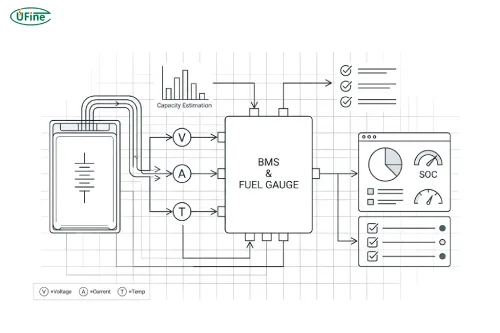
In embedded devices, battery calibration refers to the process of synchronizing the battery monitoring system with the actual battery characteristics.
A battery-powered product usually contains several components responsible for power management:
- Lithium battery cell or battery pack
- Protection circuit module (PCM)
- Battery Management System (BMS)
- Fuel gauge IC
- Microcontroller or operating system
The fuel gauge estimates remaining battery energy by analyzing multiple parameters, including:
| Parameter | Function in battery calibration |
|---|---|
| Voltage | Provides information about battery state and charging condition |
| Current | Tracks energy entering and leaving the battery through coulomb counting |
| Temperature | Compensates for capacity changes caused by environmental conditions |
| Battery capacity | Defines the relationship between full charge and remaining energy |
The goal of calibration is to ensure that the displayed battery percentage matches the actual available energy.
For example, a wearable device may display 30% remaining battery power. However, if the fuel gauge has inaccurate parameters, the device may shut down after only a few minutes. Calibration helps reduce this difference.
The role of BMS in battery calibration
A Battery Management System (BMS) is responsible for more than battery protection.
A complete BMS solution typically manages:
- Overcharge protection
- Over-discharge protection
- Overcurrent protection
- Temperature monitoring
- Voltage measurement
- Current monitoring
- SOC estimation
For small consumer electronics, a compact protection circuit may be enough. However, more advanced devices often require intelligent battery monitoring systems.
Part 2. Why does SOC estimation become inaccurate?

The State of Charge (SOC) value represents the remaining capacity of a battery, usually expressed as a percentage.
For example:
- 100% SOC = fully charged battery
- 50% SOC = approximately half of available capacity remaining
- 0% SOC = battery reaches the minimum operating limit
However, SOC estimation is not a simple measurement. It is a calculation based on battery behavior, which can change over time.
Battery aging changes actual capacity
A lithium battery’s capacity decreases gradually during its lifetime.
For example:
A new 500mAh LiPo battery may provide close to 500mAh capacity. After hundreds of charge cycles, the actual available capacity may decrease.
If the fuel gauge still uses the original capacity value, the displayed battery percentage becomes inaccurate.
Common symptoms include:
- Battery percentage drops quickly from 30% to 0%
- Device shuts down earlier than expected
- Charging reaches 100% too quickly
Coulomb counting errors accumulate over time
Many modern fuel gauge ICs use coulomb counting technology.
The principle is:
Remaining capacity = charged energy – consumed energy
The system continuously measures:
- Charging current
- Discharging current
- Operating time
However, small measurement errors can accumulate.
Possible causes include:
- Current sensor accuracy limitations
- Standby leakage current
- Temperature-related measurement changes
- Incorrect battery parameters
After many charge and discharge cycles, these small errors may create noticeable SOC drift.
Operating conditions affect battery behavior
Lithium batteries do not behave identically under all conditions.
Factors that influence SOC accuracy include:
High current discharge
Applications such as:
- Robotics
- Drones
- Motorized devices
may experience large current fluctuations.
High discharge current causes voltage drops due to internal resistance, making voltage-based SOC estimation less accurate.
Temperature changes
Battery performance changes significantly with temperature.
Low temperatures can cause:
- Reduced available capacity
- Increased internal resistance
- Lower discharge performance
High temperatures can accelerate battery aging and permanently reduce capacity.
Part 3. How battery calibration works with fuel gauge ICs
Modern consumer electronics usually do not rely on simple voltage measurement alone. Instead, they combine multiple methods to improve accuracy.
Battery characterization
Before mass production, engineers usually need to characterize the battery.
Testing may include:
- Charge curves
- Discharge curves
- Internal resistance measurement
- Temperature performance
- Cycle life testing
The collected data is used to create a battery profile.
A battery profile helps the fuel gauge understand how the battery behaves under different conditions.
Full charge detection
The system needs to accurately identify the fully charged state.
Important parameters include:
- Maximum charging voltage
- Charging termination current
- Charging time
- Battery temperature during charging
For example, most standard LiPo batteries use a charging voltage of 4.2V per cell. However, charging behavior can vary depending on battery design and application requirements.
Empty point calibration
The fuel gauge also needs to understand the battery’s lower operating limit.
This prevents:
- Premature shutdown
- Excessive battery discharge
- Incorrect remaining capacity estimation
Engineers typically define:
- Minimum voltage
- Remaining capacity threshold
- System shutdown point
Learning cycles
Many advanced fuel gauge ICs improve accuracy through learning cycles.
During operation, the system compares:
- Estimated capacity
- Actual charging and discharging behavior
The battery model is gradually updated to compensate for aging.
Part 4. Common battery calibration methods
Different applications may require different calibration approaches.
| Calibration method | Advantages | Limitations | Typical applications |
|---|---|---|---|
| Voltage-based estimation | Simple and low cost | Less accurate under load | Basic electronics |
| Coulomb counting | High accuracy | Requires current measurement calibration | Smartphones, wearables, IoT devices |
| Impedance-based estimation | Provides advanced battery information | More complex implementation | High-performance systems |
Voltage-based calibration
Voltage-based estimation uses battery voltage to estimate SOC.
Advantages:
- Low cost
- Easy implementation
- Requires fewer components
However, lithium batteries have relatively flat voltage curves in some SOC ranges, making accurate estimation difficult.
Coulomb counting calibration
Coulomb counting measures current flow into and out of the battery.
Advantages:
- Higher accuracy
- Suitable for intelligent devices
- Works well with rechargeable LiPo batteries
However, periodic calibration is often required because small measurement errors accumulate over time.
Impedance-based estimation
This method analyzes battery internal resistance and impedance characteristics.
It can provide additional information about:
- SOC
- State of Health (SOH)
- Battery aging
It is commonly used in more advanced battery systems.
Part 5. Battery calibration process during product development
For engineers developing consumer electronics, battery calibration should be considered during the design stage rather than after production.
Step 1: Select the right battery
Battery selection affects calibration accuracy.
Important factors include:
- Voltage
- Capacity
- Discharge rate
- Physical dimensions
- Operating temperature range
A properly matched battery provides more predictable performance.
Step 2: Test battery characteristics
Engineers should collect real battery data instead of relying only on rated specifications.
Recommended tests include:
- Full charge and discharge testing
- Different discharge current conditions
- Temperature testing
- Long-term cycle testing
Step 3: Configure fuel gauge parameters
Fuel gauge settings usually include:
- Design capacity
- Full charge capacity
- Charging voltage
- Termination current
- Battery profile
Incorrect configuration can lead to inaccurate battery percentage estimation.
Step 4: Validate real-world performance
Laboratory testing alone is not enough.
Products should be tested under actual user conditions:
- Standby operation
- High-power usage
- Partial charging
- Temperature variations
Part 6. How to improve battery percentage accuracy in consumer electronics
Engineers can improve SOC accuracy through several design strategies.
Use an appropriate fuel gauge IC
A basic voltage measurement solution may work for simple products, but advanced devices usually require dedicated fuel gauge ICs.
Examples include:
- Wearable devices
- Smart headphones
- Portable medical devices
- IoT sensors
Create accurate battery profiles
Different batteries require different parameters.
Even two LiPo batteries with the same:
- Voltage
- Capacity
- Size
may behave differently because of:
- Cell chemistry
- Internal resistance
- Manufacturing differences
Battery characterization is therefore essential.
Consider real operating conditions
A battery system should be tested beyond ideal laboratory conditions.
Engineers should consider:
- User charging habits
- Peak current requirements
- Environmental temperature
- Long-term battery aging
Part 7. Common battery calibration mistakes engineers should avoid
Using rated capacity as actual capacity
The rated capacity is measured under specific test conditions. Real-world capacity may vary depending on:
- Current load
- Temperature
- Battery age
Ignoring temperature effects
A battery profile created at room temperature may not perform accurately in extreme environments.
Testing only full charge and discharge cycles
Real users often:
- Charge partially
- Use devices intermittently
- Operate under changing loads
Testing should reflect real usage patterns.
Selecting a fuel gauge without battery testing
A fuel gauge algorithm depends heavily on battery characteristics.
Using default parameters may result in poor SOC accuracy.
Part 8. FAQs
1. Can battery calibration compensate for battery aging?
Battery calibration can improve SOC accuracy after aging, but it cannot restore lost battery capacity.
2. What data is needed for battery calibration?
Battery calibration usually requires charge curves, discharge data, capacity measurements, and temperature performance data.
3. How long does battery calibration take?
The process depends on the battery system and may take several charge and discharge cycles during development.
5. Does a higher-capacity battery need different calibration?
Yes. Different capacity batteries usually require adjusted parameters for accurate SOC estimation.
6. How often should a battery system be calibrated?
The frequency depends on the battery type, application, and fuel gauge algorithm. Many systems calibrate automatically through learning cycles.
7. Can incorrect calibration harm a lithium battery?
Incorrect calibration usually does not damage the battery directly, but inaccurate SOC estimation may affect device reliability.
Related Tags:

More Articles

Battery Calibration: Why Is Your Battery % Wrong?
Is your battery percentage inaccurate? Learn how battery calibration works, when you need it, and how to fix unexpected battery drops.
How Internal Resistance Limits LiPo Battery Performance
Your LiPo Battery may have enough capacity but still fail under load. Discover how Internal Resistance causes voltage sag, heat, and power loss.
What Engineers Can Learn From a Discharge Curve for LithiumBattery?
What can a discharge curve for lithium ion battery tell engineers? Learn how voltage, C-rate, temperature, and capacity affect real-world performance.
Best 24V Lithium Battery: Top 10 Compared
Discover the top 24V lithium batteries. We compare capacity, price, cycle life, safety features, and the best options for different applications.


