
- Part 1. What is battery pack welding?
- Part 2. Which battery cells are suitable for DIY welding?
- Part 3. Choosing the right battery welding method
- Part 4. How to choose nickel strip for a battery pack
- Part 5. How welding current, time, and pressure affect weld quality
- Part 6. Battery pack welding layout matters more than it seems
- Part 7. Battery welding for high-current applications
- Part 8. How to test a battery pack after welding
- Part 9. Common battery welding mistakes
- Part 10. DIY battery pack welding safety considerations
- Part 11. FAQs
For DIY projects, one of the most important steps in building a reliable Battery Pack is creating a safe, low-resistance connection between cells.
Battery Welding is commonly used for this purpose. However, successful battery welding involves much more than simply placing a nickel strip on a cell and pressing a welding machine electrode against it. Welding current, pulse duration, electrode pressure, strip material, cell construction, heat management, and the final current path all affect the performance and safety of the finished pack.
Key takeaways
- Battery welding creates a low-resistance mechanical and electrical connection between battery cells and conductive tabs or strips.
- Resistance spot welding is widely used for cylindrical lithium-ion cells, while LiPo pouch cells require different connection approaches.
- Welding current, pulse duration, and electrode pressure must be considered together rather than using one universal setting.
- Excessive heat can damage a lithium battery even when the weld appears visually acceptable.
- Nickel strip selection should consider current, resistance, dimensions, material, and temperature rise.
- A reliable Battery Pack requires more than good welds. Cell matching, insulation, protection circuitry, wiring, connectors, and testing are equally important.
Part 1. What is battery pack welding?
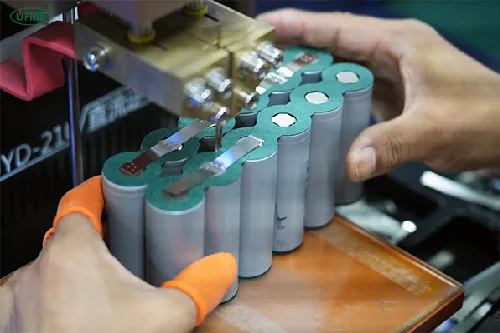
Battery Pack welding is a process used to join battery cells to conductive materials such as nickel strips, tabs, or busbars. The goal is to create an electrical connection with sufficiently low resistance while maintaining adequate mechanical strength.
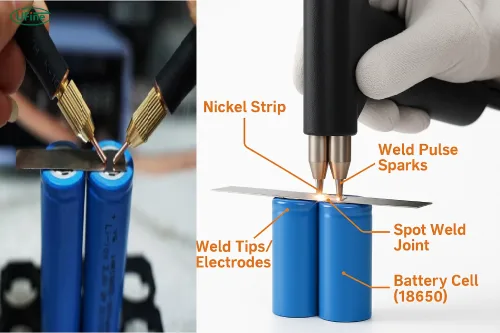
For many cylindrical lithium-ion battery packs, resistance spot welding is a common method. Instead of heating the entire cell terminal, a short, high-current pulse produces localized heat at the interface between the cell terminal and metal strip.
This is important because conventional soldering can transfer considerable heat into the cell. Welding can keep the main heat concentration at the connection point when the process is properly controlled.
How resistance spot welding works
Resistance spot welding relies on electrical resistance to generate localized heat.
The basic process is straightforward:
- Electrodes press the conductive strip against the cell terminal.
- A high-current pulse passes through the contact area.
- Electrical resistance produces localized heat.
- The metal interface reaches a temperature sufficient to form a weld.
- The current stops and the joint cools.
The heat generated can be simplified as:
Q = I²Rt
where I represents welding current, R represents electrical resistance, and t represents welding time.
This explains why welding current and pulse duration cannot be considered separately.
A stronger-looking weld is not necessarily a better weld. Excessive energy can increase heat transfer into the cell, damage the terminal, deform the strip, or create other problems.
Part 2. Which battery cells are suitable for DIY welding?
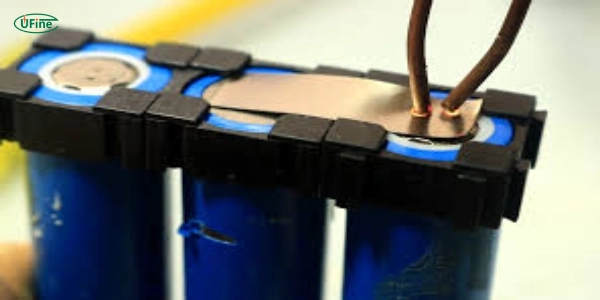
Not every rechargeable battery should be treated in the same way. The cell’s construction has a major influence on the appropriate connection method.
Cylindrical lithium-ion cells
18650 and 21700 cells are common examples. Their metal can construction makes them suitable for resistance spot welding with an appropriate conductive strip.
A typical DIY battery pack may connect cells in series and parallel using nickel or nickel-plated steel strips. The welding process creates multiple small connection points between the strip and cell terminal.
Lithium polymer pouch cells
LiPo pouch cells are different. They use a flexible pouch structure and normally have positive and negative tabs extending from the cell.
You should not assume that a conventional spot welder designed for cylindrical cells can simply be applied to a LiPo pouch cell. The pouch, tab construction, insulation, and internal electrode structure require a different assembly approach.
For many LiPo Battery Pack designs, the focus is on welding or connecting the existing tabs rather than directly spot welding a strip onto the pouch itself.
LiFePO4 cells
LiFePO4 cells can also be assembled into battery packs, but their physical construction varies significantly. Cylindrical, prismatic, and pouch formats may require different connection methods.
The correct approach should therefore be selected according to the specific cell design rather than chemistry alone.
Part 3. Choosing the right battery welding method
Several joining technologies can be used in battery pack manufacturing. The best method depends on the cell format, conductive material, production volume, required current, and thermal limitations.
| Welding method | Typical use | Main advantage | Main consideration |
|---|---|---|---|
| Resistance spot welding | Cylindrical cells | Fast and localized heating | Parameters must be controlled |
| Laser welding | Industrial battery packs | Precise and repeatable | Higher equipment cost |
| Ultrasonic welding | Tabs and conductive foils | Low thermal impact | Specialized equipment |
| Soldering | Wires and connectors | Simple equipment | Greater risk of cell heating |
For a DIY Battery Pack using cylindrical cells, resistance spot welding is often the most practical option. For commercial consumer electronics, however, manufacturers may use more advanced welding and assembly processes depending on the pack architecture.
Battery pack welding vs soldering
Welding and soldering are not interchangeable in every application.
Soldering is convenient for connecting wires, connectors, and electronic components, but prolonged heat exposure around a lithium cell can be undesirable.
Resistance welding can provide a more localized heat input when properly controlled, making it attractive for cylindrical cell interconnections.
The important question is not simply whether welding is better than soldering. The better question is whether the connection method is appropriate for the cell, material, current level, and application.
Part 4. How to choose nickel strip for a battery pack
Nickel strip is commonly used in cylindrical Battery Pack construction, but choosing a strip based only on its appearance or thickness is not enough.
You should consider:
- Electrical conductivity
- Strip width
- Strip thickness
- Strip length
- Material composition
- Continuous current
- Peak current
- Expected temperature rise
- Welding compatibility
Pure nickel generally has different electrical and welding characteristics from nickel-plated steel. Therefore, a welding parameter that works well for one material may not produce the same result with another.
Strip geometry also affects current carrying capability. A wider strip can provide a larger conductive cross-section, while a longer current path increases resistance.
For high-current applications, the strip should be designed as part of the entire electrical path rather than treated as an isolated component.
Part 5. How welding current, time, and pressure affect weld quality
Three important welding variables are current, pulse duration, and electrode pressure.
Welding current
If current is too low, the weld may have insufficient mechanical strength or excessive electrical resistance.
If current is too high, the process can generate excessive heat, damage the material, produce metal splash, or increase stress on the cell.
Welding time
A longer pulse generally increases heat input. However, simply increasing welding time to compensate for insufficient current is not always appropriate.
The goal is controlled energy input rather than maximum energy.
Electrode pressure
Electrode pressure affects the electrical contact between the electrode, strip, and cell.
Insufficient pressure can create unstable contact and inconsistent welds. Excessive pressure can change the resistance at the interface and potentially deform the materials.
The optimal combination depends on the welding machine, electrodes, strip material, cell design, and other process variables. There is no universal welding setting that works for every Battery Pack.
How to prevent battery damage during welding
Heat management is one of the most important considerations in Battery Welding.
A lithium-ion cell contains sensitive internal components, including electrodes and a separator. Excessive heat or mechanical damage can compromise the cell.
To reduce risk, avoid unnecessarily long welding pulses and repeated welding at the same location.
You should also inspect cells before assembly. Do not use cells that are swollen, punctured, severely dented, corroded, leaking, or otherwise damaged.
UL Solutions identifies short circuits, mechanical damage, contamination, misalignment, and poor welds among conditions that can contribute to lithium-ion battery failures. Proper manufacturing controls and inspection are therefore important throughout the battery assembly process.
Part 6. Battery pack welding layout matters more than it seems
A Battery Pack is an electrical system, not simply a collection of welded cells.
Consider the complete current path:
Cell → Weld → Nickel strip → Bus connection → Wire → Connector → Load
Every section contributes some resistance.
For a series-connected pack, the connections between cells influence the total current path and voltage drop. In parallel configurations, the layout also affects how current is distributed between cells.
Long strips, narrow conductors, poor welds, undersized wires, and high-resistance connectors can all increase losses.
This becomes particularly important in high-current applications such as robotics, drones, portable power equipment, and other devices with significant peak loads.
Part 7. Battery welding for high-current applications
High-current Battery Packs require special attention because even small resistances can create substantial heat.
The overall resistance can be considered as:
Rtotal = Rcell + Rweld + Rstrip + Rwire + Rconnector
The actual electrical design is more complex, but this simplified model demonstrates an important principle: improving only the weld may not solve a pack-level resistance problem.
For example, if the weld has very low resistance but the wire or connector is undersized, the connector can still become the limiting component.
High-current designs should therefore evaluate continuous current, peak current, voltage drop, temperature rise, and the complete current path.
Part 8. How to test a battery pack after welding
Battery Welding should never be considered the final step.
A finished Battery Pack should be inspected and tested before being placed into normal service.
Visual inspection
Check for:
- Inconsistent weld marks
- Damaged insulation
- Deformed terminals
- Damaged cells
- Loose strips
- Signs of overheating
Mechanical testing
A properly made weld should provide adequate mechanical strength. In manufacturing environments, controlled mechanical tests can be used to evaluate weld consistency.
Resistance testing
Measuring resistance can help identify abnormal connections. A connection with significantly higher resistance than others may indicate an inconsistent weld or poor current path.
Load testing
Voltage should be measured under realistic load conditions rather than only when the pack is at rest.
A significant voltage drop can indicate excessive resistance somewhere in the pack.
Temperature testing
Temperature measurements during charging and discharge can reveal problems that are not visible during inspection.
A connection that becomes noticeably hotter than neighboring connections deserves investigation.
Part 9. Common battery welding mistakes
Several mistakes frequently reduce the reliability of DIY Battery Packs.
Using excessive welding energy: More energy does not automatically mean a stronger connection.
Choosing strip thickness by appearance: A visually thick strip is not necessarily appropriate for the required current.
Assuming a good-looking weld has low resistance: Appearance alone cannot verify electrical performance.
Repeatedly welding the same point: Multiple weld attempts can increase localized heat.
Ignoring current distribution: Pack layout affects how current flows between cells.
Using undersized wires: A good cell-to-strip connection cannot compensate for an inadequate wire.
Skipping insulation: Exposed conductive surfaces can create accidental short circuits.
Testing only open-circuit voltage: A pack can show normal voltage while still having excessive resistance under load.
Part 10. DIY battery pack welding safety considerations
Lithium-ion batteries store a large amount of energy in a relatively compact package. A short circuit can therefore produce extremely high current.
When working on a DIY Battery Pack, use a non-conductive work surface, keep unnecessary metal objects away from exposed terminals, and prevent accidental contact between positive and negative connections.
Never weld a visibly damaged or swollen cell.
You should also use the correct charger and appropriate protection circuitry for the pack configuration. For multi-cell packs, a suitable BMS may be required depending on the application and battery architecture.
For commercial consumer electronics, battery safety also involves applicable testing, certification, transportation requirements, and production quality controls. UL Solutions lists standards such as UL 1642 and IEC 62133-2 among relevant battery safety standards for applicable lithium battery products.
Final checklist for a reliable DIY battery pack
Before using a newly assembled Battery Pack, check the following:
- Correct cell type and specification
- Compatible cells with appropriate matching
- Suitable welding method
- Correct conductive strip material
- Proper welding parameters
- Strong and consistent welds
- Low-resistance current path
- Adequate insulation
- Appropriate protection circuit or BMS
- Correct wire size
- Suitable connector
- Mechanical protection
- Voltage verification
- Load testing
- Temperature monitoring
A successful Battery Welding process is only one part of a reliable battery design. The best results come from treating the battery as a complete electrical and mechanical system.
For DIY projects, understanding how welding current, resistance, heat, and current distribution interact can help you avoid many common problems. For consumer electronics and production applications, working with a battery manufacturer can further simplify cell selection, pack design, protection, testing, and certification.
Part 11. FAQs
1. How many weld points should each battery connection have?
There is no universal number. The required weld pattern depends on the strip material, strip dimensions, current requirements, cell design, and welding process.
2. How long does a welded battery pack typically last?
Battery Pack life is primarily determined by cell chemistry, operating temperature, depth of discharge, charge conditions, current load, and usage patterns. Weld quality can also affect reliability.
3. Can battery welding connections become loose over time?
Yes. Mechanical stress, vibration, thermal cycling, poor initial weld quality, and inadequate pack construction can cause connection problems over time.
4. What causes uneven weld marks on a battery pack?
Uneven weld marks can result from inconsistent electrode pressure, unstable current, contaminated surfaces, electrode wear, inconsistent strip positioning, or unsuitable welding parameters.
5. Can battery welding be automated?
Yes. Industrial Battery Welding can be integrated into automated production lines using controlled welding equipment, fixtures, inspection systems, and robotic handling. This can improve consistency between battery packs.
6. How can you improve battery welding consistency?
Use consistent cell positioning, clean contact surfaces, properly maintained electrodes, controlled welding parameters, and regular weld inspection. Production environments can also use automated monitoring and quality-control systems.
Related Tags:

More Articles

How Internal Resistance Limits LiPo Battery Performance
Your LiPo Battery may have enough capacity but still fail under load. Discover how Internal Resistance causes voltage sag, heat, and power loss.
What Engineers Can Learn From a Discharge Curve for LithiumBattery?
What can a discharge curve for lithium ion battery tell engineers? Learn how voltage, C-rate, temperature, and capacity affect real-world performance.
Best 24V Lithium Battery: Top 10 Compared
Discover the top 24V lithium batteries. We compare capacity, price, cycle life, safety features, and the best options for different applications.
Top LFP Cell Manufacturers in China You Should Know
Looking for reliable LiFePO4 cells? Explore China's top LFP battery manufacturers, key technologies, production capabilities, and supplier selection tips.
Check If Your Charger Works: Simple Test Guide
Think your battery charger's broken? Quick tests can show you for sure. See if it’s the charger or the battery that's causing issues. Read more.


