- Key takeaways
- Part 1. What is an aluminum-air battery?
- Part 2. How does an aluminum-air battery work?
- Part 3. Aluminum air battery vs lithium-ion battery
- Part 4. Materials needed to build an aluminum-air battery
- Part 5. How to assemble an aluminum air battery
- Part 6. Factors that affect aluminum-air battery efficiency
- Part 7. Common challenges in aluminum-air battery design
- Part 8. How to increase aluminum-air battery lifespan
- Part 9. Applications of aluminum air batteries
- Part 10. Future trends in aluminum-air battery technology
- Part 11. FAQs about aluminum air batteries
Aluminum-air batteries are a type of metal-air battery. They generate electricity using aluminum and oxygen from the air. These batteries are known for high energy density, low material cost, and lightweight design. Because of these features, they are often considered for backup power, transport systems, and remote energy applications.
This guide explains how an aluminum-air battery works, the materials used in its design, how it is assembled, key efficiency factors, common challenges, and real-world applications.
Key takeaways
- An aluminum-air battery produces electricity from a reaction between aluminum and oxygen in the air.
- It can offer higher energy density than many lithium-ion batteries.
- Main parts include an aluminum anode, air cathode, electrolyte, and separator.
- Most aluminum-air batteries are not electrically rechargeable and need aluminum replacement after use.
- Performance depends on aluminum purity, cathode structure, electrolyte choice, and corrosion control.
- Common uses include backup power systems, military devices, remote sensors, and range-extender systems.
Part 1. What is an aluminum-air battery?
An aluminum-air battery is a metal-air electrochemical cell. It produces electricity through a reaction between aluminum and oxygen.
Unlike normal batteries, oxygen is not stored inside the cell. Instead, oxygen enters from the surrounding air through the air cathode during operation. This makes the battery lighter and helps it achieve high energy density.
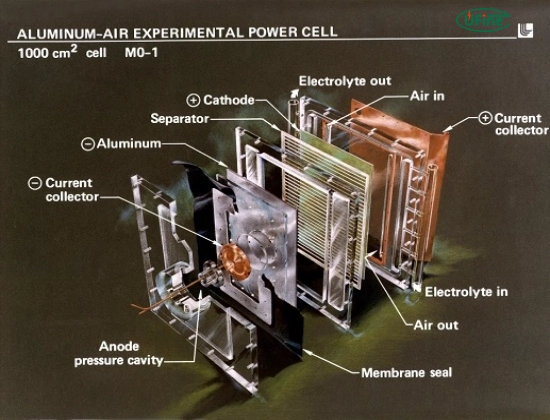
Main Components
- Aluminum anode
- Air cathode
- Electrolyte solution
- Separator membrane
- Current collectors
- Battery housing
When the battery works, aluminum reacts and releases electrons. These electrons flow through an external circuit and provide power to connected devices.
Part 2. How does an aluminum-air battery work?
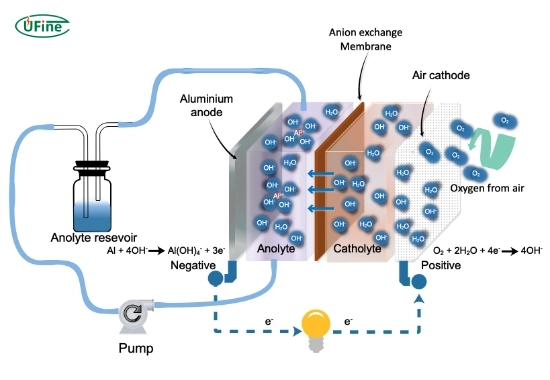
The battery produces electricity through chemical reactions at both electrodes.
Anode Reaction (Oxidation)
Al → Al³⁺ + 3e⁻
Aluminum loses electrons and slowly dissolves during discharge.
Cathode Reaction (Reduction)
O₂ + 6H₂O + 4e⁻ → 4OH⁻
Oxygen from the air reacts with water and incoming electrons.
Overall Reaction
4Al + 3O₂ + 6H₂O → 4Al(OH)₃
The main byproduct is aluminum hydroxide. It builds up over time. If not managed, it can lower battery performance.
The reactions above follow principles widely accepted by the U.S. Department of Energy (DOE) and other battery research groups.
Part 3. Aluminum air battery vs lithium-ion battery
Many people compare aluminum air batteries with lithium-ion batteries because both technologies target high-energy applications.
| Feature | Aluminum Air Battery | Lithium-Ion Battery |
|---|---|---|
| Energy Density | Up to 1,300 Wh/kg (practical systems lower) | Typically 150–300 Wh/kg |
| Weight | Very lightweight | Moderate |
| Rechargeability | Mechanical replacement of aluminum | Electrical recharge |
| Raw Material Cost | Relatively low | Higher |
| Safety | Low fire risk | Thermal runaway possible |
| Power Output | Moderate | High |
| Cycle Life | Limited by aluminum consumption | Hundreds to thousands of cycles |
| Environmental Impact | Recyclable aluminum | More complex recycling |
When aluminum-air batteries make sense
Aluminum-air technology works best in these cases:
- Long-term energy storage
- Emergency backup power
- Military use cases
- Remote monitoring devices
- Range-extender systems
- Marine and aerospace uses
For systems that need frequent charging and high power output, lithium-ion batteries are still the better option.
Battery performance is strongly affected by its internal structure. This includes how the main parts are arranged and work together. A lithium-ion battery, for example, uses layers like the cathode, anode, separator, and electrolyte.
You can learn more about this structure in our guide on lithium-ion battery structure.
Part 4. Materials needed to build an aluminum-air battery
The performance of an aluminum-air battery depends a lot on the materials used. Good material choice improves efficiency and stability.
Aluminum Anode
The anode is usually made from:
- High-purity aluminum
- Aluminum alloys
- Special corrosion-resistant aluminum types
Higher purity aluminum helps reduce self-corrosion. It also improves overall efficiency.
Air Cathode
Common materials for the air cathode include:
- Activated carbon
- Carbon cloth
- Carbon paper
- Catalysts like manganese oxide or silver-based materials
The air cathode must let oxygen pass through. At the same time, it must block electrolyte leakage.
Electrolyte
Common electrolyte options are:
- Sodium chloride (saltwater)
- Potassium hydroxide (KOH)
- Sodium hydroxide (NaOH)
Alkaline electrolytes often give better performance. However, they must be handled with care.
Additional Components
- Separator membrane
- Nickel mesh current collector
- Stainless steel mesh
- Conductive wires
- Plastic or acrylic housing
Part 5. How to assemble an aluminum air battery
The following process is commonly used for educational prototypes and laboratory demonstrations.
Prepare the Aluminum Anode
Cut an aluminum sheet or foil to the required size.
Build the Air Cathode
Attach activated carbon or carbon cloth to a conductive support structure.
Install the Separator
Place a porous separator between the anode and cathode.
Add Electrolyte
Soak the separator and electrode assembly with electrolyte solution.
Connect Current Collectors
Attach conductive wires to both electrodes.
Assemble the Housing
Install all components inside a non-corrosive container.
Allow Air Access
Ensure the cathode remains exposed to air while preventing contamination.
Test the Cell
Connect a small load such as:
- LED lights
- Sensors
- Small motors
- Low-power electronics
Assembly Tips
- Do not let the two electrodes touch each other.
- Keep the space between electrodes even and stable.
- Make sure air can flow well to the cathode.
- Reduce internal resistance with tight and secure connections.
Material choice is closely linked to how the battery is built. Small changes in electrode prep or stacking order can change resistance and efficiency.
For more details on manufacturing steps, see battery assembly techniques.
Part 6. Factors that affect aluminum-air battery efficiency
Aluminum-air batteries have high theoretical energy density. However, real performance can vary a lot in practice.
- Aluminum Purity: Impurities increase corrosion and reduce usable capacity.
- Cathode Design: A larger surface area helps oxygen move in and improves reaction efficiency.
- Electrolyte Quality: Fresh electrolyte improves ion flow and reduces performance loss.
- Electrode Spacing: Shorter distance lowers internal resistance.
- Operating Temperature: Medium temperatures usually give better performance.
- Byproduct Management: Aluminum hydroxide can build up and block active sites.
Well-designed systems can reach about 50% to 70% practical energy efficiency.
Recent studies in battery research journals focus on better cathode catalysts, lower corrosion, and possible rechargeable aluminum systems.
Part 7. Common challenges in aluminum-air battery design
Aluminum-air batteries have clear benefits. But they still face several technical limits.
- Self-Corrosion: Aluminum may react with electrolyte even when not in use.
- Aluminum Hydroxide Buildup: Byproducts reduce active surface area.
- Limited Rechargeability: Most systems need aluminum replacement instead of electrical charging.
- Air Cathode Degradation: The cathode can get blocked, flooded, or too dry during use.
- Low Power Density: These batteries store a lot of energy but deliver lower peak power.
Part 8. How to increase aluminum-air battery lifespan
Several design choices can help extend battery life.
- Use High-Purity Aluminum: This lowers unwanted side reactions.
- Add Corrosion Inhibitors: Special additives slow down aluminum wear.
- Improve Airflow Control: Stable oxygen flow supports cathode performance.
- Control Moisture: Keep the cathode damp, but not flooded.
- Remove Byproducts: Flow systems can clear aluminum hydroxide buildup.
Adopt Hybrid Battery Systems
Many systems combine aluminum-air and lithium-ion batteries:
- Aluminum-air provides long run time energy.
- Lithium-ion provides high power output.
This hybrid setup improves overall system performance.
Part 9. Applications of aluminum air batteries
The unique characteristics of aluminum-air technology make it suitable for specific industries.
| Application | Why Aluminum Air Batteries Are Used |
|---|---|
| Emergency Backup Power | Long storage life and high energy density |
| Military Equipment | Lightweight portable power |
| Remote Sensors | Extended runtime with minimal maintenance |
| Marine Systems | Reduced weight and corrosion-resistant designs |
| Aerospace | High energy-to-weight ratio |
| Electric Vehicle Range Extenders | Supplemental energy source for long-distance travel |
Many research groups are still studying aluminum-air systems. They see them as a possible option for future transport and large-scale energy storage.
Part 10. Future trends in aluminum-air battery technology
Research on aluminum batteries and aluminum-air systems is growing fast.
Main innovation areas include:
- Rechargeable Aluminum-Air Batteries: Researchers are testing new electrolytes and electrode designs. These may allow partial electrical recharge.
- Advanced Air Cathodes: New nanostructured catalysts can improve oxygen reaction speed and efficiency.
- Additive Manufacturing: 3D printing helps create custom battery parts and speeds up prototyping.
- Sustainable Materials: Using recycled aluminum can lower cost and reduce environmental impact.
- Intelligent Battery Management: Smart monitoring systems can improve performance and predict maintenance needs.
As these technologies improve, aluminum-air batteries may become more important in future energy storage systems.
Research on aluminum-based storage is not limited to aluminum-air batteries. Another key area is rechargeable metal-ion chemistry. It focuses on better cycle life and reversibility.
A related technology is aluminum-ion batteries. These systems aim to create rechargeable aluminum-based energy storage.
Part 11. FAQs about aluminum air batteries
Are aluminum air batteries rechargeable?
Most aluminum-air batteries cannot be electrically recharged. The used aluminum anode is replaced instead. The electrolyte may also be refreshed. This is often called mechanical recharging.
What is the energy density of an aluminum air battery?
Aluminum-air batteries can reach higher energy density than lithium-ion batteries in practice. Theoretical values can go over 1,000 Wh/kg. This makes them useful for long-duration energy use.
How long can an aluminum air battery last?
Runtime depends on battery size, load, and conditions. Large systems can run for days or even weeks before the aluminum needs to be replaced.
Are aluminum air batteries safer than lithium-ion batteries?
In general, yes. Aluminum-air batteries have lower risk of fire or thermal runaway. They do not store large amounts of reactive lithium materials.
What is the difference between an aluminum-air battery and an aluminum-ion battery?
An aluminum-air battery makes electricity from aluminum and oxygen in the air. It is usually not rechargeable. An aluminum-ion battery works through reversible ion movement. It is designed to be rechargeable, like lithium-ion batteries.
Related Tags:

More Articles
Dead Battery or Device Failure? How to Find the Cause
Think your device is broken? Learn how to tell if the problem comes from battery aging or hardware failure before replacing your electronics.
Why iPhone Duo Uses Two Batteries: The Engineering Behind Foldable Phone Power
Why do foldable phones need two batteries? Explore the engineering challenges behind iPhone Duo’s dual-battery architecture and future battery trends.
Solid-State Batteries: 3 Myths You Need to Know
Solid-state batteries promise safer EVs and longer range, but the reality is more complex. Discover the challenges behind this next-gen technology.
Battery Capacity vs Discharge Rate: The Choice Engineers Face
Higher capacity or higher discharge rate? Learn how to choose the right LiPo battery for longer runtime, stable power output, and better device performance.
Battery Cable Size Guide: Choose the Right Wire Fast
Not sure what battery cable size you need? Learn how to select the right wire gauge, terminal size, and cable for safer, more efficient battery systems.