
- Key takeaways
- Part 1. What does 500mah mean in a battery?
- Part 2. How to calculate 500mah battery life in hours
- Part 3. What types of devices use a 500mah battery?
- Part 4. Typical runtime of a 500mah battery
- Part 5. Is a 500mah battery enough for your product?
- Part 6. Are 500mah batteries rechargeable?
- Part 7. How long does it take to charge a 500mah battery?
- Part 8. How to extend the life of a 500mah battery?
- Part 9. 500mah vs other battery capacities
- Part 10. How to choose the right 500mah lithium battery?
- Part 11. Safety considerations for 500mah lithium batteries
- Part 13. FAQs about 500mah batteries
A 500mAh battery stores enough charge to provide 500mA for 1 hour, 250mA for 2 hours, or 100mA for about 5 hours. It is commonly used in wearables, IoT sensors, medical devices, and other low-power electronics.
Understanding what a 500mAh battery means helps manufacturers estimate battery life, choose the right capacity, and balance runtime, size, and cost during product development.
Key takeaways
- A 500 mAh battery stores 500 milliamp-hours of electrical charge.
- To estimate 500mAh battery life in hours, divide battery capacity by device current draw.
- A device consuming 100mA may run for about 5 hours on a fully charged 500mAh battery.
- Actual runtime varies based on temperature, battery age, discharge rate, and system efficiency.
- 500mAh batteries are commonly used in wearables, IoT sensors, medical devices, Bluetooth products, and compact electronics.
- Battery capacity alone is not enough. Voltage, discharge current, dimensions, cycle life, and certifications are equally important.
Part 1. What does 500mah mean in a battery?
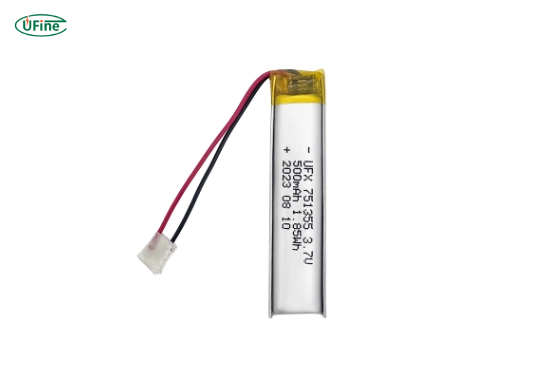
The term 500mAh battery means the battery can store 500 milliamp-hours (mAh) of electrical charge.
mAh is a unit used to measure battery capacity. It tells you how much current a battery can provide over time.
For example:
- 500mA × 1 hour = 500mAh
- 250mA × 2 hours = 500mAh
- 100mA × 5 hours = 500mAh
- 50mA × 10 hours = 500mAh
This is why battery capacity is often used to estimate runtime.
Battery capacity vs battery energy
Many people confuse mAh with actual energy storage.
Battery energy is measured in watt-hours (Wh).
Formula: Watt-hours (Wh) = Voltage (V) × Capacity (Ah)
For a typical 3.7V lithium battery:
3.7V × 0.5Ah = 1.85Wh
This means a 500mAh lithium battery stores approximately 1.85 watt-hours of energy.
Understanding both mAh and Wh provides a more accurate comparison between batteries.
Part 2. How to calculate 500mah battery life in hours
One of the most searched questions is: How long does a 500mAh battery last?
The simplest formula is: Battery Life (Hours) = Battery Capacity (mAh) ÷ Device Current Draw (mA)
500mAh Battery Life Hours Examples
| Device Current Draw | Estimated Runtime |
|---|---|
| 20mA | 25 hours |
| 50mA | 10 hours |
| 100mA | 5 hours |
| 200mA | 2.5 hours |
| 250mA | 2 hours |
| 500mA | 1 hour |
These figures are theoretical.
Actual runtime is often 10%–20% lower because of:
- Voltage conversion losses
- Battery aging
- Temperature effects
- High discharge rates
- Wireless communication spikes
- Standby system consumption
For commercial products, laboratory testing should always be used to verify actual operating time.
Part 3. What types of devices use a 500mah battery?
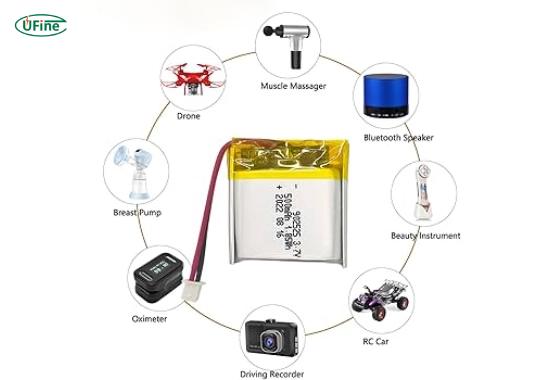
A 500mAh battery is commonly used in compact devices where space and weight are limited.
Typical applications include:
Wearable Electronics
- Fitness trackers
- Smart bands
- Health monitoring devices
- Smart badges
Wireless Audio Products
- Bluetooth earbuds
- Voice recorders
- Portable microphones
Medical Devices
- Portable ECG monitors
- Patient monitoring sensors
- Medical data loggers
IoT and Smart Sensors
- Temperature sensors
- Humidity sensors
- GPS trackers
- Asset monitoring devices
Consumer Electronics
- Smart key fobs
- Remote controls
- Electronic toys
- Portable LED devices
In these products, engineers often prioritize small size, lightweight construction, and adequate runtime rather than maximum capacity.
Part 4. Typical runtime of a 500mah battery
The table below provides practical estimates for various applications.
| Device/Application | Average Current Draw | Estimated Runtime |
|---|---|---|
| Fitness tracker | 50mA | 10 hours |
| Bluetooth earbud | 100mA | 5 hours |
| IoT sensor | 25mA | 20 hours |
| Portable ECG monitor | 40mA | 12.5 hours |
| Mini drone | 300mA | 1.6 hours |
| Smart lock | 5mA average | 100 hours |
Actual results depend heavily on usage patterns.
For example, an IoT sensor that sleeps most of the time and transmits data every 15 minutes may operate for days or weeks despite having only a 500mAh battery.
Part 5. Is a 500mah battery enough for your product?
The answer depends on power consumption and user expectations.
A 500mAh Battery Is Usually Suitable For:
- Low-power IoT devices
- Wearables
- Portable sensors
- Tracking devices
- Medical monitoring equipment
- Intermittently used electronics
You May Need a Larger Battery If:
- Continuous current exceeds 200mA
- Long operating time is required
- Wireless communication is frequent
- Display brightness is high
- Processing loads are heavy
During product development, engineers should evaluate:
- Runtime targets
- Device dimensions
- Product weight
- Manufacturing cost
- Charging frequency
Finding the right balance often produces the best user experience.
Part 6. Are 500mah batteries rechargeable?
Yes.
Most modern 500mAh batteries use:
Lithium-Ion (Li-ion)
Advantages:
- High energy density
- Stable voltage
- Long service life
- Mature manufacturing process
Lithium Polymer (LiPo)
Advantages:
- Flexible shape options
- Thin profile designs
- Lightweight construction
- Excellent fit for wearables
Most quality lithium batteries provide:
- 300–500 charge cycles or more
- Low self-discharge
- Consistent performance
For additional protection, many manufacturers integrate a PCM (Protection Circuit Module).
You can learn more about protection systems in our guide on PCM vs PCB vs BMS in LiPo Batteries.
Part 7. How long does it take to charge a 500mah battery?
Charging time depends on charging current.
| Charging Current | Approximate Charging Time |
|---|---|
| 100mA | 5 hours |
| 250mA | 2 hours |
| 500mA | 1 hour |
| 750mA | Less than 1 hour (if supported) |
Most lithium battery manufacturers recommend charging between 0.5C and 1C.
For a 500mAh battery:
- 0.5C = 250mA
- 1C = 500mA
This helps maintain battery health while providing reasonable charging speed.
According to the battery charging guidance published by the Battery University, excessive charging rates can increase cell stress and reduce long-term battery life.
Part 8. How to extend the life of a 500mah battery?
Proper battery management can significantly improve service life.
Avoid Deep Discharges
Try to keep battery levels above 20% whenever possible.
Reduce Heat Exposure
High temperatures accelerate lithium battery aging.
Use Quality Charging Circuits
Protection circuits help prevent:
- Overcharging
- Over-discharging
- Overcurrent
- Short circuits
Optimize Device Software
Reduce unnecessary power consumption through:
- Sleep modes
- Low-power communication
- Efficient firmware design
Store Correctly
For long-term storage:
- Charge to around 40–60%
- Store in a cool, dry location
The U.S. Department of Energy and battery industry standards consistently identify temperature management as one of the most important factors affecting battery lifespan.
Part 9. 500mah vs other battery capacities
The following comparison helps illustrate where a 500mAh battery fits in the market.
| Capacity | Common Applications | Runtime at 100mA |
|---|---|---|
| 500mAh | Wearables, sensors | 5 hours |
| 1000mAh | GPS trackers, cameras | 10 hours |
| 2000mAh | Bike lights, speakers | 20 hours |
| 3000mAh | Smartphones | 30 hours |
| 5000mAh | Tablets, industrial devices | 50 hours |
| 10000mAh | Power banks | 100 hours |
Higher capacity generally increases runtime but also increases:
- Weight
- Physical size
- Cost
- Charging time
This is why selecting the largest battery is not always the best engineering decision.
Part 10. How to choose the right 500mah lithium battery?
Battery selection involves more than capacity.
Voltage
Most lithium cells use:
- 3.7V nominal
- 4.2V maximum charge voltage
Your electronics must match battery voltage requirements.
Peak Discharge Current
Determine:
- Continuous current
- Pulse current
- Startup current
A battery that cannot deliver required current may experience voltage drops.
Battery Dimensions
Verify:
- Length
- Width
- Thickness
- Connector location
Mechanical fit is critical in compact products.
Operating Temperature
Consider environmental conditions. Applications in cold or hot environments may require specialized battery chemistry.
Certifications
For international markets, common requirements include:
- UN38.3
- IEC 62133
- CE
- RoHS
- MSDS
For more information, see our article on IEC 62133 Certification for Lithium Batteries.
Manufacturer Reliability
Consistent cell quality helps ensure:
- Stable capacity
- Long cycle life
- Safe operation
- Reliable mass production
Part 11. Safety considerations for 500mah lithium batteries
Although small, a 500mAh lithium battery should still be handled properly.
Follow these safety practices:
- Use certified batteries
- Avoid crushing or puncturing cells
- Prevent exposure to water
- Avoid overheating
- Use compatible chargers
- Follow transportation regulations
For shipping lithium batteries internationally, compliance with UN38.3 testing requirements is especially important.
Additional safety information can be found through the International Electrotechnical Commission (IEC) and the U.S. Consumer Product Safety Commission (CPSC).
Related reading
To better understand lithium battery selection and performance, you may also find these guides useful:
- What Does Ah Mean on Lithium-ion Batteries
- Li-ion vs LiPo Battery Comparison
- How Long Does a Lithium-Ion Battery Last
Part 13. FAQs about 500mah batteries
Is a 500mAh battery good?
A 500mAh battery is suitable for low-power devices such as wearables, sensors, Bluetooth products, and medical monitoring equipment. Whether it is “good” depends on the device’s power requirements.
How many hours does a 500mAh battery last?
To estimate 500mAh battery life in hours, divide 500mAh by the device current draw. A device consuming 100mA can theoretically run for about 5 hours.
Can I replace a 500mAh battery with a higher mAh battery?
Yes, provided the voltage, dimensions, connector type, and charging system are compatible. A higher-capacity battery generally provides longer runtime.
How many charge cycles can a 500mAh lithium battery handle?
Most quality lithium-ion and LiPo batteries can achieve 300–500 full charge cycles. Proper charging habits can extend lifespan beyond this range.
What is the difference between 500mAh and 5000mAh?
A 5000mAh battery stores ten times more charge than a 500mAh battery. Assuming the same voltage and power consumption, it can theoretically provide ten times longer runtime.
Related Tags:

More Articles

JST vs Molex: The Right Battery Connector Choice
JST or Molex for your battery? Learn how connector selection affects current, voltage drop, reliability, and device performance.
Custom Battery Pricing: Costs Manufacturers Don’t Mention
A low battery quote may not be the final cost. Discover common hidden expenses that affect custom lithium battery projects.
Battery Wire Length: Hidden Cause of Power Loss
A longer battery wire can cause voltage drop, power loss, and unstable operation. Learn how wire length affects battery performance.
How Device Sleep Modes Affect Battery Life
Think sleep mode extends battery life? Learn why devices still drain power and how firmware, hardware, and batteries affect runtime.
LiPo Battery and PCB Design: Clearance, Insulation, and Placement
Learn how to optimize LiPo battery PCB clearance, insulation, placement, wiring, and thermal design—and avoid common integration mistakes.


