
- Key takeaways
- Part 1. What is a 3.7V battery?
- Part 2. Electrical characteristics of 3.7V lithium batteries
- Part 3. 3.7V Li-ion battery vs 3.7V LiPo battery
- Part 4. 3.7V 18650 battery vs LiPo battery
- Part 5. 3.2V vs 3.7V battery: Understanding LiFePO4 differences
- Part 6. Comparing 3.7V Li-ion, 3.7V LiPo, 3.7V 18650 and 3.2V LiFePO4 batteries
- Part 7. How to choose the right 3.7V battery
- Part 8. Custom 3.7V LiPo battery solutions
- Part 9. FAQs
According to the International Energy Agency (IEA), global lithium-ion battery demand exceeded 750 GWh in 2023, driven by the rapid adoption of electric vehicles, consumer electronics, energy storage systems, and industrial applications. As lithium battery technology continues to expand into more industries, choosing the right battery chemistry and specification has become increasingly important for product engineers and manufacturers.
Among different lithium battery solutions, the 3.7V battery is one of the most commonly used options for portable electronic devices. From smartphones and wireless communication products to wearable devices, IoT equipment, and medical electronics, 3.7V lithium batteries provide a practical balance between energy density, size, weight, and performance.
However, when selecting a 3.7V lithium battery for a new product, many engineers face questions such as:
- What is the difference between a 3.7V Li-ion battery and a 3.7V LiPo battery?
- Is an 18650 battery better than a lithium polymer battery?
- Why are LiFePO4 batteries rated at 3.2V instead of 3.7V?
- Which battery type is more suitable for compact or high-performance devices?
This guide explains the technical differences between 3.7V lithium batteries, LiPo batteries, 18650 batteries, and 3.2V LiFePO4 batteries to help you select the most suitable power solution for your application.
Key takeaways
- A 3.7V battery refers to the nominal voltage of a lithium-ion battery, while the actual voltage changes during charging and discharging.
- 3.7V Li-ion and 3.7V LiPo batteries share similar voltage characteristics but differ significantly in structure, flexibility, and application scenarios.
- 18650 batteries are a cylindrical cell format that provides excellent reliability and cost advantages, while LiPo batteries offer greater design flexibility.
- Standard LiFePO4 batteries usually have a 3.2V nominal voltage rather than 3.7V because of their different chemical composition.
- The best battery choice depends on multiple factors, including available space, required capacity, discharge performance, safety requirements, and product design goals.
Part 1. What is a 3.7V battery?
A 3.7V battery is a rechargeable lithium battery with a nominal voltage of approximately 3.7 volts. The term “nominal voltage” refers to the average voltage level that a battery provides during normal operation, rather than the exact voltage output at every moment.
For example, a typical 3.7V lithium battery does not remain at exactly 3.7V throughout its entire cycle. When fully charged, the voltage can reach approximately 4.2V. During operation, the voltage gradually decreases as energy is consumed, and the battery management system prevents further discharge when it reaches the lower voltage limit.
The typical voltage characteristics of a 3.7V lithium battery are:
| Parameter | Typical value |
|---|---|
| Nominal voltage | 3.6V-3.7V |
| Fully charged voltage | 4.2V |
| Discharge cut-off voltage | Around 2.5V-3.0V |
| Battery chemistry | Lithium-ion or lithium polymer |
The reason 3.7V lithium batteries are widely used is that lithium-based chemistry provides a high voltage output compared with many traditional rechargeable battery technologies. A single lithium cell can deliver enough voltage for many portable electronics, reducing the need for multiple cells connected in series.
This makes 3.7V batteries especially suitable for compact devices where minimizing size and weight is important.
Part 2. Electrical characteristics of 3.7V lithium batteries
When designing an electronic product, understanding the electrical characteristics of a 3.7V lithium battery helps engineers determine whether the battery can meet the device’s power requirements.
Important specifications include:
| Feature | 3.7V Li-ion battery | 3.7V LiPo battery |
|---|---|---|
| Internal structure | Liquid electrolyte cell | Polymer electrolyte pouch cell |
| Shape options | Mostly cylindrical or prismatic | Highly customizable |
| Thickness flexibility | Limited | Excellent |
| Weight | Relatively higher | Lightweight design possible |
| Energy density | High | High |
| Mechanical protection | Stronger due to rigid casing | Requires proper packaging and protection design |
| Typical applications | Battery packs, consumer electronics, industrial equipment | Wearables, IoT devices, medical electronics, drones |
For example, a wearable device may prioritize a thin battery with high energy density, while a robotic application may require a battery with a higher discharge capability.
A battery with a larger capacity rating is not always the best solution. If the battery cannot provide enough current during peak operation, the device performance may still be limited. Therefore, battery selection should always consider the complete operating environment of the product.
Part 3. 3.7V Li-ion battery vs 3.7V LiPo battery
1 3.7V Li-ion batteries
3.7V lithium-ion batteries use a graphite anode and lithium metal oxide cathode. During charging/discharging, lithium ions shuttle between electrodes while electrons flow externally. Popular 3.7V lithium-ion battery types include lithium cobalt oxide and lithium manganese oxide.
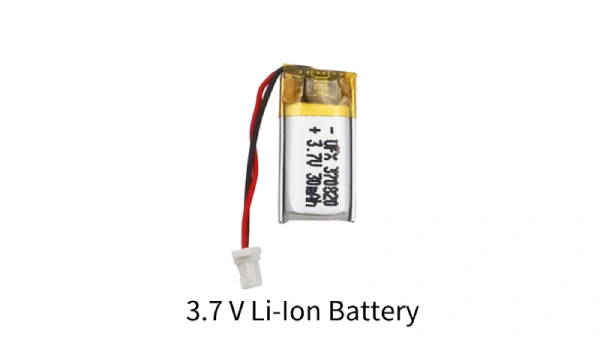
- General: The most common type of rechargeable battery, offering a good balance of energy density, power, and cycle life.
- Chemistry: Uses lithium ions as the charge carriers. Graphite/carbon anode. Lithium metal oxide (LiCoO2, LiMn2OCapable of powering devices for hours, 3.7V li-ion battery dominates portable electronics.4) cathodeNominal Voltage: 3.7V
- Full Charge Voltage: 4.2V
- Discharge Voltage Range: 2.5V to 3.0V
- Energy Density: High (150-200 Wh/kg)
- Cycle Life: Typically 500-1500 cycles
- Safety: Can overheat and catch fire if overcharged or damaged.
- Applications: Widely used in consumer electronics like smartphones, laptops, and cameras.
Advantages: High energy density, fast charging, and good power output.
Disadvantages: 3.7V li-ion cattery Can be sensitive to overcharging and overheating, with potential safety risks.
2 3.7V LiPo battery
The 3.7V lithium polymer (LiPo) battery is an alternative to traditional Li-ion batteries. Featuring a flexible and lightweight pouch-like design, LiPo batteries offer similar voltage output but with enhanced form factor versatility. They often find applications in drones, radio-controlled vehicles, and wearable devices where space and weight savings are critical.
3.7V lipo battery utilizes a similar chemistry but replaces the rigid electrode structure with a flexible polymer pouch containing ions/electrons. This thinness suits tight product spaces.
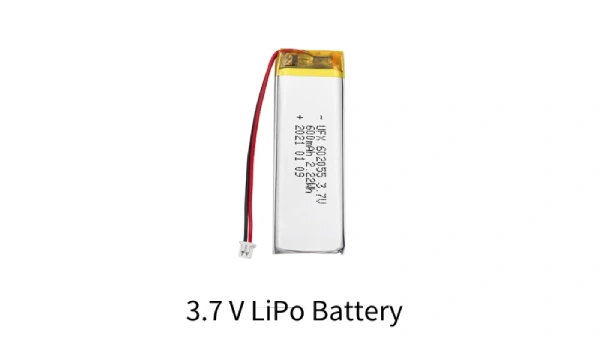
- General: A type of Li-ion battery with a polymer electrolyte.
- Chemistry: Similar to Li-ion, but with a polymer-based electrolyte instead of a liquid one. Anode, commonly graphite or lithium titanate. Cathode typically lithium cobalt oxide or lithium iron phosphate.Polymer electrolyte/separator pouch design.
- Nominal Voltage: 3.7V
- Full Charge Voltage: 4.2V
- Discharge Voltage Range: 3.0V to 3.3V (minimum)
- Energy Density: Very high (150-200 Wh/kg)
- Cycle Life: Typically 300-500 cycles
- Safety: Sensitive to overcharging and puncturing; requires careful handling.
- Applications: Similar to Li-ion batteries, 3.7V LiPo batteries consist of lithium-ion cells. But with a polymer electrolyte encased in a flexible pouch. This design allows for greater packaging flexibility, making LiPo batteries ideal for devices with unconventional shapes or limited space. Their thinness helps minimize device sizes across many hobbies. From remote-controlled toys to medical devices, the 3.7v lipo battery powers various gadgets and equipment.
Advantages: Higher energy density, thinner design, and good discharge rate.
Disadvantages: Can be more prone to swelling and potential safety hazards if mishandled.
For engineers developing compact products, a 3.7V LiPo battery is often preferred because the battery shape can be customized according to the available space inside the device. For example, wearable products may require a battery that is only a few millimeters thick or has an irregular shape to fit around other components.
However, a standard lithium-ion cell may still be a better choice when cost efficiency, standardized dimensions, or mechanical durability are the primary requirements.
Therefore, the choice between Li-ion and LiPo should not be based only on voltage. The product structure, available installation space, expected current demand, and manufacturing requirements should all be considered.
Part 4. 3.7V 18650 battery vs LiPo battery
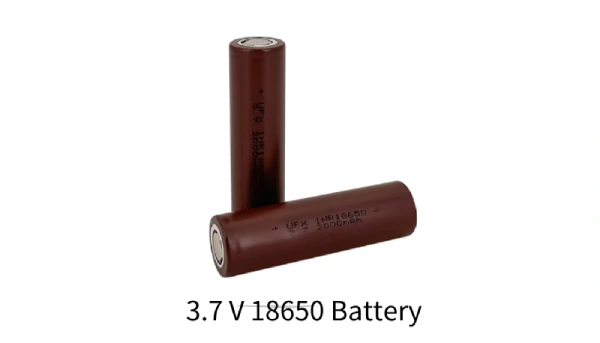
The 18650 battery is one of the most recognized lithium-ion battery formats in the market. The name “18650” refers to the physical dimensions of the cylindrical cell: approximately 18mm in diameter and 65mm in length.
Unlike LiPo, which describes a battery structure and packaging method, 18650 describes a cell format. This means an 18650 battery is a specific cylindrical size rather than a completely different battery chemistry.
A typical 3.7V 18650 battery provides advantages such as:
- General: A standard cylindrical Li-ion battery format. Safety vents and casing.
- Chemistry: Graphitic carbon anode. Cathode (typically NMC, NCA). Typically Li-ion, but can also be LiPo.
- Nominal Voltage: 3.7V
- Full Charge Voltage: 4.2V
- Discharge Voltage Range: 2.5V to 3.0V
- Energy Density: High (1800-3500 mAh capacity)
- Cycle Life: Typically 500-1500 cycles
- Safety: Generally safe, but can vent or catch fire if damaged or overcharged.
- Applications: Electric vehicles, power tools, home energy storage – any application needing versatile, highly portable power integrates 18650 packs. Tesla, Dewalt, and Sonnen rely heavily on this format.
However, cylindrical cells have limitations when designing products with unusual shapes or extremely limited internal space.
The comparison between 18650 and LiPo batteries is:
| Feature | 18650 battery | LiPo battery |
|---|---|---|
| Battery shape | Cylindrical | Flexible pouch |
| Size customization | Limited | Excellent |
| Space utilization | Moderate | High |
| Mechanical strength | Very strong | Depends on packaging design |
| Manufacturing cost | Usually lower for standard designs | Higher for customized designs |
| Best applications | Power tools, battery packs, industrial devices | Wearables, portable electronics, smart hardware |
For applications such as flashlights, power tools, and large battery packs, 18650 cells remain a popular choice because of their reliability and standardized production.
For products such as smart glasses, wearable devices, and compact IoT products, LiPo batteries often provide better design flexibility because engineers can optimize the battery shape according to the product structure.
Part 5. 3.2V vs 3.7V battery: Understanding LiFePO4 differences
3.2V LiFePO4 battery
While 3.7V batteries reign supreme, the 3.2V lithium iron phosphate (LiFePO4) battery offers a compelling alternative for specific applications. Known for their inherent safety, long cycle life, and stable voltage output, LiFePO4 batteries find favor in solar energy storage systems, electric bikes, and marine applications where durability and reliability are critical.
While offering lower energy density than Li-ions, the 3.2V LiFePO4 battery provides unprecedented abuse tolerance and longevity suited for industrial/marine applications.
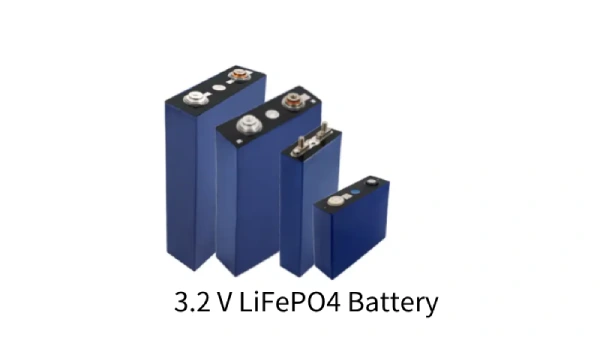
- General: A type of Li-ion battery with a lithium iron phosphate cathode.
- Chemistry: The unique chemistry of 3.2V LiFePO4 batteries comprises a cathode of lithium iron phosphate, an anode of graphite, and a lithium salt electrolyte. This combination results in a robust and stable battery chemistry.
- Nominal Voltage: 3.2V
- Full Charge Voltage: 3.65V
- Discharge Voltage Range: 2.5V to 3.6V
- Energy Density: Lower than Li-ion (90-120 Wh/kg)
- Cycle Life: Typically 2000-5000 cycles
- Safety: Very stable, less prone to overheating and thermal runaway.
- Applications: 3.2v LiFePO4 excels in power tools, solar street lights, off-grid power systems, electric buses, ferries, and stationary grid storage projects demanding maximum safety and cycle life over decades. Renewable integration leans heavily on this chemistry.
Advantages: Excellent safety characteristics, long cycle life (up to 2000 cycles), and good temperature tolerance.
Disadvantages: Lower energy density compared to Li-ion and LiPo, and slower charging rates.
The comparison between a 3.2V lithium battery and a 3.7V lithium battery is:
| Feature | 3.7V lithium battery | 3.2V LiFePO4 battery |
|---|---|---|
| Chemistry | Lithium-ion / LiPo | Lithium iron phosphate |
| Nominal voltage | 3.6V-3.7V | 3.2V |
| Energy density | Higher | Lower |
| Cycle life | Good | Excellent |
| Thermal stability | Good | Superior |
| Safety performance | Good with protection design | Excellent |
A 3.2V LiFePO4 battery is more suitable for applications where safety, long cycle life, and stable performance are more important than compact size, such as energy storage systems, solar power applications, and industrial equipment.
Part 6. Comparing 3.7V Li-ion, 3.7V LiPo, 3.7V 18650 and 3.2V LiFePO4 batteries
| Feature | 3.7V Li-ion | 3.7V LiPo | 3.7V 18650 | 3.2V LiFePO4 |
|---|---|---|---|---|
| Nominal Voltage | 3.7V | 3.7V | 3.7V | 3.2V |
| Full Charge Voltage | 4.2V | 4.2V | 4.2V | 3.6V |
| Discharge Voltage Range | 3.0V – 4.2V | 3.0V – 4.2V | 2.5V – 4.2V | 2.5V – 3.6V |
| Energy Density | High (~200-250 Wh/kg) | Moderate to High (~150-220 Wh/kg) | High (~200-250 Wh/kg) | Lower (~90-120 Wh/kg) |
| Cycle Life | 300 – 1000 cycles | 300 – 800 cycles | 500 – 1500 cycles | 2000 – 5000+ cycles |
| Applications | Smartphones, laptops, cameras | Drones, RC toys, portable electronics | Flashlights, power banks, laptops | Solar storage, EVs, medical devices |
| Safety | Moderate risk of fire/explosion | Higher risk due to soft casing | Moderate risk of fire/explosion | Very safe, stable chemistry |
| Temperature Range | -20°C to 60°C | -10°C to 60°C | -20°C to 60°C | -20°C to 70°C |
| Self-Discharge Rate | ~2-5% per month | ~2-5% per month | ~2-5% per month | ~1-3% per month |
| Weight | Light | Lighter than Li-ion | Heavier due to cylindrical shape | Heavier than Li-ion |
| Charging Method | CC-CV (Constant Current – Constant Voltage) | CC-CV (Constant Current – Constant Voltage) | CC-CV (Constant Current – Constant Voltage) | CC-CV, lower voltage charger required |
In the battle of the batteries, each contender—3.7V Li-ion, 3.7V LiPo, and 3.2V LiFePO4—brings its strengths to the table.
While 3.7V Li-ion batteries excel in energy density and versatility, 3.7V LiPo batteries offer unparalleled flexibility in form factor.
On the other hand, 3.2V LiFePO4 batteries prioritize safety and longevity, making them ideal for demanding applications where reliability is non-negotiable.
Part 7. How to choose the right 3.7V battery
Selecting the correct 3.7V battery requires more than choosing a voltage rating. Engineers should evaluate the complete product requirements before deciding on battery chemistry and structure.
Consider the available space
If the product has a limited internal space or requires a special battery shape, LiPo batteries usually provide more flexibility because manufacturers can customize dimensions and thickness.
Consider capacity requirements
Battery capacity determines how long the device can operate before recharging. However, increasing capacity usually requires additional space, so engineers need to balance runtime and product size.
Consider discharge requirements
Some devices require high current output during operation. Examples include drones, robotics, and motor-driven equipment.
For these applications, a battery with a higher discharge rate may be required to ensure stable performance.
Consider safety requirements
Battery safety is especially important for products used close to people, such as wearable and medical devices.
A properly designed lithium battery solution should include:
- Overcharge protection
- Over-discharge protection
- Short circuit protection
- Temperature monitoring
Consider certifications and regulations
Depending on the market and application, lithium batteries may require different certifications, including:
- UN38.3 transportation testing
- IEC 62133 safety certification
- UL certification
The United Nations provides official information about the transport requirements for lithium batteries and dangerous goods regulations:
Part 8. Custom 3.7V LiPo battery solutions
For many modern electronic products, standard batteries cannot always meet the requirements of the final design. A customized 3.7V LiPo battery allows manufacturers to optimize the power solution according to product specifications.
Customization options may include:
- Battery dimensions
- Thickness
- Capacity
- Voltage configuration
- Discharge performance
- Connector design
- Protection circuit design
Working with an experienced battery manufacturer during the early product development stage can help avoid design limitations and improve overall product reliability.
Part 9. FAQs
1. Can two 3.7V batteries be connected together?
Yes, two 3.7V batteries can be connected in series or parallel, but the result is different. When connected in series, the voltage increases to approximately 7.4V while the capacity remains similar. When connected in parallel, the voltage remains around 3.7V but the available capacity increases. However, battery packs require proper protection circuits and cell balancing to ensure safe operation.
2. What factors affect the lifespan of a 3.7V lithium battery?
The lifespan of a 3.7V lithium battery depends on several factors, including charging voltage, discharge depth, operating temperature, charging speed, and storage conditions. Avoiding frequent deep discharge and operating the battery within its recommended temperature range can help extend battery cycle life.
3. What is the difference between a 3.7V battery and a 7.4V battery?
A 3.7V battery usually refers to a single lithium cell. A 7.4V battery pack typically contains two 3.7V cells connected in series.
The higher voltage allows the device to operate with different power requirements, but the battery pack also requires appropriate protection and charging management.
4. Do 3.7V lithium batteries need a protection circuit?
Most 3.7V lithium batteries require a protection circuit module (PCM) or battery management system (BMS), especially for consumer and industrial applications. The protection circuit helps prevent dangerous conditions such as overcharging, over-discharging, excessive current, and short circuits.
5. What certifications are required for 3.7V lithium batteries?
The required certifications depend on the application and target market. Common lithium battery certifications include UN38.3 for transportation safety, IEC 62133 for battery safety, and UL certifications for specific products. Manufacturers should confirm certification requirements during the early product development stage to avoid delays during mass production.
Related Tags:

More Articles
Comprehensive Guide to Choosing the Right Cart Battery
Learn how to choose the right cart battery for a vape cartridge or electric cart. Compare types, voltage, capacity, compatibility, safety, and care.
The Complete Guide to Doorbell Batteries
Learn which doorbell battery you need, common sizes and voltages, battery life, charging tips, and how to choose batteries for wired or smart doorbells.
What Is an SLI Battery? Key Facts You Need to Know
Confused about SLI car batteries? This guide explains SLI battery meaning, performance, lifespan, maintenance, and how to choose the right option.
USB LiPo charger: A complete guide to charging LiPo batteries via USB
Learn how USB LiPo chargers work, compare USB-C and traditional options, and discover how to choose the right charger for safe and efficient LiPo charging.
3.2V AA Battery Basics for Everyone
Looking for a 3.2V AA battery manufacturer? Explore LiFePO4 AA battery features, customization options, specifications, and industrial applications.


