
- Part 1. How does a battery charge and discharge?
- Part 2. Common battery charging modes
- Part 3. Voltage: the driving force
- Part 4. Capacity (mAh): the energy reservoir
- Part 5. Charge rate (C-Rate): the speed of charging
- Part 6. Discharge rate (C-Rate): the power delivery
- Part 7. Cycle life: the battery’s lifespan
- Part 8. Depth of discharge (DoD): how much you use
- Part 9. Internal resistance: the hidden enemy
- Part 10. Self-discharge rate: The silent drain
- Part 11. Operating temperature: the comfort zone
- Part 12. State of charge (SoC): the energy gauge
- Part 13. FAQs
⚡ Have you ever wondered why some batteries degrade faster than others?
⚡ Why does one battery charge faster, while another struggles to hold a charge?
⚡ How can you ensure that your battery operates safely and lasts as long as possible?
The answer lies in understanding the fundamental parameters that govern battery charging and discharging. These parameters control the flow of energy in and out of the battery, affecting its efficiency, safety, and overall lifespan.
Whether you are an engineer designing power systems, a solar energy enthusiast, or just someone looking to get the most out of your batteries, this guide will break down the 10 most important battery charging and discharging parameters—so you can maximize battery performance and reliability.
Key takeaways
- Battery charging stores electrical energy through reversible chemical reactions, while battery discharging releases that stored energy.
- The charging and discharging of battery systems directly affects cycle life, efficiency, and safety.
- Key battery parameters include voltage, capacity, energy, internal resistance, C-rate, and cycle life.
- Most modern lithium-ion batteries use the CC-CV (Constant Current-Constant Voltage) charging method.
- Battery discharge rate, usually expressed as C-rate, determines how quickly stored energy is delivered.
Part 1. How does a battery charge and discharge?
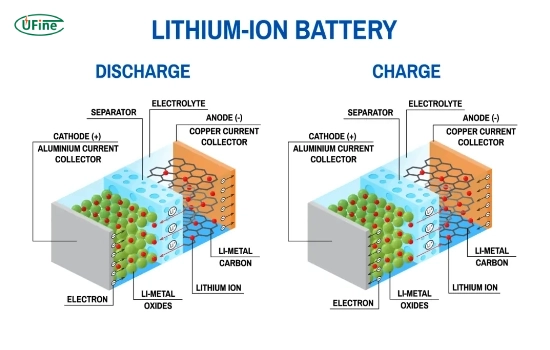
To understand how a battery works, it helps to look at what happens inside the cells.
During charging:
- An external power source applies voltage to the battery.
- Lithium ions (or other charge carriers, depending on the chemistry) move from the positive electrode to the negative electrode.
- Energy is stored as chemical potential.
During discharging:
- The battery is connected to a device or load.
- Chemical reactions release stored energy.
- Electrons flow through the external circuit, powering the device.
- Ions move back to the positive electrode inside the battery.
This reversible movement of ions and electrons allows rechargeable batteries to complete hundreds or even thousands of charging and discharging cycles.
Part 2. Common battery charging modes
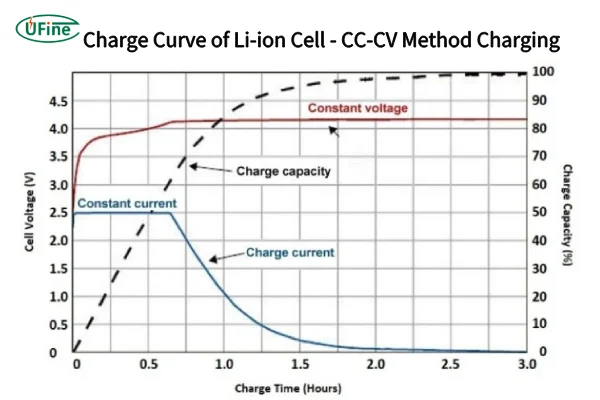
Different battery chemistries require different battery charging modes. Selecting the correct charging method improves efficiency, safety, and battery life.
Constant current (CC) charging
In Constant Current charging, the charger supplies a fixed current while the battery voltage gradually increases. This method is commonly used during the initial stage of charging lithium-ion batteries.
Constant voltage (CV) charging
In Constant Voltage charging, the charger maintains a fixed voltage while the charging current gradually decreases. This stage helps safely complete the charging process without overcharging the battery.
CC-CV charging
The combination of Constant Current and Constant Voltage, known as CC-CV charging, is the most common charging mode for lithium-ion batteries.
The battery is first charged at a constant current until it reaches its target voltage. The charger then switches to constant voltage mode until the current drops to a preset cutoff level.
Trickle charging
Trickle charging provides a very small maintenance current to compensate for self-discharge. It is widely used with lead-acid and nickel-based batteries but is generally not recommended as a continuous charging method for lithium-ion cells.
Understanding these battery charging modes is important because using an incompatible charger can reduce battery life or even create safety risks.
To better understand voltage changes during operation, check out our guide on how to read lithium battery discharge curve and charging curve.
Part 3. Voltage: the driving force
Voltage is the electrical potential difference between the positive and negative terminals of a battery. It’s the driving force that pushes current through a circuit, and it’s one of the most fundamental parameters to understand.
-
Nominal Voltage: This is the average voltage during discharge. For example, a lithium-ion battery typically has a nominal voltage of 3.7V.
-
Fully Charged Voltage: When fully charged, the voltage reaches its peak. For a LiPo battery, this is usually 4.2V.
-
Discharged Voltage: This is the minimum voltage before the battery is considered empty. For most LiPo batteries, this is around 3.0V.
Typical Charging Voltages by Chemistry
| Battery Type | Maximum Charging Voltage per Cell |
|---|---|
| Lithium-Ion (Li-ion) | 4.2V per cell |
| LiFePO4 (Lithium Iron Phosphate) | 3.6V per cell |
| Lead-Acid | 2.45V per cell |
Why It Matters:
Operating outside the recommended voltage range can damage the battery or reduce its lifespan. For instance, overcharging (exceeding 4.2V for a LiPo battery) can cause overheating, swelling, or even fire. On the other hand, deep discharging (below 3.0V) can lead to irreversible damage.
Pro Tip: Always use a charger with built-in voltage regulation to prevent overcharging.
Part 4. Capacity (mAh): the energy reservoir
Capacity, measured in milliampere-hours (mAh), indicates how much energy a battery can store. Think of it as the size of the battery’s fuel tank.
-
Theoretical Capacity: This is the total energy the battery can store under ideal conditions.
-
Actual Capacity: In real-world scenarios, the usable capacity is often lower due to inefficiencies like heat loss and internal resistance.
Why It Matters:
Higher capacity means longer runtime, but it also means a larger and heavier battery. For example, a 5000mAh battery will last twice as long as a 2500mAh battery in the same device, but it will also be bulkier.
Pro Tip: Choose a battery with a capacity that balances runtime and portability for your specific application.
Part 5. Charge rate (C-Rate): the speed of charging
The charge rate, or C-rate, defines how quickly a battery can be charged. It’s expressed as a multiple of the battery’s capacity.
-
1C Charge Rate: Charging a 2000mAh battery at 2000mA (1 × capacity).
-
2C Charge Rate: Charging the same battery at 4000mA (2 × capacity).
Why It Matters:
Charging too quickly can generate heat, which can damage the battery or reduce its lifespan. Most batteries have a recommended maximum charge rate, often around 1C.
Pro Tip: If you need faster charging, look for batteries specifically designed for high C-rates.
Part 6. Discharge rate (C-Rate): the power delivery
The discharge rate indicates how quickly a battery can safely deliver energy. Like the charge rate, it’s expressed as a multiple of the battery’s capacity.
-
1C Discharge Rate: Discharging a 2000mAh battery at 2000mA.
-
2C Discharge Rate: Discharging the same battery at 4000mA.
Why It Matters:
High discharge rates are essential for power-hungry devices like drones or RC cars. However, consistently discharging at high rates can reduce the battery’s lifespan.
Pro Tip: Match the battery’s discharge rate to your device’s power requirements to avoid overloading the battery.
Part 7. Cycle life: the battery’s lifespan
Cycle life refers to the number of charge-discharge cycles a battery can undergo before its capacity drops to a specified percentage (usually 80% of its original capacity).
-
Typical Cycle Life: 300–500 cycles for LiPo batteries.
-
Factors Affecting Cycle Life: Depth of discharge, charging speed, and operating temperature.
Why It Matters:
Understanding cycle life helps you plan battery replacements and optimize usage. For example, shallow discharges (using only 20–30% of the battery’s capacity) can significantly extend cycle life.
Pro Tip: Avoid fully discharging the battery whenever possible to maximize its lifespan.
Part 8. Depth of discharge (DoD): how much you use
Depth of discharge (DoD) indicates how much of the battery’s capacity has been used.
-
Shallow Discharge: Using only 20–30% of the battery’s capacity.
-
Deep Discharge: Using 80–100% of the battery’s capacity.
Why It Matters:
Deeper discharges can shorten the battery’s lifespan. For example, a battery cycled at 80% DoD may last only 500 cycles, while the same battery cycled at 20% DoD could last 2000 cycles.
Pro Tip: Aim for shallow discharges to extend your battery’s life.
What Is Battery DoD? Does It Affect Battery Life?
Part 9. Internal resistance: the hidden enemy
Internal resistance is the resistance within the battery that opposes the flow of current. It’s measured in milliohms (mΩ).
-
Low Internal Resistance: Allows higher discharge rates and better performance.
-
High Internal Resistance: Reduces efficiency and causes heat buildup.
Why It Matters:
Batteries with high internal resistance are less efficient and may not deliver the required power. Over time, internal resistance increases, reducing the battery’s performance.
Pro Tip: Regularly check your battery’s internal resistance to monitor its health.
Part 10. Self-discharge rate: The silent drain
The self-discharge rate is the rate at which a battery loses energy when not in use.
-
Typical Self-Discharge Rate: 1–5% per month for lithium-ion batteries.
-
Factors Affecting Self-Discharge: Temperature and battery age.
Why It Matters:
A high self-discharge rate means the battery will lose energy faster when stored, reducing its usability.
Pro Tip: Store batteries at around 50% charge in a cool, dry place to minimize self-discharge.
Part 11. Operating temperature: the comfort zone
Operating temperature refers to the range of temperatures within which a battery can safely function.
-
Typical Range: 0°C to 45°C for charging, -20°C to 60°C for discharging.
-
Effects of Extreme Temperatures: Reduced performance, swelling, or even fire.
Why It Matters:
Operating outside the recommended temperature range can damage the battery and pose safety risks.
Pro Tip: Avoid exposing batteries to extreme temperatures, and use thermal management systems if necessary.
Part 12. State of charge (SoC): the energy gauge
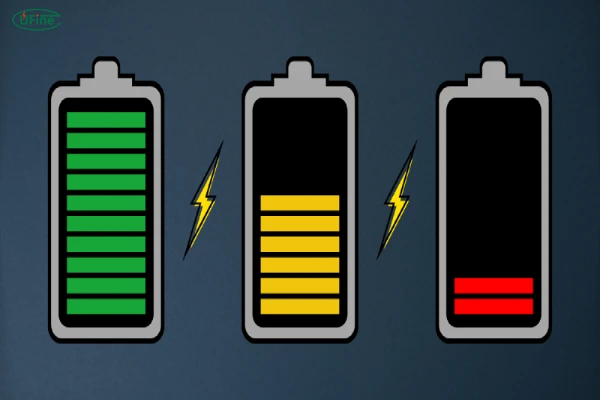
State of charge (SoC) indicates how much energy is left in the battery as a percentage of its total capacity.
-
100% SoC: Fully charged.
-
0% SoC: Fully discharged.
Why It Matters:
Monitoring SoC helps you avoid overcharging or deep discharging, both of which can harm the battery.
Pro Tip: Use a battery management system (BMS) to monitor SoC and protect your battery.
Part 13. FAQs
Can a battery be charged and discharged at the same time?
Yes, some battery systems can charge and discharge simultaneously, especially in renewable energy storage applications. However, this requires a battery management system (BMS) to safely control the energy flow.
Why does a battery get warm during charging or discharging?
Heat is generated because of internal resistance and electrochemical reactions inside the battery. Excessive heat may indicate high current, poor ventilation, or battery aging.
Does a higher discharge rate reduce battery capacity?
Yes. At very high discharge rates, the usable capacity of a battery often decreases because energy is delivered too quickly, increasing losses and heat generation.
Why should you avoid over-discharging a lithium battery?
Over-discharging can lower the cell voltage below the safe operating limit, causing irreversible chemical changes that reduce battery capacity and cycle life.
Does partial charging improve battery lifespan?
Yes. Frequently charging a lithium-ion battery between about 20% and 80% state of charge can reduce stress on the cells and help extend overall service life.
Related Tags:

More Articles
UN3481 vs UN1323: Classification Guide for Lithium Batteries
Learn the difference between UN3481 and UN1323, UN3481 label meaning, shipping requirements, and how UN3481 differs from UN3480 for lithium batteries.
Lithium vs Lithium Salt: What’s the Difference?
Learn the difference between lithium and lithium salts, their battery applications, common types, safety considerations, and roles in lithium-ion batteries.
How to Build LiFePO4 Battery Pack: Easy Steps and Expert Tips
Want to build a DIY LiFePO4 battery? Learn the exact steps, tools, BMS selection, wiring tips, and mistakes to avoid in this complete guide.
How Many Volts Is a AAA Battery? Full Guide + Chart
Learn AAA battery voltage, normal range, full charge level, and dead voltage with a clear chart explaining different battery types.
Confused about 18350 batteries? Learn the size, capacity, charger options, and key differences between 18350 vs 18650 before you buy.


