
- Key Takeaways
- Part 1. Why cold weather is a problem for lithium batteries
- Part 2. What is a lithium battery heater?
- Part 3. What is a heated lithium battery?
- Part 4. How lithium battery heating systems work?
- Part 5. Lithium battery heater vs heated lithium battery
- Part 6. Core advantages of heated lithium batteries
- Part 7. Typical applications in cold environments
- Part 8. How to choose the right cold-weather lithium battery solution?
- Part 9. Heated lithium battery FAQs
Cold temperatures can reduce lithium battery performance, limit charging, and even cause damage. Engineers solve this with lithium battery heaters or heated lithium batteries for safe, reliable operation.
This guide explains how these solutions work, their advantages in cold climates, and tips for selecting the right system for EVs, solar storage, RVs, marine, and industrial applications.
Key Takeaways
- Charging below 0°C risks lithium plating and capacity loss.
- Lithium battery heaters maintain safe operating temperatures externally, while heated lithium batteries integrate heating and BMS protection.
- Proper thermal management extends battery lifespan and ensures reliable power in sub-zero conditions.
- Cold-weather solutions are essential for EVs, solar energy storage, off-grid systems, and marine applications.
- Select solutions based on operating temperature, BMS features, heater efficiency, and certification (UL, CE, IEC).
Part 1. Why cold weather is a problem for lithium batteries
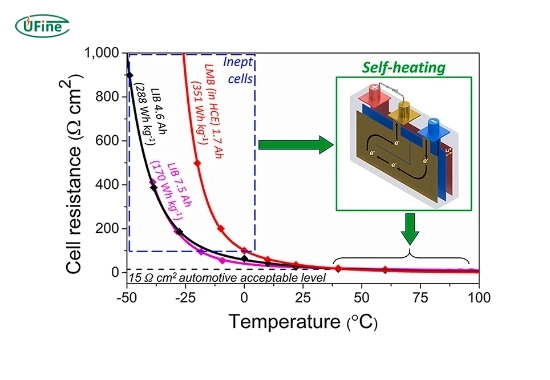
Lithium batteries rely on electrochemical reactions to store and release energy. When temperatures drop, these reactions slow significantly, leading to multiple performance and safety issues.
- Reduced electrolyte conductivity, limiting ion movement
- Higher internal resistance, causing voltage sag
- Lower usable capacity, especially at high discharge rates
- Unsafe charging below 0°C, which may cause lithium plating
Repeated cold exposure without temperature management can permanently damage the battery’s internal structure.
Lithium Battery Temperature Range: Everything You Need to Know
Part 2. What is a lithium battery heater?
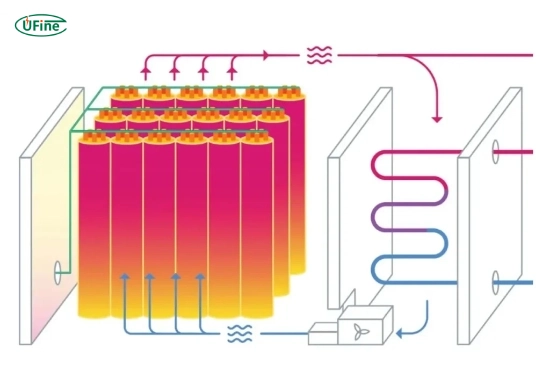
A lithium battery heater is an external or integrated heating system designed to keep a lithium battery within a safe operating temperature range, typically between 15°C and 40°C (59°F–104°F).
When ambient temperatures fall below safe limits, the heater supplies controlled heat to ensure stable charging, discharging, and energy efficiency.
- External heating pads or wraps
- Internal heating elements integrated into battery packs
- Thermostatic or sensor-based temperature control
Part 3. What is a heated lithium battery?
A heated lithium battery is a lithium battery with a built-in heating system and smart BMS. Unlike external heaters, heating is automatically controlled inside the battery.
When temperatures drop (usually around 0°C), the internal heater activates. Charging and discharging are only enabled once the battery reaches a safe temperature.
Part 4. How lithium battery heating systems work?
1 Lithium battery heater (external or modular)
- Heating pads or flexible heating films
- External or battery-powered energy source
- Basic or thermostatic control
2 Heated lithium battery (integrated system)
- Temperature sensors inside the cell or module
- Heating elements controlled by BMS
- Automatic charge enable/disable logic
Part 5. Lithium battery heater vs heated lithium battery
| Feature | Lithium Battery Heater | Heated Lithium Battery |
|---|---|---|
| Heating Integration | External or modular | Built-in |
| Charging Safety | Depends on system control | Automatic BMS protection |
| Installation | Additional components | Plug-and-play |
| Reliability | System dependent | High |
| Best For | Retrofit systems | Cold-climate applications |
Part 6. Core advantages of heated lithium batteries
-
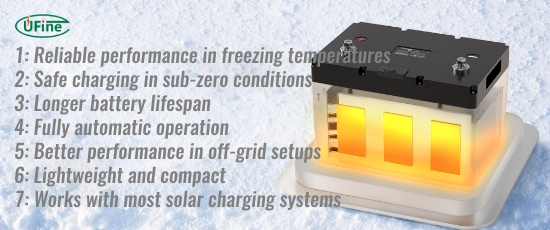
Reliable performance below freezing
- Heated lithium batteries operate reliably at temperatures as low as -20°C (-4°F) or lower, depending on design.
-
Safe charging in sub-zero conditions
- The BMS prevents charging until the battery is warm, eliminating lithium plating risk.
-
Longer battery lifespan
- Stable thermal conditions reduce internal stress and extend cycle life.
-
Fully automatic operation
- No manual heating or monitoring is required.
-
Better off-grid and solar performance
- Critical for overnight winter operation when solar input is limited.
-
Lightweight and space efficient
- No bulky insulation or external heating hardware.
-
Compatible with most solar charging systems
- Works with standard lithium-compatible charge controllers.
Part 7. Typical applications in cold environments
- Electric vehicles (EVs)
- Solar and wind energy storage
- RVs and camper vans
- Marine and offshore systems
- Off-grid cabins and backup power
- Military and aerospace equipment
Part 8. How to choose the right cold-weather lithium battery solution?
- Minimum operating temperature
- Integrated BMS logic
- Heater power consumption
- System voltage compatibility
- Certifications (UL, CE, IEC)
Part 9. Heated lithium battery FAQs
What is the difference between a lithium battery heater and a heated lithium battery?
A lithium battery heater is usually external, while a heated lithium battery has built-in heating and sensors for automatic temperature control.
Can lithium batteries operate safely in sub-zero temperatures without a heater?
They can operate, but charging below 0°C may damage the battery. Heaters ensure safe operation and maintain performance.
Do heated lithium batteries consume extra energy?
Heating only activates when needed, using minimal power relative to the battery’s total capacity.
Are heated lithium batteries compatible with standard chargers?
Yes, most work with standard lithium chargers and include low-temperature protection for safe charging.
Where can I find guidance on battery thermal management?
Refer to the U.S. DOE Battery Thermal Management Systems for design principles and safety tips.
Related Tags:

More Articles
Buck vs. Boost vs. Buck-Boost Converter: Which Is Best for Battery?
Not sure which converter your battery-powered device needs? Compare Buck, Boost, and Buck-Boost designs and discover what affects voltage stability and runtime.
How to Match 18650 Cells for a Reliable Battery Pack?
Building an 18650 battery pack? Learn how to compare cell capacity, voltage, and internal resistance to avoid mismatches and improve reliability.
Why Do 18650 Battery Packs Get Hot During Discharge?
Is your 18650 battery pack overheating under load? Learn what causes excess heat, how to spot dangerous symptoms, and what to do next.
18650 Battery BMS: How to Get the Specs Right
Learn how to choose a BMS for an 18650 battery pack. Compare voltage, current ratings, protection features, and balancing before you buy.
Why Does My Ring Camera Battery Drain So Fast or Stop Charging?
Is your Ring camera battery draining fast or not charging? Discover common causes, practical fixes, and when to replace the battery.


