
- Part 1. What is a 3.7V battery?
- Part 2. Understanding lithium battery voltage
- Part 3. Why are lithium batteries 3.7V?
- Part 4. The chemistry behind 3.7V lithium batteries
- Part 5. 3.7V vs 3.6V vs 3.85V lithium batteries
- Part 6. 3.2V vs 3.7V battery: what is the difference?
- Part 7. Why don't lithium batteries use higher voltage?
- Part 8. What voltage is a phone battery?
- Part 9. How 3.7V cells create higher voltage battery packs
- Part 10. 3.7V Li-ion vs 3.7V lithium polymer battery
- Part 11. How to choose a 3.7V battery for your device
- Part 12. FAQs
Lithium batteries power many of the devices you use every day, from smartphones and wireless earbuds to smart watches, drones, and IoT equipment. If you check the battery specifications, you will often see a common number: 3.7V.
But why are lithium batteries 3.7 volts? Why not 5V, 9V, or another voltage?
The answer comes down to battery chemistry, energy density, safety, and decades of engineering development. A 3.7V lithium battery provides a practical balance between power output, size, reliability, and manufacturing efficiency, which is why it has become one of the most widely used battery voltages worldwide.
In this guide, you will learn what a 3.7V battery means, how lithium battery voltage works, why lithium batteries use 3.7V, and how 3.7V batteries compare with other common battery voltages such as 3.2V LiFePO4 batteries.
Key takeaways
- A 3.7V battery refers to its nominal voltage, not its constant output voltage.
- A typical 3.7V lithium battery charges up to 4.2V and can discharge to around 3.0V.
- Lithium batteries use 3.7V because their chemistry provides a good balance between energy density, safety, and device compatibility.
- Most smartphone batteries use a voltage range close to 3.7V–3.85V, depending on the battery chemistry.
- A 3.2V battery (LiFePO4) offers better cycle life and stability, while a 3.7V lithium-ion battery generally provides higher energy density.
- Multiple 3.7V cells can be connected in series to create higher-voltage battery packs for larger applications.
Part 1. What is a 3.7V battery?

A 3.7V battery is a rechargeable lithium battery with a nominal voltage rating of 3.7 volts. The term “nominal voltage” means the average voltage a battery provides during normal operation.
A lithium battery does not stay at exactly 3.7V throughout its entire discharge cycle.
For example, a typical 3.7V lithium-ion or lithium polymer battery works within this range:
| Battery condition | Voltage |
|---|---|
| Fully charged | 4.2V |
| Normal operating voltage | Around 3.7V |
| Nearly empty | Around 3.0V |
When charging, the voltage gradually increases until it reaches the maximum charging voltage of 4.2V. During use, the voltage slowly decreases as energy is consumed.
Therefore, when manufacturers label a battery as 3.7V, they are describing its average operating voltage rather than a fixed output.
This voltage rating is commonly found in:
- Smartphones
- Tablets
- Wireless headphones
- Smart watches
- Portable medical devices
- IoT sensors
- Drones
- GPS trackers
Part 2. Understanding lithium battery voltage
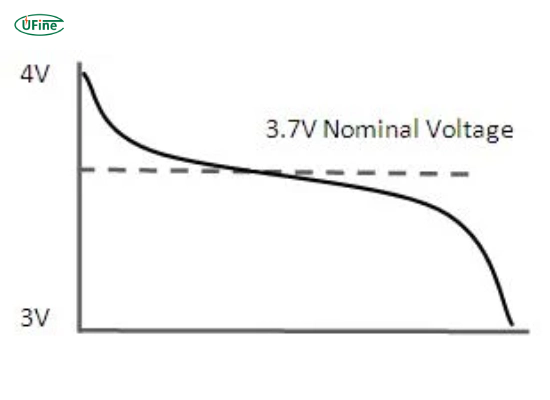
To understand why lithium batteries use 3.7V, you first need to understand how battery voltage works.
Voltage is created by the difference in electrical potential between the battery’s two electrodes:
- Anode (negative electrode)
- Cathode (positive electrode)
In most traditional lithium-ion batteries, the anode is made from graphite, while the cathode uses lithium-based materials such as lithium cobalt oxide (LiCoO₂), lithium nickel manganese cobalt oxide (NMC), or other lithium compounds.
The chemical reaction between these materials creates a voltage difference. For common lithium-ion chemistry, this difference typically produces a nominal voltage around 3.6V to 3.7V.
According to Battery University, lithium-ion cells commonly operate within a voltage range determined by their chemistry and electrode materials.
Different battery chemistries produce different voltages:
| Battery chemistry | Nominal voltage | Common applications |
|---|---|---|
| Lithium-ion (Li-ion) | 3.6V–3.7V | Consumer electronics, laptops, portable devices |
| Lithium polymer (LiPo) | 3.7V | Wearables, smart devices, custom battery packs |
| Lithium iron phosphate (LiFePO4) | 3.2V | Energy storage, solar systems, electric vehicles |
| Nickel-metal hydride (NiMH) | 1.2V | Older rechargeable devices |
storage, solar systems, electric vehiclesNickel-metal hydride (NiMH)1.2VOlder rechargeable devices
The voltage is not chosen randomly. It is a direct result of the materials used inside the battery.
Part 3. Why are lithium batteries 3.7V?
There are several reasons why lithium batteries are 3.7V instead of using a much higher or lower voltage.
1 Lithium chemistry naturally creates a high voltage
Lithium is one of the lightest metals and has a very high electrochemical potential. This allows lithium batteries to generate much higher voltage than older rechargeable battery technologies.
For comparison:
- NiMH battery: about 1.2V
- Alkaline battery: about 1.5V
- Lithium-ion battery: about 3.7V
A higher cell voltage means a battery can store more energy without increasing its physical size.
This is one reason lithium batteries became the preferred choice for compact electronics.
2 3.7V provides a good balance between energy density and safety
A battery voltage that is too low requires more cells to achieve the same power output. This increases:
- Battery size
- Weight
- Manufacturing cost
- Circuit complexity
However, increasing voltage too much creates new challenges, including:
- Higher heat generation
- More demanding protection requirements
- Greater stress on battery materials
The 3.7V range provides a practical balance. It delivers high energy density while maintaining acceptable safety and reliability.
3 Modern electronics are designed around this voltage
Many portable electronic devices are designed to work efficiently with a single lithium cell.
A single 3.7V battery can easily be converted to the voltage required by electronic components using power management circuits.
For example:
- A battery may operate at 3.7V
- Internal circuits may use 3.3V
- USB charging systems may provide 5V
This flexibility makes 3.7V batteries ideal for compact electronic products.
Part 4. The chemistry behind 3.7V lithium batteries
The voltage of a lithium battery depends mainly on the materials used for its electrodes.
A common 3.7V lithium-ion battery uses:
- Graphite as the anode
- Lithium cobalt oxide (LCO) or NMC as the cathode
The difference in electrical potential between these materials creates a voltage close to 3.7V.
Different cathode materials change the battery voltage:
Lithium-ion batteries (3.7V)
Common characteristics:
- Higher energy density
- Compact size
- Suitable for portable electronics
Applications:
- Smartphones
- Laptops
- Wearable devices
- IoT products
LiFePO4 batteries (3.2V)
LiFePO4 chemistry has a lower nominal voltage of around 3.2V because its electrode chemistry produces a smaller voltage difference.
However, it provides advantages such as:
- Longer cycle life
- Better thermal stability
- Improved safety performance
This makes 3.2V batteries popular in applications where lifespan and safety are more important than maximum energy density.
Part 5. 3.7V vs 3.6V vs 3.85V lithium batteries
Although many people search for 3.7V lithium batteries, you may also see batteries labeled as 3.6V or 3.85V.
The difference mainly comes from battery chemistry and naming standards.
| Battery rating | Full charge voltage | Typical use |
|---|---|---|
| 3.6V | 4.2V | Standard lithium-ion cells |
| 3.7V | 4.2V | Li-ion and LiPo batteries |
| 3.85V | 4.45V | High-voltage lithium batteries |
A 3.6V and 3.7V lithium battery usually have very similar operating ranges. The difference is often related to manufacturer specifications or how the nominal voltage is calculated.
A 3.85V battery, however, is designed with higher-voltage chemistry and is commonly used in newer smartphones that require higher energy density.
For most consumer electronics, 3.7V remains the most common lithium battery voltage because it offers an excellent combination of performance, compatibility, and reliability.
Part 6. 3.2V vs 3.7V battery: what is the difference?
One of the most common comparisons in lithium battery selection is 3.2V vs 3.7V battery. Although both are rechargeable lithium batteries, they use different chemistries and are designed for different applications.
The main difference is that 3.7V batteries usually use lithium-ion or lithium polymer chemistry, while 3.2V batteries typically use lithium iron phosphate (LiFePO4).
| Feature | 3.2V battery (LiFePO4) | 3.7V battery (Li-ion/LiPo) |
|---|---|---|
| Nominal voltage | 3.2V | 3.7V |
| Full charge voltage | 3.65V | 4.2V |
| Energy density | Lower | Higher |
| Cycle life | Longer | Moderate to long |
| Thermal stability | Excellent | Good |
| Size efficiency | Larger for the same energy | More compact |
| Common applications | Solar storage, EVs, backup power | Smartphones, IoT devices, wearables |
A 3.7V lithium battery is usually preferred when size and weight are important. For example, a smart watch or wireless sensor needs maximum energy in a small space, making lithium polymer batteries a common choice.
A 3.2V LiFePO4 battery is often selected for applications that require extremely long cycle life and higher safety margins, such as energy storage systems and electric vehicles.
Neither voltage is universally better. The right choice depends on the device requirements, including available space, required runtime, charging system, and expected battery life.
Part 7. Why don’t lithium batteries use higher voltage?
You may wonder: if a higher voltage battery can deliver more energy, why not make lithium batteries 5V, 9V, or even higher?
The reason is that battery design requires a balance between voltage, chemistry stability, and safety.
1. Battery materials limit the voltage range
A battery voltage is determined by the chemical properties of its electrodes and electrolyte.
Increasing voltage requires materials that can operate safely at higher electrical potential. If the voltage exceeds the stable range of the materials, problems may occur, including:
- Electrolyte breakdown
- Reduced battery lifespan
- Increased heat generation
- Lower safety performance
2. Higher voltage requires more protection
Lithium batteries already require protection circuits and battery management systems (BMS) to monitor:
- Overcharging
- Over-discharging
- Temperature changes
- Short circuits
Higher-voltage batteries usually require more advanced protection systems, increasing design complexity and cost.
3. A single 3.7V cell is more practical
Instead of creating one very high-voltage cell, manufacturers usually connect multiple 3.7V cells together.
This modular approach provides flexibility.
For example:
- 1 cell: 3.7V
- 2 cells in series: 7.4V
- 3 cells in series: 11.1V
- 4 cells in series: 14.8V
This allows manufacturers to build battery packs for different applications while using the same proven cell technology.
Part 8. What voltage is a phone battery?
Many people search for phone battery voltage because smartphone chargers often output 5V or higher, which can be confusing.
A typical smartphone battery usually operates around:
- Nominal voltage: 3.7V–3.85V
- Fully charged voltage: 4.2V–4.45V
The battery voltage is different from the charger voltage.
For example:
- USB charger output: 5V or higher
- Phone battery voltage: around 3.7V
The phone contains charging circuits that regulate the incoming power and safely charge the lithium battery.
Modern smartphones often use higher-voltage lithium batteries, such as 3.85V cells, because they provide greater energy density without significantly increasing battery size.
This allows manufacturers to create phones with:
- Longer battery life
- Thinner designs
- Higher performance requirements
Part 9. How 3.7V cells create higher voltage battery packs
A single 3.7V lithium cell is enough for many portable electronics. However, larger devices often require higher voltage and more power.
Instead of creating completely new battery chemistry, manufacturers combine multiple 3.7V cells into battery packs.
Series connection
When cells are connected in series, voltage increases.
Examples:| Battery configuration | Nominal voltage |
|---|---|
| 1S | 3.7V |
| 2S | 7.4V |
| 3S | 11.1V |
| 4S | 14.8V |
The “S” means the number of cells connected in series.
For example, a 3S battery pack contains three 3.7V cells:
3.7V × 3 = 11.1V
Parallel connection
Parallel connections increase capacity rather than voltage.
For example:
- 1 cell: 3.7V 2000mAh
- 2 cells in parallel: 3.7V 4000mAh
This allows battery designers to customize packs according to the device’s power requirements.
For custom battery projects, engineers often combine series and parallel configurations to achieve the required voltage and capacity.
Part 10. 3.7V Li-ion vs 3.7V lithium polymer battery
Both lithium-ion batteries and lithium polymer batteries commonly have a nominal voltage of 3.7V, but their structures are different.
| Feature | 3.7V Li-ion battery | 3.7V lithium polymer battery |
|---|---|---|
| Cell structure | Cylindrical or prismatic | Flexible pouch |
| Shape flexibility | Limited | Highly customizable |
| Energy density | High | High |
| Weight | Lightweight | Very lightweight |
| Best for | Standard devices | Compact custom designs |
Traditional lithium-ion batteries are commonly used in products such as laptops, power tools, and larger electronic devices.
Lithium polymer batteries use a polymer electrolyte and pouch structure, allowing manufacturers to create batteries in different shapes and sizes.
This makes 3.7V LiPo batteries especially suitable for:
- Smart watches
- Fitness trackers
- Medical wearables
- Smart locks
- IoT devices
- Portable electronics
For products where internal space is limited, a customized 3.7V lithium polymer battery can provide better design flexibility.
Part 11. How to choose a 3.7V battery for your device
Choosing the right 3.7V lithium battery involves more than checking voltage. Several factors affect battery performance.
1. Capacity
Battery capacity determines how long a device can operate.
A higher mAh rating generally provides longer runtime, but it may require a larger battery size.
2. Battery size
Portable devices often have strict space limitations.
Lithium polymer batteries are popular because manufacturers can customize:
- Length
- Width
- Thickness
- Shape
3. Discharge current
Some devices require high current output, such as:
- Motors
- Cameras
- Power tools
The battery must support the device’s peak current requirements.
4. Protection features
A reliable lithium battery should include proper protection against:
- Overcharging
- Over-discharging
- Short circuits
- Excessive temperature
A battery management system (BMS) helps improve safety and battery life.
5. Operating environment
Temperature range, charging conditions, and expected cycle life should also be considered when selecting a battery.
Part 12. FAQs
1. Are all 3.7V lithium batteries interchangeable?
No. Even if two batteries have the same 3.7V rating, they may have different capacities, dimensions, discharge rates, connectors, charging requirements, or protection circuits. Always check the battery specifications before replacement.
2. Does a higher mAh rating make a 3.7V battery more powerful?
A higher mAh rating means the battery can store more charge and usually provides longer runtime. However, battery energy depends on both voltage and capacity. The total energy can be calculated using watt-hours (Wh): Wh = Voltage × Ah.
3. What is the difference between a 3.7V battery and a 7.4V battery?
A 3.7V battery usually contains one lithium cell, while a 7.4V battery pack typically contains two 3.7V cells connected in series. The 7.4V pack provides higher voltage for devices that require more power, while the individual cells use the same basic chemistry.
4. Can a 3.7V lithium battery be used in extreme temperatures?
A standard 3.7V lithium battery has recommended operating temperature limits. Very high or low temperatures can reduce capacity, affect charging performance, and shorten battery lifespan. For extreme environments, specialized battery designs may be required.
Related Tags:

More Articles

How to Choose the Right Electric Fence Battery?
Learn how to choose the best electric fence battery by voltage, chemistry, Ah capacity, runtime, solar charging, maintenance, and safety.
PS4 Controller Battery: Everything You Need to Know
Learn everything about PS4 controller battery type, size, lifespan, features, replacement, and care. Play longer with the right battery!
The Ultimate Guide to Charging 24V Lithium Battery
Learn how to charge a 24V lithium battery safely. Compare 29.2V LiFePO4 and 29.4V Li-ion chargers, charging current, solar methods, and safety tips.
Battery Bags: Essential Safety Guide for Lithium Batteries
Discover the best fireproof battery bags for safe storage & travel. Prevent lithium battery fires with expert tips & top-rated picks. Essential read!
Understanding 1.2 V NiMH Battery: Key Insights
Understand 1.2V NiMH battery voltage, charging voltage, discharge behavior, and key differences between NiMH and other rechargeable batteries.


