
- Part 1. Why do batteries need distilled water?
- Part 2. Which batteries need distilled water?
- Part 3. Distilled water for battery price
- Part 4. How to add distilled water to a battery
- Part 5. Battery acid vs. distilled water: A detailed comparison
- Part 6. Distilled water vs. tap water for battery use
- Part 7. Can anything replace distilled water in batteries?
- Part 8. Can I make distilled water for battery use at home?
- Part 9. Is distilled water for battery safe to drink?
- Part 10. Conclusion
- Part 11. FAQs
Part 1. Why do batteries need distilled water?
Lead-acid batteries operate through a chemical reaction between sulfuric acid and water inside each cell. During charging, water in the electrolyte gradually evaporates or breaks down into hydrogen and oxygen gas.
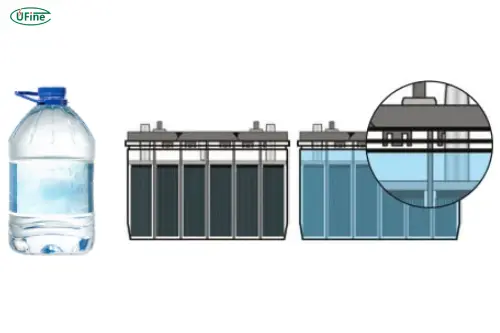
Reasons distilled water is required:
- Purity: Distilled water contains no minerals, iron, chlorine, or contaminants.
- Prevents sulfate buildup: Minerals from tap water form deposits, reducing battery capacity and lifespan.
- Protects internal components: Impurities cause corrosion on plates and separators.
- Ensures correct electrolyte density: Maintaining water levels keeps the acid-to-water ratio stable.
In short: distilled water protects the battery’s chemistry and prevents damage.
Part 2. Which batteries need distilled water?
Only flooded lead-acid batteries (also called wet-cell batteries) require distilled water.
Batteries that need distilled water:
- Car batteries (older serviceable types)
- Motorcycle wet-cell batteries
- Deep-cycle marine batteries
- Golf cart batteries
- Solar storage FLA batteries
- Industrial forklift batteries
Batteries that do NOT need distilled water:
- AGM (Absorbent Glass Mat)
- Gel batteries
- Lithium-ion (LiFePO4, NMC)
- Sealed maintenance-free lead-acid (SMF)
These batteries are sealed and do not require refilling.
AGM VS Lithium VS Lead-Acid Battery: Comprehensive Comparison
Part 3. Distilled water for battery price
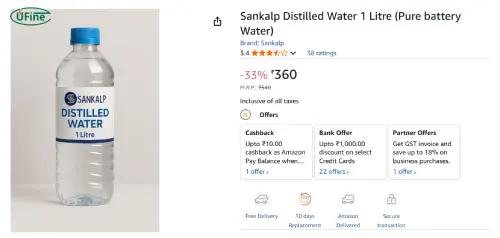
The price of distilled water depends on brand, packaging size, and region.
Typical retail prices:
- 1 gallon (3.78 L): USD $0.80 – $2.50
- 5-gallon container: USD $3.50 – $10
- Industrial-grade bulk: USD $0.20 – $0.40 per liter
Because battery applications don’t require large amounts, distilled water is usually inexpensive and widely accessible.
Part 4. How to add distilled water to a battery
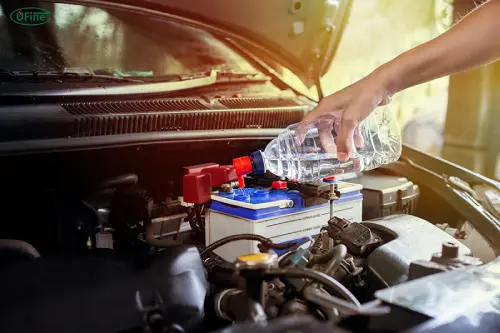
Adding distilled water is simple but must be done carefully.
Step-by-step guide:
- Turn off the battery charger or vehicle.
- Open the battery caps or vent covers.
- Check the water level—electrolyte should cover the battery plates.
- Slowly add distilled water until it reaches the “FULL” line or 1/8 inch above the plates.
- Do not overfill (water expands during charging).
- Close caps tightly.
- Charge the battery if needed.
Important safety tips:
- Wear gloves and eye protection.
- Only add water after charging, unless plates are exposed.
- Never add sulfuric acid—only refill with distilled water.
Part 5. Battery acid vs. distilled water: A detailed comparison
| Feature | Battery Acid (Electrolyte) | Distilled Water |
|---|---|---|
| Composition | Sulfuric acid + water | Pure H₂O |
| Purpose | Enables electrical reaction | Restores water lost during charging |
| When to Add | Only during factory fill or if acid spills | Regular maintenance |
| Safety | Corrosive and hazardous | Safe, non-corrosive |
| Can you substitute? | No | No—only water refills, not acid |
The key point:
You NEVER refill a battery with acid. Only distilled water should be added.
Part 6. Distilled water vs. tap water for battery use
Tap water contains minerals such as:
- Calcium
- Magnesium
- Chlorine
- Iron
- Copper
These contaminants lead to:
- Plate sulfation
- Mineral buildup
- Reduced capacity
- Shortened battery lifespan
- Overheating during charging
Distilled water advantages:
- 99.9% pure
- No minerals
- Safe for battery chemistry
- Prevents premature failure
Conclusion: Only distilled water is recommended for flooded batteries. Tap water must be avoided.
Part 7. Can anything replace distilled water in batteries?
Technically, no safe alternative matches the purity of distilled water.
However, in emergencies:
- Deionized (DI) water is acceptable
- Reverse osmosis (RO) water is acceptable if TDS < 10 ppm
Not recommended but sometimes used in extreme emergencies:
- Bottled drinking water → contains minerals (use only once if absolutely necessary)
Never use:
- Tap water
- Mineral water
- Rainwater
- Purified water with additives
They will damage the battery.
Part 8. Can I make distilled water for battery use at home?
Yes, you can make distilled water at home, although it’s less efficient than buying it.
How to make home-distilled water:
- Boil tap water in a pot.
- Capture the steam on a lid.
- Let the condensed droplets drip into a clean container.
This produces steam-distilled water, safe for battery use.
Important note:
Ensure the container collecting water is clean and mineral-free.
Part 9. Is distilled water for battery safe to drink?
Technically, distilled water is safe to drink because it is just pure H₂O without minerals.
However:
- It contains no electrolytes, so it tastes flat.
- Drinking only distilled water long-term is not recommended.
Battery-grade distilled water is NOT bottled for drinking, so avoid consuming it.
Part 10. Conclusion
Using distilled water for battery maintenance is essential for keeping flooded lead-acid batteries healthy, efficient, and long-lasting. From understanding why distilled water matters to learning how to refill and which alternatives are safe, proper water maintenance will dramatically extend your battery’s performance and lifespan.
Part 11. FAQs
1. How often should I add distilled water to my battery?
Typically every 1–3 months, depending on usage and temperature.
2. What happens if I use tap water?
Mineral contamination will cause sulfation, plate corrosion, and reduced battery life.
3. Should I add water before or after charging?
Add water after charging, unless plates are exposed.
4. Can I use distilled water in AGM or Lithium batteries?
No—AGM, Gel, and Lithium batteries are sealed and do NOT require water.
5. Why does my battery lose water so quickly?
Possible causes include overcharging, high temperatures, or internal damage.
Related Tags:

More Articles

Comparative Analysis: 14500 Battery Vs. 18650 Battery
Compare 14500 vs 18650 batteries by size, voltage, capacity, runtime, discharge current, charging, safety, and applications to choose the right cell.
12V Lithium-Ion What Voltage at Fully Charged and Why Your Battery Might Not Reach It
Check the 12V lithium battery voltage chart for 3S Li-ion and 4S LiFePO4. Learn full charge, resting voltage, charger limits, and fault checks.
LiFePO4 Voltage Chart Guide: Everything You Need to Know
Check the LiFePO4 voltage chart for 3.2V, 12V, 24V and 51.2V batteries. Compare SOC, charging voltage, cutoff limits and internal resistance.
Lithium Ion Cell Sizes: A Comprehensive Guide
Compare lithium ion cell sizes with a chart of dimensions, capacity ranges, cell types, applications, and key factors for selecting the right battery.
6 Volt Tractor Battery vs 12 Volt: Which One Fits Your Farm Equipment Best?
Compare 6V and 12V tractor batteries. Learn which voltage fits vintage or modern tractors, which specifications matter, and how to convert safely.


