
- key takeaways
- Part 1. How heavy are typical 12 v marine batteries
- Part 2. Are all boat batteries 12V?
- Part 3. Why battery weight actually matters
- Part 4. What affects battery weight?
- Part 5. Not all 12 v batteries weigh the same
- Part 6. Is it better to have a heavier battery or a lighter one for boats?
- Part 7. Planning your battery bank
- Part 8. FAQs
key takeaways
- A 12 V marine battery’s weight varies wildly depending on capacity and chemistry — from about 20 lbs for lightweight lithium to 100 + lbs for large lead‑acid units.
- Lithium (LiFePO₄) packs are much lighter per usable amp‑hour and can dramatically improve handling, performance, and fuel consumption on small boats.
- Battery weight matters for boat trim, balance, safety, and ease of installation — especially if you’re switching from heavy lead‑acid to lighter alternatives.
- Even within the same 12 V category, weights differ because capacity (Ah), physical size (group), and design all influence pounds on the scale.
When you’re researching “how much does a marine battery weigh” or trying to decide which 12 V battery for your boat makes sense, it’s easy to get lost in numbers. But here’s the honest truth: the weight isn’t just a boring spec — it’s something you feel every time you pick the battery up, install it, and watch how your boat behaves on the water.
Part 1. How heavy are typical 12 v marine batteries
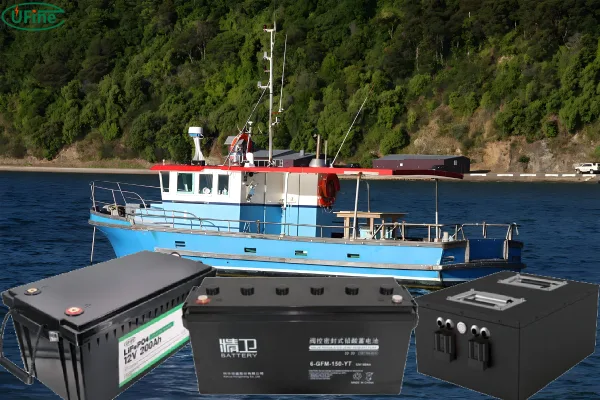
Depending on battery chemistry and size, the weight swings a lot.
typical 12 v marine battery weights
| Battery type | 12 V 100 Ah weight (approx) |
|---|---|
| Flooded lead‑acid | 80–100 lbs (36–45 kg) |
| AGM lead‑acid | 60–80 lbs (27–36 kg) |
| Gel battery | 60–80 lbs (27–36 kg) |
| LiFePO₄ (lithium) | 20–35 lbs (9–16 kg) |
These numbers tell a story: at the same 100 Ah rating, lithium batteries can be 60–70% lighter than traditional lead‑acid types. That’s a huge difference when you’re talking about lifting a 35 lb battery versus nearly a hundred pounds.
And if you’re curious about other capacities, larger lead‑acid batteries (like 200 Ah or 8D group sizes) can easily exceed 120 lbs, while equivalent high‑capacity lithium options stay much lighter.
Part 2. Are all boat batteries 12V?

While 12V is the most common voltage for boat batteries, it’s essential to understand that other voltage options exist to cater to diverse boat applications:
- 12V: The standard voltage for most small to medium-sized recreational boats and yachts.
- 24V: Commonly used in larger vessels or boats with more power-intensive systems.
- 6V: Often utilized in series configurations to create 12V or 24V systems.
- 36V and 48V: Found in specialized applications such as electric boats or advanced trolling motor setups.
Part 3. Why battery weight actually matters
ease of lifting and installation
You can laugh about how many pounds a battery weighs until you actually haul it inside your boat. Heavy lead‑acid batteries often require two people or even a set of straps and a plan to avoid back strain. Lighter lithium options save effort — and energy — every time you install, service, or remove them.
boat performance and trim
Weight isn’t just about strength — it affects how your boat sits in the water. Too much heavy gear aft or off‑center? You might notice:
- the bow riding higher than normal
- reduced top speed
- more fuel consumption
- sluggish handling
These effects are especially noticeable on smaller boats, where an extra 50–100 lbs is a meaningful percentage of total boat weight.
safety and balance
Placing heavy batteries without thought can throw off your boat’s balance. That’s why many experienced boaters recommend placing batteries close to the centerline and low — it improves stability and reduces the chance of listing in chop or turns.
Part 4. What affects battery weight?

Several factors contribute to the overall weight of a boat battery:
Battery Chemistry:
The chemical composition of the battery significantly influences its weight. Lead-acid batteries are the heaviest due to the density of lead, while lithium-ion batteries are the lightest, thanks to their advanced chemistry.
Capacity:
Generally, higher capacity batteries (measured in amp-hours or Ah) weigh more. However, this relationship is not always linear, especially with newer technologies like lithium-ion.
Case Material:
The material used for the battery casing can affect overall weight. Some manufacturers use reinforced plastics or composite materials to reduce weight without compromising durability.
Internal Construction:
The design and components inside the battery, such as plate thickness and separator materials, can influence weight.
Size:
While size often correlates with weight, advancements in battery technology have led to more compact, high-capacity options.
Part 5. Not all 12 v batteries weigh the same
It’s tempting to think “a 12 V marine battery is just a number.” But once you start comparing chemistry, weight, and performance, you see how practical decisions come into play.
Here’s a comparison that helps frame what you’re giving up — or gaining — by choosing one type over another:
| Battery characteristic | Lead‑acid (AGM) | Lithium (LiFePO₄) |
|---|---|---|
| Typical 100 Ah weight | ~60–80 lbs | ~20–35 lbs |
| Usable capacity | ~50% | ~80–100% |
| Typical lifespan | ~3–5 years | ~10–15 years |
| Charge time | slower | faster |
| Upfront cost | lower | higher |
| Weight per usable Ah | higher | lower |
This isn’t just theory — it’s what many experienced boaters tell each other when they talk about “weight vs performance vs budget.” Lighter lithium batteries can give you more usable energy for less weight, but they come at a sticker price premium.
If your boat sees lots of use, plans long cruises, or you’re weight‑sensitive — go for lithium. If it’s a weekend toy with tight budget constraints, a traditional AGM battery might make sense.
Part 6. Is it better to have a heavier battery or a lighter one for boats?
The choice between heavier and lighter batteries depends on various factors:
Advantages of Heavier Batteries:
- Lower initial cost
- Widely available and familiar technology
- Often more durable in harsh boat environments
Disadvantages of Heavier Batteries:
- Can negatively impact boat performance and fuel efficiency
- More challenging to install and replace
- Shorter lifespan compared to newer technologies
Advantages of Lighter Batteries:
- Improved boat performance and fuel efficiency
- Easier handling during installation and maintenance
- Often have longer lifespans and better cycle life
- Higher energy density, providing more power in a smaller package
Disadvantages of Lighter Batteries:
- Higher upfront cost
- May require specialized charging systems
- Less familiar technology for some boat owners and mechanics
For most modern boating applications, lighter batteries, particularly lithium-ion, are becoming the preferred choice due to their superior performance characteristics and long-term value. However, the optimal choice depends on factors such as boat size, power requirements, budget, and intended use.
Part 7. Planning your battery bank
Imagine you’re outfitting a 16‑foot fishing boat. You want enough capacity to run fish finders, lights, and a small trolling motor for a few hours. You’re weighing a 100 Ah AGM pack versus a 100 Ah lithium.
With AGM you’re lugging 60–80 lbs into the battery compartment (possibly two of ’em if you need more capacity). That’s a solid 120–160 lbs just in batteries — and that doesn’t include wiring, enclosure, or a secure mounting system.
Switch to lithium, and a pair of 100 Ah packs might only be 40–70 lbs total. You’ve just saved muscle, improved balance, and freed up space for gear.
Part 8. FAQs
How often should you inspect a marine battery for damage?
At least every 3–6 months, checking for corrosion, leaks, or loose terminals.
Can you combine different types of marine batteries in one boat?
Mixing chemistries (AGM + lithium) isn’t recommended — it can cause uneven charging and reduce lifespan.
Do smaller boats need lighter batteries?
Almost always — lightweight options improve maneuverability, reduce strain on the hull, and simplify installation.
Can weight reduction extend battery life?
Not directly, but lighter, more efficient batteries (like lithium) often provide more usable energy without over‑discharge, effectively prolonging service life.
Related Tags:

More Articles

Comparative Analysis: 14500 Battery Vs. 18650 Battery
Compare 14500 vs 18650 batteries by size, voltage, capacity, runtime, discharge current, charging, safety, and applications to choose the right cell.
12V Lithium-Ion What Voltage at Fully Charged and Why Your Battery Might Not Reach It
Check the 12V lithium battery voltage chart for 3S Li-ion and 4S LiFePO4. Learn full charge, resting voltage, charger limits, and fault checks.
LiFePO4 Voltage Chart Guide: Everything You Need to Know
Check the LiFePO4 voltage chart for 3.2V, 12V, 24V and 51.2V batteries. Compare SOC, charging voltage, cutoff limits and internal resistance.
Lithium Ion Cell Sizes: A Comprehensive Guide
Compare lithium ion cell sizes with a chart of dimensions, capacity ranges, cell types, applications, and key factors for selecting the right battery.
6 Volt Tractor Battery vs 12 Volt: Which One Fits Your Farm Equipment Best?
Compare 6V and 12V tractor batteries. Learn which voltage fits vintage or modern tractors, which specifications matter, and how to convert safely.


