
- Key Takeaways
- Part 1. What is an inverter?
- Part 2. What is a converter?
- Part 3. Difference between inverter and converter
- Part 4. Why inverters matter in solar systems
- Part 5. Why converters matter in electronics
- Part 6. Inverter vs converter selection guide
- Part 7. Inverter vs converter real-world examples
- Part 8. Inverter and converter technical limitations
- Part 9. Inverter vs converter FAQs
You may often see terms like inverter vs converter when working with batteries, solar systems, or power electronics. Many users ask: what is a converter, what does a converter do, and what is the difference between an inverter and a converter?
The answer is simple but critical in real applications. Choosing the wrong device can reduce efficiency, damage equipment, or cause system failure. This guide explains the difference between inverter and converter in a clear, engineering-focused way.
Key Takeaways
- An inverter converts DC to AC, while a converter changes voltage or current type.
- Inverters are used for AC loads and solar systems.
- Converters are used for charging, voltage regulation, and electronics.
- Many systems (like EVs and energy storage) use both together.
- Selection depends on power source, load type, and voltage requirements.
Part 1. What is an inverter?
An inverter is a device that converts direct current (DC) into alternating current (AC).
This is necessary because:
- Batteries and solar panels produce DC
- Most appliances and grids use AC
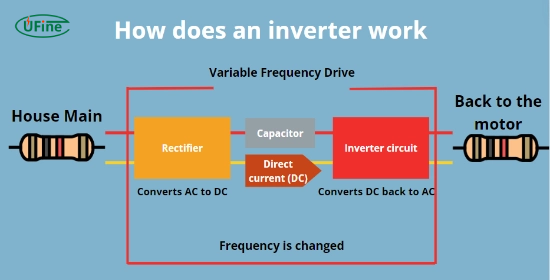
1 How does an inverter work?
An inverter operates in three steps:
- DC input from a battery or solar panel
- High-speed switching using transistors
- Waveform shaping into usable AC
2 Types of inverters
- Square wave (basic loads)
- Modified sine wave (general use)
- Pure sine wave (sensitive electronics)
3 Applications of inverters
- Solar energy systems
- UPS and backup power
- Portable power stations
- Off-grid systems
👉 Learn more:
inverter vs generator comparison
Part 2. What is a converter?
A converter is a broader category of device. It changes electrical energy from one form to another.
So if you ask what is a converter:
It is a device that adjusts voltage, current type, or frequency.
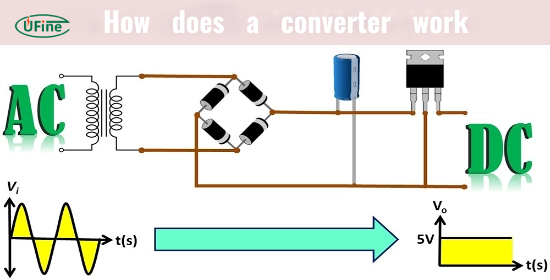
1 Types of converters
- AC to DC (rectifier)
- DC to DC (buck/boost)
- AC to AC (frequency/voltage conversion)
2 What does a converter do?
- Converts AC wall power to DC
- Regulates voltage in battery systems
- Supports multi-voltage architectures
Converters are widely used in power supplies, EV systems, and industrial electronics.
Part 3. Difference between inverter and converter
| Feature | Inverter | Converter |
|---|---|---|
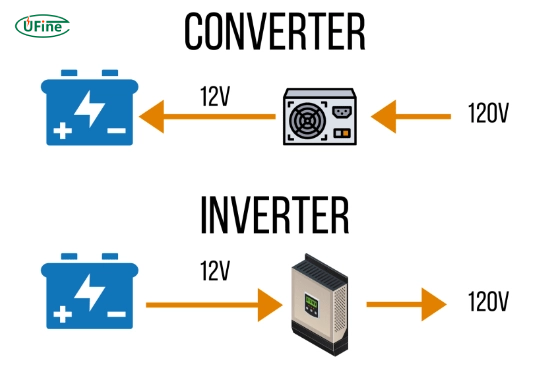
| Function | DC → AC | AC ↔ DC or DC ↔ DC |
| Input | DC only | AC or DC |
| Output | AC | AC or DC |
| Use case | Power appliances | Voltage control / charging |
👉 Key point:
- Inverter = specific type of converter
- Converter = broader category
Part 4. Why inverters matter in solar systems
Solar panels produce DC electricity. Homes and grids require AC.
An inverter:
- Converts DC to AC
- Synchronizes with grid
- Improves efficiency (MPPT)
Without an inverter, solar energy cannot be used directly.
Part 5. Why converters matter in electronics
Converters ensure devices receive correct voltage and current.
Common uses:
- Phone chargers (AC → DC)
- LED drivers
- Battery systems
- EV power distribution
👉 Explore solutions: lithium battery customization
Part 6. Inverter vs converter selection guide
Choose an inverter if:
- Your source is DC (battery, solar)
- Your load requires AC
- You need backup or off-grid power
Choose a converter if:
- You need voltage regulation
- You are charging batteries
- Your system runs on DC
Use both if:
- Designing EV systems
- Building energy storage systems
- Integrating solar + battery
Part 7. Inverter vs converter real-world examples
Inverter examples
- Home solar inverter
- Backup power system
- Car power inverter
Converter examples
- Laptop charger
- DC-DC converter in EV
- Industrial power supply
Part 8. Inverter and converter technical limitations
Inverter limitations
- Energy loss during conversion
- Harmonics in low-quality models
- Higher cost for pure sine wave
Converter limitations
- Heat generation
- EMI noise
- Complex design for high power
Part 9. Inverter vs converter FAQs
What is the difference between an inverter and a converter?
An inverter converts DC to AC, while a converter can convert AC to DC or adjust voltage levels.
What does a converter do in a battery system?
It regulates voltage and ensures stable power for charging and discharging.
Can I use a converter instead of an inverter?
No. A converter cannot replace an inverter when AC output is required.
Why do solar systems need an inverter?
Because solar panels generate DC, but homes and grids use AC power.
Which is better: inverter or converter?
They serve different roles. The correct choice depends on your system design and power needs.
Related Tags:

More Articles

Comparative Analysis: 14500 Battery Vs. 18650 Battery
Compare 14500 vs 18650 batteries by size, voltage, capacity, runtime, discharge current, charging, safety, and applications to choose the right cell.
12V Lithium-Ion What Voltage at Fully Charged and Why Your Battery Might Not Reach It
Check the 12V lithium battery voltage chart for 3S Li-ion and 4S LiFePO4. Learn full charge, resting voltage, charger limits, and fault checks.
LiFePO4 Voltage Chart Guide: Everything You Need to Know
Check the LiFePO4 voltage chart for 3.2V, 12V, 24V and 51.2V batteries. Compare SOC, charging voltage, cutoff limits and internal resistance.
Lithium Ion Cell Sizes: A Comprehensive Guide
Compare lithium ion cell sizes with a chart of dimensions, capacity ranges, cell types, applications, and key factors for selecting the right battery.
6 Volt Tractor Battery vs 12 Volt: Which One Fits Your Farm Equipment Best?
Compare 6V and 12V tractor batteries. Learn which voltage fits vintage or modern tractors, which specifications matter, and how to convert safely.


