- Key takeaways
- Part 1. What is a battery bus bar?
- Part 2. Advantages of battery bus bars
- Part 3. Common applications of battery bus bars
- Part 4. What is a battery cable?
- Part 5. Advantages of battery cables
- Part 6. Common applications of battery cables
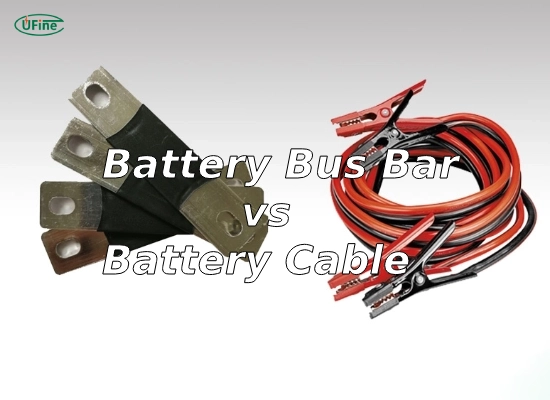
- Part 7. Battery bus bar vs battery cable: main differences
- Part 8. When should you use a battery bus bar?
- Part 9. When should you use a battery cable?
- Part 10. Battery terminal bus bar vs battery terminal cable
- Part 11. How to choose between a battery bus bar and a battery cable
- Part 12. Installation tips for battery bus bars and battery cables
- Part 13. Battery bus bar vs battery cable common mistakes to avoid
- Part 14. Battery bus bar and cable selection table
- Part 15. FAQs about battery bus bars and battery cables
Battery bus bars and battery cables both carry power but serve different roles. A battery bus bar is a rigid conductor for stable, high-current distribution, while a battery cable is a flexible insulated wire for routing and movement.
Key takeaways
- A battery bus bar is a solid copper or aluminum conductor for fixed, high-current connections.
- A battery cable is a flexible insulated wire for movable or complex routing.
- Bus bars offer lower resistance, better heat control, and cleaner layouts.
- Battery cables are easier to install and better for vibration or movement.
- A battery terminal bus bar or battery link bar connects battery terminals or modules.
- Selection depends on current, voltage, heat, space, vibration, and maintenance needs.
Part 1. What is a battery bus bar?
A battery bus bar is a solid metal strip or plate that connects battery cells, modules, terminals, or distribution points. It is usually made of copper or aluminum for good conductivity.
In lithium battery packs, bus bars connect cells in series or parallel. In larger systems, they connect modules, fuses, contactors, BMS, inverters, chargers, and loads.

Bus bars are also called battery link bars, battery terminal bus bars, or battery interconnect bars. All refer to stable, low-resistance connections.
Common battery bus bar materials
| Material | Main Advantage | Common Use |
|---|---|---|
| Copper | High conductivity, low resistance | High-current battery packs, EVs, industrial power systems |
| Tin-plated copper | Better corrosion resistance and solderability | Battery terminals, marine systems, exposed electrical areas |
| Nickel-plated copper | Better surface protection and weldability | Lithium battery packs, harsh environments |
| Aluminum | Lower weight and lower cost | EV battery modules, large energy storage systems |
| Laminated copper | Better insulation and compact design | High-voltage battery packs and power electronics |
Copper is preferred for high current. Aluminum is used when weight and cost matter. Plating improves corrosion resistance and contact reliability.
Part 2. Advantages of battery bus bars
1. Lower resistance
Large cross-section reduces resistance and voltage drop, improving efficiency.
2. Better heat dissipation
Flat shape increases surface area, helping heat release.
3. Cleaner layout
Replaces multiple wires, making systems simpler and easier to inspect.
4. Strong structure
Rigid design provides stable connections in fixed systems.
5. Easy series/parallel connection
Battery link bars simplify consistent connections between cells or terminals.
Part 3. Common applications of battery bus bars
Electric vehicles and mobility systems
Used to connect cells, modules, and power electronics. A car battery bus bar can also support custom power distribution.
Lithium battery packs
Used for cell and module connections. Must match current, heat, vibration, and insulation needs. See battery terminal stud vs battery terminal screw for terminal options.
Energy storage systems
Used for module connections and DC distribution. Systems may follow standards like IEC 62619 for safety.
Solar and renewable energy systems
Connect battery banks, inverters, and controllers, handling high current efficiently.
Industrial equipment
Used in forklifts, AGVs, telecom systems, and machinery for stable power distribution.
Part 4. What is a battery cable?
A battery cable is a flexible insulated conductor made of stranded copper or aluminum wire. The strands allow bending and routing.
Insulation materials like PVC, rubber, or XLPE protect against short circuits, moisture, and damage.

Battery cables connect batteries to starters, inverters, chargers, switches, and distribution units. SAE J1127 defines standards for low-voltage vehicle cables.
Part 5. Advantages of battery cables
1. High flexibility
Easy to route through tight or complex paths.
2. Vibration resistance
Handles movement better than rigid conductors.
3. Easy installation
Simple to cut, crimp, and replace.
4. Insulation protection
Reduces risk of short circuits and damage.
5. Wide selection
Available in many sizes, lengths, and terminal types.
Part 6. Common applications of battery cables
Automotive battery systems
Connect battery to starter, alternator, and ground. Flexibility is essential.
Marine battery systems
Used for onboard wiring with added corrosion resistance.
UPS and backup power
Connect batteries to inverters and chargers.
Portable and serviceable equipment
Ideal where batteries need frequent removal or replacement.
Part 7. Battery bus bar vs battery cable: main differences
| Item | Battery Bus Bar | Battery Cable |
|---|---|---|
| Structure | Rigid metal strip, plate, or bar | Flexible stranded wire with insulation |
| Common material | Copper, plated copper, aluminum | Copper or aluminum conductor |
| Flexibility | Low | High |
| Current capacity | Usually higher for compact fixed layouts | Depends on cable gauge and length |
| Heat dissipation | Better surface heat dissipation | Depends on conductor size, insulation, and airflow |
| Installation | Needs accurate layout and secure mounting | Easier to route and install |
| Maintenance | Fewer connection points in some designs | Easier to replace in the field |
| Best use | Fixed high-current power distribution | Flexible or movable battery connections |
| Common terms | Battery bus bar, battery link bar, battery terminal bus bar | Battery cable, battery lead, battery wire |
Structural difference
A battery bus bar is a rigid metal conductor, usually flat or custom-shaped to fit a battery pack. It stays fixed and does not bend.
A battery cable is made of many fine wire strands. This makes it flexible and easy to route through tight or moving areas.
Electrical difference
Bus bars offer low resistance and stable current flow, making them ideal for high-current systems like EV battery packs and energy storage.
Battery cables can also handle high current, but performance depends on cable length, wire size, insulation rating, and connection quality.
Heat difference
Bus bars dissipate heat efficiently due to their larger surface area, helping reduce hot spots.
Battery cables are insulated, which limits heat dissipation. Proper sizing and insulation rating are important to prevent overheating.
Mechanical difference
Bus bars are best for fixed, stable connections in compact layouts.
Battery cables are better for applications with movement, vibration, or where flexible routing is needed.
For example, use a battery terminal bus bar for fixed battery banks, and a battery cable for connections to movable or serviceable components.
Part 8. When should you use a battery bus bar?
Use a battery bus bar when the system needs:
- High current in a compact space
- Fixed connection points
- Low voltage drop
- Better heat spreading
- Clean battery pack layout
- Parallel or series battery terminal connection
- Fewer loose wires
- Repeatable manufacturing assembly
A bus bar is often the better choice for lithium battery packs, EV modules, battery energy storage systems, and industrial power distribution.
For terminal conversion and connection planning, see our article on how to convert M6 and M8 lithium battery terminals to standard post terminals.
Part 9. When should you use a battery cable?
Use a battery cable when the system needs:
- Flexible routing
- Easy installation
- Serviceable or replaceable connections
- Vibration tolerance
- Longer connection distance
- Insulated protection
- Connection to moving parts
- Automotive, marine, or backup power wiring
A cable is often better for car battery systems, marine battery banks, UPS systems, starter circuits, and equipment where parts move or need field service.
If your project uses clamp-style battery connections, this guide to battery terminal clamps can help you choose the right terminal interface.
Part 10. Battery terminal bus bar vs battery terminal cable
A battery terminal bus bar is used to connect two or more battery terminals with a rigid metal bar. It is common in battery banks, lithium battery modules, and compact DC systems.
A battery terminal cable connects the battery terminal to another part with a flexible wire. It is common in automotive, marine, and serviceable power systems.
The best choice depends on layout:
| Connection Need | Better Option |
|---|---|
| Short, fixed connection between battery terminals | Battery terminal bus bar |
| Long connection from battery to inverter or starter | Battery cable |
| Parallel battery bank connection | Battery link bar or bus bar |
| System with movement or vibration | Battery cable |
| Compact battery pack assembly | Custom battery bus bar |
| Field service and easy replacement | Battery cable |
Part 11. How to choose between a battery bus bar and a battery cable
1. Check current
Confirm continuous and peak current first. Undersized conductors cause heat, voltage drop, and power loss. For lithium packs, include charge, discharge, peak, and fault current.
2. Check voltage and insulation
Higher voltage needs better insulation, spacing, and protection. Prevent accidental contact and damage. Follow standards like NEC Article 706 for safety.
3. Check space and layout
Use a bus bar for short, fixed paths. Use a cable for long, curved, or complex routing.
4. Check heat
Heat depends on current, resistance, airflow, and size. Bus bars usually cool better, but poor connections can still overheat.
5. Check vibration
Use cables in high-vibration systems. If using bus bars, add support or flexible design.
6. Check terminals
Connection quality matters. Terminals, studs, crimping, and torque all affect resistance. See battery posts and battery terminals.
7. Plan maintenance
Bus bars reduce clutter but need safe access. Cables are easier to replace but add more joints. For corrosion issues, see battery terminal corrosion guide.
Part 12. Installation tips for battery bus bars and battery cables
For battery bus bars
- Use the correct copper or aluminum thickness and width.
- Check continuous current, peak current, and temperature rise.
- Use plating when corrosion protection is needed.
- Keep enough clearance and creepage distance for the voltage level.
- Add insulation covers or sleeves where accidental contact is possible.
- Use correct torque for bolts, screws, or studs.
- Avoid mechanical stress on battery terminals.
- Check contact surface flatness and cleanliness.
For battery cables
- Select the correct cable gauge for current and length.
- Use insulation rated for the working temperature and environment.
- Avoid sharp bends and high-heat areas.
- Use proper crimping tools and matching terminals.
- Add strain relief where vibration is present.
- Protect cables from abrasion, oil, moisture, and chemicals.
- Keep positive and negative cables clearly identified.
- Inspect terminals for looseness, corrosion, and heat marks.
Part 13. Battery bus bar vs battery cable common mistakes to avoid
Mistake 1: Treating bus bars and cables as interchangeable
They both carry current, but they solve different design problems. A bus bar is better for fixed, compact, high-current layouts. A cable is better for flexible routing and movement.
Mistake 2: Only comparing material cost
A bus bar may cost more at the beginning. But it can reduce assembly time, wiring clutter, voltage drop, and long-term maintenance. A cable may be cheaper and easier to install, but it can add more routing and connection points.
Mistake 3: Ignoring contact resistance
Many failures happen at the connection point, not in the conductor itself. Loose bolts, poor crimps, dirty terminals, or corrosion can create heat and voltage drop.
Mistake 4: Choosing by current only
Current is important, but it is not the only factor. You also need to check temperature, vibration, insulation, voltage, space, terminal type, safety rules, and service needs.
Mistake 5: Forgetting safety covers
Exposed bus bars and terminals can create short-circuit risks. Use insulation covers, terminal caps, shields, or enclosures when needed.
Part 14. Battery bus bar and cable selection table
| Application | Recommended Choice | Reason |
|---|---|---|
| EV battery module | Battery bus bar | Compact, high-current, fixed connection |
| Car starter battery connection | Battery cable | Flexible routing and vibration resistance |
| Parallel battery bank | Battery link bar or bus bar | Clean terminal-to-terminal connection |
| Marine battery wiring | Battery cable | Flexible, insulated, corrosion-resistant options |
| Industrial DC cabinet | Bus bar | Organized high-current distribution |
| UPS battery string | Cable or bus bar | Depends on layout and service access |
| Lithium battery pack terminal output | Bus bar or cable | Depends on current, case design, and terminal type |
| Inverter battery connection | Battery cable | Longer route and easier field installation |
Part 15. FAQs about battery bus bars and battery cables
What is the difference between a battery bus bar and a battery cable?
A bus bar is rigid and used for fixed, high-current connections. A cable is flexible and used for routed or movable connections.
Is a battery bus bar better than a battery cable?
No. Bus bars suit compact, fixed, high-current setups. Cables suit flexible routing, vibration, and longer runs.
What is a battery link bar?
A metal bar that connects battery terminals or modules, usually a type of bus bar.
Can I use a car battery bus bar instead of battery cables?
Only for fixed connections. Use cables where flexibility or movement is needed.
What material is best for a battery terminal bus bar?
Copper is best for conductivity. Plated copper improves corrosion resistance. Aluminum is lighter and cheaper but needs careful design.
Related Tags:

More Articles

Dead Battery or Device Failure? How to Find the Cause
Think your device is broken? Learn how to tell if the problem comes from battery aging or hardware failure before replacing your electronics.
Why iPhone Duo Uses Two Batteries: The Engineering Behind Foldable Phone Power
Why do foldable phones need two batteries? Explore the engineering challenges behind iPhone Duo’s dual-battery architecture and future battery trends.
Solid-State Batteries: 3 Myths You Need to Know
Solid-state batteries promise safer EVs and longer range, but the reality is more complex. Discover the challenges behind this next-gen technology.
Battery Capacity vs Discharge Rate: The Choice Engineers Face
Higher capacity or higher discharge rate? Learn how to choose the right LiPo battery for longer runtime, stable power output, and better device performance.
Battery Cable Size Guide: Choose the Right Wire Fast
Not sure what battery cable size you need? Learn how to select the right wire gauge, terminal size, and cable for safer, more efficient battery systems.