
What Is “C” in a Battery?
When evaluating lithium batteries for high-power applications, one parameter appears repeatedly on datasheets: C rating. If you’ve ever asked “what is C in battery?” or “what does C rating mean?”, the short answer is this:
The battery C rating defines how fast a battery can be charged or discharged relative to its capacity—safely and continuously.
Understanding the battery C rating is essential for engineers, system integrators, and buyers because it directly affects power output, thermal behavior, safety margins, and cycle life—especially when designing packs with a proper battery management system (BMS).
Key Takeaways
- Battery C rating expresses current relative to capacity, not absolute power.
- A 1C battery discharges its full capacity in 1 hour; higher C = higher current capability.
- C rating is constrained by chemistry, electrode design, thermal limits, and safety margins.
- Selecting a C rating that is too low risks overheating and degradation; too high may add unnecessary cost.
- Always size batteries using continuous C rating, not peak or burst ratings.
- Real-world usable C rate is affected by temperature, SOC range, and aging.
Part 1. What is battery c rating?
1 Definition of battery c rating
The C rating (or C rate) indicates the rate at which a battery can be charged or discharged relative to its nominal capacity.
- 1C means the battery will fully discharge in 1 hour
- 2C means full discharge in 30 minutes
- 10C means full discharge in 6 minutes
For example, a 2Ah battery rated at 5C can deliver:
- 2Ah × 5 = 10A (continuous discharge current)
This definition applies across lithium chemistries, including Li-ion, LiPo, LiFePO₄, and high-power cylindrical or pouch cells, each of which has different lithium battery chemistry characteristics that limit achievable C rates.
2 Why battery c rating matters
Understanding the battery C rate is critical because it directly impacts:
- Power delivery capability
- Heat generation and thermal stability
- Voltage sag under load
- Battery lifespan and safety
A battery with insufficient C rating may experience overheating, accelerated aging, voltage drop, or protection cutoff, even if the nominal capacity seems adequate.
Part 2. Battery c rating chart (discharge time reference)
The table below shows how different C rates translate into discharge time under continuous load.
| C Rating | Discharge Time |
|---|---|
| 1C | 1 hour |
| 2C | 30 minutes |
| 5C | 12 minutes |
| 10C | 6 minutes |
| 15C | 4 minutes |
| 20C | 3 minutes |
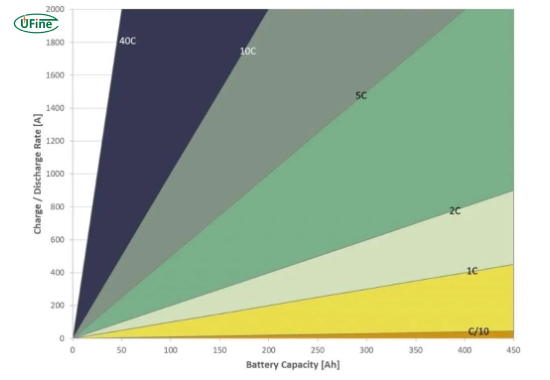
⚠️ Note: This chart assumes ideal conditions. Real-world discharge time is influenced by temperature, internal resistance, cutoff voltage, and aging.
Part 3. Why c ratings differ between batteries
Not all batteries can achieve the same C rating—even with identical capacity. The differences come from multiple engineering constraints.
1 Battery chemistry
Different chemistries support different current densities:
- LiFePO₄ (LFP): Moderate energy density, good thermal stability, typically lower C than LiPo
- LiPo / High-power Li-ion: Optimized for high discharge (RC, drones)
- NMC / NCA: Balanced energy and power (used in EVs)
For example, EV batteries from manufacturers like Tesla prioritize energy density and longevity over extreme C rates.
2 Cell construction & electrode design
Higher C ratings require:
- Thicker current collectors
- Larger electrode surface area
- Shorter ion diffusion paths
High-C batteries often sacrifice energy density to achieve power density.
3 Material quality & internal resistance
Low internal resistance (IR) enables:
- Higher current flow
- Less heat generation
- More stable voltage under load
Premium cells typically achieve higher usable C rates, not just higher labeled values.
4 Intended application
Manufacturers design batteries for specific use cases:
| Application | Typical C Rating |
|---|---|
| Remote controls | <1C |
| Energy storage | 0.5C–1C |
| Power tools | 5C–10C |
| Drones / RC | 20C–60C |
| EV traction packs | ~2C–5C |
Part 4. How to calculate battery c rating?
1 Battery c rating formula
C Rating = Maximum Continuous Discharge Current (A) ÷ Nominal Capacity (Ah)
2 Example calculation
- Nominal capacity: 2000mAh (2Ah)
- Max continuous current: 10A
- C = 10A ÷ 2Ah = 5C
This battery can safely discharge at 5 times its capacity continuously.
3 C rating vs capacity vs current
- Capacity (Ah): How much energy is stored
- Current (A): How fast energy is delivered
- C Rate: Normalized expression of current relative to capacity
Two batteries with different capacities can have the same C rating but very different current outputs.
Part 5. Practical selection: how to choose the right c rating
When selecting a battery, do not choose the highest C rating by default. Instead:
- Calculate maximum continuous current demand
- Add 20–30% safety margin
- Match this current to battery capacity × C rating
- Verify thermal and environmental conditions
Part 6. FAQs about battery c rating
Is a higher C rating always better?
Not always. Higher C ratings allow more current but often increase cost and reduce energy density. Choose based on actual load requirements.
What is a 1C, 2C, or 3C battery?
These indicate discharge rates relative to capacity. A 1C battery discharges in 1 hour; 2C in 30 minutes; 3C in 20 minutes.
What does 25C mean on a battery?
It means the battery can discharge at 25 times its capacity. A 2Ah 25C battery supports up to 50A continuous discharge (if rated honestly).
Which is better: 10C or 20C battery?
A 20C battery can deliver higher current, but it’s only “better” if your application actually requires it.
How do I choose the correct battery C rating?
Base your choice on continuous current demand, not peak bursts, and include safety margin for temperature and aging.
Related Tags:

More Articles

JST vs Molex: The Right Battery Connector Choice
JST or Molex for your battery? Learn how connector selection affects current, voltage drop, reliability, and device performance.
Custom Battery Pricing: Costs Manufacturers Don’t Mention
A low battery quote may not be the final cost. Discover common hidden expenses that affect custom lithium battery projects.
Battery Wire Length: Hidden Cause of Power Loss
A longer battery wire can cause voltage drop, power loss, and unstable operation. Learn how wire length affects battery performance.
How Device Sleep Modes Affect Battery Life
Think sleep mode extends battery life? Learn why devices still drain power and how firmware, hardware, and batteries affect runtime.
LiPo Battery and PCB Design: Clearance, Insulation, and Placement
Learn how to optimize LiPo battery PCB clearance, insulation, placement, wiring, and thermal design—and avoid common integration mistakes.


