
- Key takeaways
- Part 1. What are power converters?
- Part 2. What is a buck converter?
- Part 3. How does a buck converter work?
- Part 4. What is a boost converter?
- Part 5. How does a boost converter work?
- Part 6. Buck converter vs boost converter
- Part 7. What are buck and boost converters used for in lithium battery systems?
- Part 8. Critical components that affect converter performance
- Part 9. Factors affecting buck converter and boost converter efficiency
- Part 10. Design challenges engineers must consider
- Part 11. How to choose between a buck converter vs boost converter
- Part 12. Buck converter and boost converter FAQs
Power electronics control how voltage moves inside modern devices. Smartphones, industrial equipment, electric vehicles, solar systems, and lithium battery packs all rely on efficient voltage regulation.
Among the most important DC-DC power conversion technologies are buck converters and boost converters. These switching regulators improve power efficiency while delivering stable voltage to sensitive electronics.
If you have ever asked:
- What is a buck converter?
- What is a boost converter?
- How do buck converters work?
- How does a boost converter work?
- What is the difference between a boost converter vs buck converter?
This guide explains everything engineers, battery designers, and equipment buyers need to know.
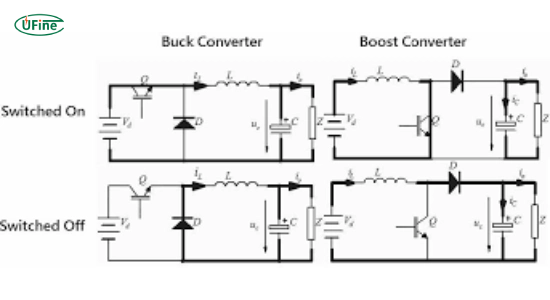
Key takeaways
- A buck converter reduces DC voltage efficiently (step-down conversion).
- A boost converter increases DC voltage efficiently (step-up conversion).
- Both belong to the category of DC-DC switching converters.
- Buck and boost converters commonly achieve efficiency above 90%.
- Inductors, capacitors, switches, and control circuits determine performance.
- Converter selection depends on voltage range, battery system design, thermal limits, and load conditions.
- Lithium battery systems often use buck and boost converters to optimize power delivery and battery life.
Part 1. What are power converters?
Power converters transform electrical energy into a form required by electronic systems. They regulate voltage, current, or frequency to ensure equipment operates safely and efficiently.
Common power converter categories include:
| Converter Type | Function | Example Application |
|---|---|---|
| Buck Converter | Steps voltage down | Battery-powered electronics |
| Boost Converter | Steps voltage up | Solar charging systems |
| Buck-Boost Converter | Can step voltage up or down | Portable battery systems |
| AC-DC Converter | Converts AC to DC | Laptop chargers |
| DC-AC Converter (Inverter) | Converts DC to AC | Energy storage systems |
Buck and boost converters are among the most widely used DC-DC converters because they minimize energy loss and improve battery utilization.
Part 2. What is a buck converter?
A buck converter, also called a step-down converter, reduces input voltage to a lower output voltage while maintaining high efficiency.
For example:
- 24V → 12V
- 12V → 5V
- 48V → 24V
Buck converters are essential when the power source voltage exceeds the voltage required by the load.
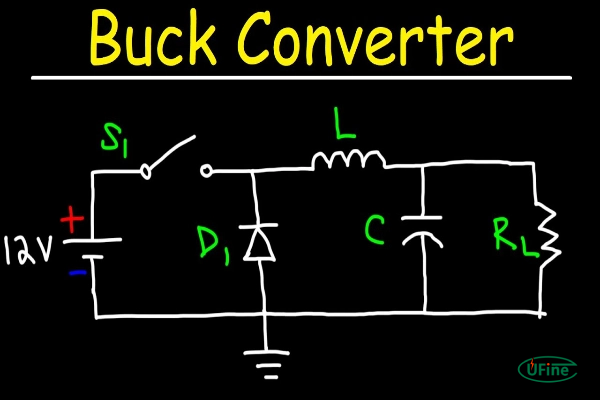
Part 3. How does a buck converter work?
Many engineers ask: how do buck converters work?
Buck converters use high-speed switching and energy storage components.
The operating sequence is:
Switch ON
A MOSFET or transistor closes. Current flows through the inductor. The inductor stores energy in a magnetic field.
Switch OFF
The switch opens. The inductor releases stored energy into the load. Current continues flowing even when switching stops.
Output Filtering
A capacitor smooths voltage ripple. The result is a stable lower DC output voltage.
The switching process typically occurs from hundreds of kHz to several MHz. Higher switching frequency reduces component size but can increase switching losses.
Main components inside a buck converter
- Inductor
- MOSFET switching transistor
- Diode or synchronous rectifier
- Output capacitor
- PWM controller
Advantages of buck converters
- High efficiency (often 90–98%)
- Reduced heat generation
- Smaller cooling requirements
- Longer battery operating time
- Compact circuit design
Common buck converter applications
Battery-Powered Devices
Portable electronics use buck converters to extend runtime.
Examples:
- Smartphones
- Tablets
- Wearables
- IoT devices
Lithium Battery Systems
Industrial battery packs frequently require voltage reduction.
For example: 48V lithium battery → 12V control electronics.
Related reading: Custom Lithium Battery Pack Guide
LED Drivers
Buck converters provide stable current control and reduce flickering.
Industrial Automation
PLCs, sensors, and embedded controllers often require stepped-down voltage rails.
Part 4. What is a boost converter?
A boost converter, also called a step-up converter, increases DC voltage from a lower input voltage to a higher output voltage.
Examples:
- 3.7V → 5V
- 12V → 24V
- 24V → 48V
Boost converters are critical when battery voltage is lower than equipment operating requirements.
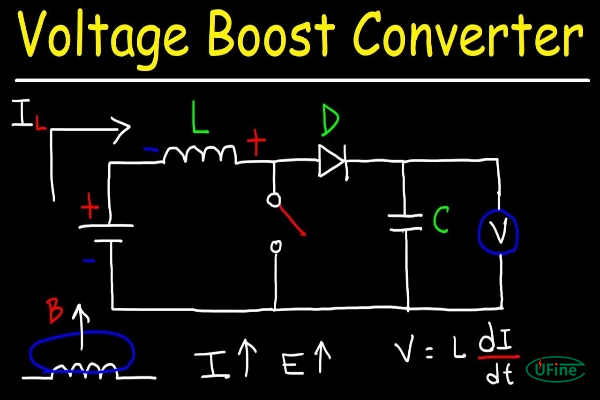
Part 5. How does a boost converter work?
Many engineers search: how does a boost converter work?
The process resembles buck converter operation but changes energy flow.
Switch ON
The transistor closes. Current flows into the inductor. Energy accumulates in the magnetic field.
Switch OFF
The switch opens. Inductor energy releases into the circuit. The inductor voltage adds to input voltage. Output voltage rises above input voltage.
Output Smoothing
Capacitors reduce ripple. The system delivers stable elevated DC voltage.
Main components inside a boost converter
- Inductor
- Switching transistor
- Diode
- Capacitor
- PWM control circuit
Advantages of boost converters
- Raises low battery voltage efficiently
- Supports compact battery-powered systems
- High power conversion efficiency
- Flexible voltage design capability
Common boost converter applications
Portable Electronics
USB power banks commonly use boost converters.
Example: 3.7V lithium battery → 5V USB output.
Electric Vehicles
Electric vehicle systems use voltage conversion for auxiliary systems and power electronics.
Solar Energy Systems
Solar output changes with sunlight intensity. Boost converters stabilize voltage before charging batteries or feeding power systems.
Industrial Sensors
Low-voltage battery-powered sensors often require higher operating voltages.
Part 6. Buck converter vs boost converter
Engineers often compare boost converter vs buck converter during power system design.
The main difference is voltage direction.
| Parameter | Buck Converter | Boost Converter |
|---|---|---|
| Voltage Function | Step Down | Step Up |
| Input Voltage | Higher than output | Lower than output |
| Output Voltage | Lower than input | Higher than input |
| Energy Storage | Inductor | Inductor |
| Efficiency | 90–98% | 85–95% |
| Typical Use | Battery voltage reduction | Battery voltage increase |
| Example | 24V → 5V | 3.7V → 5V |
When to use a buck converter
Choose buck conversion when:
- Battery voltage exceeds device voltage
- High efficiency matters
- Thermal constraints exist
- Long battery runtime is important
When to use a boost converter
Choose boost conversion when:
- Battery voltage is insufficient
- Voltage must remain stable as batteries discharge
- Portable equipment needs fixed output voltage
Part 7. What are buck and boost converters used for in lithium battery systems?
Lithium batteries frequently require voltage conversion.
Battery voltage changes during charging and discharge cycles.
Converters maintain stable operation.
Examples:
| Lithium Battery Application | Converter Function |
|---|---|
| Portable medical devices | Boost voltage stability |
| AGV robots | Step battery voltage down |
| Solar energy storage | Boost charging voltage |
| Industrial battery packs | Multi-stage voltage conversion |
| EV auxiliary electronics | Buck voltage regulation |
Related reading:
Part 8. Critical components that affect converter performance
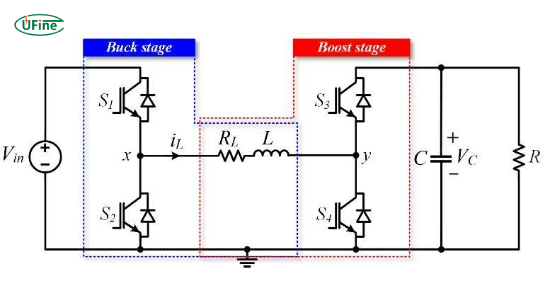
Both buck and boost converters depend on component quality.
-
Inductor
- Stores energy temporarily.
- Inductor size and core material influence efficiency.
-
MOSFET Switch
- Controls switching speed.
- Lower switching resistance improves performance.
-
Capacitor
- Reduces ripple voltage.
- Improves output stability.
-
Diode
- Prevents reverse current flow.
- Fast recovery diodes reduce losses.
-
PWM Controller
- Controls duty cycle.
- Ensures output voltage regulation.
Part 9. Factors affecting buck converter and boost converter efficiency
Efficiency matters in battery-powered systems because wasted power becomes heat.
Important factors include:
-
Switching Frequency
Higher frequency:
Advantages:
- Smaller components
- Compact design
Disadvantages:
- Increased switching losses
- Higher EMI risk
-
Component Quality
Premium inductors and MOSFETs reduce conduction losses.
-
Thermal Design
Poor cooling reduces efficiency.
Thermal solutions include:
- Heat sinks
- Copper PCB layers
- Forced airflow
-
Load Conditions
Converters operate most efficiently near optimized load ranges.
Light-load operation often lowers efficiency.
Part 10. Design challenges engineers must consider
-
Electromagnetic Interference (EMI)
Fast switching generates electrical noise.
Shielding and filtering reduce EMI problems.
-
Thermal Stress
Heat affects MOSFET lifespan and capacitor reliability.
Thermal simulation becomes critical in industrial systems.
-
Cost vs Efficiency Tradeoff
Higher efficiency usually increases BOM cost.
Designers balance:
- Performance
- Reliability
- Thermal limits
- Manufacturing cost
Part 11. How to choose between a buck converter vs boost converter
Use this simplified decision guide:
| Requirement | Recommended Solution |
|---|---|
| Need lower voltage | Buck converter |
| Need higher voltage | Boost converter |
| Input voltage varies above and below target | Buck-boost converter |
| Battery runtime optimization | High-efficiency switching converter |
| Compact industrial design | High-frequency converter |
For battery-powered industrial systems, engineers should also evaluate:
- Voltage tolerance
- Peak current demand
- Operating temperature
- EMI requirements
- Long-term reliability
For technical standards and converter design principles, engineers can reference:
Part 12. Buck converter and boost converter FAQs
What is the difference between a buck converter and a boost converter?
A buck converter lowers voltage. A boost converter increases voltage. Both are efficient DC-DC switching regulators.
How does buck converter work?
A buck converter rapidly switches current through an inductor and capacitor network to create a stable lower voltage output.
How does a boost converter work?
A boost converter stores energy in an inductor and releases it to generate output voltage higher than the input voltage.
Are buck converters more efficient than linear regulators?
Yes. Buck converters commonly exceed 90% efficiency, while linear regulators lose more energy as heat.
Can lithium batteries use both buck and boost converters?
Yes. Lithium battery systems often combine buck and boost converters for voltage stabilization, charging systems, and power distribution.
Related Tags:

More Articles
Buck vs. Boost vs. Buck-Boost Converter: Which Is Best for Battery?
Not sure which converter your battery-powered device needs? Compare Buck, Boost, and Buck-Boost designs and discover what affects voltage stability and runtime.
How to Match 18650 Cells for a Reliable Battery Pack?
Building an 18650 battery pack? Learn how to compare cell capacity, voltage, and internal resistance to avoid mismatches and improve reliability.
Why Do 18650 Battery Packs Get Hot During Discharge?
Is your 18650 battery pack overheating under load? Learn what causes excess heat, how to spot dangerous symptoms, and what to do next.
18650 Battery BMS: How to Get the Specs Right
Learn how to choose a BMS for an 18650 battery pack. Compare voltage, current ratings, protection features, and balancing before you buy.
Why Does My Ring Camera Battery Drain So Fast or Stop Charging?
Is your Ring camera battery draining fast or not charging? Discover common causes, practical fixes, and when to replace the battery.


