- Key Takeaways
- Part 1. What is a 3.7v dc battery?
- Part 2. 3.7v dc battery construction and chemistry
- Part 3. How does a 3.7v dc battery work in real devices?
- Part 4. Advantages and applications of 3.7v dc battery
- Part 5. How to choose the right 3.7v dc battery?
- Part 6. 3.7V dc battery maintenance and safety
- Part 7. Common misconceptions about 3.7v dc batteries
- Part 8. FAQs about 3.7v dc battery
A 3.7V DC battery is one of the most widely used power sources in modern electronics. It powers devices from smartphones to drones and medical equipment. But how does a DC 3.7V battery actually work, and how do you choose the right one?
This guide explains the fundamentals, key specifications, and real-world selection logic for engineers, buyers, and product designers.
Key Takeaways
- A 3.7V DC battery is typically a lithium-ion or lithium-polymer cell with high energy density and stable output.
- The actual voltage ranges from 4.2V (fully charged) to ~3.0V (cutoff), not fixed at 3.7V.
- Choosing the right battery depends on capacity, discharge rate, size, and safety requirements.
- Common formats like 18650 and pouch cells serve very different applications.
- Proper charging, storage, and protection circuits are critical for safety and lifespan.
Part 1. What is a 3.7v dc battery?
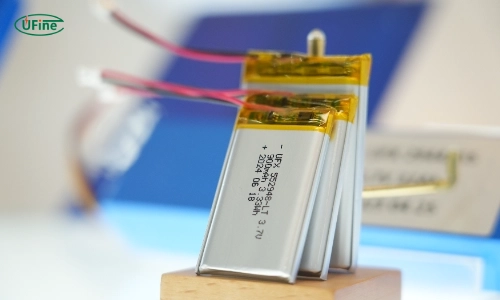
A 3.7V DC battery (also called battery DC 3.7V or DC 3.7V battery) is a rechargeable lithium-based battery with a nominal voltage of 3.7 volts.
Key Characteristics
- Nominal voltage: 3.7V
- Full charge voltage: 4.2V
- Cut-off voltage: ~2.75V–3.0V
- Chemistry: Lithium-ion (Li-ion) or Lithium polymer (LiPo)
- Rechargeable: Yes
👉 For custom lithium battery solutions, see our li-ion 18650 battery options.
Part 2. 3.7v dc battery construction and chemistry
Lithium-Ion Working Principle
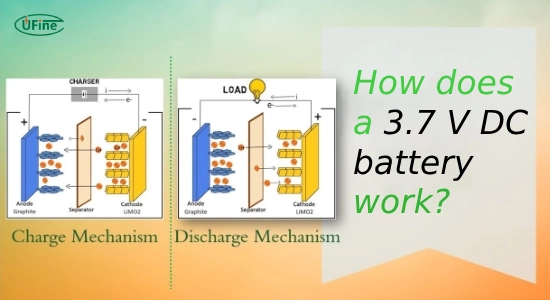
A 3.7V DC battery works by moving lithium ions between two electrodes:
- During discharge: ions move from anode → cathode
- During charging: ions move back to anode
Core Components
- Anode: Graphite (stores lithium ions)
- Cathode: Lithium metal oxide (LiCoO₂, NMC, etc.)
- Electrolyte: Lithium salt in organic solvent
- Separator: Prevents short circuits while allowing ion flow
For detailed manufacturing insights, see battery production process.
Part 3. How does a 3.7v dc battery work in real devices?
When a device uses a DC 3.7V battery:
- Chemical energy converts to electrical energy
- Electrons flow through the external circuit
- Lithium ions move internally to maintain charge balance
This stable DC output makes it ideal for electronics that require consistent voltage.
Part 4. Advantages and applications of 3.7v dc battery
Advantages
- High Energy Density: More power in a smaller size. Ideal for portable devices.
- Long Cycle Life: Typically 300–1000+ cycles depending on chemistry and usage.
- Low Self-Discharge: Retains charge during storage better than NiMH or NiCd.
- Lightweight Design: Critical for drones, wearables, and handheld devices.
Application Overview
| Application | Why 3.7V DC Battery Fits |
|---|---|
| Smartphones | High energy density + compact size |
| Laptops & Tablets | Stable voltage + long runtime |
| Electric Vehicles | Scalable cell configuration |
| Solar Energy Storage | Efficient charge/discharge cycles |
| Medical Devices | Reliability and long shelf life |
Real-World Use Cases
- Consumer electronics: Smartphones use pouch-type 3.7V DC batteries for slim design
- EV battery packs: Thousands of 18650 cells connected in series/parallel
- Medical devices: Require stable and safe discharge behavior
Part 5. How to choose the right 3.7v dc battery?
Choosing the correct battery DC 3.7V is critical for performance and safety.
1. Capacity (Mah)
- Higher mAh = longer runtime
- Trade-off: larger size and weight
👉 Example: 3.7 V 30mAh Lithium Ion Battery 370820 for ultra-compact devices
2. Discharge Rate (C-Rating)
- Important for high-drain devices
- Low C-rate → sensors, IoT
- High C-rate → drones, power tools
3. Size And Form Factor
| Type | Typical Use |
|---|---|
| 18650 | EVs, flashlights |
| 14500 | AA-replacement devices |
| 10440 | Compact electronics |
| Pouch cell | Smartphones, wearables |
4. Safety And Protection
Always check:
- Built-in PCM/BMS
- Overcharge/overdischarge protection
- Certifications (UL, IEC, UN38.3)
👉 Refer to safety guidelines from UL Standards.
Part 6. 3.7V dc battery maintenance and safety
Charging Best Practices
- Use dedicated Li-ion charger
- Avoid overcharging above 4.2V
- Do not charge unattended in unsafe environments
Storage Guidelines
- Store at 40–60% charge
- Keep temperature: 15°C–25°C
- Avoid humidity and direct sunlight
Safety Risks To Avoid
- Short circuits
- Mechanical damage (puncture, crush)
- High-temperature exposure
Part 7. Common misconceptions about 3.7v dc batteries
Myth 1: Memory Effect
- False. Lithium batteries do not suffer from memory effect.
Myth 2: Always 3.7V Output
- Incorrect. Actual voltage varies between 3.0V–4.2V.
Myth 3: Unlimited Lifespan
- All lithium batteries degrade over time, even in storage.
Part 8. FAQs about 3.7v dc battery
What does “3.7V” mean in a DC 3.7V battery?
It refers to the nominal voltage. The actual voltage changes during use, typically from 4.2V (full) to about 3.0V (empty).
What is the most common 3.7V DC battery type?
The 18650 lithium-ion battery is the most common due to its balance of capacity, size, and cost.
Can I replace a 3.7V battery with another voltage?
No. Using a different voltage can damage your device or cause safety risks.
How long does a 3.7V DC battery last?
Cycle life: 300–1000 cycles. Calendar life: 2–5 years depending on usage and storage.
Are 3.7V DC batteries safe?
Yes, if used correctly with proper protection circuits and certified chargers. Always follow safety guidelines.
Related Tags:

More Articles

Best 24V Lithium Battery: Top 10 Compared
Discover the top 24V lithium batteries. We compare capacity, price, cycle life, safety features, and the best options for different applications.
Top LFP Cell Manufacturers in China You Should Know
Looking for reliable LiFePO4 cells? Explore China's top LFP battery manufacturers, key technologies, production capabilities, and supplier selection tips.
Check If Your Charger Works: Simple Test Guide
Think your battery charger's broken? Quick tests can show you for sure. See if it’s the charger or the battery that's causing issues. Read more.
Best Camera Batteries: 7 Brands Compared & Tested
Looking for the best camera battery? Compare 7 top brands, including OEM and third-party options, to find the right battery for your camera.
What You Need to Know About Portable Fan Batteries
Discover the best portable electric fan battery, its types, lifespan, and maintenance tips. Learn how to choose the right one and keep it running longer.