- Part 1. What a 12V LiPo battery really is
- Part 2. Why your “12V battery” is not exactly 12V
- Part 3. 12V lithium battery types compared
- Part 4. 12V LiPo battery vs 12V lithium-ion battery
- Part 5. How many 18650 cells to make a 12V battery
- Part 6. How battery capacity is calculated (wh and ah)
- Part 7. Should you choose a 12V LiPo or 12V lithium-ion battery?
- Part 8. Key considerations for buying a 12V LiPo battery
- Part 9. How to choose a 12V LiPo battery charger
- Part 10. FAQs
Key takeaways
- A “12V LiPo battery” is not exactly 12V — it operates between ~9.0V and 12.6V depending on charge state.
- Most 12V lithium packs are built using a 3S configuration (3×3.7V cells).
- To increase capacity, you add parallel cells (e.g., 3S2P, 3S4P).
- DIY 18650 battery packs are possible, but BMS and cell matching are critical for safety.
- For long-term reliability, LiFePO4 is often safer than LiPo or standard Li-ion.
Part 1. What a 12V LiPo battery really is
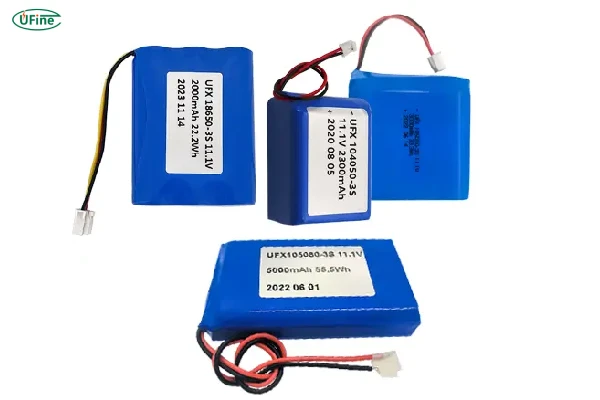
If you’re looking for a “12V LiPo battery,” you’re usually not dealing with a single fixed-voltage cell. Instead, you’re working with a lithium battery pack built from multiple cells.
Most commonly, a 12V lithium battery uses a 3S configuration:
- 3 cells in series (3 × 3.7V nominal)
- Total nominal voltage: 11.1V
- Fully charged voltage: 12.6V
- Safe discharge cut-off: ~9.0V (depends on BMS settings)
That’s why a “12V lithium battery” is always a range, not a fixed value.
Part 2. Why your “12V battery” is not exactly 12V
You might notice something confusing: when fully charged, your “12V battery” reads 12.6V, and when in use, it slowly drops toward 11V and below.
This is normal.
A lithium battery does not hold a flat voltage like a lead-acid battery. Instead, it follows a discharge curve.
- Fully charged: 12.6V
- Nominal: 11.1V
- Nearly empty: 9.0–10.5V
This is important because devices designed for “12V systems” must tolerate this range.
How many cells does a 12V LiPo battery have?
Understanding the number of cells in a battery is key to understanding how it works.
Each LiPo cell provides a nominal voltage of 3.7V. To reach higher voltages like 12V, manufacturers combine cells in series.
Complete Overview Lithium Batteries in Parallel and Series
So for a 12V battery:
- 3 cells in series (3S configuration) = 3.7V × 3 = 11.1V nominal
- Fully charged, it becomes 4.2V × 3 = 12.6V
Therefore, a 12V LiPo battery is typically a 3S battery, consisting of three individual cells connected in series. This design keeps the pack compact but powerful enough for medium to high-load applications.
It’s important to buy batteries that are clearly labeled, and know whether you’re getting a 3S LiPo pack. Also, matching the charger to this configuration is critical, as we’ll discuss later.
Part 3. 12V lithium battery types compared
Not all “12V lithium batteries” are the same. Depending on your application, you may encounter LiPo packs, 18650-based packs, or LiFePO4 systems.
| Type | Nominal voltage | Safety level | Lifespan | Typical use cases |
|---|---|---|---|---|
| LiPo (soft pack) | 11.1V | Medium | Medium | RC, drones, compact devices |
| 18650 Li-ion pack | 11.1V | High | High | DIY packs, power tools, backup systems |
| LiFePO4 | 12.8V | Very high | Very high | Solar, RV, off-grid storage |
If you’re building something long-term like solar storage or RV power, LiFePO4 is usually the most stable option.
Part 4. 12V LiPo battery vs 12V lithium-ion battery
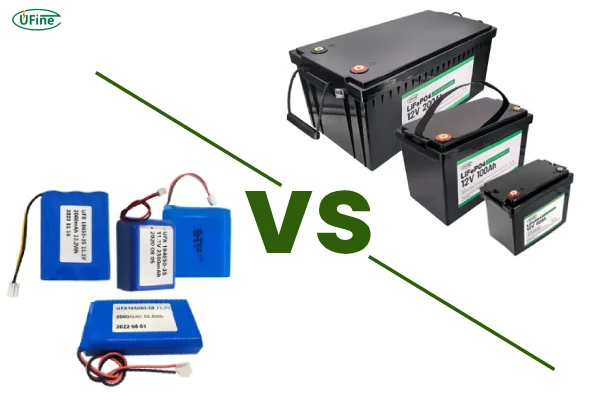
Both 12V LiPo and 12V lithium-ion batteries serve similar roles but perform differently. Let’s compare them across key areas:
| Feature | 12V LiPo Battery | 12V Lithium-Ion Battery |
|---|---|---|
| Weight | Lighter and more compact | Slightly heavier |
| Discharge Rate | High burst discharge (great for motors) | Lower discharge (for consistent power) |
| Shape Flexibility | Can be made ultra-thin or curved | More rigid cylindrical form |
| Cycle Life | 200–400 cycles | 500–1000 cycles |
| Safety | Sensitive to overcharge, puncture | Safer with built-in protections |
| Cost | Slightly more expensive | More affordable in many cases |
For a deeper look at battery chemistry, read our comparison of lithium-ion and lithium polymer batteries before making your final decision.
Part 5. How many 18650 cells to make a 12V battery
If you want to build a 12V battery using 18650 cells, you need to understand two concepts: series and parallel connections.
Step 1: series connection (voltage)
Each 18650 cell has:
- Nominal voltage: 3.7V
So:
- 3 cells in series (3S) = 11.1V nominal
- Fully charged = 12.6V
👉 This is your “12V equivalent”
Step 2: parallel connection (capacity)
Parallel cells increase capacity (Ah), not voltage.
For example:
- 3S1P = basic pack (low capacity)
- 3S2P = double capacity
- 3S4P = high-capacity storage pack
Part 6. How battery capacity is calculated (wh and ah)
To understand runtime, you need to think in energy, not just voltage.
Core formula:
- Wh = V × Ah
For example:
- A 12V (11.1V nominal) 10Ah battery:
- 11.1 × 10 = 111Wh
If your device uses 20W:
- 111Wh ÷ 20W ≈ 5.5 hours runtime
This is why higher Ah doesn’t just mean “bigger battery” — it directly affects how long your system runs.
Part 7. Should you choose a 12V LiPo or 12V lithium-ion battery?
This choice depends on how you intend to use the battery. Here’s a breakdown:
Choose a 12V LiPo battery if:
- You need a lightweight, high-discharge power source
- Space is limited but performance matters
- You’re working with RC cars, UAVs, robotics, or portable medical devices
- You’re comfortable handling charging and safety requirements
Choose a 12V lithium-ion battery if:
- You need long cycle life and better thermal stability
- Your application is less power-hungry (like LED lighting or backup storage)
- You want a safer, lower-maintenance solution
Need help deciding? Ufine Battery offers expert consultation and custom battery solutions. We can help you weigh the pros and cons based on your project’s exact needs.
Part 8. Key considerations for buying a 12V LiPo battery
When you’re in the market for a 12V LiPo battery, you’ll find countless options. But not all batteries are created equal. Making the right choice is critical for safety, performance, and long-term reliability. Here are 7 key factors to keep in mind before you buy:
1. Voltage and Cell Count Compatibility
Always confirm the nominal voltage is truly what your device requires. A 12V LiPo battery typically means 3S (3-cell) at 11.1V nominal, 12.6V when fully charged. Ensure this matches your load requirements—some sensitive electronics can’t tolerate even small voltage variations.
2. Capacity Based on Usage Time
Think about how long you need your device to run. A larger capacity (mAh or Ah) means longer operation time, but it also adds size and weight. Make a realistic estimate based on current draw and runtime expectations, and always add a little buffer.
3. Discharge Rate (C-Rating)
The C-rating tells you how quickly the battery can safely discharge. If your application needs fast, high bursts of power (like motors or drones), go for a high C-rated battery. Otherwise, a low-to-mid C-rating will save you money and heat stress.
4. Size and Form Factor
Some projects have limited battery compartments. Measure your available space, and check the battery’s dimensions. Luckily, manufacturers like Ufine Battery offer custom-sized 12V LiPo battery packs tailored exactly to your space and design.
5. Safety Features
Look for batteries with built-in protection circuits, especially for overcharge, over-discharge, and short-circuit scenarios. These add a layer of peace of mind, especially if the battery will be used in high-temperature or high-impact environments.
6. Manufacturer Reliability
Don’t gamble on a no-name supplier. Choose a company that offers quality assurance, clear specifications, and technical support. That’s why so many choose Ufine Battery—a trusted Chinese manufacturer offering lithium batteries customized to your project’s exact voltage, capacity, and safety needs.
7. Availability of Compatible Chargers
Make sure you can easily find a compatible charger for your battery, or better yet, buy them as a pair. Chargers vary by voltage, cell count, and charging method. Ufine Battery can also help match your battery with the right charger to ensure safe and optimal charging.
Part 9. How to choose a 12V LiPo battery charger
Charging LiPo batteries isn’t something to take lightly. These batteries require dedicated balance chargers that can charge each cell evenly to prevent damage or danger.
Here’s what to look for in a 12V LiPo battery charger:
- Balance charging support for 3S (three-cell) packs
- Current control (usually 1C is recommended, meaning 1x the capacity in amps)
- Safety features like temperature monitoring and overcharge protection
- Battery type compatibility – Make sure it’s designed specifically for LiPo batteries
Never use a standard 12V power adapter. Doing so could overcharge the cells and risk fire or explosion. LiPo safety is no joke, but with the right charger, you’ll be fine.
If you’re ordering a custom battery from Ufine, we can recommend a charger that pairs perfectly with your pack, reducing the guesswork and maximizing safety.
Part 10. FAQs
Can I use a 12V LiPo battery in cold environments?
LiPo batteries are sensitive to temperature. In cold conditions (below 0°C or 32°F), their performance drops significantly. Capacity shrinks, and internal resistance increases, which can lead to premature failure. If you must use them in cold weather, pre-warm the battery or use a high-temperature LiPo variant, which manufacturers like Ufine Battery can provide on request.
What’s the shelf life of a 12V LiPo battery?
With proper care and storage, a 12V LiPo battery can last 2–3 years even if not regularly used. Store it at about 50% charge, in a cool, dry place, ideally around 15–25°C (59–77°F). Avoid full charge or full discharge during storage, as both shorten battery life.
How do I know if my 12V LiPo battery is damaged?
Warning signs include swelling, overheating, uneven charging, or reduced runtime. Swollen batteries must be disposed of immediately. Always handle with care and follow disposal regulations. Ufine can advise you on proper handling or replacements if needed.
Can I connect multiple 12V LiPo batteries together?
Yes, you can connect them in parallel to increase capacity (runtime) or in series to increase voltage—but you must match the batteries in voltage, capacity, and health. Mixing different batteries can lead to dangerous imbalances. Always consult with an expert or supplier like Ufine before creating battery arrays.
Are custom 12V LiPo batteries worth it?
Absolutely, especially for unique applications. Whether it’s about shape, voltage, or high discharge rates, a custom battery ensures maximum efficiency and safety.
Related Tags:

More Articles
Aluminum Air Battery Design: Materials, Assembly & Efficiency Tips
Learn how an aluminum air battery works, its materials, assembly process, efficiency factors, advantages, limitations, and key applications.
AGM vs Flooded Battery: A Detailed Comparison
Compare AGM vs flooded battery performance, cost, lifespan, charging speed, and maintenance. Find the best battery for your application.
Lithium-ion Battery Structure: Components, Functionality, and Innovations
Learn the lithium-ion battery structure, key components, internal design, and how it works. Explore cell types, safety features, and battery innovations.
12V 100Ah Lithium Battery: Weight, Watt Hours, Lifespan and Uses
Find out how long a 12V 100Ah lithium battery lasts, what it can power, how much it weighs, and whether it's worth the upgrade.
Learn what deep discharge is, battery discharge meaning, depth of discharge (DoD), deep-cycle batteries, and how to prevent battery damage.