
- Key takeaways
- Part 1. What does deep discharge mean?
- Part 2. Understanding battery depth of discharge (dod)
- Part 3. What happens during deep discharge?
- Part 4. Which batteries can handle deep discharge?
- Part 5. Deep discharge tolerance by battery type
- Part 6. Depth of discharge vs state of charge
- Part 7. Benefits of deep discharge batteries
- Part 8. Why battery management systems (bms) matter
- Part 9. How to prevent deep discharge damage
- Part 10. Can a deeply discharged battery be repaired?
- Part 11. Common applications of deep discharge batteries
- Part 12. Best practices for 12v deep discharge batteries
- Part 13. FAQs about deep discharge and battery discharge
Deep discharge happens when a battery uses 80% or more of its capacity before recharging. It can shorten battery life if the battery is not designed for deep cycling. Understanding battery discharge, depth of discharge (DoD), and which batteries tolerate deep cycles helps extend performance in solar, marine, RV, EV, and industrial applications.
Key takeaways
- Deep discharge typically means using 80% or more of a battery’s available capacity before recharging.
- Depth of Discharge (DoD) measures how much energy has been removed from a battery.
- Higher DoD generally reduces battery cycle life.
- Lithium iron phosphate (LiFePO4) batteries tolerate deep discharge much better than lead-acid batteries.
- AGM batteries are more resistant to deep discharge than flooded lead-acid batteries.
- Battery Management Systems (BMS) help prevent over-discharge and extend battery life.
- Solar, marine, RV, EV, and off-grid systems commonly use batteries designed for deep cycling.
Part 1. What does deep discharge mean?
Many users ask:
- What is deep discharge?
- What does battery discharge mean?
- What does discharging a battery mean?
Battery discharge refers to the process of releasing stored electrical energy to power a device or system.
A battery is considered deeply discharged when approximately 80% or more of its total capacity has been used before recharging.
For example:
| Battery Capacity | Energy Used | Depth of Discharge |
|---|---|---|
| 100Ah | 20Ah | 20% DoD |
| 100Ah | 50Ah | 50% DoD |
| 100Ah | 80Ah | 80% DoD (Deep Discharge) |
| 100Ah | 95Ah | 95% DoD (Very Deep Discharge) |
Repeated battery deep discharge accelerates aging and can permanently reduce capacity.
Part 2. Understanding battery depth of discharge (dod)
Depth of Discharge (DoD) is one of the most important battery performance metrics.
It describes the percentage of battery capacity that has been consumed relative to the battery’s full capacity.
DoD Formula
DoD = (Capacity Used ÷ Total Capacity) × 100%
For example:
- Total battery capacity = 100Ah
- Energy used = 70Ah
- DoD = 70%
The remaining charge is called the State of Charge (SoC).
Why DoD Matters
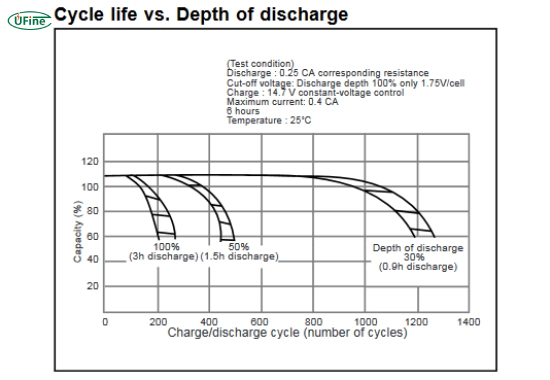
The deeper a battery is discharged, the fewer total cycles it generally delivers during its lifetime.
A battery regularly discharged to:
- 20% DoD may last thousands of cycles
- 50% DoD may last fewer cycles
- 80–100% DoD usually results in faster degradation
This relationship is especially important in solar energy storage, electric vehicles, marine systems, and industrial backup power.
Related Reading: Learn more about Depth of Discharge (DoD) and how it impacts battery lifespan.
Part 3. What happens during deep discharge?
When a battery undergoes deep discharge, several chemical and electrical changes occur.
Voltage Drops Significantly
As energy leaves the battery, voltage gradually decreases.
Each battery chemistry has a recommended minimum voltage threshold.
For example:
- 12V lead-acid battery: approximately 10.5V cutoff
- LiFePO4 battery: approximately 2.5–2.8V per cell cutoff
Going below these limits increases the risk of permanent damage.
Internal Resistance Increases
Deep discharge often raises internal resistance.
Consequences include:
- Reduced charging efficiency
- Lower power output
- Increased heat generation
- Voltage sag under load
Chemical Degradation Occurs
Lead-Acid Batteries
Deep discharge promotes sulfation. Lead sulfate crystals form on battery plates and become difficult to reverse if the battery remains discharged for extended periods.
Lithium-Ion Batteries
Excessive discharge may cause:
- SEI layer degradation
- Copper dissolution
- Lithium plating during recovery charging
These effects permanently reduce capacity and cycle life.
Impact on Battery Lifespan
Research published in the Journal of Power Sources shows that deeper cycling significantly reduces cycle life across most battery chemistries.
In practical applications, batteries discharged to 80% DoD often experience substantially shorter service life than batteries operated at 50% DoD.
Part 4. Which batteries can handle deep discharge?
Not all batteries are designed for deep cycling.
Deep-Cycle Batteries
Deep-cycle batteries are specifically engineered for repeated charge and discharge cycles.
Common applications include:
- Solar storage systems
- RV power systems
- Marine batteries
- Golf carts
- Industrial equipment
Lithium Iron Phosphate (LiFePO4)
LiFePO4 batteries offer the best deep discharge performance among commonly used rechargeable batteries.
Advantages include:
- 80–100% usable capacity
- 3,000–8,000+ cycles
- Excellent thermal stability
- Low maintenance
Many modern solar systems now use custom LiFePO4 battery packs because of their high cycle life.
Deep Discharge AGM Battery
A deep discharge AGM battery uses Absorbent Glass Mat technology.
Benefits include:
- Better deep-cycle performance than flooded lead-acid
- Sealed and maintenance-free design
- Lower self-discharge
- Improved vibration resistance
AGM batteries are commonly used in marine and backup power applications.
Deep Discharge Marine Battery
A deep discharge marine battery is designed to provide continuous power for:
- Trolling motors
- Fish finders
- Navigation systems
- Onboard electronics
Marine batteries must withstand repeated deep cycling while operating in harsh environments.
Part 5. Deep discharge tolerance by battery type
| Battery Type | Recommended Maximum DoD | Typical Cycle Life |
|---|---|---|
| Flooded Lead-Acid | 50% | 300–700 cycles |
| AGM Battery | 70–80% | 600–1,000 cycles |
| Gel Battery | 70–80% | 500–1,200 cycles |
| NMC Lithium-Ion | 80–90% | 1,000–2,000 cycles |
| LiFePO4 | 90–100% | 3,000–8,000+ cycles |
Part 6. Depth of discharge vs state of charge
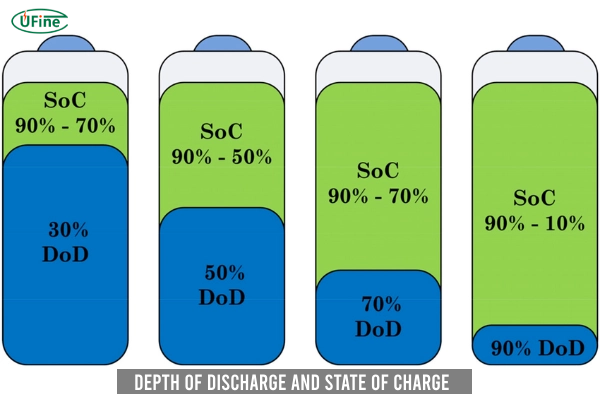
Many users confuse DoD and SoC.
Depth of Discharge (DoD)
Measures how much energy has been used.
Example:
- Battery capacity = 100Ah
- Energy consumed = 40Ah
- DoD = 40%
State of Charge (SoC)
Measures how much energy remains.
Using the same example:
SoC = 60%
Relationship
DoD + SoC = 100%
Understanding both metrics helps optimize charging strategies and extend battery life.
Related Reading: Battery State of Charge vs State of Health Explained
Part 7. Benefits of deep discharge batteries
Longer Runtime
Deep-cycle batteries deliver more usable energy before requiring recharge.
Better for Renewable Energy
Solar and wind storage systems often experience daily discharge cycles. Deep-cycle batteries are designed for this operating pattern.
Lower Long-Term Cost
Although the upfront cost may be higher, batteries with strong deep-cycle capability often provide lower lifetime cost per cycle.
Greater System Flexibility
Deep discharge batteries support:
- Solar storage
- RV systems
- Marine applications
- Telecom backup
- Industrial equipment
- Portable power stations
Part 8. Why battery management systems (bms) matter
A Battery Management System helps prevent damage caused by excessive battery discharge.
A BMS continuously monitors:
- Cell voltage
- State of Charge
- Temperature
- Current flow
- Over-discharge conditions
Modern lithium batteries rely heavily on BMS protection to maintain safety and maximize lifespan.
If you’re selecting a custom lithium battery pack, choosing a high-quality BMS is just as important as selecting the battery cells.
Part 9. How to prevent deep discharge damage
Set Safe Discharge Limits
Recommended limits:
| Battery Type | Recommended Daily DoD |
|---|---|
| Flooded Lead-Acid | ≤50% |
| AGM | ≤70% |
| NMC Lithium | ≤80% |
| LiFePO4 | ≤90% |
Recharge Promptly
Never leave a battery in a discharged state for extended periods. This is especially important for lead-acid batteries.
Use Smart Battery Monitoring
Battery monitors provide:
- Voltage tracking
- Remaining capacity estimates
- DoD alerts
- Historical usage data
Install Automatic Low-Voltage Disconnects
Low-voltage disconnect devices automatically shut down loads before battery damage occurs.
Part 10. Can a deeply discharged battery be repaired?
Recovery depends on battery chemistry and how long the battery remained discharged.
Lead-Acid Battery Recovery
Possible methods include:
- Desulfation chargers
- Slow charging
- Equalization charging (when manufacturer-approved)
Success rates vary widely.
Lithium Battery Recovery
If cell voltage falls below the manufacturer’s minimum threshold, recovery may not be possible. Many BMS units permanently disconnect severely over-discharged cells to prevent safety risks.
Always follow the battery manufacturer’s recovery procedures.
Part 11. Common applications of deep discharge batteries
- Solar Energy Storage: Solar systems often cycle batteries daily and require high DoD capability.
- Electric Vehicles: EV batteries routinely experience significant discharge cycles and require advanced battery management.
- Marine Systems: Deep discharge marine batteries power onboard electronics and propulsion systems.
- Recreational Vehicles (RVs): RVs rely on deep-cycle batteries for lighting, refrigeration, and off-grid power.
- Industrial Equipment: AGVs, robots, backup systems, and telecommunications infrastructure often use deep-cycle lithium batteries.
Part 12. Best practices for 12v deep discharge batteries
If you use a 12V deep discharge battery, follow these recommendations:
- Avoid routinely discharging below 50% for lead-acid systems.
- Install a battery monitor.
- Recharge as soon as possible after use.
- Use a charger designed for your battery chemistry.
- Maintain proper operating temperatures.
- Choose LiFePO4 if deep cycling occurs daily.
Part 13. FAQs about deep discharge and battery discharge
What is deep discharge in a battery?
Deep discharge occurs when approximately 80% or more of a battery’s capacity is used before recharging. Excessive deep discharge can shorten battery lifespan.
What is battery discharge meaning?
Battery discharge is the process of delivering stored electrical energy from a battery to power a device, system, or load.
What is the ideal depth of discharge battery level?
The ideal DoD depends on battery chemistry. Lead-acid batteries perform best below 50% DoD, while LiFePO4 batteries can safely operate at 80–90% DoD.
Can a discharged battery be restored?
Sometimes. Lead-acid batteries may recover through desulfation charging. Lithium batteries may recover if voltage has not dropped below critical limits.
Is a deep discharge AGM battery better than a flooded battery?
For deep-cycle applications, AGM batteries generally offer better discharge tolerance, lower maintenance requirements, and longer cycle life than flooded lead-acid batteries.
Related Tags:

More Articles
Buck vs. Boost vs. Buck-Boost Converter: Which Is Best for Battery?
Not sure which converter your battery-powered device needs? Compare Buck, Boost, and Buck-Boost designs and discover what affects voltage stability and runtime.
How to Match 18650 Cells for a Reliable Battery Pack?
Building an 18650 battery pack? Learn how to compare cell capacity, voltage, and internal resistance to avoid mismatches and improve reliability.
Why Do 18650 Battery Packs Get Hot During Discharge?
Is your 18650 battery pack overheating under load? Learn what causes excess heat, how to spot dangerous symptoms, and what to do next.
18650 Battery BMS: How to Get the Specs Right
Learn how to choose a BMS for an 18650 battery pack. Compare voltage, current ratings, protection features, and balancing before you buy.
Why Does My Ring Camera Battery Drain So Fast or Stop Charging?
Is your Ring camera battery draining fast or not charging? Discover common causes, practical fixes, and when to replace the battery.


