- Key takeaways
- Part 1. How to tell if one 12V battery is not charging in parallel
- Part 2. Why two 12V batteries charge unevenly in parallel
- Part 3. What to check when one 12V parallel battery stops charging
- Part 4. 12V parallel charging example with one battery at 0 A
- Part 5. FAQs about uneven charging in parallel 12V batteries
If only one of your two 12V batteries seems to charge in parallel, check the current flowing into each battery. If one branch stays near 0 A while the other takes steady current, check the charger stage, the battery’s protection status, and the branch connection.
Key takeaways
- Different app percentages can occur while both batteries are charging. State of charge is an estimate.
- Two parallel batteries can share the same connection voltage and draw different currents. A 50/50 split is not required.
- A sustained near-zero reading is more useful than a single snapshot. Compare both batteries during the same active charging stage.
Part 1. How to tell if one 12V battery is not charging in parallel
This guide uses two 12V LiFePO₄ battery packs, each with its own battery management system (BMS). Both packs share one charger. Check that your battery manufacturer approves the combination before charging 12V batteries in parallel.
Compare both branch readings at the same time. Here, positive current means current flowing into the battery. Check your app or meter’s sign convention first.
| What you see | What it means |
|---|---|
| The apps show different percentages, but both branches take current. | Both batteries are charging during the measurement. |
| Both branches take current, but one consistently takes less. | The batteries are charging at different rates. |
| One branch briefly shows 0 A near the end of charging. | Charge current may have tapered below the meter’s resolution. |
| One branch stays near 0 A while the other takes steady current. | Only one battery is receiving measurable charge during that interval. |
| Both branches show little or no current. | Check whether the charger has ended the cycle or equipment is using its output. |
Sensor location determines what a battery monitor can tell you. A shunt on the shared battery connection measures the bank’s net current. To see what each pack is doing, you need individual pack readings or measurements on each branch.
Part 2. Why two 12V batteries charge unevenly in parallel
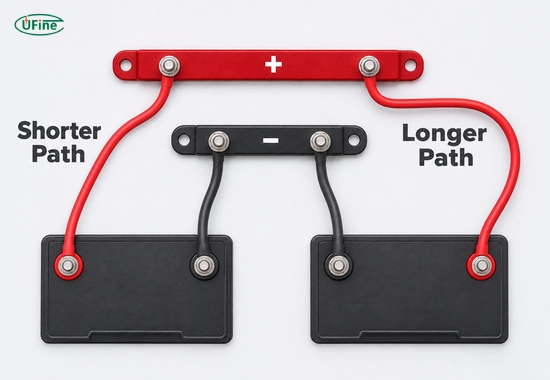
One battery has a higher-resistance wiring path
Each battery has its own path to the shared connection points. Cable length, cable size, and terminal connections all affect resistance. A branch with higher resistance can carry less current under similar battery conditions. Compare the full path, including the negative return. Victron’s battery bank wiring guide shows how cable layout affects current sharing.
The batteries reach the end of charging at different times
A pack that started closer to full may take less current as the charger approaches the end of its cycle. Check whether both packs accepted current earlier. If the difference persists throughout active charging, confirm both model numbers and rated capacities. This matters when mixing lithium batteries with different Ah ratings, a setup that requires manufacturer approval.
One battery’s BMS blocks charging
The BMS can block charging if a cell reaches its upper voltage limit or the battery is outside its allowed charging temperature range. One cell can reach its limit while the rest of the pack is still below full charge. Check the affected pack’s charge status and protection history against its manual. Renogy’s parallel lithium charging troubleshooting guide also covers how to check for pack and wiring differences.
Part 3. What to check when one 12V parallel battery stops charging
-
Check the charger mode and stage.
Confirm that the charger is set for the battery chemistry and is still in an active charging stage. If both batteries take current but the bank charges slowly with the equipment on, check how a running load affects 12V parallel battery charging.
-
Compare the two branch currents.
Record battery A current, battery B current, and charger stage at the same time. If a technician uses a DC clamp meter, they should zero it first and clamp around one conductor per branch. Clamping around both the positive and negative leads can produce a false near-zero reading.
-
Match the current drop to the BMS event log.
If the current falls when the BMS reports a charge protection event, use the recorded reason and the manufacturer’s instructions. If the BMS allows charging but the branch stays near 0 A, have a technician inspect the fuse, disconnect, and terminals with the system shut down according to its service procedure.
-
Test the suspect pack separately if the cause is still unclear.
A technician can use the manufacturer’s approved test procedure. If the pack charges on its own, check the installed wiring and shared charger settings. If the symptom follows the pack, send the supplier its model number, branch current readings, and any BMS event timestamps.
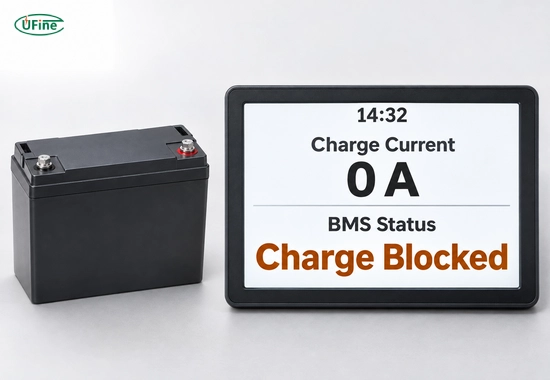
Part 4. 12V parallel charging example with one battery at 0 A
Two approved 12V LiFePO₄ packs share one charger. The equipment load is off, and the charger is still active. These readings are illustrative.
| Reading | Both batteries charging | Only one battery charging |
|---|---|---|
| Battery A branch current | 6 A | 10 A |
| Battery B branch current | 4 A | 0 A |
| Total current into the bank | 10 A | 10 A |
The bank meter reads 10 A in both cases. The individual branch readings show whether both batteries are accepting charge.
Part 5. FAQs about uneven charging in parallel 12V batteries
Does 0 A mean a parallel 12V battery has failed?
No. A single 0 A reading can occur near the end of charging or below the meter’s resolution. A sustained 0 A reading during active charging calls for a BMS and branch check.
Can two parallel 12V batteries show the same voltage but take different currents?
Yes. The packs share a connection voltage, but wiring resistance and battery conditions can cause different charging currents.
Can one 12V battery’s BMS stop charging while the other battery keeps charging?
Yes, if each BMS can block its own branch independently. If a BMS controls the shared charger, a protection event can reduce or stop charging for the whole bank.
What if both 12V batteries charge separately but one stops charging in parallel?
Check whether the two packs are approved for parallel use. Then compare branch connections, shared charger settings, and BMS events recorded during parallel charging.
Will a bigger charger fix uneven charging in a 12V parallel battery bank?
A bigger charger can help if the bank is limited by charger output and the system supports more current. A poor connection or BMS protection event needs to be addressed separately.
Related Tags:

More Articles
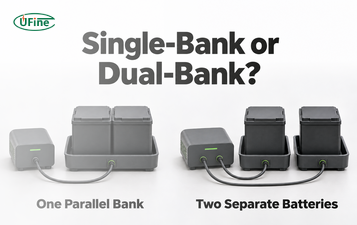
Single-Bank vs. Dual-Bank Chargers for Two 12V Batteries
Choose a single-bank or dual-bank charger for two 12V batteries. Compare amps per bank, output control, and the charging setup each design supports.
Can You Charge Two 12V Batteries in Parallel While Running a Load?
Can you charge two 12V batteries in parallel while running a load? Calculate net charging current and check whether your recharge window is long enough.
Capacitors vs. Batteries: Key Differences Explained
Discover how capacitors, supercapacitors, and lithium batteries compare. Learn their advantages, limitations, and best uses in modern electronics.
Two-Wire vs. Three-Wire Batteries: What’s the Difference?
Why do some batteries have three wires? Learn what the extra wire does, how NTC sensing works, and which battery your device needs.
How to Qualify a Second Supplier for a Robot Vacuum Battery Pack
Qualify a second robot vacuum battery pack supplier with an A/B test plan for carpet boost, dock charging, fit, traceability, and pilot approval.