- Part 1. How do capacitors and batteries work?
- Part 2. Capacitor vs. battery: What are the key differences?
- Part 3. Can a capacitor replace a battery?
- Part 4. Capacitor vs. lithium battery: Energy density, lifespan, and charging speed
- Part 5. Supercapacitor vs. lithium polymer battery: Which is better for portable electronics?
- Part 6. How to choose between a battery and a capacitor for your device
- FAQs
Batteries are not the only components responsible for storing and delivering electrical energy. Capacitors and supercapacitors also play important roles in modern electronics. Although they may seem similar, they work differently and serve distinct purposes.
So, what is the difference between a capacitor and a battery? Can a capacitor replace a battery? And when should you choose a lithium polymer battery over a supercapacitor? Let’s explore how these technologies work and where each one performs best.
Key Takeaways
-
Batteries store energy through chemical reactions, while capacitors store energy in an electric field.
-
Batteries generally offer higher energy density, making them suitable for long-lasting power supply.
-
Capacitors provide rapid charging and discharging, making them useful for short bursts of power.
-
Supercapacitors offer exceptionally long cycle life and high power density but generally store less energy than lithium batteries.
-
Batteries and capacitors often work together in electronic devices to provide stable and reliable power.
-
Lithium polymer batteries are particularly suitable for compact consumer electronics because of their lightweight construction and flexible form factors.
Part 1. How do capacitors and batteries work?
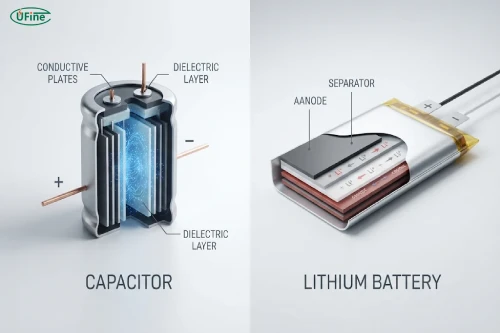
A capacitor is an electronic component that stores electrical energy in an electric field. It typically consists of two conductive plates separated by an insulating material called a dielectric. When voltage is applied, electrical charges accumulate on the plates, allowing the capacitor to store and release energy quickly.
A battery works differently. It stores energy through chemical reactions and converts that chemical energy into electrical energy when connected to a circuit. Rechargeable lithium batteries reverse these reactions during charging, allowing them to be used repeatedly.
The key difference is how energy is stored and released. Capacitors respond quickly to changes in electrical demand, while batteries provide a more sustained energy supply.
This is why both technologies are commonly found in electronic devices. A battery supplies the main operating power, while capacitors help manage short-term electrical demands.
Part 2. Capacitor vs. battery: What are the key differences?
Although capacitors and batteries both store energy, their performance characteristics differ significantly.
| Feature | Capacitor | Rechargeable Battery |
|---|---|---|
| Energy storage | Electric field | Chemical reactions |
| Energy density | Low | High |
| Power density | Generally high | Varies by chemistry and design |
| Charging speed | Very fast | Generally slower |
| Discharging speed | Very fast | Controlled by battery specifications |
| Cycle life | Very long | Limited by degradation |
| Voltage output | Decreases during discharge | Depends on chemistry and discharge conditions |
| Main applications | Power buffering and filtering | Long-term power supply |
One important distinction is energy density versus power density. Energy density describes how much energy a device can store relative to its weight or volume. Power density describes how quickly that energy can be delivered.
A capacitor can deliver a large amount of power in a short period, but it usually cannot provide sustained energy for hours. A battery, on the other hand, can supply power over a much longer operating period.
Why do electronic devices need both batteries and capacitors?
Batteries and capacitors are not necessarily competing technologies. In many electronic circuits, they work together to improve overall power performance.
The battery acts as the primary energy source, supplying electricity during normal operation. Capacitors handle smaller, short-term electrical demands that the battery may not respond to as efficiently on its own.
For example, when a wireless device suddenly activates its transmitter, the circuit may experience a brief increase in current demand. A properly selected capacitor can help stabilize the supply voltage and reduce short-term voltage fluctuations.
Capacitors also serve other important functions, including filtering electrical noise, smoothing voltage variations, and supporting power management circuits.
This combination is particularly useful in smartphones, wireless communication devices, IoT products, and other battery-powered electronics.
However, capacitors do not automatically extend battery life. Their actual benefits depend on circuit design, component selection, and the device’s power consumption.
Part 3. Can a capacitor replace a battery?
In most portable electronic devices, a capacitor cannot directly replace a rechargeable battery.
Imagine using wireless earbuds. They need to operate continuously for several hours while maintaining a compact size and lightweight design. A conventional capacitor cannot store enough energy to meet this requirement.
A battery is a better solution because its higher energy density allows it to provide sustained power in a relatively small package.
However, capacitors can replace batteries in certain applications where only short-term energy storage is required. For example, they can provide temporary backup power for memory circuits, maintain clock settings, or deliver brief bursts of energy.
Supercapacitors extend these capabilities. They store considerably more energy than conventional capacitors and can support applications requiring frequent charging and discharging.
However, their energy density is still generally lower than that of lithium batteries. Therefore, they are not always practical replacements for batteries in devices that require long operating times.
Part 4. Capacitor vs. lithium battery: Energy density, lifespan, and charging speed
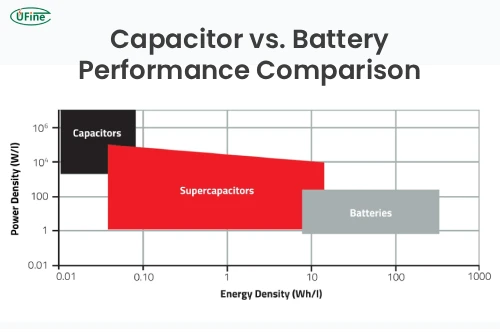
When comparing supercapacitors with lithium batteries, three factors deserve particular attention: energy density, cycle life, and charging speed.
Energy density: Lithium batteries can store significantly more energy per unit of weight than conventional supercapacitors. This is especially important for portable electronics, where every gram and millimeter matters.
Lifespan: Supercapacitors can typically withstand hundreds of thousands of charge and discharge cycles, sometimes exceeding one million cycles depending on their design and operating conditions. Lithium batteries have a shorter cycle life because their internal materials gradually degrade.
Charging speed: Supercapacitors can accept and release energy extremely quickly. Lithium batteries generally require more controlled charging to maintain safety, performance, and service life.
For a device that needs a brief power boost, a supercapacitor may be the better option. For a device that needs several hours of continuous operation, a lithium battery is usually more practical.
Battery vs. capacitor: Which is more efficient for energy storage?
The answer depends on what you mean by efficiency.
If you want to store a large amount of energy in a small space, batteries are generally more efficient in terms of energy density. This makes lithium-ion batteries particularly useful for smartphones, tablets, smartwatches, and other portable electronics.
If your priority is rapid energy delivery and repeated short charging cycles, capacitors have an advantage. They can charge and discharge quickly while experiencing relatively little degradation from cycling.
Self-discharge is another important consideration. Capacitors, especially supercapacitors, can lose stored energy relatively quickly compared with many rechargeable batteries. This makes them less suitable for devices that need to remain powered for long periods without recharging.
Therefore, neither technology is universally more efficient. Batteries are generally better for long-term energy storage, while capacitors are useful for rapid energy transfer and short-term power management.
Part 5. Supercapacitor vs. lithium polymer battery: Which is better for portable electronics?
The best choice depends on the device’s power requirements, available space, and expected operating time.
For most portable consumer electronics, lithium polymer (LiPo) batteries offer several practical advantages.
Unlike rigid cylindrical cells, LiPo batteries use a pouch-style structure that can be manufactured in different dimensions and shapes. This makes them suitable for products with limited internal space or unconventional designs.
Consider some common applications:
Smartphones and tablets: These devices need high energy capacity to support displays, processors, cameras, and wireless communication. Lithium batteries are the preferred solution because they provide sustained power throughout the day.
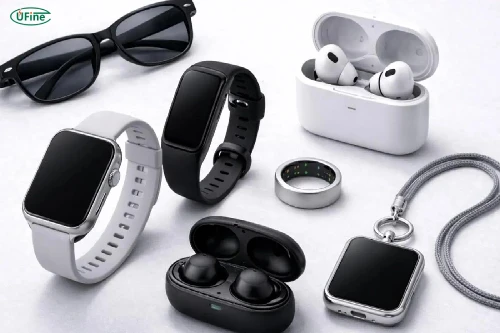
Wireless earbuds and Bluetooth speakers: Compact size and lightweight construction are essential. Small lithium polymer batteries can fit into limited spaces while providing enough energy for extended use.
Smartwatches and smart rings: These wearable devices have particularly strict size and weight requirements. Custom-shaped or ultra-thin LiPo batteries can help manufacturers optimize internal layouts.
Camera flash systems: Capacitors are often used because they can accumulate energy and release it rapidly to produce a short, powerful flash.
High-power equipment: Some power tools and electronic systems experience sudden increases in current demand. Supercapacitors can help manage these temporary power peaks when integrated into an appropriate power management system.
| Application | Preferred Technology | Main Advantage |
|---|---|---|
| Smartphones | Lithium battery | High energy density |
| Wireless earbuds | LiPo battery | Compact and lightweight |
| Smart rings | Custom LiPo battery | Flexible form factor |
| Camera flash | Capacitor | Rapid energy release |
| Short-term backup | Supercapacitor | Fast response |
| Power buffering | Supercapacitor | High power density |
For portable electronics, the choice is often straightforward: if the device needs to operate for extended periods without frequent recharging, a lithium polymer battery is generally more suitable.
Part 6. How to choose between a battery and a capacitor for your device
Choosing between a battery and a capacitor starts with understanding how your device uses energy.
If your product needs continuous power for minutes or hours, a rechargeable battery is usually the better choice. If it needs to deliver short bursts of energy, respond to sudden power demands, or maintain voltage stability, a capacitor may be more appropriate.
You should also consider available installation space, operating temperature, charging requirements, expected cycle life, and safety standards.
For compact consumer electronics, lithium polymer batteries are often worth considering because they can be customized in terms of dimensions, capacity, voltage, and discharge performance.
For example, a smart wearable device may require an ultra-thin battery, while a wireless accessory may need a small, lightweight cell with a specific connector and protection circuit.
Working with an experienced battery manufacturer can help you identify a suitable battery configuration based on your product’s actual electrical and mechanical requirements.
FAQs
1. What happens if a capacitor is connected directly to a battery?
When a capacitor is connected to a battery, it begins charging until its voltage approaches the battery voltage. The initial current can be very high because an uncharged capacitor has very low impedance. A suitable current-limiting component or circuit may be necessary to prevent excessive inrush current and protect the battery and other components.
2. What is the difference between a capacitor and a battery in a power supply circuit?
In a power supply circuit, a battery typically provides the primary electrical energy, while capacitors help regulate short-term voltage changes. Capacitors are commonly placed near electronic components to reduce voltage fluctuations, filter electrical noise, and provide temporary current during sudden load changes.
3. How does temperature affect capacitor and battery performance?
Temperature affects both technologies, but in different ways. High temperatures can accelerate battery degradation and increase safety risks, while low temperatures can reduce available battery capacity and charging performance. Capacitors also experience temperature-dependent changes in capacitance, equivalent series resistance (ESR), and leakage current, depending on their materials and construction.
4. What is ESR, and why does it matter in batteries and capacitors?
ESR stands for Equivalent Series Resistance. It represents the internal resistance associated with a component and affects energy loss, heat generation, and voltage drop during operation. In capacitors, low ESR is particularly important for applications involving rapid current changes. In batteries, internal resistance influences voltage stability, discharge performance, and heat generation under load.
5. Can batteries and supercapacitors be connected in the same energy storage system?
Yes. Batteries and supercapacitors can be integrated into hybrid energy storage systems. The battery supplies sustained energy, while the supercapacitor handles short-duration power peaks and rapid changes in demand. However, successful integration requires appropriate power management, voltage matching, and charging control to ensure reliable operation.
Related Tags:

More Articles

Why Is Only One of My Two 12V Batteries Charging in Parallel?
Only one of your two 12V batteries seems to charge in parallel? Check branch current, charger status, and BMS alerts to find out why.
Two-Wire vs. Three-Wire Batteries: What’s the Difference?
Why do some batteries have three wires? Learn what the extra wire does, how NTC sensing works, and which battery your device needs.
How to Qualify a Second Supplier for a Robot Vacuum Battery Pack
Qualify a second robot vacuum battery pack supplier with an A/B test plan for carpet boost, dock charging, fit, traceability, and pilot approval.
Robot Vacuum Battery Pack Design for a Low-Profile Chassis
Design a robot vacuum battery pack around bay height, connector clearance, and service access. Compare pouch and cylindrical packs in the same chassis.
How to Test a Robot Battery Pack Before Mass Production
Use this OEM checklist to test robot battery pack samples for startup load, usable energy, charging, protection, fit, and pilot-lot approval.