- Key takeaways
- Part 1. How does a metal-air battery work?
- Part 2. Advantages of metal-air batteries
- Part 3. Applications of metal-air batteries
- Part 4. Metal-air vs lithium-ion batteries
- Part 5. Types of metal-air batteries
- Part 6. Metal-air battery market outlook
- Part 7. Challenges facing metal-air batteries
- Part 8. FAQs about metal-air batteries
Metal-air batteries are a promising next-generation energy storage solution. They use oxygen from the air as a cathode, which allows them to store more energy per weight than many conventional batteries.
As electric vehicles (EVs), renewable energy storage, and portable power systems grow in demand, metal-air batteries are gaining attention. Common types include zinc-air, aluminum-air, iron-air, magnesium-air, and lithium-air.
This article explains how metal-air batteries work, their advantages, key types, applications, challenges, and future market potential.
Key takeaways
- Metal-air batteries use a metal anode and oxygen from air to generate electricity.
- Common types: zinc-air, aluminum-air, iron-air, magnesium-air, lithium-air.
- Advantages: high energy density, lightweight, low material cost.
- Challenges: limited cycle life, moisture sensitivity, air electrode stability.
- Applications: EVs, grid storage, medical devices, portable electronics.
- Zinc-air: widely used in hearing aids and small electronics.
- Iron-air: promising for long-duration grid storage.
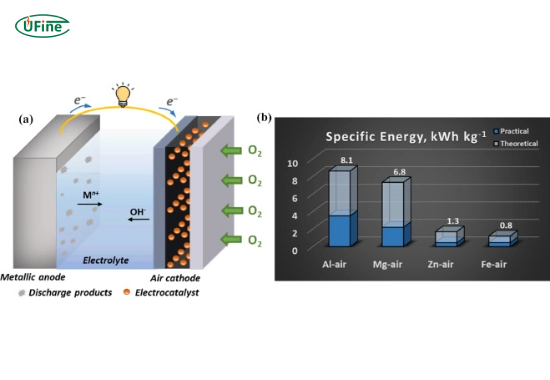
- Compared to lithium-ion: higher theoretical energy density but lower cycle life.
Part 1. How does a metal-air battery work?
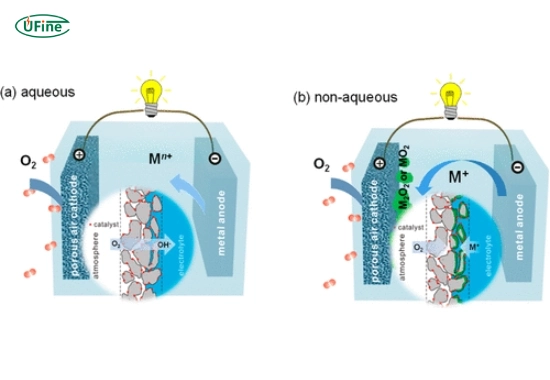
Metal-air batteries have three main parts:
- Anode: metal such as zinc, aluminum, iron, magnesium, or lithium.
- Air cathode: porous material allowing oxygen from air to react.
- Electrolyte: conducts ions between anode and cathode.
When the battery discharges:
- Metal oxidizes at the anode.
- Electrons flow through an external circuit.
- Oxygen is reduced at the cathode.
- Electricity is produced.
Simplified reaction:
Metal + Oxygen → Electricity + Byproducts
Part 2. Advantages of metal-air batteries
High Energy Density
Metal-air batteries can store more energy per weight than lithium-ion. For example, zinc-air batteries reach 300–400 Wh/kg.
Lightweight
Oxygen comes from air. The battery does not carry all reactants inside. This reduces weight.
Cost-Effective
Metals like zinc, aluminum, and iron are abundant and cheaper than lithium or cobalt.
Environmental Benefits
Fewer rare materials means lower ecological impact. For sustainable energy storage, see our guide on lithium battery environmental impact.
Part 3. Applications of metal-air batteries
- Electric Vehicles (EVs): High energy density can extend driving range. Aluminum-air and lithium-air batteries are being explored for EVs.
- Grid Storage: Iron-air batteries are suitable for storing solar and wind energy for long periods.
- Medical Devices: Zinc-air batteries power hearing aids and medical sensors.
- Portable Electronics: Potential for smartphones, laptops, and wearables.
- Military & Aerospace: Lightweight, high-energy solutions for remote systems.
Part 4. Metal-air vs lithium-ion batteries
| Feature | Metal-Air Battery | Lithium-Ion Battery |
|---|---|---|
| Energy Density | Higher | 150–250 Wh/kg |
| Weight | Lighter | Heavier |
| Cost | Lower | Higher |
| Rechargeability | Limited | Excellent |
| Cycle Life | 100–300 | 500–5000+ |
| Commercial Maturity | Emerging | Mature |
For high cycle life and ready-to-use products, lithium-ion remains dominant. For more on lithium solutions, see custom lithium battery pack design.
Part 5. Types of metal-air batteries
Zinc-Air
- Advantages: High energy density, low cost, safe.
- Applications: Hearing aids, small electronics.
- Challenges: Limited recharge, moisture sensitive.
Aluminum-Air
- Advantages: Very high energy density, lightweight, safe.
- Applications: EV range-extenders, military systems.
- Challenges: Non-rechargeable, corrosion.
Iron-Air
- Advantages: Low cost, abundant, environmentally friendly.
- Applications: Grid storage, renewable integration.
- Challenges: Efficiency and cycle life limitations.
Magnesium-Air
- Advantages: Abundant, safe, decent energy density.
- Applications: Marine systems, portable power.
- Challenges: Electrolyte issues, limited cycles.
Lithium-Air
- Advantages: Ultra-high theoretical energy density.
- Applications: Experimental EVs and aerospace.
- Challenges: Recharge difficulty, air electrode stability, side reactions.
Part 6. Metal-air battery market outlook
The global metal-air battery market is growing due to:
- EV adoption and demand for lighter batteries
- Renewable energy requiring long-duration storage
- Interest in low-cost metals like zinc, iron, and aluminum
- Sustainability goals to reduce critical mineral dependency
Iron-air is gaining traction for large-scale storage. Zinc-air remains commercially established in consumer electronics.
Part 7. Challenges facing metal-air batteries
- Limited Cycle Life: Electrode degradation and byproducts reduce reuse.
- Air Cathode Stability: Must allow oxygen flow while resisting contamination.
- Moisture & CO₂ Sensitivity: Can lower performance.
- Manufacturing Complexity: Scalable, high-quality production is difficult.
Part 8. FAQs about metal-air batteries
Are metal-air batteries rechargeable?
Some zinc-air batteries are rechargeable. Most aluminum-air and iron-air designs are not.
What is the most common metal-air battery?
Zinc-air is widely used in hearing aids and small electronics.
Why do metal-air batteries have high energy density?
They use ambient oxygen, so the battery does not store all reactants inside. This reduces weight and increases energy per kilogram.
What are the main challenges of metal-air batteries?
Limited cycle life, air electrode degradation, moisture sensitivity, and manufacturing complexity.
Will metal-air batteries replace lithium-ion?
They complement lithium-ion in high energy or long-duration storage applications but are unlikely to fully replace it soon.
Related Tags:

More Articles

Comparative Analysis: 14500 Battery Vs. 18650 Battery
Compare 14500 vs 18650 batteries by size, voltage, capacity, runtime, discharge current, charging, safety, and applications to choose the right cell.
12V Lithium-Ion What Voltage at Fully Charged and Why Your Battery Might Not Reach It
Check the 12V lithium battery voltage chart for 3S Li-ion and 4S LiFePO4. Learn full charge, resting voltage, charger limits, and fault checks.
LiFePO4 Voltage Chart Guide: Everything You Need to Know
Check the LiFePO4 voltage chart for 3.2V, 12V, 24V and 51.2V batteries. Compare SOC, charging voltage, cutoff limits and internal resistance.
Lithium Ion Cell Sizes: A Comprehensive Guide
Compare lithium ion cell sizes with a chart of dimensions, capacity ranges, cell types, applications, and key factors for selecting the right battery.
6 Volt Tractor Battery vs 12 Volt: Which One Fits Your Farm Equipment Best?
Compare 6V and 12V tractor batteries. Learn which voltage fits vintage or modern tractors, which specifications matter, and how to convert safely.