
- Key Takeaways
- Part 1. What is a lead carbon battery?
- Part 2. What is a lithium-ion battery?
- Part 3. Lead carbon battery vs lithium-ion: technical comparison
- Part 4. Lead carbon battery vs lithium-ion: Environmental & safety considerations
- Part 5. Lead carbon battery vs lithium-ion: Which battery is better for your application?
- Part 6. FAQs about lead carbon battery vs. lithium ion
Lead carbon battery vs lithium-ion is a common comparison for engineers, integrators, and buyers selecting energy storage for UPS, telecom, solar, or mobility projects. While both technologies are mature, they are optimized for very different operating priorities—cost structure, safety model, cycling profile, and system complexity.
This guide provides a decision-oriented comparison, focusing on real-world performance, total cost logic, and application suitability rather than lab-only metrics.
Key Takeaways
- Lead carbon batteries are optimized for cost-sensitive, safety-critical, and PSOC (partial state of charge) applications such as UPS, telecom backup, and high-temperature sites.
- Lithium-ion batteries deliver higher energy density and longer cycle life, making them ideal for EVs, daily-cycling ESS, and weight-constrained systems.
- Lead carbon offers lower upfront cost ($100–200/kWh) and minimal fire risk, while lithium-ion requires BMS, thermal protection, and higher initial investment.
- From a sustainability perspective, lead carbon currently achieves ~98% recyclability, significantly higher than most lithium-ion recycling chains.
- The “better” battery depends less on chemistry and more on duty cycle, environment, and system design constraints.
Part 1. What is a lead carbon battery?
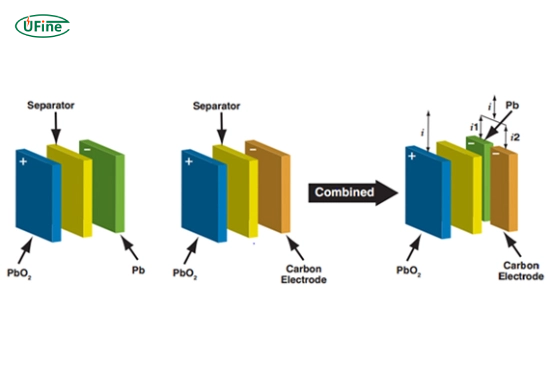
A lead carbon battery is an advanced evolution of traditional lead-acid technology. By introducing carbon materials into the negative plate, sulfation is significantly reduced, enabling faster charging, improved PSOC performance, and longer cycle life.
👉 Related reading: Lead Carbon Battery Explained: Structure, Benefits, and Applications
1 Key technical characteristics
- Improved PSOC tolerance: Carbon suppresses lead sulfate crystallization, a common failure mode in conventional lead-acid batteries.
- Faster charge acceptance: Suitable for opportunity charging and intermittent renewable input.
- Robust thermal behavior: Stable operation in high-temperature environments (40 °C+).
- Simplified system design: No active BMS or cell balancing required.
2 Typical applications
- UPS & data centers (short-duration, high-reliability backup)
- Telecom base stations
- Solar + storage systems with intermittent charging
- Industrial traction and hybrid vehicles (cost-driven platforms)
3 Industry validation
Independent testing referenced by IEEE indicates that lead carbon batteries demonstrate:
- ~30% lower capacity fade after extended PSOC cycling
- Measurably higher efficiency under partial-charge operation
4 Why choose a lead carbon battery?
If your project prioritizes safety, cost control, and operational simplicity, lead carbon often outperforms lithium-ion.
Three Practical Advantages
- Lower system cost: No BMS, thermal management, or fire-suppression infrastructure required.
- High instantaneous discharge capability: Suitable for high-current demand (UPS, industrial loads).
- Intrinsic safety: Non-flammable chemistry with no thermal runaway mechanism.
Part 2. What is a lithium-ion battery?
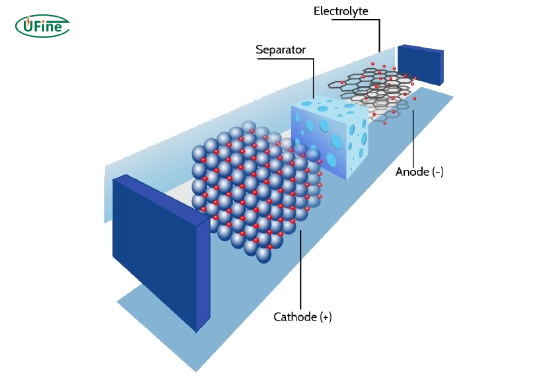
Lithium-ion batteries store and release energy via lithium-ion migration between electrodes through an electrolyte. Their high gravimetric and volumetric energy density has made them the default choice for modern electronics and electric vehicles.
1 Key technical characteristics
- High energy density: ~150–250 Wh/kg
- Long cycle life: Up to ~5,000 cycles under controlled conditions
- Lightweight and compact
- Low self-discharge
2 Typical applications
- Electric vehicles (EVs)
- Residential and commercial ESS
- Portable electronics
- Marine and aerospace systems
Part 3. Lead carbon battery vs lithium-ion: technical comparison
When evaluating lead carbon battery vs lithium-ion, engineers should assess performance across energy density, cost structure, safety model, and lifecycle behavior.
1 Core performance metrics
| Feature | Lead Carbon Battery | Lithium-Ion Battery |
|---|---|---|
| Energy density | 30–50 Wh/kg | 150–250 Wh/kg |
| Cycle life (80% DoD) | ~2,000 cycles | Up to ~5,000 cycles |
| Charging speed | Fast (high charge acceptance) | Moderate–fast (chemistry dependent) |
| Weight | Heavy | Lightweight |
| Cost per kWh | $100–200 | $300–700 |
| Safety profile | Non-flammable | Thermal runaway risk |
| Recyclability | ~98% | ~50% (varies by region) |
Performance benchmarks aligned with IEC stationary storage testing methodologies. External reference: International Electrotechnical Commission – IEC 61427-1.
Part 4. Lead carbon battery vs lithium-ion: Environmental & safety considerations
- Lead carbon batteries benefit from a mature global recycling infrastructure, but require controlled lead handling.
- Lithium-ion batteries face challenges in mining impact, thermal safety, and end-of-life processing, although recycling technologies are improving.
From a fire-risk standpoint, lead carbon systems are inherently safer for indoor and mission-critical installations.
Part 5. Lead carbon battery vs lithium-ion: Which battery is better for your application?
1 Choose lead carbon if:
- Budget constraints dominate procurement decisions
- The system operates at high temperatures
- Safety and reliability outweigh size and weight
- Application involves backup or PSOC cycling
2 Choose lithium-ion if:
- High energy density is mandatory
- Daily deep cycling is expected
- Space and weight are critical
- Long-term operational efficiency offsets higher upfront cost
Part 6. FAQs about lead carbon battery vs. lithium ion
Is a lead carbon battery better than lithium-ion?
Neither is universally “better.” Lead carbon excels in cost, safety, and PSOC use, while lithium-ion dominates in energy density and cycle count.
Which is cheaper: lead carbon or lithium-ion battery?
Lead carbon batteries are significantly cheaper upfront, typically 60–70% lower per kWh than lithium-ion.
Can lead carbon batteries catch fire like lithium-ion?
No. Lead carbon batteries are non-flammable and do not experience thermal runaway.
Do lithium-ion batteries last longer than lead carbon?
In cycle count, yes. However, lead carbon often shows longer calendar life in float or standby service.
Which is more environmentally friendly?
Currently, lead carbon batteries have a clear advantage in recyclability, though lithium recycling is improving.
Related Tags:

More Articles

JST vs Molex: The Right Battery Connector Choice
JST or Molex for your battery? Learn how connector selection affects current, voltage drop, reliability, and device performance.
Custom Battery Pricing: Costs Manufacturers Don’t Mention
A low battery quote may not be the final cost. Discover common hidden expenses that affect custom lithium battery projects.
Battery Wire Length: Hidden Cause of Power Loss
A longer battery wire can cause voltage drop, power loss, and unstable operation. Learn how wire length affects battery performance.
How Device Sleep Modes Affect Battery Life
Think sleep mode extends battery life? Learn why devices still drain power and how firmware, hardware, and batteries affect runtime.
LiPo Battery and PCB Design: Clearance, Insulation, and Placement
Learn how to optimize LiPo battery PCB clearance, insulation, placement, wiring, and thermal design—and avoid common integration mistakes.


