
- Key Takeaways
- Part 1. What does agm mean on a battery?
- Part 2. How to tell if a battery is agm: 5 reliable checks
- Part 3. How to identify an agm battery: Which signs are reliable?
- Part 4. Agm vs regular battery: What is the difference?
- Part 5. Is an agm battery a lead-acid battery?
- Part 6. What is an agm car battery and how can you identify it?
- Part 7. Agm battery vs gel vs lithium-ion battery
- Part 8. Can you use a regular charger with an agm battery?
- Part 9. How to choose the right agm battery replacement
- Part 10. Agm battery identification FAQs
The easiest way to tell if a battery is AGM is to check the label or manufacturer specifications for “AGM” or “Absorbent Glass Mat.” If the label is unclear, use the battery model number, equipment manual, case design, and charging requirements to confirm the battery type.
Do not identify an AGM battery by voltage or appearance alone. AGM and standard flooded batteries can have the same nominal voltage and similar cases.
Key Takeaways
- AGM means Absorbent Glass Mat.
- An AGM battery is a type of lead-acid battery.
- The battery label and manufacturer datasheet are the most reliable ways to identify AGM.
- “VRLA,” “SLA,” “sealed,” or “maintenance-free” alone does not always mean AGM.
- Voltage, weight, and case design are supporting clues, not proof.
- If a vehicle specifies an AGM battery, use a compatible AGM replacement unless the manufacturer approves another type.
Part 1. What does agm mean on a battery?
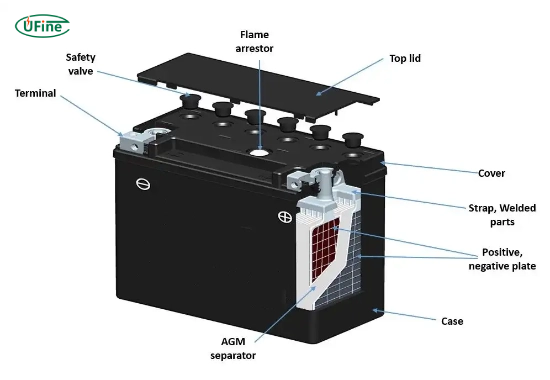
AGM battery meaning is Absorbent Glass Mat. An AGM battery is a type of valve-regulated lead-acid battery in which fiberglass separators absorb and hold the sulfuric acid electrolyte.
Unlike a flooded lead-acid battery, the electrolyte does not move freely around the plates. This construction allows AGM batteries to use a sealed, low-maintenance design.
U.S. Department of Energy technical documents also describe AGM batteries as valve-regulated lead-acid (VRLA) battery technology.
Are AGM, VRLA, and SLA batteries the same?
Not exactly.
VRLA means Valve-Regulated Lead-Acid. SLA is commonly used for Sealed Lead-Acid. AGM is a specific battery construction within the sealed or valve-regulated lead-acid family.
This means:
| Battery marking | Does it confirm AGM? |
|---|---|
| AGM | Yes |
| Absorbent Glass Mat | Yes |
| VRLA AGM | Yes |
| VRLA | Not necessarily |
| SLA | Not necessarily |
| Sealed Lead-Acid | Not necessarily |
| Maintenance-Free | Not necessarily |
| EFB | No |
For example, AGM and Gel batteries can both be classified as VRLA batteries. Therefore, seeing “VRLA” alone is not enough to identify an AGM battery. AGM separators are widely used in VRLA lead-acid batteries, but VRLA describes the broader battery category.
Part 2. How to tell if a battery is agm: 5 reliable checks
If you want to know how to tell if a battery is AGM, start with documentation before relying on physical clues.
1. Check the battery label for AGM
The battery label is usually the fastest identification method.
Look for terms such as:
- AGM
- Absorbent Glass Mat
- Absorbed Glass Mat
- AGM Technology
- VRLA AGM
- Start-Stop AGM
If AGM is clearly printed on the case, the battery is an AGM type.
Do not assume a battery is AGM simply because it says “sealed,” “SLA,” or “maintenance-free.”
2. Search the exact battery model number
If the battery label does not clearly identify the technology, find the model or part number.
Check the manufacturer’s:
- Product page
- Datasheet
- Technical manual
- Battery catalog
- Replacement guide
Look for specifications such as:
Battery Type: AGM
or
Technology: AGM / VRLA AGM
This is one of the most reliable methods when the original label is faded or incomplete.
3. Check the vehicle or equipment manual
The vehicle or equipment manual may specify whether an AGM battery type is required.
This is particularly important in vehicles with:
- Start-stop systems
- Regenerative braking
- High electrical loads
- Battery monitoring systems
SAE J3012 covers 12V lead-acid storage batteries designed for start-stop operation, making the equipment manufacturer’s battery specification an important reference when choosing a replacement.
If the manual specifies AGM, do not replace it with a standard flooded battery without checking compatibility.
4. Check the AGM battery case design
AGM batteries normally have a sealed design and do not provide conventional removable caps for adding water.
Possible AGM battery characteristics include:
- No accessible water-filling caps
- Closed upper case
- No routine electrolyte maintenance
- Valve-regulated construction
However, case design alone cannot confirm an AGM battery. Some maintenance-free flooded batteries may also have sealed-looking cases.
5. Check the AGM battery charging specifications
Charging instructions can provide another strong clue.
The charger or battery manual may specify:
- AGM charging mode
- AGM-compatible charger
- AGM charging voltage
- Specific absorption and float settings
AGM charging requirements can differ from other lead-acid designs, so the manufacturer’s recommended charging profile should always take priority.
For more information, see our guide to AGM battery charging voltage and charging requirements.
Part 3. How to identify an agm battery: Which signs are reliable?
Not every method used to identify an AGM battery is equally accurate.
| Identification Method | Reliability | What It Tells You |
|---|---|---|
| “AGM” on battery label | Very high | Direct AGM identification |
| Manufacturer datasheet | Very high | Confirms exact battery technology |
| Model number lookup | Very high | Identifies the manufacturer’s specification |
| Vehicle/equipment manual | High | Confirms required battery type |
| “VRLA” or “SLA” marking | Medium | Indicates sealed lead-acid family, not necessarily AGM |
| AGM charging specification | Medium to high | Strong supporting evidence |
| No removable caps | Medium | Possible AGM or another maintenance-free design |
| Battery voltage | Low | Cannot reliably distinguish AGM from flooded |
| Battery weight | Low | Varies by size, capacity, and construction |
| Case appearance | Low | Different battery types can look similar |
Can you tell an AGM battery by voltage?
No. Voltage alone cannot tell you if a battery is AGM.
For example, an AGM car battery and a flooded car battery may both be nominally rated at 12V. Their measured voltage ranges can also overlap.
A multimeter can help check the battery’s state of charge, but it cannot reliably identify the internal battery construction.
Can you tell an AGM battery by weight?
Weight can sometimes provide a clue, but it is not a reliable identification method.
Battery weight depends on:
- Capacity
- Plate design
- Case construction
- Battery size
- Manufacturer
Use the label, model number, or datasheet instead.
Part 4. Agm vs regular battery: What is the difference?
When people search for AGM vs regular battery, “regular battery” usually refers to a conventional flooded lead-acid battery.
Both AGM and regular flooded batteries use lead-acid chemistry. The main difference is how the electrolyte is contained.
| Feature | AGM Battery | Regular Flooded Battery |
|---|---|---|
| Chemistry | Lead-acid | Lead-acid |
| Electrolyte | Absorbed in fiberglass mat | Free-flowing liquid |
| Construction | Valve-regulated | Flooded/vented |
| Water addition | Normally not required | May be required |
| Spill resistance | Higher | Lower |
| Vibration resistance | Generally higher | Generally lower |
| Maintenance | Low | Low to moderate |
| Typical cost | Higher | Lower |
| Common applications | Start-stop vehicles, marine, UPS | Conventional vehicles, general starting |
The key difference between AGM and regular battery technology is therefore the internal construction rather than the basic battery chemistry.
For a deeper technical comparison, see our AGM vs flooded lead-acid battery comparison.
Part 5. Is an agm battery a lead-acid battery?
Yes. An AGM battery is a lead-acid battery.
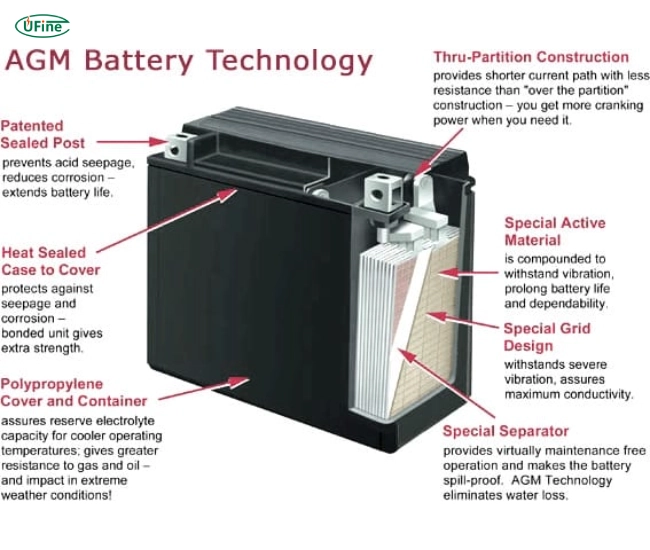
This is important when comparing AGM or lead-acid battery terminology. AGM is not a separate chemistry that replaces lead-acid. It is one type of lead-acid battery construction.
A simplified classification is:
Lead-acid batteries
- Flooded lead-acid
- Valve-Regulated Lead-Acid (VRLA)
- AGM
- Gel
AGM batteries still use lead-based electrodes and sulfuric acid electrolyte. The difference is that the electrolyte is absorbed by fiberglass separators rather than remaining as free-flowing liquid.
Research and government technical literature commonly describe the technology as VRLA-AGM lead-acid batteries.
Therefore, when people search for AGM vs lead acid, the more technically accurate comparison is usually AGM vs flooded lead-acid battery.
Part 6. What is an agm car battery and how can you identify it?
An AGM car battery is an AGM lead-acid battery designed to provide engine-starting power and support the vehicle’s electrical system.
AGM car batteries are commonly used where the battery must handle frequent starts, repeated partial cycling, or higher electrical demand.
Typical applications include:
- Start-stop vehicles
- Vehicles with high electrical loads
- Some regenerative braking systems
- Premium vehicles with many electronic systems
- Auxiliary automotive power systems
AGM technology is also used in start-stop vehicle applications studied by automotive and environmental agencies.
How can you tell if a car battery is AGM?
Use this order:
- Check for AGM on the battery label.
- Search the battery model number.
- Check the vehicle manufacturer’s battery specification.
If the original battery is AGM, the replacement should normally meet the same AGM, voltage, capacity, size, and starting-current requirements.
For automotive applications, our 12V STD vs 12V AGM battery guide explains how standard and AGM batteries differ in vehicle use.
Part 7. Agm battery vs gel vs lithium-ion battery
An AGM battery type can also be confused with Gel or lithium-ion batteries. These technologies differ in both construction and chemistry.
| Battery Type | Chemistry | Electrolyte / Design | Common Uses |
|---|---|---|---|
| AGM | Lead-acid | Electrolyte absorbed in fiberglass mat | Cars, marine, UPS, backup power |
| Gel | Lead-acid | Gelled electrolyte | Deep-cycle, solar, mobility systems |
| Lithium-ion | Lithium-based | Lithium-ion cell system | Portable devices, EVs, energy storage |
AGM and Gel are both lead-acid technologies, but their electrolyte structures differ. Lithium-ion uses a completely different battery chemistry.
For more detail, compare AGM and Gel battery construction and charging or review the differences between AGM and lithium batteries.
A lithium battery should not be treated as a direct AGM replacement based only on voltage or capacity. Charging, protection, operating voltage, current demand, and equipment compatibility must also be considered.
Part 8. Can you use a regular charger with an agm battery?
A regular charger can be used only if its charging profile is compatible with the AGM battery manufacturer’s requirements.
Do not assume every lead-acid charger is suitable for AGM batteries.
Incorrect charging voltage can reduce battery performance and service life. A suitable charger should control the required charging stages and voltage according to the battery datasheet.
An AGM-compatible smart charger is usually preferred when the existing charger does not clearly specify AGM support.
There is no single charging voltage that applies to every AGM battery. Always follow the battery manufacturer’s charging specification.
Part 9. How to choose the right agm battery replacement
After confirming that your battery is AGM, compare the replacement specifications rather than choosing by physical size alone.
| Specification | What to Check |
|---|---|
| Voltage | Match the equipment or vehicle system voltage |
| Capacity (Ah) | Follow the recommended capacity range |
| CCA | Meet the required starting current for automotive use |
| Dimensions | Match battery space and hold-down design |
| Terminal position | Confirm terminal type and polarity |
| Battery use | Choose starting or deep-cycle AGM as required |
| Charging compatibility | Confirm the charging system supports the battery |
For a car battery, the OEM battery specification should be the primary reference.
For marine, UPS, solar, or other equipment, also consider the actual discharge current, cycling pattern, operating temperature, and charging system.
Part 10. Agm battery identification FAQs
How can I tell if my car battery is AGM?
Check the label for “AGM” or “Absorbent Glass Mat.” If unclear, search the model number or check the vehicle manufacturer’s battery specification.
What does AGM mean on a battery?
AGM means Absorbent Glass Mat. It is a lead-acid battery design that holds the electrolyte in fiberglass separators.
Is an AGM battery a lead-acid battery?
Yes. AGM is a type of valve-regulated lead-acid battery with electrolyte absorbed in a glass mat.
What is the difference between AGM and a regular battery?
AGM holds electrolyte in fiberglass mats, while a regular flooded battery contains free liquid electrolyte. AGM normally requires less maintenance and offers better spill and vibration resistance.
Does VRLA or SLA mean a battery is AGM?
Not always. AGM can be a VRLA or sealed lead-acid battery, but Gel batteries can also fall into these categories. Look for “AGM” on the label or datasheet for confirmation.
Related Tags:

More Articles
Buck vs. Boost vs. Buck-Boost Converter: Which Is Best for Battery?
Not sure which converter your battery-powered device needs? Compare Buck, Boost, and Buck-Boost designs and discover what affects voltage stability and runtime.
How to Match 18650 Cells for a Reliable Battery Pack?
Building an 18650 battery pack? Learn how to compare cell capacity, voltage, and internal resistance to avoid mismatches and improve reliability.
Why Do 18650 Battery Packs Get Hot During Discharge?
Is your 18650 battery pack overheating under load? Learn what causes excess heat, how to spot dangerous symptoms, and what to do next.
18650 Battery BMS: How to Get the Specs Right
Learn how to choose a BMS for an 18650 battery pack. Compare voltage, current ratings, protection features, and balancing before you buy.
Why Does My Ring Camera Battery Drain So Fast or Stop Charging?
Is your Ring camera battery draining fast or not charging? Discover common causes, practical fixes, and when to replace the battery.


