- Key Takeaways
- Part 1. What is a mechanical battery?
- Part 2. What are lithium batteries?
- Part 3. Mechanical battery vs lithium battery comparison
- Part 4. Advantages of mechanical batteries
- Part 5. Advantages of lithium batteries
- Part 6. Application scenarios for mechanical battery storage
- Part 7. How to choose between mechanical and lithium batteries?
- Part 8. FAQs on mechanical batteries
A mechanical battery stores energy using physical systems such as motion, pressure, or elevation. Unlike chemical batteries, it does not rely on electrochemical reactions. This makes mechanical battery storage highly durable and suitable for long-term, high-cycle energy applications.
This guide explains how mechanical batteries work, how they compare to lithium batteries, and how to choose the right solution based on real engineering needs.
Key Takeaways
- Mechanical battery storage uses physical energy (kinetic or potential), which reduces degradation over time.
- It is ideal for grid-scale, long-duration, and high-cycle energy storage systems.
- Lithium batteries provide high energy density and compact size for mobile and space-limited applications.
- Lifecycle cost often favors mechanical energy storage in stationary infrastructure projects.
- Hybrid systems combining lithium and mechanical batteries improve both response speed and storage duration.
Part 1. What is a mechanical battery?
A mechanical battery is an energy storage system that converts electrical energy into mechanical form, stores it, and converts it back to electricity when needed. This approach avoids chemical reactions, which are the main cause of battery aging.
Common types of mechanical battery storage
- Pumped hydro storage: Uses water elevation to store potential energy. Widely used in grid-scale systems.
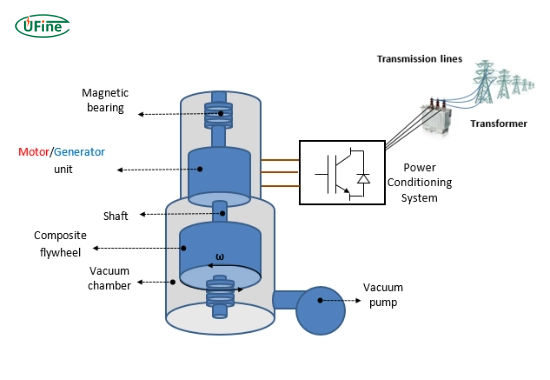
- Flywheel energy storage: Stores kinetic energy in a rotating mass. Delivers very fast response.
- Compressed air energy storage (CAES): Stores energy by compressing air in underground or sealed systems.
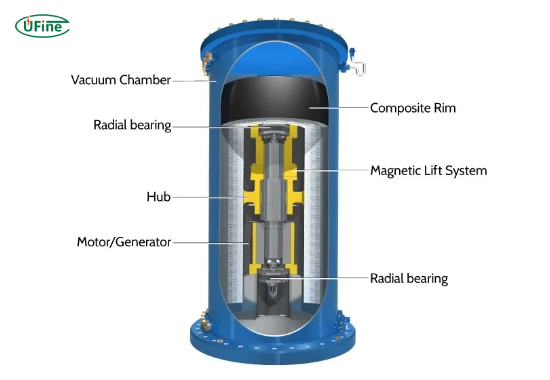
How Mechanical Energy Storage Works
Mechanical batteries store energy in physical form. When electricity is available, it drives a system such as a pump, compressor, or rotor. When energy is needed, the system reverses the process.
Example:
- A flywheel spins at high speed and stores kinetic energy
- When discharged, it slows down and generates electricity almost instantly
Part 2. What are lithium batteries?
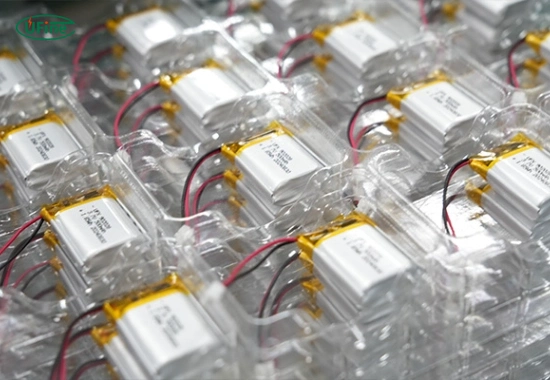
Lithium batteries store energy chemically through the movement of lithium ions between electrodes. They are widely used due to their high energy density and efficiency.
Typical applications include:
- Electric vehicles (EVs)
- Consumer electronics
- Residential solar storage
For deeper technical details, see:
Part 3. Mechanical battery vs lithium battery comparison
Mechanical and lithium batteries are not direct replacements. They solve different engineering problems.
| Factor | Mechanical Battery Storage | Lithium Batteries |
|---|---|---|
| Storage Mechanism | Physical (kinetic or potential energy) | Chemical (lithium-ion reactions) |
| Energy Density | Low | High |
| Lifespan | 20–40+ years | 500–3,000 cycles (chemistry dependent) |
| Efficiency | 70–90% | 90–95% |
| Response Time | Fast (especially flywheels) | Fast |
| Environmental Impact | Low chemical impact | Mining and recycling challenges |
| Best Use Case | Grid and infrastructure | Mobile and distributed energy |
For grid-scale standards and energy storage frameworks, refer to International Energy Agency (IEA) energy storage reports.
Part 4. Advantages of mechanical batteries
- Ultra-long lifespan: Can operate for decades with minimal performance loss.
- High cycle capability: Suitable for frequent charge and discharge.
- Low degradation: No chemical breakdown.
- High safety: No risk of thermal runaway or fire.
- Scalable: Supports megawatt to gigawatt storage systems.
Part 5. Advantages of lithium batteries
- High energy density: Ideal for compact systems.
- High efficiency: Low energy loss during operation.
- Flexible deployment: Works in small devices and modular systems.
- Mature ecosystem: Strong supply chain and global standards.
For custom lithium solutions, see our li-ion 18650 battery solutions and battery production process.
Part 6. Application scenarios for mechanical battery storage
Mechanical batteries
- Grid energy storage and frequency regulation
- Renewable energy buffering (wind and solar farms)
- Industrial backup systems and data centers
- Long-duration storage (hours to days)
Lithium batteries
- Electric vehicles and mobility systems
- Consumer electronics
- Residential and commercial solar storage
- Portable and modular energy systems
Part 7. How to choose between mechanical and lithium batteries?
Use engineering criteria instead of general assumptions.
- Storage duration: Use mechanical battery storage for long-duration needs.
- Energy density: Choose lithium for compact systems.
- Cycle frequency: Mechanical systems handle frequent cycling better.
- Installation space: Mechanical systems require larger infrastructure.
- Total cost: Compare lifecycle cost, not just upfront price.
- Safety requirements: Mechanical batteries reduce chemical risks.
In many real projects, hybrid systems are used:
- Lithium batteries for fast response
- Mechanical energy storage for bulk energy
Part 8. FAQs on mechanical batteries
What is a mechanical battery used for?
Mechanical battery storage is mainly used for grid stabilization, renewable energy integration, and long-duration storage in industrial systems.
Are mechanical batteries better than lithium batteries?
Not always. Mechanical batteries are better for large-scale and long-life applications, while lithium batteries are better for compact and mobile use.
Why do mechanical batteries have lower energy density?
Mechanical energy storage requires physical space for motion or elevation, which limits how much energy can be stored per unit volume.
Can mechanical battery storage replace lithium batteries?
No. They serve different roles. Mechanical batteries are not suitable for portable devices but are strong in grid applications.
What is the future of mechanical energy storage?
Mechanical energy storage is expected to grow in grid-scale applications, especially for renewable energy integration and long-duration storage systems.
Related Tags:

More Articles

The Ultimate Guide to Small Size Battery
Learn small battery types, sizes, and applications. Compare lithium, alkaline, and coin cells. Find the best small size battery for your device or project.
Lithium Battery Comparison: Soft Pack Vs. Hard Pack
Compare soft pack vs hard pack lithium battery. Understand structure, safety, energy density, and applications to choose the right battery.
What Size are 18650 Batteries?
Learn exact 18650 battery dimensions (18mm × 65mm), tolerances, and pack configurations. Compare 18650 size with 21700 and others for better battery selection.
The Ultimate Guide to Battery Terminal Clamps
Learn battery terminal clamps, including types, materials, installation, and how to choose the right battery clamp for car and industrial use.
What Is a Lithium-Ion Battery Pack?
Learn what a lithium ion battery pack is, how it works, key components, configurations, and real-world applications for industrial and commercial use.