
- Part 1. What is a 1S LiPo battery?
- Part 2. Voltage: the heart of a 1S LiPo battery
- Part 3. Capacity: how much energy can it store?
- Part 4. 1S LiPo vs 1S lithium-ion battery
- Part 5. Advantages and disadvantages
- Part 6. Cycle life and running time: maximizing battery performance
- Part 7. Where are 1S LiPo batteries used?
- Part 8. Multiple 1S LiPo battery connections: series and parallel
- Part 9. Connector: the link to your device
- Part 10. How to charge a 1S LiPo battery safely
- Part 11. FAQs
If you’re diving into the world of drones, RC vehicles, or portable electronics, you’ve likely encountered the term “1S LiPo battery.” But what exactly is it, and why is it so widely used? In this in-depth guide, we’ll explore everything you need to know about 1S LiPo batteries, from their technical specifications to their applications and maintenance. Whether you’re a beginner or a seasoned tech enthusiast, this article will provide you with the knowledge to make informed decisions about these powerful little energy sources.
Key takeaways
- A 1S battery contains one lithium cell connected in series
- Most 1S LiPo batteries have a nominal voltage of 3.7V
- Fully charged 1S LiPo batteries reach 4.2V
- 1S batteries are widely used in drones, wearables, RC toys, and portable electronics
- LiPo and lithium-ion 1S batteries share similar voltage ranges but differ in structure and discharge performance
- Proper charging and storage are essential for battery lifespan and safety
Part 1. What is a 1S LiPo battery?
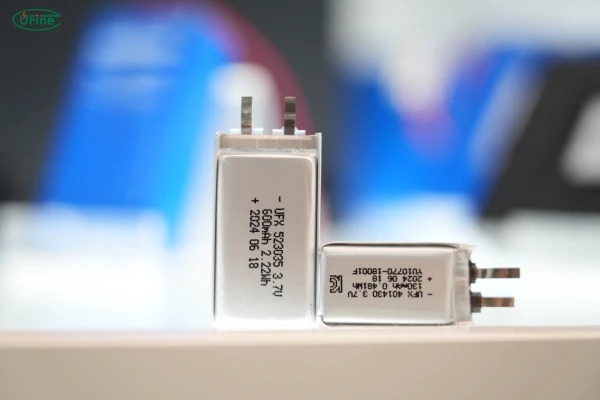
A 1S LiPo (Lithium Polymer) battery is a single-cell rechargeable battery known for its lightweight design, high energy density, and versatility. The “1S” refers to the single cell configuration, meaning it has one cell with a nominal voltage of 3.7V. LiPo batteries are a type of lithium-ion battery but use a polymer electrolyte instead of a liquid one, making them more flexible in shape and size.
These batteries are commonly used in applications where weight and space are critical, such as drones, RC cars, and portable electronics. Their ability to deliver high discharge rates makes them ideal for power-hungry devices, while their compact size ensures they don’t add unnecessary bulk.
What does “1S” mean in a battery?
The “S” in battery terminology stands for “series.” Therefore, a 1S battery means there is only one cell connected in series inside the battery pack.
That may sound overly technical at first, but the concept becomes simple once you compare it with multi-cell battery packs.
| Battery Configuration | Number of Cells | Nominal Voltage |
|---|---|---|
| 1S | 1 | 3.7V |
| 2S | 2 | 7.4V |
| 3S | 3 | 11.1V |
| 4S | 4 | 14.8V |
A single lithium cell naturally operates around 3.7 volts. When manufacturers connect multiple cells in series, the voltage increases proportionally. That is why a 2S LiPo battery outputs roughly 7.4V while a 4S battery reaches approximately 14.8V.
However, many compact electronic products simply do not need high voltage. In those situations, using a lightweight 1S lithium-ion battery makes more sense because it reduces size, heat generation, and overall complexity.
This is one reason why single-cell battery designs remain extremely popular in consumer electronics.
If you want to better understand battery configurations like 1S, 2S, or 4P setups, check out our guide to S and P battery packs.
Part 2. Voltage: the heart of a 1S LiPo battery
Understanding the voltage of a 1S LiPo battery is crucial for proper usage and maintenance. Here’s a breakdown of its voltage at different stages:
-
Fully Charged Voltage: 4.2V
When fully charged, a 1S LiPo battery reaches 4.2V. This is the maximum voltage it should ever reach, as exceeding this can lead to overheating or even fire. -
Nominal Voltage: 3.7V
The nominal voltage is the average voltage during discharge. This is the value most commonly used to describe the battery’s voltage. -
Discharged Voltage: 3.0V
When the battery voltage drops to 3.0V, it’s considered fully discharged. Draining the battery below this level can cause irreversible damage, so it’s essential to monitor the voltage during use.
To ensure the longevity of your 1S LiPo battery, always use a charger with a built-in voltage regulator and avoid overcharging or deep discharging.
Part 3. Capacity: how much energy can it store?
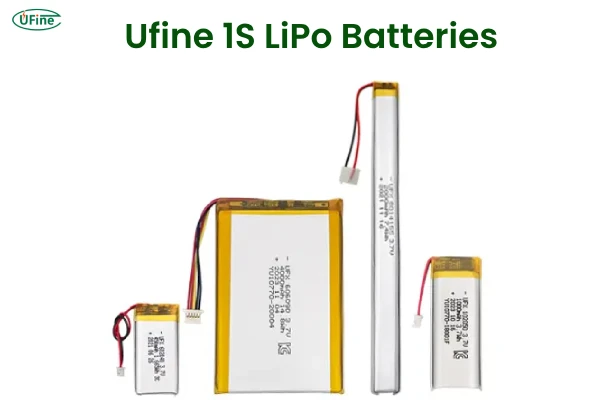
The capacity of a 1S LiPo battery is measured in milliampere-hours (mAh), which indicates how much energy the battery can store. Common capacities for 1S LiPo batteries range from 150mAh to 1200mAh, depending on the size and intended application.
-
Small Capacities (150mAh–300mAh):
These are typically used in tiny drones, micro RC cars, and other lightweight devices where space and weight are at a premium. -
Medium Capacities (500mAh–800mAh):
These are ideal for slightly larger devices, such as mini quadcopters or handheld gadgets. -
Large Capacities (1000mAh–1200mAh):
These are used in applications requiring longer run times, such as larger RC vehicles or portable electronics.
If your project requires a specific capacity, Ufine Battery can help. As a leading manufacturer of custom lithium batteries, Ufine offers tailored solutions to meet your exact needs, whether it’s a unique size, shape, or capacity. Contact us now!
Part 4. 1S LiPo vs 1S lithium-ion battery
People often use the terms “LiPo” and “lithium-ion” interchangeably, but they are not exactly the same.
Both battery types typically use lithium-based chemistry and share a similar voltage range. However, their physical construction and discharge characteristics are different.
| Feature | 1S LiPo Battery | 1S Lithium-Ion Battery |
|---|---|---|
| Structure | Soft pouch cell | Cylindrical or prismatic cell |
| Weight | Lighter | Slightly heavier |
| Discharge Rate | Very high | Moderate |
| Common Uses | FPV drones, RC devices | Flashlights, portable electronics |
| Shape Flexibility | Excellent | Limited |
A 1S LiPo battery is usually preferred when high discharge performance and lightweight design are critical. That is why drone manufacturers heavily rely on LiPo technology.
Meanwhile, 1S lithium-ion batteries are often chosen for devices requiring longer runtime and improved energy density. For instance, portable medical equipment, handheld scanners, and LED flashlights commonly use cylindrical lithium-ion cells.
Neither option is universally “better.” Instead, each battery type fits different engineering priorities.
Part 5. Advantages and disadvantages
Like any technology, 1S LiPo batteries have their pros and cons. Understanding these can help you decide if they’re the right choice for your application.
Advantages:
-
Lightweight and Compact:
Their small size and low weight make them perfect for portable devices. -
High Energy Density:
They can store a significant amount of energy relative to their size. -
Flexible Design:
LiPo batteries can be manufactured in various shapes and sizes, making them highly customizable. -
High Discharge Rates:
They can deliver high currents, making them suitable for power-hungry devices like drones and RC cars.
Disadvantages:
-
Sensitive to Overcharging and Overheating:
Improper charging can lead to swelling, leakage, or even fire. -
Requires Careful Handling:
They must be stored and used within specific voltage and temperature ranges. -
Limited Lifespan:
Even with proper care, LiPo batteries have a finite number of charge cycles.
Part 6. Cycle life and running time: maximizing battery performance
The cycle life and running time of a 1S LiPo battery are critical factors that determine its usability and longevity. Understanding these aspects can help you get the most out of your battery while ensuring it lasts as long as possible.
Cycle Life: How Long Will It Last?
The cycle life of a 1S LiPo battery refers to the number of charge-discharge cycles it can undergo before its capacity significantly degrades. On average, a well-maintained 1S LiPo battery lasts 300-500 cycles. However, this number can vary depending on factors such as:
-
Depth of Discharge (DoD): Regularly discharging the battery to very low levels (e.g., below 3.0V) can shorten its lifespan.
-
Charging Practices: Using a high-quality charger and avoiding overcharging can extend cycle life.
-
Operating Temperature: Extreme heat or cold can accelerate capacity loss.
To maximize cycle life:
-
Avoid fully discharging the battery. Aim to recharge it when it reaches around 3.3V–3.5V.
-
Store the battery at around 3.7V when not in use for extended periods.
-
Use a balanced charger to ensure even charging and prevent cell imbalance.
Running Time: How Long Can It Power Your Device?
Running time refers to how long a 1S LiPo battery can power a device before needing to be recharged. This depends on two main factors:
-
Battery Capacity (mAh): The higher the capacity, the longer the running time.
-
Device Power Consumption (mA): The more power a device draws, the shorter the running time.
To calculate the theoretical running time, use the following formula:
Running Time (hours) = Battery Capacity (mAh) ÷ Device Current Draw (mA)
For example:
-
If you have a 500mAh battery and your device draws 100mA, the running time would be:
500mAh ÷ 100mA = 5 hours.
However, this is a theoretical value. In real-world scenarios, running time can be shorter due to factors like:
-
Voltage Drop: As the battery discharges, its voltage decreases, which can affect device performance.
-
Efficiency Losses: No device is 100% efficient, so some energy is lost as heat.
-
High Discharge Rates: If the device draws high currents, the battery’s effective capacity may be reduced.
How to Use Technical Running Time in Practice
Understanding technical running time can help you plan and optimize your device’s performance. Here’s how to use this knowledge effectively:
-
Choose the Right Battery for Your Device:
Match the battery’s capacity to your device’s power requirements. For example, if your device draws 200mA and you need it to run for 3 hours, you’ll need a battery with at least 600mAh capacity (200mA × 3 hours = 600mAh). -
Monitor Battery Usage:
Use a voltage alarm or telemetry system to monitor the battery’s voltage during use. This helps you avoid deep discharging and ensures you recharge the battery at the right time. -
Optimize Device Settings:
If your device has adjustable settings (e.g., brightness, speed, or power modes), lowering these can reduce power consumption and extend running time. -
Carry Spare Batteries:
For applications like drones or RC cars, carrying extra batteries ensures uninterrupted operation. Calculate the total running time based on the combined capacity of all batteries. -
Test and Adjust:
Run your device under typical conditions and measure the actual running time. Compare this to the theoretical value and adjust your calculations or battery choice as needed.
For example, if you’re using a 1S LiPo battery in a drone:
-
Check the drone’s power consumption during flight (e.g., 5A or 5000mA).
-
If your battery has a capacity of 1000mAh, the theoretical running time would be:
1000mAh ÷ 5000mA = 0.2 hours (12 minutes). -
In practice, the running time might be closer to 8-10 minutes due to efficiency losses and voltage drop.
By understanding and applying technical running time, you can make informed decisions about battery selection, usage, and maintenance, ensuring optimal performance for your devices.
Part 7. Where are 1S LiPo batteries used?
1S LiPo batteries are incredibly versatile and are used in a wide range of applications, including:
-
Drones and RC Vehicles:
Their lightweight design and high discharge rates make them ideal for powering drones, RC cars, and airplanes. -
Portable Electronics:
They’re commonly used in devices like Bluetooth earbuds, handheld gaming consoles, and small cameras. -
DIY Projects:
Hobbyists and engineers use 1S LiPo batteries to power custom electronics and prototypes. -
Medical Devices:
Their compact size and reliability make them suitable for portable medical equipment.
If you’re working on a specialized project, Ufine Battery can provide custom 1S LiPo batteries tailored to your specific requirements.
Part 8. Multiple 1S LiPo battery connections: series and parallel
Sometimes, a single 1S LiPo battery isn’t enough. By connecting multiple batteries, you can increase voltage or capacity:
-
Series Connection:
Connects batteries end-to-end to increase voltage. For example, two 1S batteries in series provide 7.4V. -
Parallel Connection:
Connects batteries side-by-side to increase capacity. For example, two 500mAh batteries in parallel provide 1000mAh.
Always ensure the batteries have the same voltage and capacity before connecting them, and use a proper balancing connector to avoid imbalances.
Still confused about voltage and capacity differences? This comparison of series vs parallel batteries explains how lithium battery connections actually work.
Part 9. Connector: the link to your device
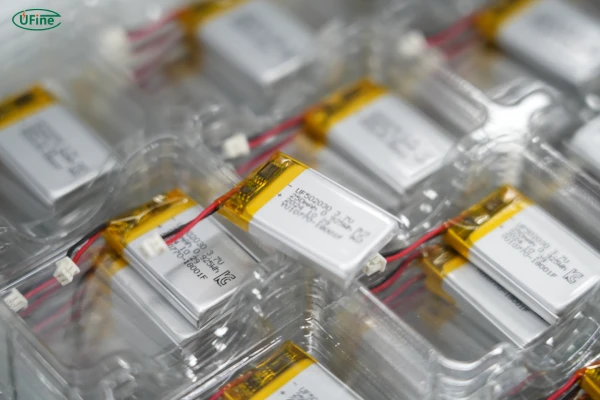
The connector is a small but critical component that links the battery to your device. Common types include:
-
JST Connector: Widely used in small drones and RC vehicles.
-
PH2.0 Connector: Popular in micro drones and lightweight devices.
-
Micro Losi Connector: Often used in tiny RC cars and planes.
Ensure your device and battery connectors match, or use an adapter if necessary.
Part 10. How to charge a 1S LiPo battery safely
Charging a 1S LiPo battery is straightforward, but safety should never be ignored.
Lithium batteries store a large amount of energy in a very compact space. While modern batteries are generally safe when used properly, incorrect charging practices can still create serious risks.
A few practical habits make a big difference:
- Always use a charger designed for lithium batteries
- Never charge above 4.2V
- Avoid puncturing or swelling the battery
- Store the battery around 3.8V if unused for extended periods
Many experienced hobbyists also avoid leaving LiPo batteries unattended while charging. Although battery failures are relatively uncommon, responsible charging practices greatly reduce potential hazards.
Another overlooked factor is connector quality. Loose connectors or damaged wires can create resistance, heat buildup, and unstable charging behavior — especially in high-discharge applications like RC drones.
1S LiPo battery charger
Using the right charger is essential for maintaining your 1S LiPo battery. Look for chargers with:
-
Overcharge Protection: Prevents the battery from exceeding 4.2V.
-
Balancing Function: Ensures even charging across all cells.
-
Automatic Shutoff: Stops charging once the battery is full.
Avoid using cheap or incompatible chargers, as they can damage the battery or pose safety risks.
Part 11. FAQs
What is the difference between 1S and 2S batteries?
A 1S battery contains one lithium cell with a nominal voltage of 3.7V, while a 2S battery contains two cells connected in series for a nominal voltage of 7.4V. A 2S battery provides more power but is heavier and larger.
Why do 1S LiPo batteries puff or swell?
Swelling usually happens because of overcharging, over-discharging, overheating, aging, or physical damage. A swollen LiPo battery should not continue to be used because it may become unsafe.
What connector types are common on 1S LiPo batteries?
Small 1S LiPo batteries often use JST-PH, BT2.0, Molex, or Pico connectors depending on the application. Drone batteries commonly use lightweight connectors to reduce resistance and improve efficiency.
What does “C rating” mean on a 1S LiPo battery?
The C rating indicates how quickly the battery can safely discharge energy. Higher C ratings are important for applications like FPV drones and RC vehicles that require strong burst power.
Related Tags:

More Articles

JST vs Molex: The Right Battery Connector Choice
JST or Molex for your battery? Learn how connector selection affects current, voltage drop, reliability, and device performance.
Custom Battery Pricing: Costs Manufacturers Don’t Mention
A low battery quote may not be the final cost. Discover common hidden expenses that affect custom lithium battery projects.
Battery Wire Length: Hidden Cause of Power Loss
A longer battery wire can cause voltage drop, power loss, and unstable operation. Learn how wire length affects battery performance.
How Device Sleep Modes Affect Battery Life
Think sleep mode extends battery life? Learn why devices still drain power and how firmware, hardware, and batteries affect runtime.
LiPo Battery and PCB Design: Clearance, Insulation, and Placement
Learn how to optimize LiPo battery PCB clearance, insulation, placement, wiring, and thermal design—and avoid common integration mistakes.


