- Key takeaways
- Part 1. What is an 18650 battery holder?
- Part 2. Types of 18650 battery holders
- Part 3. 18650 battery holder applications
- Part 4. How to choose the right 18650 battery holder?
- Part 5. Safety tips for using 18650 battery holders
- Part 6. Common 18650 battery holder problems
- Part 7. Maintenance best practices for 18650 battery holders
- Part 8. Innovative uses of 18650 battery holders
- Part 9. Where to buy 18650 battery holders?
- Part 10. FAQs about 18650 battery holder
18650 lithium-ion batteries are compact, high-capacity power sources used in electronics, power banks, robotics, and EV prototypes. Choosing the right 18650 battery holder ensures stable electrical connections, easy maintenance, and safe operation.
This guide covers types, configurations, applications, safety considerations, and selection tips for engineers, hobbyists, and makers.
Key takeaways
- 18650 battery holders secure one or more cells and maintain reliable contact.
- Holder types: single, multi-cell, PCB mount, snap-in.
- Series vs. parallel connections affect voltage and capacity.
- Contact material, fit, current rating, and mounting style influence performance.
- Proper installation and maintenance prevent overheating, corrosion, and connection issues.
Part 1. What is an 18650 battery holder?
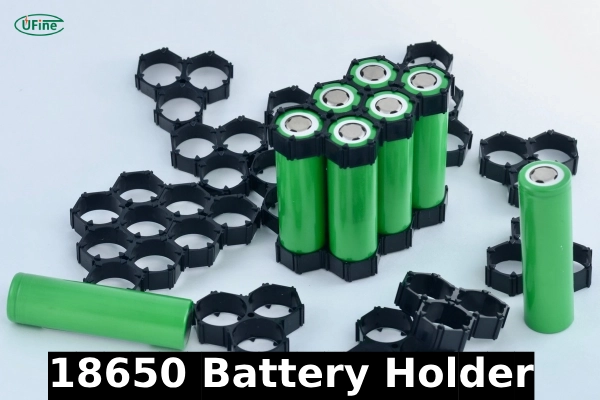
An 18650 battery holder is a mechanical component designed to securely hold one or more 18650 lithium-ion batteries while maintaining stable electrical connections.
A battery holder serves several important functions:
- Holds batteries firmly in place
- Provides positive and negative electrical contacts
- Simplifies battery replacement
- Protects cells from vibration and movement
- Improves battery pack organization
- Reduces assembly complexity
Unlike welded battery packs, battery holders allow batteries to be removed and replaced easily, making them ideal for prototyping, testing, and serviceable products.
Part 2. Types of 18650 battery holders
Different projects require different holder designs. Understanding the available options helps ensure optimal performance and reliability.
Single 18650 battery holder
A single-cell holder accommodates one 18650 battery.
Advantages:
- Compact size
- Easy installation
- Low cost
- Suitable for portable devices
Common applications:
- Flashlights
- Sensors
- Portable electronics
- DIY projects
Multiple 18650 battery holders
Multi-cell holders accommodate two or more batteries and are available in various configurations.
These holders are commonly used in:
- Power banks
- Solar energy storage systems
- Robotics
- Industrial electronics
- Portable power stations
Series configuration
When batteries are connected in series:
- Voltage increases
- Capacity remains unchanged
Example:
- One 18650 cell: 3.7V, 3000mAh
- Two cells in series: 7.4V, 3000mAh
Series connections are commonly used when devices require higher operating voltages.
Parallel configuration
When batteries are connected in parallel:
- Voltage remains the same
- Capacity increases
Example:
- One 18650 cell: 3.7V, 3000mAh
- Two cells in parallel: 3.7V, 6000mAh
Parallel configurations are ideal for extending runtime.
PCB mount 18650 battery holders
PCB mount holders are designed to be soldered directly onto a printed circuit board.
Benefits include:
- Compact integration
- Reduced wiring
- Improved assembly efficiency
- Lower manufacturing costs
Common uses:
- Embedded systems
- IoT devices
- Consumer electronics
Snap-in 18650 battery holders
Snap-in holders allow batteries to be inserted and removed quickly without tools.
Advantages:
- Easy battery replacement
- User-friendly design
- Lower maintenance costs
Common applications:
- Portable electronics
- Rechargeable devices
- Testing equipment
Part 3. 18650 battery holder applications
Consumer electronics
Many electronic products use 18650 cells due to their excellent energy density.
Examples include:
- LED flashlights
- Portable speakers
- Wireless devices
- Emergency radios
Battery holders simplify battery replacement and maintenance.
DIY electronics projects
The maker community frequently uses 18650 battery holders for:
- Arduino projects
- Raspberry Pi systems
- Portable power banks
- Custom electronics
Battery holders make battery pack assembly easier and safer than spot welding.
Robotics
Robots require stable and reliable power sources.
Battery holders allow:
- Easy battery replacement
- Modular power systems
- Flexible voltage configurations
They are commonly found in educational and industrial robotics platforms.
Solar energy storage systems
Many DIY solar projects use 18650 cells to build battery banks.
Battery holders provide:
- Modular expansion
- Simplified maintenance
- Better airflow between cells
For larger energy storage systems, professionally assembled battery packs are recommended.
Related reading: Solar Battery Storage Guide
Electric vehicles and mobility devices
Early EV prototypes and light electric vehicles often utilize 18650 cell holders during development.
Applications include:
- E-bikes
- E-scooters
- Battery testing platforms
- Prototype EV packs
Commercial EV packs typically use welded or laser-connected battery assemblies rather than removable holders.
Part 4. How to choose the right 18650 battery holder?
1. Current rating
Not all holders can handle high discharge currents.
Low-quality holders may suffer from:
- Voltage drop
- Excessive heating
- Contact degradation
Choose a holder rated for the maximum expected current.
2. Contact material
The contact material significantly affects performance.
Common options include:
| Material | Advantages |
|---|---|
| Nickel-Plated Steel | Affordable, corrosion resistant |
| Phosphor Bronze | Better spring properties |
| Nickel-Plated Brass | Lower resistance and higher conductivity |
Higher-quality contacts generally provide:
- Lower contact resistance
- Better conductivity
- Longer service life
3. Battery fit and tolerance
Not all 18650 batteries have identical dimensions.
Protected 18650 cells are often longer than standard cells.
Before purchasing a holder, verify compatibility with:
- Flat-top cells
- Button-top cells
- Protected cells
- High-capacity cells
4. Mounting method
Consider how the holder will be integrated into the final product.
Options include:
- PCB mount
- Chassis mount
- Screw mount
- Adhesive mount
The correct mounting style improves reliability and simplifies assembly.
5. Environmental conditions
For industrial applications, consider:
- Temperature range
- Humidity
- Dust exposure
- Vibration levels
Industrial-grade holders offer better durability under harsh conditions.
Part 5. Safety tips for using 18650 battery holders
Avoid excessive current loads
Using a holder beyond its current rating can cause:
- Heat buildup
- Contact damage
- Reduced battery life
Always verify current specifications.
Ensure proper ventilation
Lithium-ion batteries generate heat during charging and discharging.
Allow adequate airflow around battery holders, especially in enclosed devices.
Prevent short circuits
Never allow:
- Metal objects to contact battery terminals
- Damaged insulation
- Loose wiring
Short circuits can cause serious battery failures.
Use quality batteries
Battery safety starts with quality cells.
Consider using cells from reputable manufacturers and suppliers.
For custom battery pack projects, see: Custom Lithium Battery Solutions
Part 6. Common 18650 battery holder problems
Loose battery connections
Symptoms:
- Intermittent power
- Device resets
- Flickering LEDs
Solutions:
- Clean contacts
- Replace worn springs
- Ensure proper battery fit
Corrosion on contacts
Corrosion increases resistance and reduces performance.
To prevent corrosion:
- Store devices in dry environments
- Clean contacts periodically
- Replace damaged holders
Overheating
Potential causes:
- Excessive current
- Poor contact quality
- Inadequate ventilation
Inspect the entire power system when overheating occurs.
Part 7. Maintenance best practices for 18650 battery holders
To maximize service life:
- Inspect holders regularly
- Clean contacts with isopropyl alcohol
- Replace worn springs and damaged components
- Monitor battery condition
- Remove batteries during long-term storage
Routine maintenance improves safety and performance.
Part 8. Innovative uses of 18650 battery holders
Custom power banks
Battery holders make it easy to build modular power banks with:
- USB outputs
- Charging circuits
- Battery indicators
Portable solar chargers
Combining solar panels with removable 18650 battery holders creates flexible off-grid charging solutions.
Home energy storage prototypes
Battery holders allow hobbyists and engineers to experiment with battery storage concepts before moving to welded battery packs.
Educational battery systems
Many schools and training centers use battery holders to teach:
- Battery fundamentals
- Series and parallel wiring
- Power management concepts
Part 9. Where to buy 18650 battery holders?
Reliable sources include:
Electronics Distributors
- DigiKey
- Mouser Electronics
- Newark
Maker Electronics Suppliers
- Adafruit
- SparkFun
- Pololu
Battery Manufacturers
Purchasing directly from battery pack manufacturers often provides better technical support and compatibility recommendations.
Part 10. FAQs about 18650 battery holder
Can I use protected 18650 batteries in any holder?
No. Protected 18650 batteries are typically longer than standard cells. Always verify holder dimensions before purchase.
What is the difference between an 18650 battery holder and an 18650 cell holder?
There is no significant difference. Both terms generally refer to devices designed to hold 18650 lithium-ion cells securely.
Are battery holders suitable for high-current applications?
Some are, but many standard holders are intended for low-to-medium current loads. Check the holder’s current rating before use.
Can I connect multiple 18650 battery holders together?
Yes. Multiple holders can be wired in series or parallel to achieve the desired voltage and capacity.
Is a battery holder better than spot welding?
For prototyping and removable battery systems, holders are more convenient. For permanent high-current battery packs, spot welding is generally more reliable and efficient.
Related Tags:

More Articles

JST vs Molex: The Right Battery Connector Choice
JST or Molex for your battery? Learn how connector selection affects current, voltage drop, reliability, and device performance.
Custom Battery Pricing: Costs Manufacturers Don’t Mention
A low battery quote may not be the final cost. Discover common hidden expenses that affect custom lithium battery projects.
Battery Wire Length: Hidden Cause of Power Loss
A longer battery wire can cause voltage drop, power loss, and unstable operation. Learn how wire length affects battery performance.
How Device Sleep Modes Affect Battery Life
Think sleep mode extends battery life? Learn why devices still drain power and how firmware, hardware, and batteries affect runtime.
LiPo Battery and PCB Design: Clearance, Insulation, and Placement
Learn how to optimize LiPo battery PCB clearance, insulation, placement, wiring, and thermal design—and avoid common integration mistakes.