
- Key takeaways
- Part 1. What does “charging batteries in parallel” actually mean?
- Part 2. Benefits of parallel charging
- Part 3. Parallel vs. series charging: choosing the right configuration
- Part 4. How to charge batteries in parallel?
- Part 5. The role of parallel charging boards
- Part 6. Why wiring batteries in parallel can be dangerous
- Part 7. Advanced precautions for optimal performance
- Part 8. Charging 12 volt batteries in parallel: what changes?
- Part 9. Lead acid vs lithium: parallel charging is not the same
- Part 10. Internal resistance
- Part 11. Common mistakes you should avoid
- Part 12. Final thoughts
- Part 13. FAQs
When you start working with battery systems—whether for solar storage, RV setups, or custom lithium packs—you’ll quickly run into one common question:
Can you charge batteries in parallel safely?
The short answer is yes.
But the real answer is: it depends on how well you understand what’s happening electrically.
Charging batteries in parallel sounds simple—just connect positive to positive, negative to negative. However, behind that simplicity lies current imbalance, internal resistance mismatch, and potential safety risks.
Key takeaways
- You can charge batteries in parallel, but only if voltage, chemistry, and condition are closely matched
- Current does not distribute evenly—internal resistance plays a critical role
- Parallel charging is generally safer than series in terms of voltage stress, but still carries risks
- Lithium batteries require extra protection (BMS), unlike most lead-acid systems
- Small mistakes—like mixing old and new batteries—can lead to overheating or long-term degradation
Part 1. What does “charging batteries in parallel” actually mean?
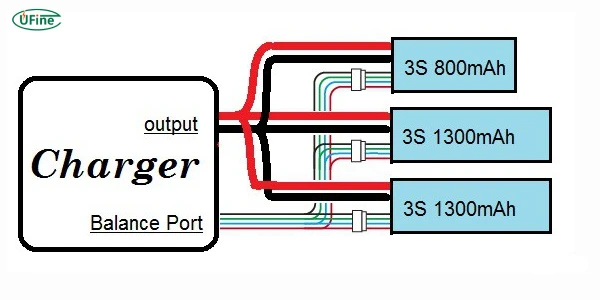
At a basic level, connecting batteries in parallel means:
- Voltage stays the same
- Capacity (Ah) increases
- Current is shared between batteries
When you connect two batteries together, they don’t just “cooperate.” They interact. If their voltages are even slightly different, current will immediately flow between them—even before the charger is involved.
That’s why parallel charging is less about wiring and more about system balance.
Part 2. Benefits of parallel charging
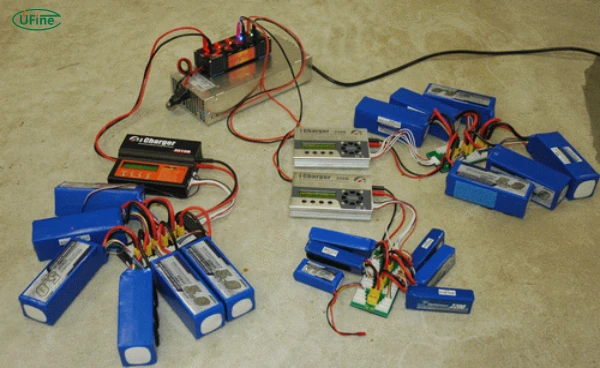
Scalability for Diverse Applications
-
Renewable Energy Storage: Solar arrays often use parallel banks to store excess energy without increasing voltage, simplifying inverter compatibility.
-
RV and Marine Use: Doubling capacity extends runtime for appliances like refrigerators and lighting.
-
Backup Power Systems: Hospitals and data centers rely on parallel configurations for redundancy during outages.
Cost and Maintenance Advantages
-
Modular Upgrades: Expand capacity incrementally instead of replacing entire systems.
-
Easier Replacements: Swap out individual batteries without dismantling the entire bank.
Enhanced Efficiency
Parallel setups reduce stress on individual batteries by distributing loads evenly, prolonging lifespan. A 2022 study by Battery Council International found parallel lead-acid banks lasted 15–20% longer than single-battery systems under similar conditions.
Part 3. Parallel vs. series charging: choosing the right configuration
| Parameter | Parallel | Series |
|---|---|---|
| Voltage | Unchanged (e.g., 12V) | Adds up (e.g., 24V for two 12V batteries) |
| Capacity | Sum of all batteries (200Ah for two 100Ah) | Matches the lowest-capacity battery |
| Current Handling | Higher total current | Same current through all batteries |
| Ideal Use Cases | Energy storage, low-voltage applications | High-voltage devices (e.g., EVs, power tools) |
Hybrid Systems: Some setups combine series and parallel (e.g., 4x 12V batteries in 2S2P for 24V/200Ah). These require expert design to avoid imbalance.
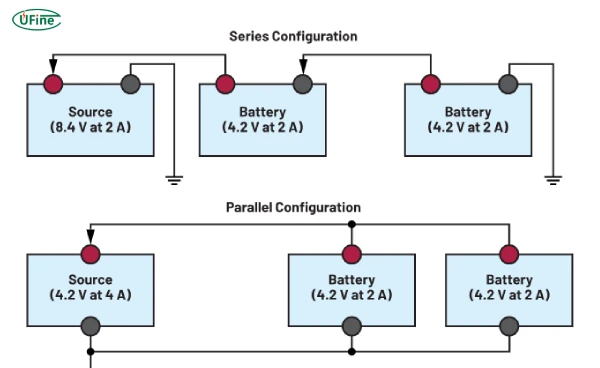
Part 4. How to charge batteries in parallel?
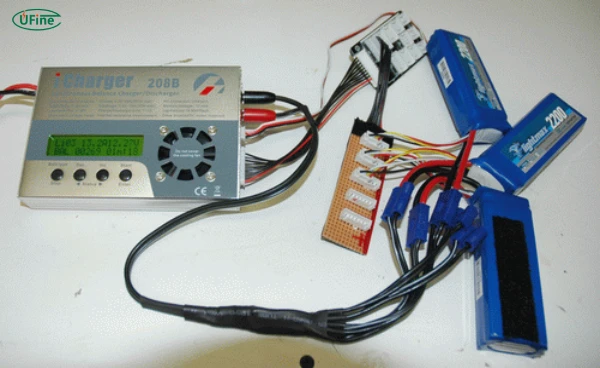
Tools and Materials
-
Batteries: Identical voltage, chemistry, and capacity.
-
Cables: Thick enough to handle total current (e.g., 4 AWG for 100A loads).
-
Fuses: Match the max current rating of your batteries.
-
Battery Monitor: A digital shunt (e.g., Victron BMV-712) for real-time tracking.
Procedure
-
Pre-Charge Preparation
-
Charge each battery individually to the same voltage (±0.1V).
-
Clean terminals with a wire brush to ensure low-resistance connections.
-
-
Wiring the Bank
-
Star Topology: Connect each battery’s positive terminal to a central busbar, then link the busbar to the charger. This minimizes voltage drop.
-
Daisy Chain Avoidance: Never connect one battery’s positive to the next—this creates uneven load distribution.
-
-
Fuse Installation
-
Attach a Class T fuse (for lithium) or ANL fuse (for lead-acid) to each positive terminal.
-
-
Charger Setup
-
Use a charger rated for the bank’s total Ah. A 30A charger is sufficient for a 300Ah lead-acid bank charged at 0.1C.
-
For lithium, select a charger with a constant current/constant voltage (CC/CV) profile.
-
-
Post-Charge Validation
-
Measure individual battery voltages. Deviation >0.2V indicates a faulty connection or aging battery.
-
Part 5. The role of parallel charging boards
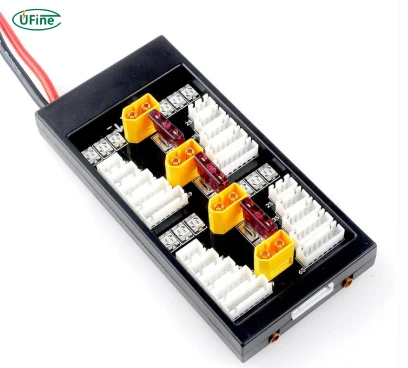
What Is a Parallel Charging Board?
A parallel charging board (PCB) is a pre-wired circuit board designed to connect multiple batteries in parallel through standardized ports. It acts as a centralized hub, eliminating the need for manual cable connections. Key features include:
-
Standardized Ports: XT60, XT30, EC5, or JST connectors for plug-and-play compatibility.
-
Built-in Balancing: Some PCBs integrate balancing circuits to equalize cell voltages.
-
Safety Features: Fuses, reverse polarity protection, and heat-resistant materials.
When Do You Need a Parallel Charging Board?
-
Multi-Battery Charging: Charging 4+ batteries simultaneously (common in drone/RC hobbies).
-
Lithium-Based Chemistries: LiPo/LiFePO4 batteries require precise voltage matching—PCBs reduce human error.
-
High-Current Applications: Prevents voltage drop with thick copper traces vs. DIY wiring.
Step-by-Step: Using a Parallel Charging Board
Tools Required
-
Parallel charging board (e.g., ISDT PB200 or HOTA Parallel Board)
-
Batteries with matching connectors and voltages
-
Compatible high-current charger (e.g., SkyRC Q200)
Procedure
-
Pre-Charge Checks
-
Ensure all batteries are within 0.1V of each other.
-
Confirm identical cell counts (e.g., all 4S LiPos).
-
-
Connect Batteries to the Board
-
Plug each battery’s discharge/balance leads into the board’s ports.
-
For LiPo packs: Attach both the main lead (XT60) and balance lead (JST-XH).
-
-
Link the Board to the Charger
-
Connect the board’s output leads to the charger.
-
Set the charger to the total combined capacity (e.g., 4x 1500mAh = 6000mAh).
-
-
Initiate Charging
-
Select the correct chemistry (LiPo/LiFePO4) and voltage (e.g., 4S).
-
Monitor cell voltages via the charger’s display or a standalone cell checker.
-
-
Post-Charge Protocol
-
Disconnect batteries starting from the lowest voltage to avoid sparks.
-
Store batteries at 3.8V per cell if not used immediately.
-
Advantages of Parallel Charging Boards
-
Time Efficiency: Charge 6–8 batteries in one cycle vs. individually.
-
Safety: Reduces loose connections and polarity reversal risks.
-
Precision: High-quality PCBs ensure minimal voltage drop across ports.
Risks of Skipping a Parallel Charging Board
-
Voltage Imbalances: Manual wiring often leads to uneven connections, stressing batteries.
-
Fire Hazards: Poorly soldered DIY boards can overheat under high currents.
-
Human Error: Miswiring positives and negatives can destroy batteries or chargers.
Part 6. Why wiring batteries in parallel can be dangerous
You’ve probably seen the phrase: “wiring batteries in parallel danger.”
And yes—there are real risks, especially if you cut corners.
Let’s break down the most common failure mechanisms:
- Voltage mismatch → causes sudden inrush current between batteries
- Different internal resistance → leads to uneven charging and overheating
- Mixing old and new batteries → accelerates degradation of the entire pack
- Lack of protection → no fuse or BMS increases failure risk
In extreme cases, especially with lithium-ion batteries, this can lead to thermal runaway—a chain reaction of heat and failure.
Part 7. Advanced precautions for optimal performance
Environmental Factors
-
Temperature: Lithium batteries should be charged between 32°F–113°F (0°C–45°C). Cold increases internal resistance, while heat accelerates degradation.
-
Ventilation: Hydrogen gas from lead-acid batteries requires vented enclosures.
Balancing Strategies
-
Passive Balancing: Resistor-based systems bleed excess charge from higher-voltage batteries.
-
Active Balancing: Transfer energy between cells using capacitors or inductors (common in EV battery packs).
Maintenance Schedule
-
Monthly: Check voltage and temperature.
-
Annually: Perform a full discharge test to identify weak batteries.
Part 8. Charging 12 volt batteries in parallel: what changes?
If you’re dealing with charging 12 volt batteries in parallel, the principles remain the same—but the applications become more practical.
This setup is extremely common in:
- RV power systems
- Marine batteries
- Off-grid solar storage
However, there’s a subtle but important detail:
Cable resistance matters.
If one battery is connected with shorter or thicker cables, it will receive more current. This is why professional systems use balanced wiring (diagonal connection) to equalize current flow.
Part 9. Lead acid vs lithium: parallel charging is not the same
Not all batteries behave the same when connected in parallel.
Here’s a simplified comparison:
| Parameter | Lead-Acid Batteries | Lithium-Ion Batteries |
|---|---|---|
| Parallel charging tolerance | High | Moderate (requires control) |
| Risk of imbalance | Lower | Higher |
| Protection needed | Basic | BMS required |
| Sensitivity to mismatch | Low | High |
Lead-acid batteries are more forgiving. You can often connect them in parallel without sophisticated electronics.
Lithium batteries, on the other hand, demand tighter control. A proper Battery Management System (BMS) is not optional—it’s essential.
Part 10. Internal resistance
Every battery has internal resistance. Even two identical batteries from the same batch will have slight differences.
When charging batteries in parallel:
- Lower resistance battery → takes more current
- Higher resistance battery → takes less current
Over time, this creates a loop:
→ one battery works harder
→ heats up more
→ degrades faster
→ becomes even less balanced
That’s why professional battery packs are matched and tested before assembly.
To understand how internal resistance affects current sharing in parallel batteries, check our guide on measuring lithium battery internal resistance.
Part 11. Common mistakes you should avoid
Even experienced users make these mistakes when charging parallel batteries:
- Connecting batteries with different voltages
- Mixing different brands or chemistries
- Ignoring temperature differences
- Skipping fuses or protection circuits
These might not cause immediate failure—but they almost always reduce lifespan.
Part 12. Final thoughts
Charging batteries in parallel is not inherently dangerous—but it’s not as simple as it looks either.
If you respect the fundamentals—voltage matching, proper wiring, and system balance—you can safely build scalable and efficient battery systems.
But if you ignore them, even a small mismatch can quietly reduce performance, shorten lifespan, or in worst cases, create safety risks.
So the next time you connect batteries in parallel, don’t just think about the wires.
Think about what’s happening inside the batteries.
Part 13. FAQs
Q1: Can I mix old and new batteries in parallel?
A: Avoid it. Older batteries have higher internal resistance, causing uneven load distribution and reduced efficiency.
Q2: How does parallel charging affect battery lifespan?
A: Properly balanced banks extend lifespan by reducing individual stress. Mismanaged banks can shorten it by 50% or more.
Q3: What gauge wire should I use for parallel connections?
A: Calculate using the formula:
For 100A over 1m with 0.5V drop, use 25mm² (3 AWG).
Q4: Can I parallel different chemistries if voltages match?
A: No. Charging profiles differ—lead-acid uses bulk/absorption stages, while lithium requires CC/CV.
Q5: Why does my parallel bank charge slower than expected?
A: The charger’s current is divided across batteries. For faster charging, upgrade to a higher-amperage charger.
Q6: Is a parallel charging board mandatory for parallel setups?
A: No, but highly recommended for multi-battery lithium systems. For small lead-acid banks, manual wiring may suffice.
Q7: Can I use a PCB with mixed-capacity batteries?
A: Only if voltages are identical. Capacity differences are tolerated if the PCB supports balancing (e.g., ISDT PB200).
Related Tags:

More Articles
Dead Battery or Device Failure? How to Find the Cause
Think your device is broken? Learn how to tell if the problem comes from battery aging or hardware failure before replacing your electronics.
Why iPhone Duo Uses Two Batteries: The Engineering Behind Foldable Phone Power
Why do foldable phones need two batteries? Explore the engineering challenges behind iPhone Duo’s dual-battery architecture and future battery trends.
Solid-State Batteries: 3 Myths You Need to Know
Solid-state batteries promise safer EVs and longer range, but the reality is more complex. Discover the challenges behind this next-gen technology.
Battery Capacity vs Discharge Rate: The Choice Engineers Face
Higher capacity or higher discharge rate? Learn how to choose the right LiPo battery for longer runtime, stable power output, and better device performance.
Battery Cable Size Guide: Choose the Right Wire Fast
Not sure what battery cable size you need? Learn how to select the right wire gauge, terminal size, and cable for safer, more efficient battery systems.


