- Key Takeaways
- Part 1. What is battery lifespan?
- Part 2. What is a battery warranty?
- Part 3. Battery warranty vs battery lifespan: Key differences
- Part 4. Common types of battery warranties
- Part 5. What drives battery lifespan in real applications?
- Part 6. How to extend battery lifespan (practical guidelines)
- Part 7. Understanding battery degradation
- Part 8. How manufacturers define warranty periods
- Part 9. Battery lifespan and warranty: Application-based selection
- Part 10. Battery warranty and lifespan FAQs
Understanding battery lifespan and battery warranty is critical when selecting batteries for industrial, automotive, or energy storage use. These terms are often confused, but they measure very different things: actual performance vs manufacturer guarantee.
Key Takeaways
- Battery lifespan reflects real-world performance, including cycle life and degradation over time.
- Battery warranty defines the period and conditions under which manufacturers cover defects or failures.
- A longer battery warranty often signals higher product confidence, but does not guarantee full capacity retention.
- Most warranties cover failure, not normal degradation (capacity loss is expected).
- Proper usage, temperature control, and charging habits significantly extend battery lifespan.
- For procurement, always evaluate both lifespan data and warranty terms, not just one metric.
Part 1. What is battery lifespan?
Battery lifespan is the total usable life of a battery before its performance drops below acceptable levels. It includes both:
- Cycle life (charge/discharge cycles)
- Calendar life (aging over time)
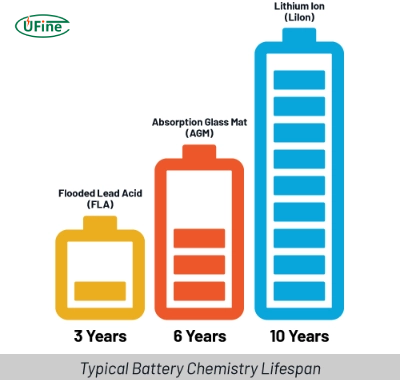
Typical Battery Lifespan by Type
| Battery Type | Typical Lifespan | Key Use Cases |
|---|---|---|
| Lithium-ion (Li-ion) | 8–15 years | EVs, solar storage, electronics |
| LiFePO4 (LFP) | 10–20 years | Energy storage, RV, marine |
| Lead-acid | 3–5 years | Automotive starter batteries |
| NiMH | 5–10 years | Hybrid vehicles |
👉 For a deeper breakdown, see: lithium battery performance and voltage behavior
Key factors that affect battery lifespan
- Depth of Discharge (DoD)
Frequent deep discharge (<20%) accelerates degradation
Shallow cycles significantly extend lifespan - Temperature
High heat = faster chemical aging
Low temperatures reduce efficiency (temporary) - Charging Behavior
Optimal range: 20%–80%
Overcharging and fast charging increase stress - Battery Chemistry & Design
LFP > NMC in lifespan stability
High-quality materials reduce internal resistance
Part 2. What is a battery warranty?
A battery warranty is a manufacturer’s guarantee that covers defects and premature failure within a defined period.
👉 Learn more here: What is a battery warranty?
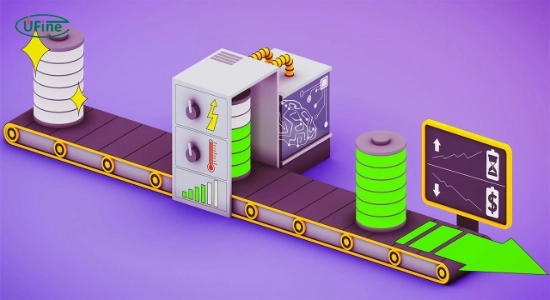
Key elements of battery warranty
Warranty Duration
- Consumer batteries: 1–5 years
- EV batteries: typically 8 years
- Industrial/ESS: up to 10+ years
Coverage Types
- Free Replacement Warranty
Full replacement during initial period - Prorated Warranty
Partial refund based on usage time - Performance Warranty (EV/ESS)
Guarantees minimum capacity (e.g., 70–80%)
Conditions & Limitations
- Proper installation required
- Misuse or overheating voids warranty
- Proof of purchase needed
📌 Industry reference: U.S. Department of Energy – EV Battery Basics
Part 3. Battery warranty vs battery lifespan: Key differences
| Aspect | Battery Lifespan | Battery Warranty |
|---|---|---|
| Definition | Actual usable life | Manufacturer guarantee |
| Focus | Performance & degradation | Defects & failure |
| Measurement | Cycles + years | Fixed time period |
| Coverage | Not applicable | Conditional |
| Predictability | Usage-dependent | Contract-defined |
Critical Insight
- A battery can outlast its warranty
- A battery can also degrade within warranty but still be “valid”
👉 Example:
An EV battery may retain only 75% capacity after 6 years.
It still works → not a warranty claim, but lifespan has declined.
Part 4. Common types of battery warranties
Understanding warranty structure is essential for procurement decisions.
- Free Replacement Warranty
Full cost coverage within early period - Prorated Warranty
Reduced compensation over time - Composite Warranty
Combines full + partial coverage
💡 Tip: Always check if warranty includes capacity retention clauses.
Part 5. What drives battery lifespan in real applications?
- Material Quality
High-grade cathodes (LFP, NMC) improve durability
Stable electrolytes reduce degradation
Advanced separators prevent internal short circuits - Manufacturing Quality
Uniform electrode coating
Controlled formation cycles
Automated production reduces defects - System-Level Design (Critical for B2B)
Battery Management System (BMS)
Thermal management system
Pack balancing and protection
👉 Related reading: smart battery and BMS communication
Part 6. How to extend battery lifespan (practical guidelines)
For real-world applications, these practices deliver measurable gains:
- Keep SOC between 20%–80%
- Avoid high-temperature environments (>35°C)
- Use certified chargers only
- Store at ~50% charge for long-term storage
- Perform periodic maintenance checks
Part 7. Understanding battery degradation
Battery aging is unavoidable. It happens in two ways:
- Cycle Aging
Caused by charge/discharge cycles
Typical Li-ion: 500–1500 cycles - Calendar Aging
Happens even without use
Driven by temperature and time
📌 Key takeaway:
Time alone reduces battery lifespan, even with zero usage.
Part 8. How manufacturers define warranty periods
Battery warranty periods are based on:
- Lab testing data (cycle + stress testing)
- Field failure rates
- Industry benchmarks
- Risk control and cost modeling
In B2B procurement, always request:
- Cycle life test reports
- Degradation curves
- Warranty claim conditions
Part 9. Battery lifespan and warranty: Application-based selection
| Scenario | Priority | Recommendation |
|---|---|---|
| EV / Mobility | Warranty + lifespan | Look for 8-year warranty + capacity guarantee |
| Solar Storage | Lifespan | Choose LFP with 4000+ cycles |
| UPS / Backup | Warranty | Focus on reliability and replacement terms |
| Industrial Equipment | Both | Balance lifecycle cost vs warranty coverage |
Part 10. Battery warranty and lifespan FAQs
What happens if a battery fails during the warranty period?
If failure is due to manufacturing defects, you can request repair or replacement. You must provide proof of purchase and meet usage conditions.
Does battery warranty cover capacity loss?
Usually no. Most warranties cover failure, not gradual degradation. Some EV batteries include capacity thresholds (e.g., 70%).
Which matters more: battery lifespan or warranty?
For long-term ROI, battery lifespan matters more. For risk control, battery warranty is critical. You need both.
Can a battery last longer than its warranty?
Yes. Many high-quality lithium batteries exceed their warranty period if used properly.
How can I check my battery warranty status?
Check purchase records or register your battery with the manufacturer. Some brands offer online warranty tracking.
Related Tags:

More Articles
Smart Watch Battery: Everything You Need to Know
Learn how smart watch batteries work, how long they last, what battery types are used, and how to choose the right battery for longer performance.
Is a 3000 mAh Lithium Battery Enough for Your Device?
Wondering what a 3000mAh battery means? Learn about its power, lifespan, types, and how to choose the best one for your device!
Understanding 5V Batteries: From Basics to Choosing the Right Charger
Discover everything about 5V batteries, from types and capacities to applications and charging options. Learn how to make the best choice for your power needs.
What Type of Battery Powers a Fitbit?
Discover the types of Fitbit batteries, their sizes, and how to extend their life. Learn about replacement options and maintenance tips for optimal performance.
Bloated LiPo Battery: Will It Explode?
Will a bloated LiPo battery explode? Discover the causes, risks, safety steps, and expert tips to avoid disaster and protect your gear. Must-read safety guide!