
- Key Takeaways
- Part 1. What is a 14250 battery?
- Part 2. Types of 14250 batteries (And how to choose)
- Part 3. 14250 Battery vs equivalent batteries
- Part 4. Can you use a 14250 rechargeable battery?
- Part 5. Typical applications of 14250 batteries
- Part 6. Why engineers choose 14250 batteries?
- Part 7. 14250 Battery safety and handling guidelines
- Part 8. FAQs about 14250 battery
The 14250 battery is a compact lithium cell built for long-life, low-maintenance applications. It is widely used in smart meters, wireless sensors, and industrial monitoring systems where reliability matters more than high current output.
If you are evaluating a 14250 rechargeable battery, checking a 14250 battery equivalent, or comparing a CR14250 battery, this guide gives you a clear engineering-focused answer.
Note: The 14250 battery (14×25mm) is optimized for low-drain, long-life applications, not high-power devices. Most variants are primary lithium (non-rechargeable), especially Li-SOCl₂ (3.6V).
Key Takeaways
- The 14250 battery (14×25mm) is optimized for low-drain, long-life applications, not high-power devices
- Most variants are primary lithium (non-rechargeable), especially Li-SOCl₂ (3.6V)
- A 14250 battery equivalent must match size + voltage + chemistry, not just dimensions
- The CR14250 battery (3V Li-MnO₂) differs from 3.6V Li-SOCl₂ versions in output and use case
- Best suited for IoT, metering, and backup systems where replacement is costly
- Not interchangeable with CR123A or AA batteries due to size and discharge differences
Part 1. What is a 14250 battery?
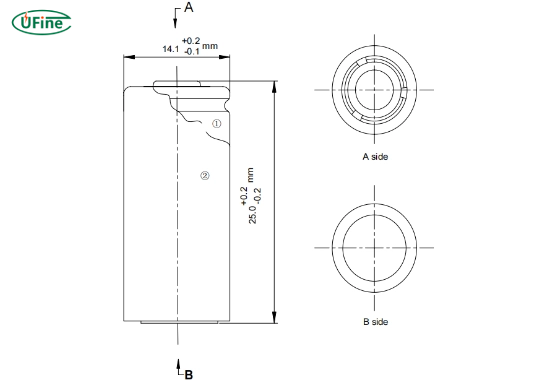
The 14250 battery is a cylindrical lithium cell measuring 14mm × 25mm. The name directly reflects its dimensions.
It typically comes in two voltage systems:
- 3V → Lithium Manganese Dioxide (Li-MnO₂) → often labeled as CR14250 battery
- 3.6V → Lithium Thionyl Chloride (Li-SOCl₂) → industrial-grade long-life cell
Unlike consumer batteries (AA, AAA), the 14250 is designed for:
- Low current draw
- Long standby operation
- High reliability over years
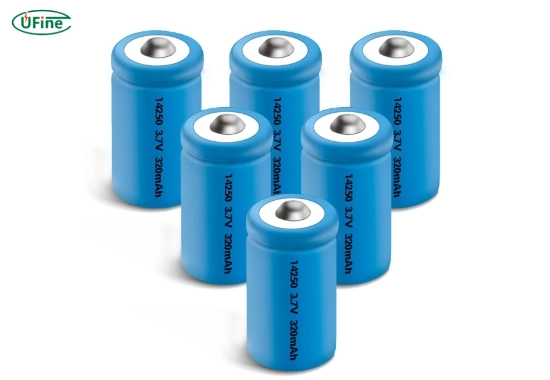
14250 Battery Specifications (Quick Reference)
| Parameter | Value |
|---|---|
| Size | 14mm × 25mm |
| Voltage | 3V / 3.6V |
| Capacity | 800–1200 mAh |
| Chemistry | Li-MnO₂ / Li-SOCl₂ |
| Rechargeable | No (standard types) |
| Shelf Life | 5–10 years (up to 15 for Li-SOCl₂) |
| Self-Discharge | <1% per year |
| Operating Temp | -40°C to +85°C |
👉 For lithium battery standards and transport guidelines, refer to the IEC (International Electrotechnical Commission) and UN 38.3 lithium battery regulations.
Part 2. Types of 14250 batteries (And how to choose)
1. Li-MnO₂ (CR14250 Battery – 3V)
- Stable voltage output
- Moderate discharge capability
- Lower energy density than Li-SOCl₂
Typical uses:
- Cameras
- Sensors
- Portable electronics
2. Li-SOCl₂ (3.6V Industrial Type)
- Very low self-discharge
- Highest energy density
- Designed for 10+ year deployments
Typical uses:
- Smart meters
- IoT devices
- Remote monitoring systems
Note: In most industrial cases, Li-SOCl₂ is the preferred choice due to lifespan and reliability.
Part 3. 14250 Battery vs equivalent batteries
When users search for a 14250 battery equivalent, they often mean “same size replacement.” However, true equivalence requires matching three parameters:
- Size (14×25mm)
- Voltage (3V or 3.6V)
- Chemistry (affects discharge curve)
14250 Battery Vs Equivalent Batteries Common Comparisons
| Battery Type | Size | Voltage | Key Difference |
|---|---|---|---|
| 14250 | 14×25mm | 3V / 3.6V | Industrial, long-life |
| CR123A | 17×34.5mm | 3V | Larger, higher current |
| CR2 | 15.6×27mm | 3V | Consumer electronics |
| AA Lithium | 14×50mm | 1.5V | Not compatible |
Note: There is no direct drop-in equivalent for a 14250 battery in most cases.
Part 4. Can you use a 14250 rechargeable battery?
Short answer: Rarely recommended.
- Standard 14250 cells are primary (non-rechargeable)
- Rechargeable versions (Li-ion 3.7V) exist but:
- Different voltage profile
- Safety risks in non-compatible devices
- Shorter lifespan in standby applications
👉 If rechargeability is required, consider reading: Lithium-ion vs LiFePO4 Battery Guide
Part 5. Typical applications of 14250 batteries
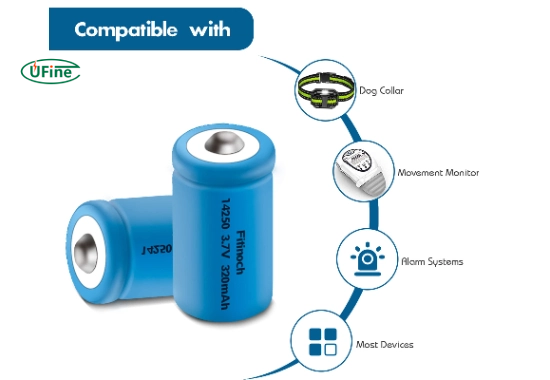
The 14250 battery is widely used where long service life and reliability outweigh power output.
- Smart Metering & Iot
- Water, gas, electricity meters
- Wireless sensor networks
- LoRa / NB-IoT devices
- Security Systems
- Motion detectors
- Alarm systems
- Backup power modules
- Medical Devices
- Portable monitoring equipment
- Diagnostic tools
- Emergency kits
- Industrial Monitoring
- Oil & gas sensors
- Environmental monitoring stations
- Asset tracking systems
Part 6. Why engineers choose 14250 batteries?
- Ultra-Low Self-Discharge
- Ideal for devices that must operate 5–10 years without maintenance
- Stable Voltage Output
- Critical for sensors and communication modules
- Wide Temperature Range
- Reliable in extreme outdoor environments
- Compact Form Factor
- Fits space-constrained industrial designs
Part 7. 14250 Battery safety and handling guidelines
- Do not recharge standard 14250 batteries
- Avoid short circuits and physical damage
- Store at cool, dry temperatures
- Do not mix old and new batteries
- Dispose according to local lithium battery regulations
Part 8. FAQs about 14250 battery
What is a CR14250 battery?
A CR14250 battery is a 3V lithium manganese dioxide version of the 14250 format, typically used in sensors and compact devices.
Is there a true 14250 battery equivalent?
No exact equivalent exists. You must match size, voltage, and chemistry for safe replacement.
How long does a 14250 battery last?
In low-drain applications, it can last 5–10 years, depending on usage and environment.
Can I replace a CR123A with a 14250 battery?
No. CR123A is larger and designed for higher current. Substitution may cause device failure.
Are all 14250 batteries non-rechargeable?
Most are. Rechargeable variants exist but are not compatible with devices designed for primary lithium cells.
Related Tags:

More Articles

Buck vs. Boost vs. Buck-Boost Converter: Which Is Best for Battery?
Not sure which converter your battery-powered device needs? Compare Buck, Boost, and Buck-Boost designs and discover what affects voltage stability and runtime.
How to Match 18650 Cells for a Reliable Battery Pack?
Building an 18650 battery pack? Learn how to compare cell capacity, voltage, and internal resistance to avoid mismatches and improve reliability.
Why Do 18650 Battery Packs Get Hot During Discharge?
Is your 18650 battery pack overheating under load? Learn what causes excess heat, how to spot dangerous symptoms, and what to do next.
18650 Battery BMS: How to Get the Specs Right
Learn how to choose a BMS for an 18650 battery pack. Compare voltage, current ratings, protection features, and balancing before you buy.
Why Does My Ring Camera Battery Drain So Fast or Stop Charging?
Is your Ring camera battery draining fast or not charging? Discover common causes, practical fixes, and when to replace the battery.


