- Part 1. What is a group 65 battery?
- Part 2. Group 65 vs Group 65N vs AGM-65: What’s the difference?
- Part 3. Battery types
- Part 4. Can Group 65 lithium batteries work in cold weather?
- Part 5. Lifespan of group 65 batteries
- Part 6. Price comparison
- Part 7. Best group 65 batteries (2026 edition)
- Part 8. Buying guide: How to choose the right group 65 battery
- Part 9. FAQs
If you drive a truck, SUV, or heavy-duty vehicle, having a powerful and long-lasting battery is crucial. Among all automotive battery sizes, the Group 65 battery stands out for its high cold cranking amps, durability, and reliability under demanding conditions.
In this complete guide, we’ll cover everything you need to know about Group 65 batteries — their size, voltage, types, and lifespan — plus a full comparison of the best Group 65 batteries in 2026, including price, performance, and brand recommendations.
Quick Specs: Group 65 Battery At a Glance
| Feature | Standard Specification |
| BCI Group Size | Group 65 |
| Dimensions (L x W x H) | 12.06″ x 7.5″ x 7.56″ (306 x 190 x 192 mm) |
| Voltage | 12 Volts |
| Average CCA | 650A – 950A (Up to 1000A+ for Lithium) |
| Common Applications | Ford, Dodge, Jeep, Lincoln Trucks & SUVs |
Part 1. What is a group 65 battery?
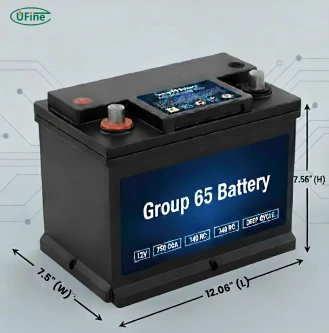
A Group 65 battery refers to a specific size classification standardized by the Battery Council International (BCI). The “65” indicates the physical dimensions of the battery case — approximately 12.06″ (L) × 7.5″ (W) × 7.56″ (H) — not its voltage or capacity.
You may also encounter the “Group 65N” label, where “N” stands for North, indicating a model with higher Cold Cranking Amps (CCA) designed for freezing climates.
This group size is mainly designed for:
- Trucks and SUVs
- Diesel vehicles
- Heavy-duty and off-road equipment
1 Voltage and capacity
Like most automotive batteries, Group 65 batteries deliver 12 volts — enough to start large engines and power high-demand electronics such as infotainment systems, winches, or towing equipment.
Typical capacity ranges from 70Ah to 90Ah, ensuring long-lasting power for vehicles with multiple electrical components. For off-road or outdoor users who run lights or accessories when the engine is off, this extra capacity is a big advantage.
2 Advantages
✅ High Cold Cranking Amps (CCA): Reliable starting power in cold weather.
✅ Durable Construction: Built to handle vibrations and shocks from heavy-duty use.
✅ Long Lifespan: AGM and lithium batteries can last years longer than conventional lead-acid models.
3 Disadvantages
⚠️ Heavier weight than smaller battery groups.
⚠️ Higher cost for AGM or lithium models.
Still, for drivers who need dependable performance in harsh environments, Group 65 batteries are one of the best investments available.
Part 2. Group 65 vs Group 65N vs AGM-65: What’s the difference?
Although “Group 65” is a standardized BCI battery size, you may also come across terms like Group 65N or AGM-65, which often cause confusion.
Group 65 refers strictly to the battery’s physical dimensions and terminal layout. As long as a battery meets the BCI Group 65 size standard, it will physically fit vehicles designed for this group.
Group 65N is not an official BCI classification. In most cases, it is a manufacturer-specific label indicating a Group 65 battery with a slightly modified terminal orientation or enhanced internal design. Fitment is usually the same, but terminal position should always be verified.
AGM-65 does not describe size at all—it describes battery chemistry. An AGM-65 battery is simply a Group 65 battery built using AGM (Absorbent Glass Mat) technology, offering better vibration resistance, higher CCA, and maintenance-free operation.
Key takeaway:
- Group 65 = size standard
- Group 65N = manufacturer variation (check terminals)
- AGM-65 = chemistry, not size
Group 65 battery vs other common battery sizes
Battery group numbers help users quickly identify compatible replacement batteries. However, different group sizes are designed for different vehicle requirements.
| Battery group | Typical applications | Size comparison |
|---|---|---|
| Group 35 | Compact cars, sedans | Smaller than Group 65 |
| Group 48 (H6) | European vehicles, luxury cars | Medium size |
| Group 65 | SUVs, trucks, heavy-duty vehicles | Larger capacity |
| Group 78 | Trucks and performance vehicles | Similar size with different terminal layout |
Part 3. Battery types
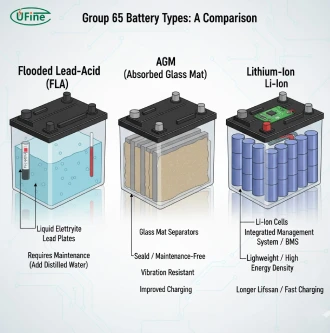
Group 65 batteries come in three main types. Each has unique benefits depending on your needs and budget.
| Type | Description | Pros | Cons |
|---|---|---|---|
| Flooded Lead-Acid | Traditional design with liquid electrolyte. | Low cost, widely available. | Requires maintenance, risk of spills. |
| AGM (Absorbent Glass Mat) | Electrolyte absorbed in fiberglass mats. | Maintenance-free, vibration-resistant, long life. | More expensive than flooded. |
| Lithium-Ion | Advanced chemistry offering lightweight and high energy density. | Longest lifespan, fast charging, lightweight. | Highest upfront cost. |
AGM vs Lithium vs Lead-Acid — Which Is Best?
- For budget buyers, flooded lead-acid is affordable but needs regular maintenance.
- For daily drivers and trucks, AGM offers the best balance of performance and durability.
- For maximum lifespan and minimal weight, lithium Group 65 batteries are the ultimate choice.
AGM VS Lithium VS Lead-Acid Battery: Comprehensive Comparison
Part 4. Can Group 65 lithium batteries work in cold weather?
Cold temperature performance is one of the most common concerns when switching from AGM to lithium.
Like all batteries, lithium batteries are affected by low temperatures. Cold conditions can increase internal resistance and reduce available power because chemical reactions inside the battery slow down.
However, modern lithium Group 65 batteries can be designed with solutions to improve cold-weather performance.
Low-temperature charging protection
One important difference between AGM and lithium batteries is charging behavior in freezing conditions.
Charging lithium batteries at very low temperatures without protection may cause lithium plating and long-term battery damage.
A quality lithium battery may include:
- Low-temperature charging cutoff
- Temperature sensors
- Smart BMS control
Self-heating lithium batteries
For extreme environments, some lithium batteries include built-in heating elements.
These systems allow the battery to warm itself before charging, improving winter reliability.
Cold-weather tips for Group 65 lithium batteries
To improve performance in cold climates:
- Choose a lithium battery with low-temperature protection
- Install the battery in a protected location when possible
- Avoid charging a frozen battery
- Select a battery designed for your climate
For comparison, cold weather also affects traditional batteries. Lower temperatures increase battery resistance and reduce starting performance, which is why CCA ratings are important for winter vehicle operation.
Part 5. Lifespan of group 65 batteries
Battery life varies depending on type and maintenance level:
| Battery Type | Average Lifespan |
|---|---|
| Flooded Lead-Acid | 3–5 years |
| AGM | 5–7 years |
| Lithium-Ion | 8–10 years+ |
To maximize lifespan:
- Keep terminals clean.
- Avoid deep discharges.
- Store in a cool, dry environment.
Why Lithium is the Best Group 65 Investment in 2026
In 2026, the technical superiority of LiFePO4 chemistry is undeniable. According to the U.S. Department of Energy, lithium-ion batteries offer significant advantages in energy density and cycle life compared to traditional lead-acid counterparts.For users in
2026, the Lithium Group 65 battery (like the Ufine series) offers three critical upgrades:
- Smart BMS: Built-in protection against overcharging and short circuits.
- Cold-Start Tech: Modern lithium batteries now include internal heating to ensure starts in sub-zero temps.
- 100% Depth of Discharge: Unlike AGM, you can use the entire capacity without damaging the battery.
Ufine Battery can customize capacity, voltage, and integrated BMS features for our Group 65 lithium batteries to meet your exact specifications—whether you need specialized power for prototype testing or high-volume production for vehicle fleets.
Find A Solution NowPart 6. Price comparison
Pricing varies depending on battery chemistry and brand:
| Type | Typical Price Range | Lifespan | Maintenance |
|---|---|---|---|
| Flooded Lead-Acid | $100–$150 | 3–5 years | Regular water checks |
| AGM | $150–$250 | 5–7 years | Maintenance-free |
| Lithium-Ion | $300–$500+ | 8–10 years | Maintenance-free |
Though lithium batteries have a higher upfront cost, they offer the lowest lifetime cost due to their long service life and stable performance.
Part 7. Best group 65 batteries (2026 edition)
Here are the most recommended Group 65 batteries on the market in 2026, based on performance, reliability, and customer feedback.
| Brand & Model | Type | CCA | Capacity (Ah) | Warranty | Price | Best For |
|---|---|---|---|---|---|---|
| Odyssey 65-PC1750T | AGM | 950 | 74 | 3–4 yrs | ~$300 | Heavy-duty trucks |
| Optima RedTop 8004-003 | AGM | 770 | 65 | 3 yrs | ~$250 | Cold-weather reliability |
| DieHard Gold 65-2 | Lead-acid | 850 | 75 | 2 yrs | ~$160 | Budget-friendly vehicles |
| NorthStar NSB-AGM65 | AGM | 930 | 70 | 4 yrs | ~$320 | Long lifespan & vibration resistance |
| Ufine Lithium 12V 65 | Lithium-ion | 1000+ | 85 | 5–10 yrs | ~$400+ | Lightweight, high-performance use |
Each model offers excellent durability and power output for large engines, making them ideal for trucks, SUVs, and off-road vehicles.
Part 8. Buying guide: How to choose the right group 65 battery
When deciding which Group 65 battery to buy, consider the following:
1 Vehicle Type:
- Diesel trucks or off-road vehicles → AGM or Lithium recommended.
- Standard cars or older SUVs → Flooded lead-acid may suffice.
2 Climate:
- Cold regions → High CCA rating (≥850).
- Hot regions → AGM or lithium (resists heat degradation).
3 Usage Frequency:
- Daily driving → AGM is the best all-round choice.
- Occasional use or long-term storage → Lithium holds charge longer.
4 Budget:
- Short-term savings → Flooded type.
- Long-term investment → Lithium or AGM.
Part 9. FAQs
1. How many years does a Group 65 AGM battery typically last?
A Group 65 AGM battery typically lasts around 3–5 years under normal operating conditions. Its lifespan depends on factors such as driving frequency, temperature, charging system performance, and depth of discharge. Frequent deep discharge cycles may reduce its service life.
2. Can a Group 65 battery be used as a deep-cycle battery?
Some Group 65 batteries can be used for limited deep-cycle applications, especially lithium and AGM versions. However, standard starting batteries are mainly designed for short bursts of high current rather than continuous power delivery. For applications like solar storage or RV use, choose a battery specifically designed for deep cycling.
3. What is the difference between a Group 65 starting battery and a deep-cycle battery?
A Group 65 starting battery is designed to deliver high current quickly to start engines. A deep-cycle battery is designed to provide steady power over a longer period and withstand repeated discharge cycles. Lithium Group 65 batteries can combine high energy density with better cycling performance.
4. Are all Group 65 batteries interchangeable?
No. Even if two batteries share the same Group 65 classification, they may differ in terminal layout, capacity, discharge performance, and charging requirements. Always verify the complete specifications before replacement.
Related Tags:

More Articles
Dead Battery or Device Failure? How to Find the Cause
Think your device is broken? Learn how to tell if the problem comes from battery aging or hardware failure before replacing your electronics.
Why iPhone Duo Uses Two Batteries: The Engineering Behind Foldable Phone Power
Why do foldable phones need two batteries? Explore the engineering challenges behind iPhone Duo’s dual-battery architecture and future battery trends.
Solid-State Batteries: 3 Myths You Need to Know
Solid-state batteries promise safer EVs and longer range, but the reality is more complex. Discover the challenges behind this next-gen technology.
Battery Capacity vs Discharge Rate: The Choice Engineers Face
Higher capacity or higher discharge rate? Learn how to choose the right LiPo battery for longer runtime, stable power output, and better device performance.
Battery Cable Size Guide: Choose the Right Wire Fast
Not sure what battery cable size you need? Learn how to select the right wire gauge, terminal size, and cable for safer, more efficient battery systems.