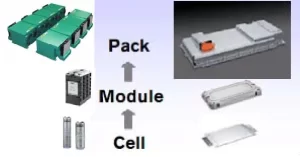
Understanding the differences between a battery cell, battery module, and battery pack is fundamental for engineers, system integrators, and B2B buyers involved in electric vehicles (EVs), energy storage systems (ESS), and industrial power solutions. These three levels represent different stages of battery system integration—each with distinct functions, design considerations, and decision criteria.
This guide explains how cells, modules, control electronics, and packs work together, and how to choose the right level for your application.
Key Takeaways (Engineering Summary)
- A battery cell is the smallest electrochemical unit that stores energy; it defines chemistry, voltage, and basic performance limits.
- A battery module groups multiple cells to improve scalability, thermal control, and serviceability in mid-to-large systems.
- A battery pack is a complete power system integrating cells/modules, BMS, protection, and enclosure for end-use deployment.
- A battery control module (BCM) handles monitoring and balancing at the module level and typically operates under a pack-level BMS.
- Cell-to-pack (CTP) designs reduce parts and cost but increase thermal and maintenance complexity.
- For B2B projects, selection should be driven by voltage, capacity, safety compliance, lifecycle cost, and system integration needs—not cell specs alone.
Part 1. Battery cell: functions, design, and applications
1 What is a battery cell?
A battery cell is the most basic energy storage unit capable of converting chemical energy into electrical energy. Each cell contains three core components:
- Anode (negative electrode)
- Cathode (positive electrode)
- Electrolyte
During charge and discharge, lithium ions move between electrodes through the electrolyte, generating usable current. All higher-level battery systems—modules and packs—are built on this fundamental unit.
From an engineering perspective, the battery cell defines:
- Nominal voltage
- Energy density
- Cycle life
- Safety characteristics
2 Battery cell design considerations
-
Cell Size
Cell size directly affects capacity and current capability. Small-format cells are common in consumer electronics, while large-format cells are designed for EVs and stationary energy storage.
-
Cell Shape
- Cylindrical (e.g., 18650, 21700): robust, standardized, good thermal behavior
- Prismatic: space-efficient, widely used in EV battery modules
- Pouch: lightweight and flexible, but mechanically sensitive
-
Internal Chemistry
Cell chemistry determines performance trade-offs:
- Lithium-ion (NMC/NCA): high energy density
- LiFePO₄ (LFP): long cycle life and thermal stability
- NiMH / Lead-acid: legacy or niche use cases
-
Electrode Materials
Materials such as LFP, NMC, and LCO influence safety, voltage plateau, and degradation behavior—critical factors in industrial procurement.
-
Packaging & Safety
Cells are sealed in metal cans or laminated pouches to prevent leakage, moisture ingress, and mechanical damage. Poor cell-level packaging increases thermal runaway risk at higher integration levels.
3 Typical battery cell applications
- Consumer electronics
- EV traction systems (as building blocks)
- Energy storage arrays
- Medical and industrial backup devices
- Portable power products
Part 2. Battery control module (BCM): functions and role
1 What is a battery control module?
A Battery Control Module (BCM) is an electronic control unit responsible for monitoring and managing a group of battery cells, usually at the module level. It acts as an intermediary between individual cells and the pack-level Battery Management System (BMS).
Core functions include:
- Cell voltage and temperature monitoring
- Active or passive cell balancing
- Overcharge / over-discharge protection
- Data communication with higher-level controllers
In large systems, multiple BCMs report to a centralized BMS.
Related reading: 👉 What Is a Battery Management System (BMS)?
2 Battery control module vs battery management system
| Aspect | Battery Control Module (BCM) | Battery Management System (BMS) |
|---|---|---|
| Control Scope | One module or cell group | Entire battery pack |
| Main Function | Monitoring & balancing | System-level safety & logic |
| Hardware Level | Distributed | Centralized |
| Typical Use | EV modules, ESS racks | EV packs, industrial ESS |
3 Common BCM issues in real applications
- Uneven cell voltages → balancing circuit failure
- Overheating alarms → sensor or cooling interface issues
- Charging interruptions → communication errors with BMS
- Error codes in EVs/ESS → firmware mismatch or calibration drift
BCMs are replaceable but often require system-level reconfiguration.
Part 3. Battery pack: functions, design, and applications
1 What is a battery pack?
A battery pack is the highest integration level of a battery system. It combines:
- Battery cells or modules
- Battery management system (BMS)
- Protection devices
- Thermal management components
- Mechanical enclosure and connectors
A battery pack is a ready-to-use power unit, engineered for a specific voltage, capacity, and operating environment.
Example: 👉 Custom Lithium-Ion Battery Pack Solutions
2 Battery pack design logic
-
Cell / Module Configuration
- Series connections → increase voltage
- Parallel connections → increase capacity
- Uniform cell matching is mandatory for safety
-
Mechanical & Thermal Design
- Aluminum or steel housings
- Air or liquid cooling paths
- Shock, vibration, and ingress protection (IP-rated)
-
Electrical & Safety Systems
- BMS integration
- Fuses, relays, and disconnects
- Compliance with UL, IEC, UN38.3 standards (e.g., IEC 62619 for industrial lithium batteries)
-
Validation & Testing
- Thermal cycling
- Electrical load testing
- Vibration and drop testing
- Certification for transport and deployment
3 Battery pack applications
- Electric vehicles (traction batteries)
- Stationary energy storage systems
- Industrial equipment
- Robotics and AGVs
- Telecom and backup power systems
Part 4. Battery cell vs battery module vs battery pack: key differences
- Battery Cell: The smallest functional unit. Defines chemistry, voltage, and energy density but cannot be used alone in most industrial applications.
- Battery Module: A scalable intermediate unit composed of multiple cells plus basic monitoring and cooling. Improves manufacturability and serviceability.
- Battery Pack: A complete energy system integrating cells/modules, electronics, thermal control, and enclosure—ready for real-world use.
Part 5. FAQs
What is the difference between a battery module and a battery pack?
A battery module groups cells, while a battery pack integrates one or more modules plus BMS, protection, cooling, and housing.
What is a cell in a battery pack?
A cell is the fundamental electrochemical unit inside the pack that stores and releases energy.
What is a modular battery pack?
A modular battery pack uses standardized modules, allowing easier scaling, maintenance, and replacement.
What is cell-to-pack vs cell-to-module?
Cell-to-pack eliminates modules to reduce cost and weight, while cell-to-module improves thermal control and maintainability.
What are the symptoms of a bad battery control module?
Common symptoms include voltage imbalance, abnormal heating, charging errors, and system fault codes.
Related Tags:

More Articles

Battery Calibration: Why Is Your Battery % Wrong?
Is your battery percentage inaccurate? Learn how battery calibration works, when you need it, and how to fix unexpected battery drops.
Battery Calibration Guide: Fix SOC Errors in Lithium Systems
SOC accuracy problems can reduce device reliability. Learn how battery calibration, BMS, and fuel gauge optimization improve lithium battery performance.
How Internal Resistance Limits LiPo Battery Performance
Your LiPo Battery may have enough capacity but still fail under load. Discover how Internal Resistance causes voltage sag, heat, and power loss.
What Engineers Can Learn From a Discharge Curve for LithiumBattery?
What can a discharge curve for lithium ion battery tell engineers? Learn how voltage, C-rate, temperature, and capacity affect real-world performance.