
- Key Takeaways
- Part 1. What is a smart battery?
- Part 2. How does a smart battery work?
- Part 3. Smart battery vs traditional battery
- Part 4. Advantages of smart batteries
- Part 5. Applications of smart batteries
- Part 6. How smart batteries communicate with chargers
- Part 7. How to choose the right smart battery
- Part 8. Common misconceptions about smart batteries
- Part 9. FAQs about smart batteries
In modern electronics and energy systems, batteries are no longer passive components. Devices now require real-time power management, safety control, and data feedback. This is where smart batteries come in.
A smart battery adds intelligence to energy storage. It improves safety, extends lifespan, and enables better system control. It is widely used in laptops, EVs, medical devices, and energy storage systems.
Key Takeaways
- A smart battery is a rechargeable battery with an integrated Battery Management System (BMS) and communication interface.
- It provides real-time monitoring of voltage, current, temperature, and state of charge (SOC).
- Smart batteries improve safety by preventing overcharge, overheating, and short circuits.
- They offer longer lifespan and better performance through optimized charge/discharge control.
- Communication protocols like SMBus and I²C allow interaction with chargers and host devices.
- Smart batteries are critical in high-reliability applications such as EVs, medical devices, and renewable energy systems.
Part 1. What is a smart battery?
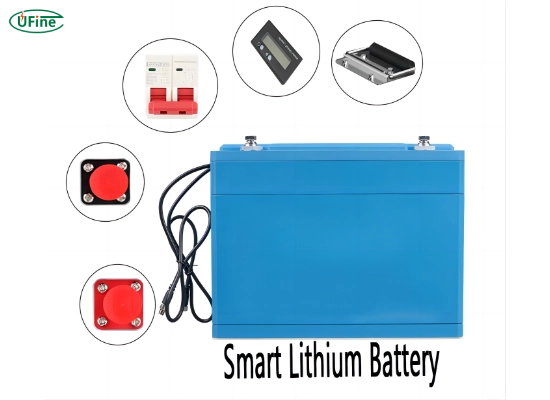
A smart battery is a rechargeable battery pack with a built-in Battery Management System (BMS) and communication capability.
Unlike traditional batteries, it can:
- Monitor its internal condition
- Control charging and discharging
- Communicate with external systems (device or charger)
👉 In simple terms:
A smart battery = battery + data + control
Key components of a smart battery
- Battery Cells
Store electrical energy (e.g., Li-ion, LiFePO4) - Battery Management System (BMS)
The core controller that manages safety and performance
👉 Learn more: What is a Battery Management System? - Communication Interface
Enables data exchange via protocols like: SMBus, I²C, PMBus

Part 2. How does a smart battery work?
A smart battery works through continuous monitoring and control by the BMS.
Core functions
- Measure: Voltage, Current, Temperature
- Calculate: State of Charge (SOC), State of Health (SOH)
- Control: Charging speed, Discharge limits, Thermal protection
The system adjusts behavior in real time. This prevents damage and improves efficiency.
Part 3. Smart battery vs traditional battery
| Feature | Smart Battery | Traditional Battery |
|---|---|---|
| Monitoring | Real-time data (SOC, SOH) | Basic or none |
| Safety | Active protection (BMS) | Passive protection |
| Lifespan | Longer (optimized cycles) | Shorter |
| Communication | Yes (SMBus, I²C) | No |
| User Feedback | Detailed diagnostics | Limited |
👉 Conclusion:
Smart batteries are essential for modern systems, especially where safety and reliability matter.
Part 4. Advantages of smart batteries
- Enhanced Safety
Prevents overcharge, over-discharge, and overheating
Reduces risk of thermal runaway
Meets safety standards (e.g., UL, IEC) - Longer Lifespan
Optimized charge cycles
Balanced cells reduce degradation - Better Performance
Stable output under varying loads
Adaptive charging improves efficiency - Real-Time Visibility
Accurate battery status
Predictive maintenance capability
Part 5. Applications of smart batteries
Smart batteries are widely used across industries:
- Consumer Electronics
Smartphones, laptops, tablets
Require compact size and precise power control - Electric Vehicles (EVs)
Critical for safety and range optimization
Advanced BMS ensures thermal and voltage control - Renewable Energy Storage
Solar and wind systems
Improve storage efficiency and grid stability - Medical Devices
High reliability required
Continuous monitoring ensures patient safety
Part 6. How smart batteries communicate with chargers
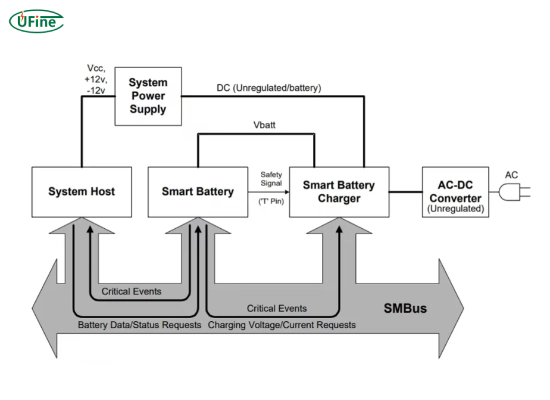
Smart batteries exchange data with chargers to optimize charging.
1 Communication protocols
- SMBus (System Management Bus)
Industry standard for battery communication - I²C (Inter-Integrated Circuit)
Simple and efficient for embedded systems
👉 For detailed technical specifications, refer to the official SMBus protocol specification.
2 Charging control mechanisms
- Voltage-based control → prevents overvoltage
- Temperature-based control → avoids overheating
- Time-based control → limits overcharging
- NDV (Negative Delta V) → detects full charge
3 Charging workflow
- Detect battery type
- Select charging mode
- Monitor in real time
- Adjust current/voltage
- Stop or switch to trickle charging
Part 7. How to choose the right smart battery
When selecting a smart battery, focus on engineering parameters:
- Compatibility
Match voltage and connector
Ensure protocol compatibility - Capacity (Ah / mAh)
Higher capacity = longer runtime
Avoid oversizing (cost + weight) - Voltage
Must match system design
Wrong voltage can damage devices - Charge/Discharge Current
Affects power output and charging speed - Cycle Life
Indicates long-term cost
LiFePO4 usually offers longer cycles - Safety Features
Overcharge protection
Short-circuit protection
Thermal management - Certification
UL, CE, IEC compliance
Part 8. Common misconceptions about smart batteries
- Myth 1: Smart batteries are too expensive
Reality: Lower total cost due to longer lifespan and fewer failures - Myth 2: Only used in high-end devices
Reality: Now common in everyday electronics - Myth 3: No maintenance needed
Reality: Proper usage still improves lifespan - Myth 4: Any charger works
Reality: Must support compatible protocols - Myth 5: Memory effect still applies
Reality: Modern lithium batteries do not have memory effect
Part 9. FAQs about smart batteries
What is a smart battery?
A smart battery is a rechargeable battery with a built-in BMS that monitors and controls performance while communicating with devices.
What are smart batteries used for?
They are used in laptops, EVs, solar storage systems, and medical devices where safety and performance are critical.
How do smart batteries improve safety?
They prevent overcharge, overheating, and short circuits using real-time monitoring and control.
Are smart batteries worth it?
Yes. They offer longer lifespan, better efficiency, and lower long-term cost.
Can I replace a regular battery with a smart battery?
Only if the system supports it. Check voltage, interface, and communication compatibility first.
Related Tags:

More Articles

Buck vs. Boost vs. Buck-Boost Converter: Which Is Best for Battery?
Not sure which converter your battery-powered device needs? Compare Buck, Boost, and Buck-Boost designs and discover what affects voltage stability and runtime.
How to Match 18650 Cells for a Reliable Battery Pack?
Building an 18650 battery pack? Learn how to compare cell capacity, voltage, and internal resistance to avoid mismatches and improve reliability.
Why Do 18650 Battery Packs Get Hot During Discharge?
Is your 18650 battery pack overheating under load? Learn what causes excess heat, how to spot dangerous symptoms, and what to do next.
18650 Battery BMS: How to Get the Specs Right
Learn how to choose a BMS for an 18650 battery pack. Compare voltage, current ratings, protection features, and balancing before you buy.
Why Does My Ring Camera Battery Drain So Fast or Stop Charging?
Is your Ring camera battery draining fast or not charging? Discover common causes, practical fixes, and when to replace the battery.


