- Key Takeaways
- Part 1. Lihv battery definition and working principle
- Part 2. Lihv voltage range (including lihv minimum voltage)
- Part 3. Core characteristics of lihv batteries
- Part 4. Lihv vs lipo: what is the difference?
- Part 5. Lihv battery applications
- Part 6. When should you choose lihv instead of lipo?
- Part 7. FAQs about lihv battery
A LiHv battery (Lithium High Voltage battery) is a lithium-ion polymer battery designed to charge to a higher maximum voltage (4.35V per cell) compared to standard LiPo batteries (4.20V per cell).
This higher charge ceiling increases energy density and runtime without increasing battery size — making LiHv cells popular in drones, RC vehicles, robotics, and other high-performance applications.
Key Takeaways
- LiHv voltage range: typically 3.0V–4.35V per cell, with 3.4–3.5V as common cutoff under load.
- Higher energy density: Up to 5–10% more usable capacity than standard LiPo at the same size.
- LiHv vs LiPo difference: 4.35V max charge vs 4.20V; requires compatible charger and ESC.
- LiHv minimum voltage: Avoid discharging below 3.0V per cell to protect cycle life.
- Best for high-power devices: Ideal for drones, racing RC, and lightweight robotics where voltage stability matters.
Part 1. Lihv battery definition and working principle
A LiHv battery is essentially an optimized lithium polymer (LiPo) cell with a modified cathode formulation that allows safe charging up to 4.35V per cell instead of the conventional 4.20V.
Standard Voltage Comparison
| Battery Type | Nominal Voltage | Max Charge Voltage | Typical Cutoff |
|---|---|---|---|
| LiPo | 3.7V | 4.20V | 3.3–3.5V |
| LiHv | 3.8V | 4.35V | 3.4–3.5V |
Because energy stored is proportional to voltage × capacity, increasing the upper voltage limit increases total usable energy without increasing battery weight.
For general lithium-ion charging standards, refer to the guidelines from the International Electrotechnical Commission.
Part 2. Lihv voltage range (including lihv minimum voltage)
One of the most searched topics is “LiHv voltage range” and “LiHv minimum voltage.” Here’s what engineers need to know:
1 Lihv battery voltage range
- Fully charged: 4.35V per cell
- Nominal voltage: ~3.8V per cell
- Recommended cutoff voltage: 3.4–3.5V under load
- Absolute minimum voltage: 3.0V (avoid going lower)
Discharging below 3.0V can:
- Cause lithium plating
- Reduce cycle life
- Increase internal resistance
- Create safety risks
For multi-cell packs (2S, 3S, 4S, etc.), multiply per-cell voltage accordingly.
Example: 4S LiHv fully charged = 4 × 4.35V = 17.4V
Part 3. Core characteristics of lihv batteries
1 Higher energy density
Charging to 4.35V provides ~5–10% more runtime compared to same-capacity LiPo packs.
2 Higher operating voltage
Higher voltage translates to:
- Increased motor RPM (drones/RC)
- Improved power response
- Reduced voltage sag under load
3 Stable power delivery
LiHv batteries typically show:
- Lower voltage sag
- More consistent throttle response
- Better sustained discharge in high-C applications
4 High discharge rates
Commonly available in high C-ratings (50C–120C), suitable for:
- FPV racing drones
- RC racing cars
- High-load robotics
5 Fast charging (with proper charger)
LiHv batteries require a charger that supports 4.35V LiHv mode. Charging them in standard 4.20V mode simply reduces capacity utilization — but overcharging a standard LiPo to 4.35V is dangerous.
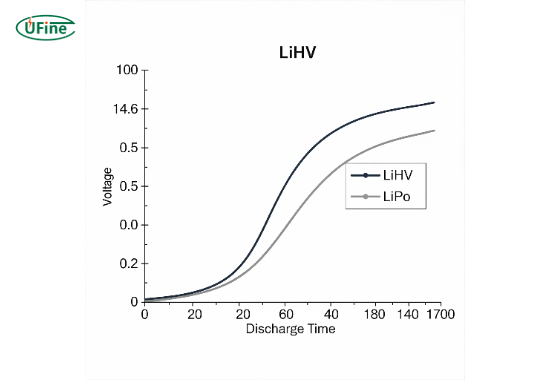
Part 4. Lihv vs lipo: what is the difference?
1 Voltage
- LiPo: 4.20V max per cell
- LiHv: 4.35V max per cell
This 0.15V difference may seem small but results in noticeable performance gains.
2 Energy density
LiHv packs typically deliver:
- 5–10% longer flight time in drones
- Higher peak power in racing applications
3 Compatibility
Not all devices designed for LiPo support LiHv.
Check:
- ESC voltage rating
- BMS upper voltage limit
- Charger LiHv compatibility
4 Safety
LiHv cells operate closer to the electrochemical stability limit. Therefore:
- Use LiHv-compatible chargers
- Avoid overcharging
- Store at 3.8V per cell
For broader lithium battery safety recommendations, see guidance from UL Solutions.
Part 5. Lihv battery applications
LiHv batteries are chosen when weight, voltage stability, and power output are critical.
1 Drones & UAVs
- Longer flight times
- Higher RPM motors
- Improved responsiveness
2 RC racing vehicles
- Higher top speed
- Better throttle control
- Competitive performance edge
3 Robotics
- Stable voltage for control systems
- High discharge capability for actuators
4 Portable high-performance devices
- Compact but high-energy designs
- Weight-sensitive electronics
If you require customized high-voltage lithium packs for drones or robotics, see our related guide on: 👉 Custom Lithium Polymer Battery
For high-rate lithium battery selection: 👉 High Discharge LiPo Battery
Part 6. When should you choose lihv instead of lipo?
Choose LiHv battery if:
- Your ESC and charger support 4.35V
- You need maximum runtime in same size pack
- You compete in racing or high-performance environments
- Slightly shorter cycle life is acceptable for higher output
Choose standard LiPo if:
- Device voltage limit is strict
- Cost sensitivity is high
- Long cycle life is more important than peak output
Part 7. FAQs about lihv battery
What is the LiHv voltage range?
The LiHv voltage range is typically 3.0V to 4.35V per cell, with nominal voltage around 3.8V.
What is the LiHv minimum voltage?
The recommended LiHv minimum voltage is 3.4–3.5V under load, with an absolute minimum of 3.0V per cell. Going lower may permanently damage the battery.
Can I charge a LiPo battery to 4.35V like LiHv?
No. Standard LiPo batteries must not exceed 4.20V per cell. Charging a LiPo to 4.35V can cause overheating, swelling, or fire.
Is LiHv better than LiPo?
LiHv offers higher voltage and slightly longer runtime, but may have slightly reduced cycle life compared to LiPo. The choice depends on performance vs longevity requirements.
Does LiHv have shorter lifespan?
Potentially yes. Because it operates at higher voltage stress, LiHv may have slightly fewer cycles compared to standard LiPo if frequently charged to 4.35V. Partial charging (e.g., 4.25V) can extend lifespan.
Related Tags:

More Articles
Dead Battery or Device Failure? How to Find the Cause
Think your device is broken? Learn how to tell if the problem comes from battery aging or hardware failure before replacing your electronics.
Why iPhone Duo Uses Two Batteries: The Engineering Behind Foldable Phone Power
Why do foldable phones need two batteries? Explore the engineering challenges behind iPhone Duo’s dual-battery architecture and future battery trends.
Solid-State Batteries: 3 Myths You Need to Know
Solid-state batteries promise safer EVs and longer range, but the reality is more complex. Discover the challenges behind this next-gen technology.
Battery Capacity vs Discharge Rate: The Choice Engineers Face
Higher capacity or higher discharge rate? Learn how to choose the right LiPo battery for longer runtime, stable power output, and better device performance.
Battery Cable Size Guide: Choose the Right Wire Fast
Not sure what battery cable size you need? Learn how to select the right wire gauge, terminal size, and cable for safer, more efficient battery systems.